Two recent stories of people in canals in freezing weather. This one had a happy ending; this one didn’t.

Two recent stories of people in canals in freezing weather. This one had a happy ending; this one didn’t.
Posted in Ashore, Extant waterways, Irish waterways general, Weather
Tagged Boyne, bridge, canal, drowning, Grand Canal, Inchicore, Ireland, lock, LUAS, Oldbridge, Operations, rescue, waterways
Photographed 11 December 2010 from Noggus Bridge (N62) on the Grand Canal, south of Ferbane. As the Swiss Army Knife has been parked there for some time, I presume its function is to block boat access to Shannon Harbour while work is under way there. But wouldn’t some planks, or a couple of padlocks at Lock 32, have been cheaper?
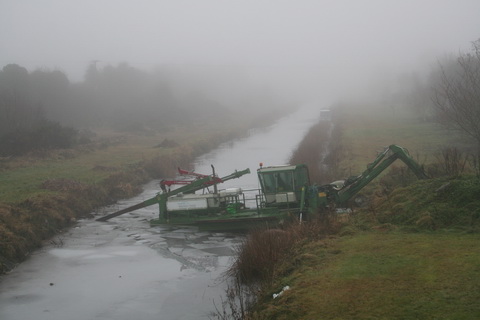
Swiss Army stop plank
If it is parked there for some other reason, I would be glad to know of it.
Join the ex-Grand Canal Company motor-barge 68M on its trip from Killaloe to Limerick Docks, carrying barrels of stout for Dolan’s Pub. The trip marked two occasions: Arthur’s Day, the annual Guinness marketing opportunity, and the fiftieth anniversary of the last commercial cargo on the Grand Canal and the Shannon, which was a shipment of stout to Limerick.
This page provides a slide-show of 300 photos taken from 68M on its journey. If you can’t make the trip in person, do it this way.
Note that the page takes some time to load. And, even clicking through pretty fast, the show is likely to take at least ten minutes.
Click on the first photo to bring up the controls. If you have any problems with it, leave a Comment to let me know. I haven’t done this before. I may not be able to fix any problems, but I can at least look into them.
Posted in Ashore, Charles Wye Williams, Economic activities, Extant waterways, Forgotten navigations, Industrial heritage, Irish inland waterways vessels, Irish waterways general, Operations, Scenery, shannon estuary, Steamers, The turf trade, Weather
Tagged Ardnacrusha, bic, boats, bridge, canal, Castleconnell, Clare, Coonagh, Curraghgour, Curragour, docks, ESB, floods, flow, Grand Canal, Guinness, Ireland, jetties, Killaloe, Limerick, lock, Lough Derg, Montpelier, O'Briensbridge, Operations, Parteen Villa Weir, Plassey, Sarsfield Lock, Shannon, vessels, water level, waterways, Waterways Ireland, weir, workboat
On my old photographic website I had a page of photos of an abandoned barge at Plassey, on the River Shannon. I have now moved those photos to here and added some text.
I am hoping that someone expert in old iron barges might be able to make a guess at the age, and perhaps even the origin, of the barge. I will, in the meantime, be trying to pin down the date of its abandonment.
Posted in Ashore, Economic activities, Extant waterways, Forgotten navigations, Industrial heritage, Irish inland waterways vessels, Irish waterways general, Operations, Sources, Steamers
Tagged Annabeg, Annaghbed, boats, bridge, canal, Clare, docks, ferry, floods, Gilloge, Gillogue, Gully, Hannan, Ireland, John Laird, Killaloe, Limerick, lock, lost, Montpelier, O'Briensbridge, Operations, Plassey, quarry, Rainsford, Shannon, Sheehy, stone, University of Limerick, vessels, waterways
To Limerick City Council offices this evening, where the family of Cecil Mercier, Mill Manager of Bannatyne’s in Limerick and later supervisor of all Ranks mills in Ireland, were handing over his papers to the Limerick City Council Archive.
No photos of the Ranks boats that worked on the Shannon, alas, but perhaps there are some in the archives.
A booklet, Cecil Mercier & the Limerick Rank Mills, was distributed (free): an interesting account of the man and the industry. But it contains this sentence:
At the turn of the twentieth century there were other flour and animal feed mills in and around the city such as the Lock Mills at the junction of the Abbey River and the Grand Canal and the maize mills in Mount Kenneth and Mallow Street.
The canal in Limerick is one of five sections of the Limerick Navigation, and has recently been dubbed the Park Canal. It was not constructed by the Grand Canal Company. It was not owned by the Grand Canal Company. It was not operated by the Grand Canal Company. The only connection between that canal and the Grand Canal is that the Grand Canal Company was permitted to operate its boats on the route and was provided with premises at the canal harbour in Limerick. It put its name on the transhipment canopy, and perhaps that may have given people the mistaken idea that the Grand Canal Company owned the canal. But during the period when the GCC operated its boats, the canal was owned and operated by the Board of Works (Shannon Navigation).
Posted in Ashore, Economic activities, Extant waterways, Forgotten navigations, Industrial heritage, Operations
Tagged Bannatynes, Board of Works, boats, bridge, canal, Cecil Mercier, Grand Canal, Grand Canal Company, Ireland, Limerick, Limerick City Council, lock, Lock Mills, mill, Office of Public Works, Operations, Park Canal, Ranks, Shannon, Shannon Navigation
I have now completed an examination of the proposals for the reconstruction of a section of the Ulster Canal from Lough Erne to the town of Clones in Co Monaghan. My conclusions are linked from this page, which also contains a brief summary of my views.
Ulster Canal 0: overview presents the main points of the argument in about 3,600 words. It does not contain most of the quotations and omits the references; it also omits some sections of the argument. However, it’s about one fifth of the length of the whole thing.
Ulster Canal 1 to Ulster Canal 10 present the argument under ten headings, amounting to about 18,500 words in all. That may be too much for most people. There are no photos or other illustrations, and most of the argument is about economics or politics.
It will be clear that I do not have full information; I will be glad to have Comments from anyone who can fill the gaps or correct anything I’ve got wrong.
For anyone who can’t wait, here is a copy of the summary of my views.
The Irish government has been pushing, since the 1990s, for the restoration of the Ulster Canal. Several studies have been commissioned; all of them show that the project is uneconomic. At no stage has either the UK or the Northern Ireland administration shown any willingness to commit funding to the project. As a result, the Irish government has scaled back its ambitions, proposing to fund the construction of a canal from Lough Erne to Clones in Co Monaghan: it would cross the border several times, but it would pass through no significant conurbation on the northern side.
However, this scaled-back project makes even less sense than the proposal for full restoration, and there is no reason to believe that the canal will ever get any further than Clones. The Irish government might, I suppose, decide to dig on to Monaghan, as a form of famine relief work, but there is no evidence that the Northern Ireland Executive will ever put money into completing the route to Lough Neagh.
The costs of the proposal have not been reexamined for many years (or, if they have, the results have not been published), and the economic analyses may overstate the likely benefits. Even if they are accurate, though, the main benefits seem to come from casual visitors rather than from boaters. The benefits will go to service providers in the area, rather than to the waterways authority, but even if they went to Waterways Ireland they would not pay the running costs, never mind repaying the capital cost. The project has failed every economic test to which it has been subjected: it simply does not provide the sort of return that would justify the project.
There seems to be some doubt over the source of the proposed funding. The Irish government said that it canal to Clones would be paid for by the Irish Exchequer, but it later said that Waterways Ireland would sell surplus assets to pay some or all of the cost. It is not clear that Waterways Ireland’s surplus assets would, in current economic conditions, bring in enough money; nor is it clear that the Department of Finance is willing to make up any shortfall.
There might be something to be said for acquiring the land and creating a walking and cycling route, but the current proposal for a canal to Clones is utterly unjustifiable and should be dropped.
Posted in Ashore, Economic activities, Extant waterways, Forgotten navigations, Industrial heritage, Irish waterways general, Operations
Tagged Assembly, Éamon Ó Cuív, Blackwater, boats, bridge, Caledon, canal, Clones, Dáil, Dublin Docklands Development Authority, Erne, Executive, Finn, Good Friday agreement, implementation body, Ireland, lock, lost, Lough Neagh, MLA, Monaghan, Nelson McCausland, North/South Ministerial Council, Northern Ireland Assembly, Operations, Plot 6, Seanad, TD, Ulster Canal, vessels, waterways, Waterways Ireland
Here is the latest (and almost the last) in this series of posts: an examination of the expected benefits of the canal to Clones. My conclusion is that the benefits cited are higher than those likely to arise in current conditions.
Posted in Ashore, Economic activities, Extant waterways, Forgotten navigations, Industrial heritage, Irish inland waterways vessels, Non-waterway, Operations, Water sports activities
Tagged boats, bridge, British Waterways, canal, Clones, Erne, fungible boats, Ireland, lock, lost, Lough Allen, Lough Neagh, Operations, Quivvy, Shannon, Ulster Canal, vessels, waterways, Waterways Ireland
The figure of €35 million is widely quoted as the cost of the canal to Clones, but the basis for that figure is not clear. Here are some thoughts on the subject.
Posted in Ashore, Economic activities, Extant waterways, Forgotten navigations, Industrial heritage, Irish waterways general, Operations
Tagged boats, bridge, canal, Clones, Erne, Ireland, jetties, lock, lost, Lough Erne, Lough Neagh, Operations, Ulster Canal, vessels, water level, water supply, Waterways Ireland
The next page of the Ulster Canal series is now up. It is, I’m afraid, rather boring: an account of the various reports (“studies and appraisals”, in the jargon) commissioned since 1994. It may help in sorting out who said what where and when.
Several ports on the Shannon Navigation have old cranes (or parts thereof), most of them nicely painted. Their age may not be apparent, but it is possible that they date back to the days of the Shannon Commissioners in the 1840s; at least one of them may be even older than that.
This page shows photographs of those cranes I know of, and discusses their possible ages. But there is much that remains unknown, and readers may be able to cast light on some of the mysteries.
Posted in Ashore, Economic activities, Extant waterways, Industrial heritage, Irish waterways general, Operations, shannon estuary, Sources, Steamers, The turf trade
Tagged Ballylongford, Banagher, Bath Street Foundry, Board of Public Works, Board of Works, boats, bridge, canal, Carrick-on-Shannon, Clare, Clarke, Connacht Harbour, Connaught Harbour, Courtney & Stephens, Cow Island, foundry, Grand Canal Company, Haughtons Mills, Ireland, John Grantham, Kerry, Kilgarvan, Killaloe, Kirkland, Leitrim, Limerick, Liverpool, lock, Lough Derg, Mather Dixon, Offaly, Operations, Pete Brown, Portumna, quay, Ringsend, Saleen, Scarriff, Shannon, Shannon Commissioners, Shannon Navigation, Shannonbridge, Tipperary, turf, vessels, waterways, Waterways Ireland, Williamstown


 Irish waterways history