
Tag Archives: Royal Canal

REWARD — OUTRAGE

Whereas, on the Evening of Sunday, the 3d inst, several Men entered the Yard of the Royal Canal Company, at the Broadstone, and, with sledges (with which they came prepared), did break Ten Casks of Porter, which had been left there the previous evening, to be forwarded by the Canal.

Now, We, the undersigned, being desirous of bringing to punishment the persons who committed this outrage, and also those parties who, from mercenary motives, are supposed to have instigated them to the act, do hereby offer a Reward of

FIFTY POUNDS

to any person who shall, within Three Months, prosecute to conviction the persons who committed said act, or those who may have instigated them to its commission.

ARTHUR GUINNESS, SONS, & Co
James’s-gate Brewery, Dublin, Sept 8 1837


The Court of Directors of the Royal Canal do hereby offer a further Reward of

FIFTY POUNDS

for the Conviction of the Persons guilty of the foregoing Outrage.

By order, Samuel Draper, Secretary
Royal Canal House, 8th Sept, 1837

Freeman’s Journal 9 September 1837. From the British Newspaper Archive run by Findmypast Newspaper Archive Limited, in partnership with the British Library.
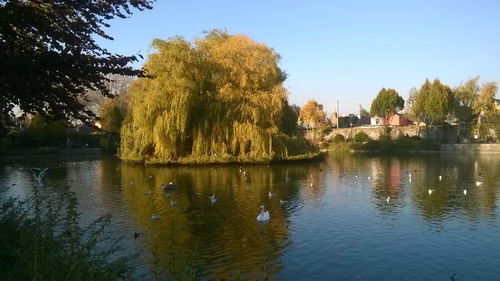
Blessington Street basin

Blessington Street Basin (Michael Geraghty) November 2015 01_resize

Blessington Street Basin (Michael Geraghty 2015)

One of North Dublin’s less-well-known treasures, this is Blessington Street Basin, off the (former) Broadstone Line of the Royal Canal. Thanks to Michael Geraghty for the photo, taken in November 2015.

The sinking of the Longford 6

Here is the sixth and final page on the sinking of the passage boat Longford on the Royal Canal on 25 November 1845. This page is about who was steering the boat and why the steerer was unable to avoid the accident.

The price of fifteen lives was 1p.


The sinking of the Longford 4 and 5

Here are the fourth and fifth pages [I split one long page] in the sequence of articles about the sinking of the passage boat Longford on the Royal Canal in 1845. They discuss some of the evidence of corporate incompetence and farcical laxity that may have persuaded the inquest jury to award a deodand against the vessel (and thus against the Royal Canal Company).

Amongst other gems, the footnotes explain what a crapper is.

The sinking of the Longford 3

Here is the third page in the sequence about the sinking of the passage boat Longford on the Royal Canal in 1845. This page, The deodand, covers the inquest and the trial.

The sinking of the Longford 2

Here is the second page of the saga. This one gives background information about the passage boat service, the boats and the crew of the Longford. The shock-horror stuff will be in later pages.

The sinking of the Longford 1

Here is the first of several articles about the sinking of the Royal Canal passage-boat Longford on 25 November 1845.

Royal Canal November

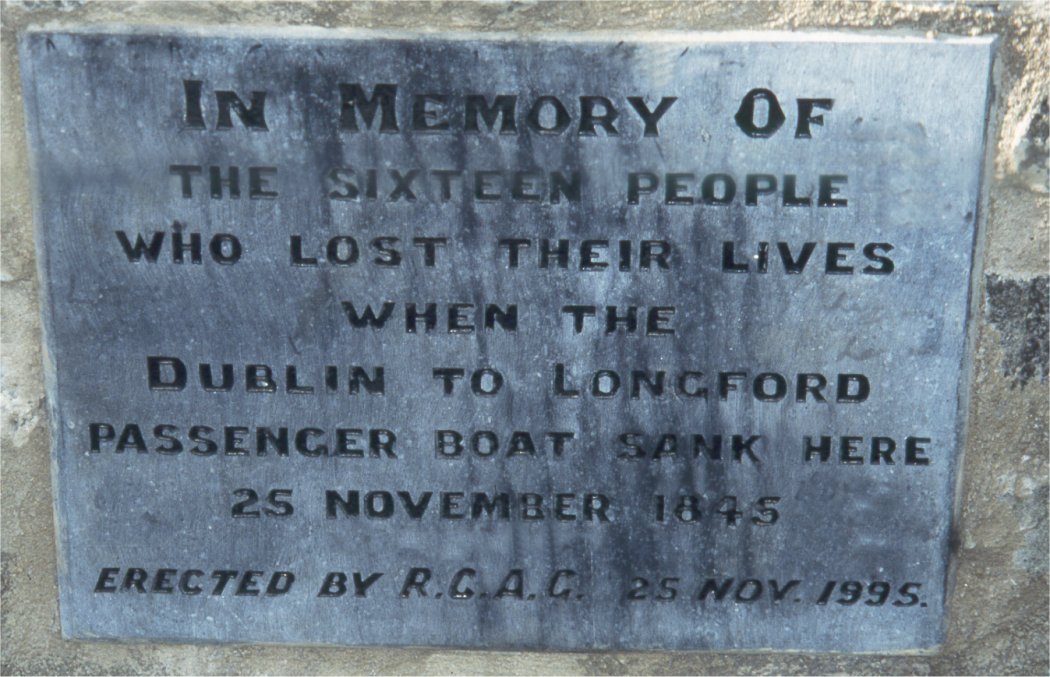
I said here that I did not know whether there was a plaque to commemorate the drowning of fifteen people on the Royal Canal in 1845. I am grateful to both Ewan Duffy and Niall Galway for telling me that there is a plaque and for sending photos of it. Ewan’s, which I show below, was taken in 1997.

Porterstown Plaque

The plaque in 1997 (copyright industrialheritageireland.info)

Niall has sent on a message from the Royal Canal Amenity Group chairman:

A Mass in memory of the 16 people who lost their lives on 25 November 1845, when a passenger boat sank on the Royal Canal at Clonsilla, will be
held in St Mochta’s Church, Porterstown Road, at 10.00 am on Friday next 27 November 2015. After the mass you are invited to Porterstown (Kennan) bridge to lay a wreath and afterwards to the Clonsilla Inn for a tea/coffee.

I know that Ruth Delany gives the figure of 16 deaths, but all the newspaper reports that I have read say that 15 people died: 7 men, 6 women and 2 children, all from the second-class cabin.

Addendum 23 November 2015: I have now read some more newspaper reports and I think the discrepancy arises because early press reports of the accident itself, notably that carried in the Freeman’s Journal, said that sixteen people had died, but reports of the inquest gave the number as fifteen. The pre-inquest reports were inaccurate in other respects too: the total numbers of passengers were wrong and the chain of events that led to the accident was not properly described.


Remember, remember the twenty-fifth of November

25 November 2015 will be the 170th anniversary of the sinking of the Royal Canal passage-boat Longford and the deaths of fifteen people.

This was not (pace Ruth Delany in Ireland’s Royal Canal 1789–2009 Lilliput Press, Dublin 2010) “the worst accident ever to happen on the Irish waterways”: that melancholy distinction belongs to the drowning at Carrick-on-Suir of about 111 people in 1799 [see “The cries at the bridge” on this page], while the second-worst was the drowning of twenty people on Lough Corrib in 1828, the event commemorated by Antoine Ó Raifteiri in his poem Eanach Dhúin.

But the 1845 accident, between Porterstown and Clonsilla Bridges, was the worst to occur on an Irish canal. Evidence at the inquest and subsequent trial suggests great laxity in the management of the Royal Canal Company’s affairs, even if the immediate cause was an act of insane irresponsibility on the part of the boat’s temporary steerer.

I do not know whether any plaque or other artefact commemorates the event.

Broadstone Luas works

Thanks to Niall Galway for these photos of work under way at the Broadstone for the new LUAS line.

Broadstone October 2015 (Niall Galway) 01_resize Broadstone October 2015 (Niall Galway) 02_resize Broadstone October 2015 (Niall Galway) 03_resize Broadstone October 2015 (Niall Galway) 04_resize Broadstone October 2015 (Niall Galway) 05_resize Broadstone October 2015 (Niall Galway) 06_resize Broadstone October 2015 (Niall Galway) 07_resize