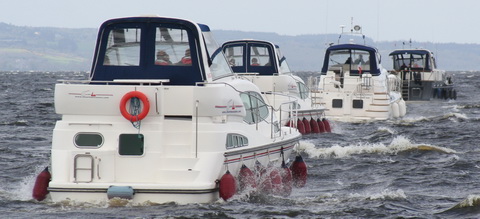
Convoy on Lough Derg

Convoy on Lough Derg
Posted in Extant waterways, Irish inland waterways vessels, Operations, Shannon, Tourism, Water sports activities, waterways, Weather
Tagged boats, Ireland, Lough Derg, Shannon
Boaters on Lough Derg were shocked today to realise that a key part of the lake’s infrastructure, the corner bollard at Dromaan, had gone missing.
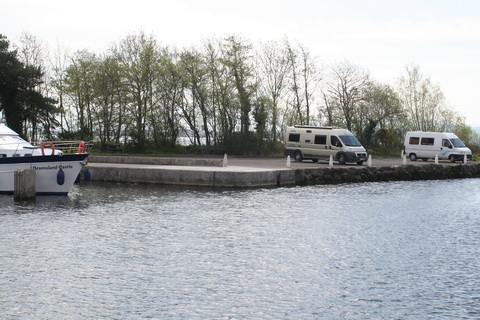
The vanished bollard
“We didn’t know it was there until it was gone,” said a weeping cruiser-owner. “Without that bollard, the outer berth on the right-hand side is useless: you can’t tie a boat there. And the middle berth is useless too. Two whole berths gone. With so many other spaces taken by harbour-hoggers and abandoned vessels, we’ll end up tying off barges or something.”
Sergeant Pluck of Whitegate said: “Is it about a bicycle?” Later, Superintendent Clohessy, from Tipp, admitted that he was baffled. The theft of a bollard had not previously been recorded. It was, he said, a quare conundrum and a right pancake.
Waterways Ireland has not commented on the matter.
I reported last October that an unused London pub, named after Henry Petty-Fitzmaurice, 3rd Marquess of Lansdowne, KG, PC, FRS, was threatened with demolition in favour of a museum extension.
I pointed out that the late Marquis had two claims on the attention of Irish waterways enthusiasts. First, the best-known of the early River Shannon steamers, the Lady Lansdowne, was named after his wife. Second, he was Lord President of the Council [the current holder of the post is Nick Clegg] when the government of Her Late Majesty Queen Victoria decided, in 1839, to spend about half a million pounds improving the Shannon Navigation.
The Indie reports today that Hackney Council’s planning committee has voted against the demolition, so the Marquis survives, at least for now.
Posted in Ashore, Built heritage, Charles Wye Williams, Economic activities, Engineering and construction, Extant waterways, Foreign parts, Forgotten navigations, Industrial heritage, Ireland, Irish inland waterways vessels, Irish waterways general, Non-waterway, Operations, People, Politics, Restoration and rebuilding, Shannon, shannon estuary, Sources, Steamers, The cattle trade, waterways, Waterways management
Tagged boats, bridge, canal, Clare, estuary, Fergus, Geffyn, Ireland, Killaloe, Kilrush, Lady< Marquis, Lansdowne, Limerick, Lord President of the Council, Lough Derg, O'Briensbridge, Operations, Petty-Fitzmaurice, Shannon, steamer, vessels, waterways
… that there were more things in heaven and earth than were dreamt of in his philosophy.
They did not, however, include any more holders of marked fuel traders’ licences [xls] along the Shannon.
Posted in Ashore, Economic activities, Extant waterways, Ireland, Irish inland waterways vessels, Operations, People, Politics, Shannon, Tourism, Water sports activities, waterways, Waterways management
Tagged boats, bridge, canal, Dublin, green diesel, Ireland, marked fuel trader's licence, Shannon, vessels, waterways
Length: 770 feet
Breadth: 3 feet 6 inches
Depth: 1 foot 3 inches
Longest straight stretch: 90 feet
Tunnels: 6, totalling 356 feet, the longest 100 feet
Transport links: monorail
More details later.
I dare say you’ve observed, Major, how singularly little originality there is about Chief Secretaries. One of them, whose name is lost in the mists of antiquity, thought of piers and seed potatoes, and since then all his successors have gone on building piers and handing out seed potatoes. They never hit on anything original. Now if I was a Chief Secretary I’d strike out a line of my own. When I found I had to build something I’d run up a few round towers.
Thus the Rev J J Meldon, curate of Ballymoy, to Major Kent in George A Birmingham’s excellent Spanish Gold. (Birmingham was really Canon James Owen Hannay, who managed to annoy nationalist Catholics, which is always useful.)
Amongst the builders of piers were Alexander Nimmo and the Shannon Commissioners, whose works on the estuary included Saleen Pier.
The Irish Press Releases website has a page dated 17 April 2013:
Funding approved for Clare piers
Co. Clare, Ireland — 17 Apr. 2013 — Funding has been approved for various harbour and pier improvement projects in County Clare. Minister for Agriculture, Food and the Marine, Simon Coveney, T.D., today announced funds totalling 91,500 euro for projects at Ballyvaughan, Cappagh, Liscannor, Carrigaholt and Kilbaha harbours/piers.
“The safety works scheduled to take place at these harbours will have a hugely positive impact on the livelihoods of fishermen and other users of the piers,” explained Clare Senator Tony Mulcahy. He added: “These projects are central to ensuring the safety of all users of the piers. The continued upgrading of these piers is essential to the development of both industry and tourism in the respective areas.”
The funding announcement features allocations of €22,500 to Carrigaholt, €37,500 to Ballyvaughan, €9,000 to Kilbaha, and €11,250 to both Liscannor and Cappagh.
According to Senator Mulcahy: “The funding contribution from the Government covers 75% of the total cost of the relevant projects which include repairs to the pier wall in Ballyvaughan, the installation of a handrail to pier access, harbour wall and upgrade of visitor moorings at Carrigaholt, a complete remediation to the existing pier walls at Liscannor, repairs to the sea wall at Cappagh, and repairs to the harbour wall capping stones at Kilbaha.”
Carrigaholt, Kilbaha and Cappa[gh] are all Shannon Estuary harbour or piers; Cappa[gh] was extended by the Shannon Commissioners. This press release suggests therefore that, if the Chief Secretary’s successors cannot afford to build any new piers, they can at least afford some money to repair them. There is no news about seed potatoes (or, alas, about fodder).
Unfortunately I could find nothing about this topic either on the website of Senator Tony Mulcahy FG or on that of the Department of Agriculture and Technical Instruction, although I may have had the wrong search terms. However, some other (coincidentally. also Fine Gael) politicians have welcomed the planned spending of money on Glin pier [do look at all the pics], which seems to be used only for swimming, so perhaps there is a nationwide campaign of spending small amounts of money in many places — and getting local Fine Gael pols to announce it. Presumably it distracts attention from the shortage of seed potatoes.
The Minister for Ag is a member of Fine Gael.
Posted in Ashore, Built heritage, Charles Wye Williams, Economic activities, Engineering and construction, Extant waterways, Forgotten navigations, Industrial heritage, Ireland, Irish waterways general, Operations, People, Politics, Restoration and rebuilding, Scenery, Shannon, shannon estuary, Sources, Steamers, The cattle trade, The turf trade, Tourism, waterways, Waterways management
Tagged boats, Cappa, Carrigaholt, Clare, estuary, George A Birmingham, Glin, Ireland, J J Meldon, jetties, kilbaha, Kilrush, Limerick, Operations, Shannon, Spanish Gold, steamer, waterways
Practical Boat Owner, a magazine, reports [in its June 2013 issue, published in April] that the British Marine Federation surveyed its members in February and March 2013 to ask about gross capacity and actual occupancy of their marinas in January 2013. The BMF press release is here.
It got 145 valid responses, a 56% response rate; it reckons that that means 31% of all UK marinas and 38% of all UK marina berths.
The total capacity of the marinas was 29118 and the occupancy 23462, which the BMF says is an 80.5% occupancy rate and a 19.5% vacancy rate.
Of those marinas, 69 [or perhaps 68] were tidal or coastal, with a total capacity of 17604 berths and the occupancy 14227 berths: an 80.8% occupancy rate and a 19.2% vacancy rate.
There were 53 responses from marinas on C&RT waterways; they had 7710 berths, 6122 of them occupied: 79.4% occupancy and 20.6% vacancy.
There were 23 responses from marinas on the waters of other navigation authorities, including the Environment Agency, the Broads Authority and some national authorities responsible for lakes. They had 3804 berths, 3113 occupied: 81.8% occupancy and 18.2% vacancy.
I don’t know what difference it would have made if the survey had been conducted at some other time of year. Should we assume that British boaters all book marina berths for the full year?
I don’t know whether the Irish Marine Federation or its associate group, the Irish Marina Operators Association, has published anything similar. While the IMOA has members on coastal and estuarial waters, it doesn’t seem to have any on non-tidal waterways. It would be interesting to know the vacancy rate on inland marinas, although there are definitional problems (does a block of flats with some moorings constitute a marina?). Maybe the only way to find out is to get HarbourAir to take aerial photos on one of their flights.
Posted in Ashore, Economic activities, Engineering and construction, Extant waterways, Foreign parts, Ireland, Irish inland waterways vessels, Irish waterways general, Non-waterway, Operations, Shannon, shannon estuary, Sources, Tourism, Water sports activities, waterways, Waterways management
Tagged berth, HarbourAir, Ireland, Irish Marina Operators Association, Irish Marine Federation, marina, Mountshannon, occupancy, Shannon, waterways
… no more licensed traders in marked fuels [xls] along the Shannon.
Funny how few marinas sell diesel nowadays.
Posted in Ashore, Economic activities, Engineering and construction, Extant waterways, Ireland, Irish inland waterways vessels, Irish waterways general, Non-waterway, Operations, People, Politics, Shannon, Sources, Tourism, Water sports activities, waterways, Waterways management
Tagged boats, Clare, green diesel, Ireland, Killaloe, Lough Derg, marked fuel trader's licence, Operations, Shannon, Tipperary, vessels, waterways
Just for a change, I’ve put up a new header photo showing a Shannon 1. The photo was taken from Shannon Airport; you can see Ringmoylan Quay on the far side of the river and the beacon on the right is (I think) on the Horse Rock.
Posted in Ashore, Built heritage, Charles Wye Williams, Economic activities, Engineering and construction, Extant waterways, Forgotten navigations, Industrial heritage, Ireland, Irish inland waterways vessels, Natural heritage, Non-waterway, Operations, Scenery, Shannon, shannon estuary, waterways, Waterways management
Tagged airport, Clare, estuary, Horse Rock, Rineanna, Ringmoylan, Shannon, Shannon 1, Shannon Foynes Port Company, waterways
I have recently written, for publication elsewhere, an article comparing Waterways Ireland’s online presence unfavourably with that of the Canal & River Trust, which manages many waterways in England and Wales. WI clearly listened, because it has completely revamped its website.
Actually, that’s my little joke, because WI has clearly had folk working hard on this for some time. Its home page address remains as it was with (as I write) a clock ticking down to the official launch on 18 April 2013, but you can bypass that. Clearly not all the pages have yet been populated, but the overall design can be seen and it is several leagues ahead of the previous version.
It promotes a wider range of activities: walking, cycling, angling, boating, rowing, canoeing, sailing and power sports (but not, alas, campervanning). It has an events section, with events listed in chronological order by starting date; you can shorten the list by selecting a waterway, an activity or a date. This online listing is far more user-friendly than WI’s print equivalent. Sensibly, information on planning events is in the same section as the events listing.
The Clones Sheugh is listed amongst the waterways under Events, but no activities are planned there. However, the sheugh is not amongst the seven waterways listed under Our Waterways.
There’s a useful Do it Online section, with subsections called Register it, Pay for it, Apply for it and Report it. The last of those is rather disappointing, suggesting off-line communication; it would be more useful to have this sort of discussion between WI and its customers conducted in public. The promised form for online compliments and complaints isn’t there, but presumably will be added soon. Apply for it includes a procedure for applying for permission to film on WI property; this is something that BW (C&RT’s predecessor) had years ago.
The Learning section includes online games, the teachers’ resource pack and, encouragingly, information on arranging group tours of WI facilities and on accessing the archives; we are promised that some archive material will appear online.
The Corporate section includes About Us, FAQs, Public Consultation, Research, Careers, Partner Information, Policies and Plans & Reports. There is little that was not on the previous version of the site. There are sections for the Media and on Commercial Activity; Visitors Centre leads to the existing pages on the Box in the Docks; there is a much better Contact Us page, with a classified list so that you can find the office you need.
The down-wid-da-kidz bit is that there are links to WI Facebook, Twitter and YouTube pages. There is nothing on the YouTube page yet; perhaps the first video will show Jimmy Deenihan cutting the ribbon on the new website tomorrow. The Twitter page — joy! — includes the marine notices, which makes this the first good reason I’ve come across for taking an interest in Twitter. The Facebook page seems to be no better or worse than other FB pages I’ve seen.
The new website does not seem to have anything about Nuttall’s Pondweed, which was the only thing on the old site that might attract nature-lovers. I see nothing on the new site to interest such folk; apart from the archives bit, WI’s wealth of industrial heritage is not represented. So, despite the much improved appearance and organisation, there are constituencies, or potential constituencies, that are not being addressed.
However, on the whole the new site does seem to fit in with and promote WI’s Marketing Strategy 2012–2017:
4.1 Marketing Mission
Essentially the marketing mission of Waterways Ireland is unchanged and is defined as increase awareness and promote greater use of Ireland’s
Inland Waterways.4.2 Strategic Marketing Objectives
Within the period 2012–2017, Waterways Ireland wishes to build on the success and achievements of the previous Strategy taking a more proactive approach in achieving the following strategic marketing objectives:
– promoting increased use of the Waterways including promoting the range of uses;
– creating awareness of the waterways including the commercial potential of thewaterways; and
– creating working relationships with other state and semi state, tourism, trade, recreational organisations and users.
What is not entirely clear to me, though, is whether this new and much-improved website is to continue the one-way communication process or whether WI will use the new media to their full potential, encouraging two-way communication (even if it includes criticism) and building a real waterways community. It will be interesting to see.
For far too long, the IWAI website was streets ahead of WI’s. The shoe is now on the other foot. Congratulations and best wishes to all involved in this major improvement to WI’s online presence.
Posted in Economic activities, Extant waterways, Foreign parts, Industrial heritage, Ireland, Natural heritage, Operations, People, Politics, Restoration and rebuilding, Shannon, Ulster Canal, waterways, Waterways management
Tagged Barrow, Erne, facebook, Grand Canal, Lower Bann, Royal Canal, Shannon, Shannon-Erne Waterway, twitter, Ulster Canal, waterways, Waterways Ireland, website


 Irish waterways history