Tag Archives: steamer

Newcomen Bridge again

Last month I wrote about the lock at Newcomen Bridge on the Royal Canal:

Industrial Heritage Ireland has created a page giving the history of the railway crossing at Newcomen Bridge. However, it would be nice to have some documentary evidence about the resiting of the lock — and about the headroom under the bridge before the lock was moved.

Here it is, from the Freeman’s Journal of 12 April 1873, in an article about the new Spencer Docks:

Above the new metal bridge there is a basin for Canal boats, with a quayage of 450 feet at either side and a depth of six feet. In connection with the new works, the lowering of Newcomen-bridge on the Clontarf-road must be alluded to. To effect this the old lock had to be moved higher up, and the old bridge replaced by one suited for the requirements of the tramway traffic. The arch of the bridge crossing the Canal was lowered five feet, and a new girder iron bridge crosses the railway at the same level. The Main Drainage Board wisely took advantage of the opportunity of the Canal being drained to make a main sewer under the canal and the railway above Newcomen-bridge at the low level required.

Happy, Mick?

Steam on the Grand Canal 1877

Freeman’s Journal 25 April 1877

ANOTHER SUSPICIOUS DEATH

Yesterday Henry L Harty, Esq, county coroner, held an inquest on the body of Patrick Savage, aged 75, who was found drowned in the Grand Canal at Portobello on Monday. The jury found that deceased was found drowned, having a fracture of the skull and jaw, and four ribs; but there was no evidence to show how the injuries were caused. One of the witnesses, named James Rea, of Reilly’s Cottages, Clanbrassil-street, said that previous to his seeing the body floating, a canal boat passed down the canal, and also a small steamer. This, the coroner said, might have caused the injuries.

Around the world with Irish waterways

Yesterday was one of those days: I managed to track down sources for several pieces of information I’ve been hunting for some time, but in the process I came across a few interesting links, from Gordon of Khartoum to the War between the States.

The starting point was William Watson, manager of the Inland Department and later Chairman of the City of Dublin Steam Packet Company. He worked with Robert Mallet on the design of an innovative boat for use on Irish inland waterways. Robert Mallet married a Cordelia Watson in 1831. (I thought that might be a daughter of William of the CoDSPCo but it’s pretty clear from the excellent Mallett Family History site that that was not so.)

One of Mallet’s inventions was a large mortar designed for use in the Crimean War. And one of Mallet’s sons, John William Mallet, went to the USA and became professor of chemistry at the University of Alabama. He joined the Confederate forces, rising to the rank of lieutenant-colonel in the artillery and superintendent of the Confederate ordnance laboratories.

Meanwhile Watson’s son Charles Moore went east rather than west. Colonel Sir Charles Moore Watson KCMG, CB, MA, of the Royal Engineers, Watson Pasha, was a general in the Egyptian Army and Governor-General of the Red Sea Littoral. Watson’s base was at Suakin on the Red Sea. The Dubliner was succeeded in that post by a Kerryman, Horatio Herbert Kitchener, from Ballylongford near Saleen on the Shannon Estuary, on which the City of Dublin Steam Packet Company operated.

Watson was “Gordon’s principal friend in Egypt”:

It is certain that Watson was, above all others, the one man in Cairo whom Gordon cared about most, and that he was the last to see Gordon off when he started [for Khartoum].

Gordon died at Khartoum; the relief expedition, led by another Irishman, Sir Garnet Wolseley, arrived two days too late.

A younger brother of Sir Garnet, Frederick Wolseley, went to Australia. His Sheep Shearing Machine Company made a brief expedition into the manufacture of motor-cars, under one Herbert Austin, who later founded his own company. Austin and Wolseley both ended up in British Leyland Motor Corporation, which made diesel engines, some of which were marinised and used in boats on the Irish inland waterways … which brings us back to where we started.

Melancholy loss of life on the River Shannon

Last Wednesday we were witness to a most melancholy spectacle. We saw three bodies floating on that part of the river Shannon which lies opposite to Castle Lough, in this county. Having rowed in to shore, we gave notice to some persons there, who, without hesitation, prepared themselves, and joined in the sad task of snatching from the watery element the livid bodies of three unfortunate fellow creatures. When we stretched them on the bank they were recognised by one of the Steam Packet Company to be the bodies of Thomas Minshoe, George Halbert, and Robert Williams, three of the unfortunate five that were drowned some few days ago, while on a party of pleasure. The bodies were far advanced in a state of putrefaction and were a revolting spectacle to look on.

A messenger being despatched to Nenagh for the coroner, James Carroll, Esq, that officer, with his usual promptness, reached here in a short time; and having empanelled a jury, “Accidentally drowned during a squall” was the verdict.

It appeared from evidence that the deceased, with others, left Killaloe on Sunday, the 20th ult, for the purpose of having a day’s amusement on the Upper Shannon. They put in at Castle Lough to take refreshment; during the time they were on shore, the wind freshened and blew a gale, upon which they determined to leave the boat at anchor, and proceed home by land, which they accordingly did. On the following morning they returned and found that the ropes, which were for the purpose of lowering the sails, had been stolen. The day being fine and the weather not likely to change, they made light of the inconvenience, and ventured homeward.

After hoisting sails and reaching the centre of the river (which, at this point, is not two miles broad), a squall came on. Having endeavoured in vain to lower sails, which was completely impracticable, on account of the loss of the ropes, the boat suddenly ducked beneath the weight of canvass, and consigned the poor fellows to an early grave. Thomas Minshoe and George Halbert are natives of Liverpool, and Williams from Wales.

No coffins being convenient, three fishermen were appointed to watch the bodies on the shore until the next day. When we saw them coffined, we observed that the ear had been eaten off Williams by, we suppose, a dog, and a part of Minshoe’s left leg. They were interred at Killaloe on the afternoon of Thursday.

1 September 1837

An early narrowboat on the Royal Canal?

This photo, which is used in Ruth Delany’s Ireland’s Royal Canal, shows the Royal Canal harbour in Mullingar, from the bridge. Note the very large amount of timber lying around (could some of it belong to Russells of Portarlington?). The wooden barge in the foreground has had its tiller unshipped, but what’s all that kit on deck and in the hold?

Then look at the vessel in front of it, which seems to be more the sort of beam we’d expect on an English narrowboat. It’s very hard to see any details, but could it be a steam tug?

Where is this?

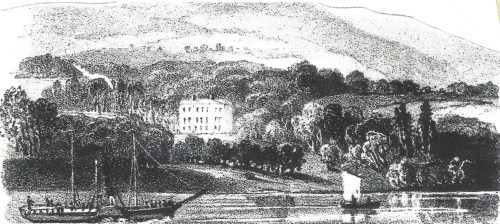
Paul Gauci's 1831 drawing of a Shannon steamer

Paul Gauci’s 1831 drawing of a Shannon steamer

This drawing of a steamer is from an 1831 book called Select Views of Lough Derg and the River Shannon by Paul Gauci. I haven’t seen the book myself, but this illustration is used in a couple of places, including Ruth Delany’s book The Shannon Navigation [The Lilliput Press Ltd, Dublin 2008]. Andrew Bowcock, in his article “Early iron ships on the River Shannon” in The Mariner’s Mirror Vol 92 No 3 August 2006, says of the steamer shown that

The funnel looks to be almost over the paddle shaft, which is artistic license.

But my question is not about the vessel but about the house in the background. If it is drawn without artistic licence, where is it?

It is a very large house, seven bays by three storeys, quite close to the water. Using the Historic 6″ Ordnance Survey map [~1840], I have followed the banks of the Shannon from Shannon Harbour down Lough Derg to Killaloe, then from Limerick down the estuary as far as Tarbert, across the estuary to Doonaha and back up on the Clare side to Limerick, then from Killaloe up the Clare and Galway shores back to Shannon Harbour. Anywhere I found a large house within what seemed the right distance of the shore, I looked it up in the Landed Estates Database and in the National Inventory of Architectural Heritage, with some supplementary googling.

I haven’t been able to find images of all the houses marked on the OSI map, but I found enough to show that houses of the size shown by Gauci were very rare. Within those few, I ruled out some (like Tervoe) because they didn’t seem to match Gauci’s drawing (although alterations could have accounted for that). I ended up with only one house that looked at all like Gauci’s, but the background may not match.

If you can identify the house, I would be glad if you could leave a Comment below.

Dick Gaughan and John Grantham …

… both had an interest in Erin-go-Bragh,

The Rideau Canal

The Cedar Lounge Revolution has an article about those who worked on the construction of the Rideau Canal in Canada in the 1820s and 1830s. Readers will, of course, recall that Charles Wye Williams compared the Rideau and the Shannon in his 1835 […] speech on the improvement of the Shannon: being in continuation of the debate in the House of Commons, 12th May, 1835, giving a comparative view of the navigation of the Rideau Canal, in Canada, and the River Shannon in Ireland, with observations on the value of a connection by steam packets, with British America.

A gratifying display of loyalty

His Excellency the Lord Lieutenant took a trip on the Shannon Estuary in July 1856 on the City of Dublin Steam Packet Company’s vessel Erin-go-Bragh. He was greeted by demonstrations of loyalty from the populace, had dejeuner on board off Scattery Island and heard an address from the proprietary, clergymen, merchants, traders and inhabitants of Kilrush, read to him by Colonel Vandeleur. Here is the Freeman’s Journal‘s account of the trip.

The end of a ghost

In the UK, the Statute Law Repeals Bill is working its way through the House of Lords. You can download a PDF list of the bills being repealed. In amongst the turnpikes, Indian railways, benevolent institutions and lotteries, we find Part 4: Ireland (Dublin City). Within that, Group 1 sees the repeal of these statutes:

  • 3 & 4 Will.4 c.cxv (1833) (City of Dublin Steam Packet Company Act)
  • 6 & 7 Will.4 c.c (1836) (Dublin Steam Packet Act)
  • City of Dublin Steam Packet Company’s Act 1860 (23 & 24 Vict. c.xcviii)
  • City of Dublin Steam Packet Company’s (Consolidation of Shares) Act 1861 (24 & 25 Vict. c.iii)
  • City of Dublin Steam Packet Company’s Act 1868 (31 & 32 Vict. c.xxx)
  • City of Dublin Steam Packet Company’s Act 1876 (39 & 40 Vict. c.xi)
  • City of Dublin Steam Packet Company’s Act 1884 (47 & 48 Vict. c.cxxx)
  • City of Dublin Steam Packet Company’s Act 1895 (58 & 59 Vict. c.cxxiii)
  • City of Dublin Steam Packet Company’s Act 1910 (10 Edw.7 & 1 Geo.5 c.vii)
  • City of Dublin Steam Packet Company’s Act 1916 (6 & 7 Geo.5 c.viii)
  • City of Dublin Steam Packet Company’s Act 1920 (10 & 11 Geo.5 c.i).

In a Consultation Paper published in 2008, the Law Commission explained:

The City of Dublin Steam Packet Company was founded by Charles Wye Williams in 1822. From 24 January 1839, the Post Office contracted the company to run the mail service from Dublin to Holyhead. This service was later extended such that the company ran both the day and night service.

During the First World War the company suffered heavy losses, including the sinking of its ship the R.M.S. Leinster by a German submarine on 10 October 1918, resulting in a loss of over 500 lives. A further two ships were sunk during this period. The company never fully recovered from its wartime losses and, in 1924, an order for the winding-up of the City of Dublin Steam Packet Company
was petitioned for and granted by the High Court at Dublin Castle.

In Ireland, the Statute Law Revision Act 2009 repealed the 1833 and 1836 Acts and the Statute Law Revision Act 2012 repealed all the rest — except the 1895 Act. I don’t know where to get a copy of that Act, so I don’t know why it was specifically retained. But, with that exception, it seems that the ghost of the CoDSPCo has been laid to rest.