Well, canoes, but better than nothing.
PS for “upstream” read “downstream”, as far as I can see.

Well, canoes, but better than nothing.
PS for “upstream” read “downstream”, as far as I can see.
Posted in Ashore, Economic activities, Engineering and construction, Extant waterways, Forgotten navigations, Industrial heritage, Ireland, Irish inland waterways vessels, Irish waterways general, Operations, People, Restoration and rebuilding, Sources, Tourism, Water sports activities, waterways, Waterways management, Weather
Tagged boats, canal, canoe, Corbally, Grand Canal, Ireland, jetties, lost, Naas, Operations, quay, Sallins, vessels, waterways, Waterways Ireland
I have updated my page about Royal Canal feeders with some information provided by Nigel Russell of WI to the An Bord Pleanála oral hearing on the Royal water supply scheme.
Incidentally, the Department of Arts, Heritage and the Gaeltacht, WI’s parent department in RoI, was among the (few) objectors to the proposed abstraction of water from Lough Ennell, although it was in favour of ceasing to abstract water from Lough Owel [Inspector’s report pp11–12]. Indeed it seemed to have some reservations about the reopening of the Royal Canal, not on economic grounds but because “some important nature consideration issues need to be fully addressed”.
Posted in Ashore, Built heritage, Drainage, Economic activities, Engineering and construction, Extant waterways, Industrial heritage, Ireland, Natural heritage, Operations, People, Restoration and rebuilding, waterways, Waterways management, Weather
Tagged boats, canal, department of arts heritage and the gaeltacht, feeder, Ireland, lock, Loiugh Owel, Lough Ennell, Nigel Russell, Operations, Royal Canal, Shannon, vessels, water level, waterways, Waterways Ireland
WI at work in Killaloe Novemebr 2012.
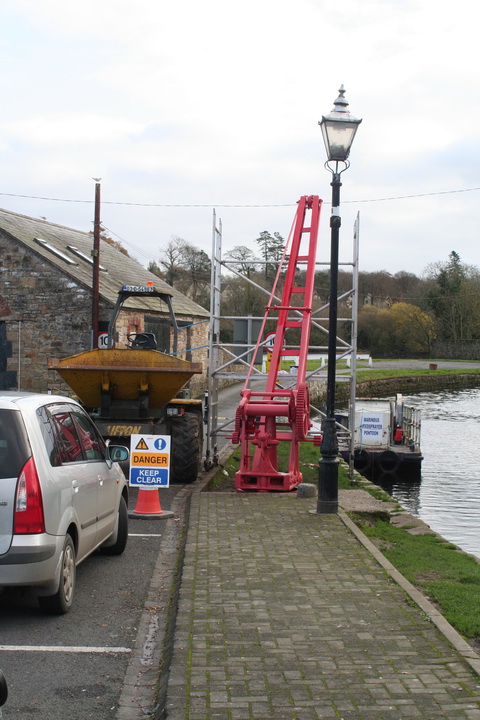
Old crane being painted
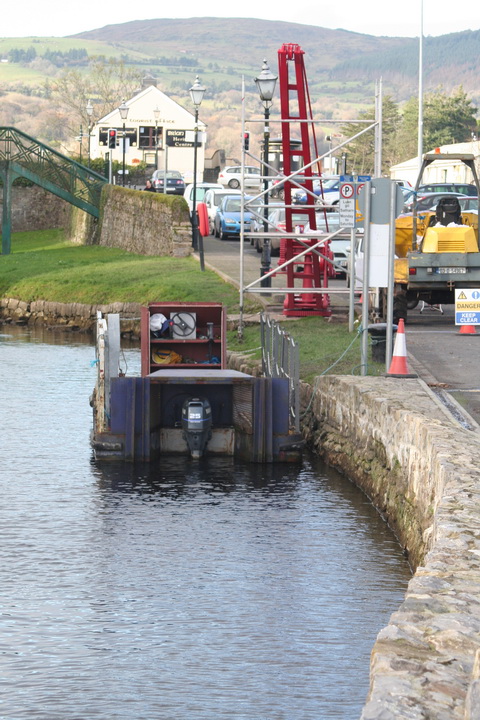
The Marindus weedspraying pontoon. This Marindus may be Marindus Engineering Ltd of Kilmore Quay, Co Wexford
Posted in Ashore, Built heritage, Charles Wye Williams, Economic activities, Engineering and construction, Extant waterways, Forgotten navigations, Industrial heritage, Ireland, Irish inland waterways vessels, Irish waterways general, Operations, Restoration and rebuilding, Shannon, waterways, Waterways management, Weather
Tagged boats, bridge, canal, Clare, crane, ESB, flow, Ireland, Killaloe, lock, Lough Derg, Marindus, Operations, paint, Shannon, vessels, waterways, Waterways Ireland, weed, workboat
Latest update here. These are the main points.
Applications for extended mooring permits at nine new locations will be available for two weeks from 19 November to 3 December 2012. The locations are Rathangan and Vicarstown on the Barrow Line (with a third stretch now at Vicarstown), two at Confey and one each at Cloondara and Lock 15 on the Royal and just one, Lock 34 to Griffith Bridge, on the Grand.
The schedule:
Applications for each set of locations are open for two weeks. Completed applications will be processed in order of receipt and mooring locations allocated. If availability exists after the application timeframe for a location has closed, late applications may be considered. Once all the extended mooring locations in an area have been allocated, no more extended mooring permits will be issued for that area in 2013. It is Waterways Ireland’s intention to complete the roll out of the extended mooring permit by March 2013.
That seems to be intended to get boaters to apply ASAP; otherwise they’ll be moored in the middle of nowhere for the rest of 2013.
The application process is set out in detail, with a new item.
From 16 November 2012 permits will no longer be issued by Lockkeepers, or the Eastern Regional Office. Permits will only be issued on completion of an application form submit to and processed by the Tullamore Office.
It is confirmed that applications must be accompanied by “copies of the insurance, and payment for the permit and a damage deposit”.
There are four downloads: the application form [DOC] and a supplementary form for consortium members [also DOC], a sample 11-page EMP licence [not permit] agreement [PDF] and a 5-page guidance document [PDF]. A consortium is defined in the guidelines as a group of more than two people who own a single vessel. Owners of unpowered vessels are advised, but not required, to have insurance.
The guidelines have a new item about disposing of rubbish:
Boat owners on the canals will be required to dispose of domestic rubbish at their own expense. On the application form you need to indicate how you intend to manage this. For example, evidence of a paid collection service or by confirming that you will take your rubbish home and dispose of it through your domestic collection service.
In a limited number of locations Waterways Ireland may offer this service for a charge. Details of this will be notified when the area opens for extended mooring permit applications.
That is as I predicted in the last issue of Afloat.
And there is a paragraph about holding-tanks:
You are asked to tell us if your boat has an operational waste holding tank. This is not a mandatory requirement, but information is being collected for management purposes.
The licence agreement says that owners have to clean up after dogs.
From 2015 Waterways Ireland will be introducing the requirement for boats needing permits and wishing to use the canals to have a current hull survey to provide evidence that the boat is in good condition.
Not all boats will require this.
Your attention is being drawn to this requirement now to allow you time to prepare for 2015.
That’s from the guidelines document (join the queue now for the dry docks). And these bits are from the licence agreement:
The Licensee undertakes to have regular inspections of the gas and electric services of his Boat as required to ensure these are kept in a safe and serviceable condition. […]
All Boats must carry adequate fire fighting equipment and have same serviced as per the manufacturer’s recommendations.
The application form requires applicants to agree to this:
I/We hereby indemnify and shall keep indemnified Waterways Ireland from and against all actions proceedings costs claims demands and liabilities howsoever arising from my/our use of the facilities provided by Waterways Ireland on the Royal Canal, Grand Canal and Barrow Navigation and shall further indemnify and keep indemnified Waterways Ireland in respect of any accident, injury, loss or damage to any person or property howsoever arising including, without prejudice to the generality of the foregoing, where such accident injury loss or damage arises by reason of any matter or thing done or omitted to be done by me/us or person authorised by me/us or the purported exercise of such use.
I would welcome guidance on whether that might invalidate insurance policies.
If a Boat is sold it must be removed from the Mooring within seven days and the Licensee must advise the Licensor’s Inspectorate. The new Boat owner will be required to make an application if they wish to avail of an extended mooring permit and Waterways Ireland will refund the balance pro rata of any fee paid for an extended mooring permit to the Boat owner less a fee of €50 to cover administration costs.
That’s from the draft licence.
Also from the draft licence.
It is not permitted to re-fuel Boats at an extended mooring.
Lots of exciting reading.
Posted in Ashore, Economic activities, Engineering and construction, Extant waterways, Ireland, Irish inland waterways vessels, Operations, People, waterways, Waterways management
Tagged Barrow, Barrow Line, boats, bridge, canal, extended morings, Grand Canal, Ireland, licence, lock, Operations, permit, Royal Canal, vessels, waterways, Waterways Ireland
A new-ish site and project here.
Posted in Ashore, Built heritage, Economic activities, Extant waterways, Forgotten navigations, Industrial heritage, Ireland, Irish inland waterways vessels, Natural heritage, Operations, People, Politics, Shannon, shannon estuary, The fishing trade, Water sports activities, waterways, Waterways management
Tagged boats, bridge, Clare, estuary, Ireland, Limerick, Shannon, vessels, waterways
I wrote here about the Park Canal and why it should not be restored. I did not include, because I had not then seen it, a link to this report in the Limerick Post. It shows why the gates on the second lock were not replaced. The core problem is that the banks in the upper section of the canal slope too steeply to be stable.
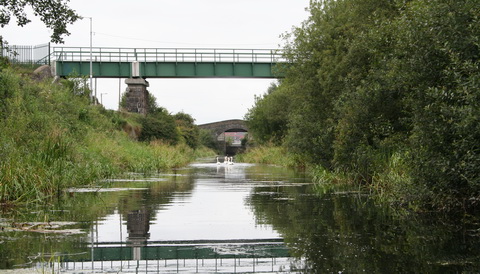
The slope of the banks above the railway bridge (from a boat)
Happily, this deficiency in the original construction has saved us from another foolish restoration.
Posted in Ashore, Built heritage, Charles Wye Williams, Drainage, Economic activities, Engineering and construction, Extant waterways, Forgotten navigations, Industrial heritage, Ireland, Operations, People, Politics, Rail, Restoration and rebuilding, Scenery, Shannon, Sources, The cattle trade, waterways, Waterways management
Tagged boats, bridge, canal, Clare, Guinness, Ireland, Limerick, Limerick City Council, lock, Operations, Park Canal, Shannon, slope, turf, vessels, water level, waterways, Waterways Ireland
IndustrialHeritageIreland has found a local newspaper that thinks that river buses on the Grand Canal could provide commuters from west Dublin with fast transport to Google HQ at Grand Canal docks. IHI points out that the journey from Hazelhatch can take eight hours; even Dublin traffic moves faster than that.
Posted in Built heritage, Economic activities, Engineering and construction, Extant waterways, Industrial heritage, Ireland, Irish inland waterways vessels, Operations, Restoration and rebuilding, Sources, waterways, Waterways management
Tagged boats, bridge, canal, commuting, Dublin, google, Grand Canal, Ireland, vessels, water bus, waterways, Waterways Ireland, workboat
It’s getting hard to keep up with the amount of new regulatory information Waterways Ireland is producing (not that I’m complaining: it’s good that (a) systems exist and (b) information be made public). Today it has put up a page about commercial operating licences with downloadable PDFs for new applicants and for renewals.
WI says that
Waterways Ireland will give consideration to applications for permission to carry on commercial operations on the waterways which would serve to encourage their use and contribute towards a vibrant waterway environment.
But getting a new licence is not easy. As well as describing the proposed business, you have to have registered the boat with WI and got a Passenger Certificate for from the Marine Surveyor’s office of the Department of Transport (which ain’t easy). If you want to sell alcohol, you have to have a Passenger Vessel
Licence from the Revenue Commissioners.
You have to provide a copy of your insurance policy:
Waterways Ireland requires that vessels carrying passengers hold adequate levels of insurance and appropriately indemnifies [sic] Waterways Ireland […].
And after that you have to show that your business has a chance of surviving:
Waterways Ireland is required to satisfy itself of the financial and economic standing of entities with whom it proposes to contract. In order to make this assessment, please provide relevant information such as recent accounts or Business Plan (including resources, financing, programme for delivery, target market, etc.).
And you have to supply a current Tax Clearance Certificate.
It seems that folk without capital (including working capital) need not apply.
Posted in Economic activities, Engineering and construction, Extant waterways, Foreign parts, Ireland, Irish inland waterways vessels, Operations, Shannon, Sources, Tourism, waterways, Waterways management
Tagged Barrow, Barrow Line, boats, canal, commercial operations, Erne, Grand Canal, Ireland, licence, Lower Bann, Northern Ireland, Royal Canal, Shannon, Ulster Canal, vessels, waterways, Waterways Ireland
… in June 2013? Maybe they’re coming to commit corporate golf …. I presume there will be hot and cold running security men, missiles, helicopters, gunboats ….
Posted in Ashore, Economic activities, Extant waterways, Foreign parts, Ireland, Irish waterways general, Operations, People, Politics, Tourism, waterways
Tagged boats, Enniskillen, Erne, Fermanagh, G8, Ireland, Northern Ireland, security, vessels, waterways
[I’m practising Ulster Scots in a spirit of parity of esteem and such.]
I wrote the other day about a Sinn Féin campaign to have the Strabane Canal foisted upon the unfortunate Waterways Ireland (as though it didn’t have enough trouble already, what with smooth newts and mooring permits).
I once went looking for the Strabane Canal but I couldn’t find it (and wasn’t allowed to spend enough time searching). I don’t know that area at all, so I thought it would be useful to send a drone [well, actually, I used Google Maps in Photos view] to capture an aerial view of the Foyle. I was particularly interested in the likely demand for the Strabane Canal and I thought the number of pleasure craft on the Foyle might be a useful indicator.
This might be the Google view of the downstream lock on the canal.
So I flew the Googledrone down one bank from Strabane to the sea, crossed the mouth of the estuary and came back on the far side. And as far as I can see, there are very few pleasure boats on the Foyle. Londonderry Port and Harbour Commissioners have a small marina in Stroke City, Lough Foyle Yacht Club races dinghies and Foyle Punts from Culmore Point and there is a port at Greencastle, but that seems to be about it. I saw no serried ranks of motor cruisers, narrowboats or barges parked anywhere. It is of course possible that I missed them in my flyover, but where are the boats to come from to sue the Strabane Canal?
Posted in Ashore, Built heritage, Economic activities, Engineering and construction, Extant waterways, Foreign parts, Forgotten navigations, Industrial heritage, Ireland, Irish inland waterways vessels, People, Politics, Restoration and rebuilding, Tourism, Waterways management
Tagged boats, canal, Derry, estuary, Foyle, Ireland, Lifford, Londonderry, Northern Ireland, Sinn Fein, Strabane, Stroke City, vessels, Waterways Ireland


 Irish waterways history