
Tag Archives: vessels

How to collide

Cases, however, occasionally arise in river navigation, wherein it is not possible to avoid collision, either with vessels, barges, or boats; as, for instance, in the pool, near the Tower, &c, owing to the very crowded condition in which such places are generally found; being surrounded on every side by one or the other. In such a dilemma the only alternative is to stop the [paddle-]wheels, and let the vessels close together as easy as possible, taking care to guard the sides and paddle boxes with fenders, and using every endeavour to boom each other off; after which, let the Steamer drift with the tide, but watch an opening among the vessels for escape, and, so soon as it offers, set her on at rather better than half speed, in order to insure a command of her.

It is somehow consoling to know that even Commanders RN have been known to collide ….

The quotation is from Commander Robert Otway RN An Elementary Treatise on Steam, more particularly as applicable to the purposes of navigation, with a familiar description of the engine; Shewing the manner of its management in giving the Rotatory Motion; how started, eased, and stopped; the Nature and Properties of Steam, on both High and Low-pressure principles; its introduction into, and discharge from, the Cylinders, illustrated; as, also, how to ascertain the quantum of Actual Pressure at which the Engine is working; and the manner of Condensing Steam explained; together with a General Account of the operations of the Engine-Room; shewing the Accidents to which Steam Boilers are liable, and means of prevention; and, further, the Economy of Coals, how to be effected, &c, &c G Poore, Plymouth 1837.

This is a very readable book, available here as a free Google PDF, giving an interesting insight into the problems of the early naval steamers — and of their engineers.
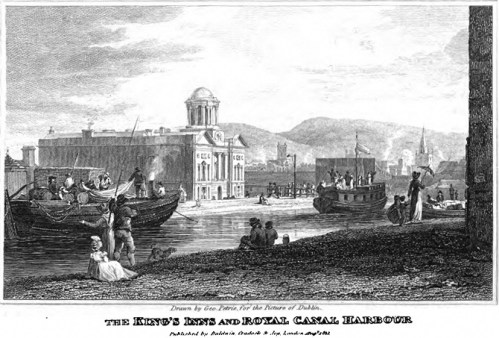
The Broadstone in 1821

The Broadstone Harbour with King’s Inns in the background, early 1820s

This is a drawing by George Petrie, made for J. J. McGregor’s New Picture of Dublin of 1821. The details of the vessels are interesting. More on the Broadstone here.

Canal mooring rules

Waterways Ireland issued two press releases about moorings today. The first was the usual one about winter moorings on the Shannon and the SEW; the second was about the canals. Here, unedited, is the text of the second.

Canal Mooring Rules Coming into Force

Waterways Ireland announced in June 2012 that the Canal Bye-laws on the Grand & Royal Canal and Barrow Navigation are to be enforced from autumn 2012, with an accompanying change in the permit system allowing for year-long mooring permits and locations.

Part of bringing in this new location-based permit has been the identification of locations suitable for extended mooring. This process is now completed and work has begun in some areas to improve accessibility.

Waterways Ireland will roll out Extended Mooring Permit applications by area, rather than giving a date when applications for the permit will open. For boat owners this will mean that enforcement of the maximum stay rule will not commence in an area until after boat owners have had the opportunity to purchase an Extended Mooring Permit.

The initial 12 month Extended Mooring Permit will cost €152 and will only be available to boats already holding a valid annual Mooring and Passage Permit.

Boats that cruise and move (staying at a mooring for up to 5 days) will not be in breach of the Bye-laws or require an Extended Mooring Permit.

Waterways Ireland has proposed a small number of draft amendments to the current Bye-laws which date from 1988. These include proposals to provide a range of charges for mooring permits that reflect the location and services provided throughout the canals and also will take into account the size of boat. These proposals include low cost rural moorings on soft banks to ensure the canals are accessible for everyone who owns a boat and requires a mooring. Boat owners allocated an extended mooring location in key areas in villages or towns or with services should be aware that if the new Bye-laws are approved Waterways Ireland will increase the charges for moorings in the future to reflect the location, services, and size of boat.

Waterways Ireland recognises the current situation whereby a small number of boat owners use their boats as their sole or permanent residence. Proposals to make provision for this use of the navigation property have been included in the Bye-law changes.

Furthermore Waterways Ireland intends to work towards the provision of a small number of serviced house boat moorings on the canal network. Such provision will be subject to finance, land availability and compliance with requisite statutory approvals.

Waterways Ireland recognises that a transition period of a number of years will be required to implement this. In the interim these boat owners should apply for an Extended Mooring Permit.

The draft Bye Law amendments are currently being considered by Waterways Ireland’s sponsor Departments. When Waterways Ireland has Ministerial consent, it will proceed to public consultation on the proposed Bye-law amendments.

Waterways Ireland will continue to contact permit holders regularly to ensure they are kept up to date with the roll-out of the new permit. All queries about the enforcement of the current bye-laws or the Extended Mooring Permit should be directed to Shane Anderson, Assistant Inspector of Navigation: Tel no +353 (0)87 286 5726, Email shane.anderson@waterwaysireland.org . Queries about houseboats should be directed to Property & Legal Section Tel no +44 (0)28 6632 3004.

These changes are necessary steps to improve the management of the canals and waterway amenities for both the navigational and recreational user, so that investment in the new infrastructure and facilities which Waterways Ireland has undertaken is maximised for every user.

Speeding on canals …

… and the perils thereof:

Having reached the highest level of the great table-land, we traversed a space of fifteen miles without a lock; and here a curious phenomenon, illustrating the incompressibility of water, arrested our attention. About every twenty or thirty minutes, the horses are obliged to stop for five or six minutes, to take breath, the cause of which was this: — The velocity of the boat impelled the water in the canal with such force that it gradually rose so as to approach the summits of the banks, when it began to recoil, so as actually to form a back-water or stream, when the horses were unable to make head, and therefore stopped till the equilibrium of the canal was restored.

James Johnson MD A Tour in Ireland with Meditations and Reflections S Highley, London 1844

Hunting Newbury

In his A Tour in Ireland with Meditations and Reflections [S Highley, London 1844], James Johnson MD describes a flyboat trip on the Grand Canal from Dublin. He says:

At Newbury, a station near Edenderry, I debarked, and spent two or three days at the hospitable mansion of Newbury Hall, with my excellent friend Mr Wolstenholme and family, where I also met my amiable friend, Mrs Evans, of Portrane.

I have been trying to find Newbury. So far, the most likely candidate seems to be Newberry Hall, in Carbury, Co Kildare; the spelling Newberry is given on the ~1840 [Historic 6″] OSI map whereas the ~1900 [Historic 25″] map gives Newbury.

The Hall is indeed fairly close to Edenderry, but if Johnson got off the boat in Edenderry I’d have expected him to refer to it as Edenderry harbour. Looking at the OSI map (link above), the only other sensible point of debarkation would (I think) have been at Ticknevin Bridge, from which there was a road towards Newbury, but I have no evidence that it was Newbury station.

I would welcome enlightenment.

The Lagan and Lough Neagh in 1830

Philip Dixon Hardy wrote in The Northern Tourist, or Stranger’s Guide to the north and north west of Ireland: including a particular description of Belfast, the Giant’s Causeway, and every object of picturesque interest in the district referred to William Curry, Jun and Co, Dublin 1830:

The river Lagan, although of very considerable breadth in the immediate vicinity of Belfast, and running nearly thirty miles, is yet by far too inconsiderable to be of any great advantage to the town in the way of trade or commerce. By its means, however, a regular communication is kept up between Belfast, Lisburn, and Lough Neagh. Since the year 1755, upwards of £100,000 have been expended in forming a canal, by the assistance of cuts in various places along the line of the river, where it was found too shallow for lighters to pass.

The Lagan Navigation Company have now the direction of the entire line, and have made such judicious improvements, as materially to promote the desired object — a speedy transit of goods and merchandise. This, however, can, after all, be only partially accomplished, as, from the circumstance of the Company not being able to have a horse-track-way along the entire line, nor to introduce steam power, the journey can be performed in a much shorter space of time by waggons and drays going direct. On Lough Neagh there is a small steam-vessel, by which the goods taken up in the lighters are rapidly conveyed to the different towns which lie in various directions round that extensive sheet of water.

W A McCutcheon, in The Canals of the North of Ireland David and Charles, Dawlish 1965, confirms the point about the trackway:

As a result [of various improvements in the early 1800s] traffic greatly increased, though water supply problems remained, and there was a horse-towing path for only part of the length of the navigation.

He gives no details, though, so I don’t know why the trackway was incomplete, how lighters travelled on those stretches that had no trackway or when and how the deficiency was remedied. My guess is that those stretches were along the river rather than the artificial cuts and that the riparian landowners were unhelpful, but I would welcome further information.

McCutcheon does not mention the steamer on Lough Neagh. However, D B McNeill mentions it in Coastal Passenger Steamers and Inland Navigations in the North of Ireland Belfast Museum and Art Gallery Transport Handbook No 3 1960:

The first steamer on the lough was the Lagan Navigation Company’s Marchioness of Donegall. She was built by Ritchie and MacLaine of Belfast, her engines were obtained from David Napier of Glasgow and she was launched at Ellis Gut in November, 1821. She was the first inland navigation steamer in Ireland and was used for towing the Lagan canal boats across the lough. When new, she was reputed to have had a speed of two knots. She was uneconomical and her owners tried to sell her in 1824, but there were no buyers. It is believed the Marquess of Donegall used her occasionally as a yacht. She was broken up sometime about 1840 and her engines were stored in Belfast.

In his Irish Passenger Steamship Services Volume 1: North of IrelandAugustus M Kelley Publishers, New York 1969 he says that the Marchioness was a wooden paddle steamer, built in 1821 and broken up in 1843, 73′ long with a beam of 16′, with a simple single-cylinder engine. He says that the engine cost £1,400, provided 30hp and gave her a speed of 6 knots. A passenger service was considered but never provided, but picnic parties could charter the boat for five guineas a day.


Dublin’s canals in 1801

Grand Canal

The formation of canals was scarcely known in Ireland until the year 1765, when the Grand Canal was begun by a company of enterprising men, who were incorporated in 1772 by an act of parliament; boats began to ply to Sallins in 1783, to Athy in 1791; it is a cheap and pleasant mode of travelling, at the rate of 3½ miles an hour. This Canal is carrying on to Philipstown, Banagher, and Birr. From the first lock at Kilmainham, a cut has been made to the river Liffey at Rings-end, extending 3 miles, having 12 neat bridges to accommodate the different roads to Dublin. At the seventh lock on this line, the great basons and docks are, 4000 feet long, and 330 feet average breadth, capable of containing 400 sail of square-rigged vessels. On the 23rd of April 1796, it was opened at high tide; when his excellency Earl Camden in the Dorset yacht, commanded by Sir A. Schomberg, with a number of barges from the canal, cutters, and boats highly decorated, were admitted under a discharge of 21 pieces of cannon, and had room to sail in various directions. There were 60,000 people present; it was the best aquatic fête ever seen in this kingdom. John Macartney Esq addressed his Excellency, and was knighted.

Royal Canal

The Royal Canal is another proof of national spirit and national industry. The subscribers were incorporated in 1789; it is now finished beyond Kilcock, 14 miles, and is proceeding rapidly to Kinnegad. On Sunday the 20th of December 1795, the first excursion was made in a barge to Kilcock, with the Duke of Leinster and Marquis of Kildare, amidst the acclamations of the people.

J S Dodd, MD The Traveller’s Director through Ireland; being a topographical description not only of all the roads but of the several cities, towns, villages, parishes, cathedrals, churches, abbeys, castles, rivers, lakes, mountains, harbours, the seats of noblemen and gentlemen on those roads: their antiquities and present state respecting parliamentary representation, patronage, trade, manufactures. commerce, markets, fairs, distances from each other, and natural curiosities; with an account of their foundations, vicissitudes, battles, sieges, and other remarkable events that have occurred at them — insomuch, that this work comprehends in itself, an accurate Irish itinerary, an extensive Irish gazetteer, an Irish chronological remebrancer [sic], and an epitome of the ecclesiastical, civil, military and natural history of Ireland, from the earliest accounts to the present year, and every information necessary for the resident, or the stranger. Embellished with  two elegant maps; one of the roads and post towns in Ireland, the other of the city of Dublin, compiled from the most authentic authorities Dublin 1801

Who fears to speak …?

I have long maintained that our knowledge of the history of the use of Irish inland waterways is woefully inadequate. Apart from the operations of the Grand Canal Company, we know little about boats, owners or traffic in the nineteenth century and almost nothing about earlier years. I am therefore delighted to have been sent an article by Malcolm Reynolds about a River Shannon vessel from the eighteenth century; it is available here.

Liffey

Users -v- visitors. Pic of Laura Lucy here.

Even though I can describe brigs, brigantines, barques, barquentines and ships (as well as ketches, yawls, schooners and snows and a few more), I have no interest in these so-called “tall ships” events. However, the Pelican‘s rig (seen from the ferry the other day) is worthy of notice.

Buggering up the Barrow

In February 2012 Waterways Ireland published a study of the River Barrow called The Barrow Corridor Recreational, Tourism and Commercial Product Identification Study. I’ve devoted a lot of time to the document and I confess that, although I’m in favour of WI’s conducting these studies, I found this one rather disappointing. The principal problem, as I see it, is that the document just doesn’t hang together: it is not clear how the recommendations derive from the analysis. I also thought that its recommendations on navigation were weak, suggesting a fundamental misunderstanding of the nature of the Barrow.

I haven’t finished putting my thoughts on the subject together because I want to do the study justice, but I have put up six pages about the report, linked from an overview page here. I need to give the navigation page a little more thought; when it’s finished I’ll link it to the overview page and mention the matter here.