Tag Archives: Waterways Ireland

DCAL and water recreation

Noting that the NI Department of Culture, Arts and Leisure [DCAL] has a Water Recreation Development Programme, I emailed the department to find out more:

I would be grateful if you could let me have a copy of your 2013-14 Inland Waterways Water Recreation Development Programme and of any subsequent equivalent programmes, policies or documents. I have been unable to find anything on your website.

I am grateful for the reply, which read:

[…] we wish to advise you that we do not have a formal Water Recreation Development Programme document. How the Water Recreation Development Programme is operated is that we apply each year for capital funding. If successful, we then go out to local authorities seeking to work in partnership with them and other public bodies to co or match fund appropriate and inclusive capital projects. Such projects should provide water related access: for example riverside paths, canoe steps or other similar facilities on public owned land which is free for the public to access and use.

The process we follow is when we receive details of the projects from local authorities we complete an assessment of the project taking into account the following criteria

  1. Does the project provide water access
  2. Are there funding or delivery partners
  3. How the project links to the community
  4. How will the project be maintained in the future
  5. Does it enhance or improve disability access
  6. How does it promote social inclusion.

If DCAL is content that these criteria are met we would then consider funding for the project.

During the 13/14 year we had a capital fund and we were able to support six projects; however due to budget constraints we do not have a capital fund this year 14/15.

The Water Recreation Development Programme appears to be distinct from the Water Recreation Programme covered here and to apply to waterways other than those managed by Waterways Ireland.

This site has what purports to be the department’s business plan for 2013–4. I expected to find it here on the DCAL site but that page seems not to have been updated for some years. If anyone can point me to a link on the DCAL site, I would be grateful for guidance.

I cannot, therefore, be certain that the purported plan is actually DCAL’s plan, but I quote it anyway.

DCAL Inland Waterways

In partnership with local authorities and the voluntary and community sector, DCAL continued to manage canal towpaths in 2012-13. In addition, under the Inland Waterways Water Recreation Development Programme, in conjunction with local councils the Department grant aided 6 projects which included a canoe slalom, interpretative signage and the installation of an outdoor exercise ‘Trim Trail’. These facilities are free for everyone to use and it is a stipulation of the Programme that projects address social exclusion. The Water Recreation Programme is continuing in 2013-14. Funding was also made available to the Lough Neagh Partnership to engage with local rural communities around the lough to explore how they could develop the cultural and leisure tourist potential of the Lough.

In 2013-14, key challenges include work towards registration of assets on the Lagan Canal and investigations into the provision of a safe system of navigation markers for Lough Neagh. DCAL will also be considering the outcomes of a study into the potential for re-opening the former Lagan Navigation.

DCAL’s target for y/e 31 March 2014 was:

By 31 March 2014, to fund at least 5 water recreation projects which provide accessible opportunities for all and target those experiencing poverty and social exclusion.

Its “opening allocations” for 2013–4 were:

  • Inland Fisheries and Waterways: current £5.87m, capital £0.17m
  • North/South Body – Waterways Ireland: current £5.42m, capital £0.25m.
 

Longford

Longford is a town about five miles from Clondra, the junction of the Royal Canal with the River Shannon near Tarmonbarry.

Some of the local cargo-cultists seem to believe that, if the Longford branch of the Royal Canal is restored, fleets of vessels (probably from Limerick) will bring untold prosperity to the town. And the unfortunates of Waterways Ireland have been told to produce a feasibility study on the matter. According to the minister for waterways, the study will be available on the Waterways Ireland at the end of October.

Irrespective of whether the restoration is feasible, the question is whether it would be sensible. I see two possibilities:

(a) some of the thousands of vessels already using the Royal Canal will be attracted to Longford, where the attractions of the night-life will entice them to spend more money than they would otherwise have spent in, say, Clondra. If they don’t spend more than they would otherwise have spent, the spending is simply displaced from one place (eg Clondra) to another (Longford). If that is so, it might be worth the while of the publicans of Longford to pay for the restoration, because they will benefit from it, but there is no benefit to the taxpayer in paying for it because the spending is simply moved from one place to another

(b) the attractions of Longford are so great that thousands of visitors who would not otherwise have visited the Royal Canal will now do so. Again, the displacement argument applies, so these thousands of visitors must come from overseas, attracted by the reputation of Longford for metropolitan sophistication. Or something. Now, if that reputation were enough to attract overseas tourists, they would already be visiting Longford in their droves. Are they?

I am sure that Longford has many attractions apart from the alternator repair shop.


Heritage outside the box

I was not entirely complimentary about Waterways Ireland’s online survey on the contribution of boating to the economy. However, its latest online survey seemed to me to be better designed.

It’s part of a consultation seeking opinions about a Heritage & Biodiversity Plan. I was afraid that the survey might limit the scope of responses to a small number of prepackaged options, but in fact I found it easy to make suggestions that might be outside the range of those expected. The response boxes expand as required, although I didn’t test the upper limits.

I encourage readers to complete it.

Heather Humphreys on waterways

From the Financial Resolutions speeches:

I am committed to developing North-South co-operation within the broader arts, heritage and commemorative activities of my Department as well as through the funding of North-South bodies. A provision of more than €38 million is made available to support the two North-South implementation bodies — An Foras Teanga and Waterways Ireland. These budgets will be subject to the approval of the North South Ministerial Council in due course. The provision will enable Waterways Ireland to keep the waterways open for navigation during the main boating season and promote increased use for recreational purposes while developing and promoting our waterways to attract increased numbers of overseas visitors.

Nothing new there, I think, but note the repetition of a point I highlighted last year:

The provision will enable Waterways Ireland to keep the waterways open for navigation during the main boating season […].


Budget 2015

End of austerity?

Waterways Ireland’s southern money [85% of its current budget plus the full cost of capital work undertaken in the republic plus, according to this unicorn who has just dropped in, the full cost of the Clones Sheugh] comes from the Department of Arts, Heritage and the Gaeltacht under the heading of North-South Co-operation. The figures are subject to the approval of the North-South Ministerial Council.

Waterways Ireland accounts for the largest portion of the North-South Co-operation funding but the budget documents [PDF] don’t show the breakdown between WI and the languages body.

The 2014 estimate for current expenditure on NSCoop was €35,271,000; the 2015 figure is €34,870,000.

The 2014 estimate for capital expenditure (all but €119,000 for Waterways Ireland according to page 213) was €3,977,000; the 2015 figure is €3,487,000. Rather neatly, that’s 10% of the current expenditure figure. In 2008 WI got €11,000,000.

The total is 2% down on 2014.

The aim of the NSCoop programme

The aim of this Programme is to maintain, develop and foster North-South co-operation in the context of the implementation of the Good Friday Agreement and the St. Andrews’ Agreement.

Under this Programme, the allocation for 2015 will:

  • Through Foras na Gaeilge and the Ulster-Scots Agency, promote the Irish and UlsterScots language and culture; and

  • Through Waterways Ireland, maintain the waterways for some 15,000 registered boat users.

I noted last year that the department’s high-level programme activities were to include:

Development of inland waterways within the context of the implementation of the Good Friday and St Andrews Agreements.

I deduce, therefore, that development of inland waterways has been abandoned; the [more sensible] aim is now that of maintenance. Furthermore, I note that there is no mention of tourism or of non-boating waterways uses like those lauded by the minister the other day.

Capital “investment”

According to Table 1  Multi-Annual Capital Investment Framework 2015-2017 on page 211, Exchequer Capital Funding to the Department of Arts, Heritage and the Gaeltacht is to fall from €62 million in 2015 to €36 million in each of 2016 and 2017. The 2015 capital estimates are:

A – ARTS, CULTURE AND FILM €42,460,000
B – HERITAGE 6,916,000
C – IRISH LANGUAGE, GAELTACHT AND ISLANDS 8,717,000
D – NORTH-SOUTH CO-OPERATION 3,487,000

The allocations to the last three groups are small, so it looks as if the luvvies will be suffering the cuts. But the level of cuts is rather large; I wonder how that’s going to work.

A win for the luvvies

The departmental overview begins on page 45. On page It shows that Total Gross Voted Current Expenditure is to stay constant at €212 million in 2015, 2016 and 2017. Below that we read:

The multi-annual expenditure ceilings are binding and it will fall to the Department of Arts,Heritage and the Gaeltacht to deliver services within these agreed allocations for the period 2015-17. This includes responding to emerging expenditure pressures over that period without recourse to additional Exchequer allocations. To do so will involve commitment to ongoing reform and efficiency measures and reprioritisation of expenditure as appropriate.

And on page 46:

This funding will enable a significant level of services to be delivered in 2015. The funding provided reflects the Government’s commitment to the conservation, preservation, protection, development and presentation of Ireland’s heritage and culture and the promotion of the Irish language, support of the Gaeltacht and development of island communities.

No mention of waterways, or even of northsouthery, in that lot.

On page 47 we learn:

The 2015 current expenditure ceiling of €212m represents an increase of €4m over the REV 2014 allocation and €7m over the previously published expenditure ceiling.

The additional current expenditure funding in 2015 will be utilised to support existing services and fund initiatives to commemorate the foundation of the State.

So the previous talk of continuing savings has vanished; the department’s total budget is up by 4%, just under €10 million. What we are seeing is a reallocation within the department:

A – ARTS, CULTURE AND FILM up 11%
B – HERITAGE down 12%
C – IRISH LANGUAGE, GAELTACHT AND ISLANDS  up 1%
D – NORTH-SOUTH CO-OPERATION down 2%,

Why are the luvvies getting the loot?

All of this is from a quick perusal; more later as information emerges, in particular when the minister addresses the Dáil.

Shannon traffic figures to September 2014

I am grateful to Waterways Ireland for letting me have the Shannon traffic figures for September 2014.

Regular readers may wish to skip this section

All the usual caveats apply:

  • the underlying figures do not record total waterways usage (even for the Shannon) as, for instance, sailing, fishing or waterskiing on lakes or river stretches, which did not involve a passage through a lock or Portumna Bridge, would not be recorded
  • the passage records would not show, for instance, a change in the balance of types of activities from those in larger cruising boats to those in smaller (sailing, fishing, waterskiing) boats
  • figures like these will not necessarily be representative of those for the year as a whole. The winter months, January to March, see little traffic in any year; for April, May and June, the weather can have a large influence on the amount of activity especially, I suspect, in private boats.

On the other hand, the figures do include the Shannon’s most significant tourism activity, the cruiser hire business. And they are our only consistent long-term indicator of usage of the inland waterways.

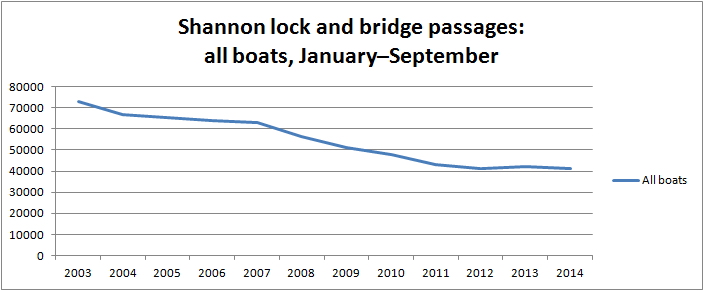
All boats

Total (private + hired) traffic for the first nine months of each year

Not a lot to say: slightly down on last year, but the numbers for the last three years have been fairly even.

Private boats

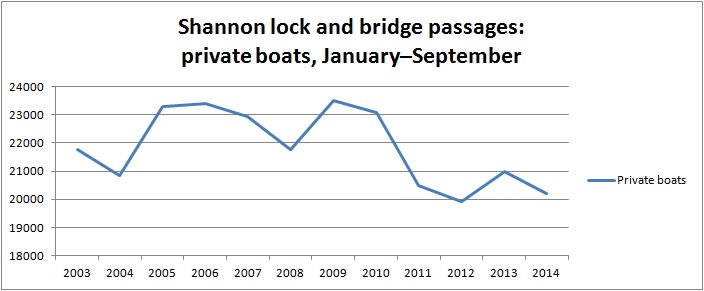
Shannon traffic 1409 private

Private-boat traffic for the first nine months of each year

Note that the vertical scale is truncated, which exaggerates the scale of the changed. The good weather, especially in July and September, doesn’t seem to have resulted in a continuation of last year’s improvement.

Hire boats

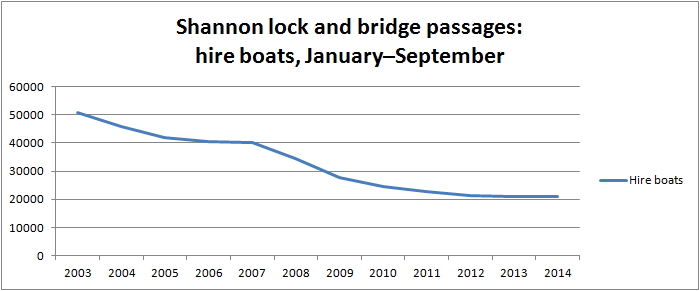
Shannon traffic 1409 hired

Hire-boat traffic for the first nine months of each year

Not much change from last year, but it’s the lowest nine-month figure in my records.

Percentages of 2003 levels

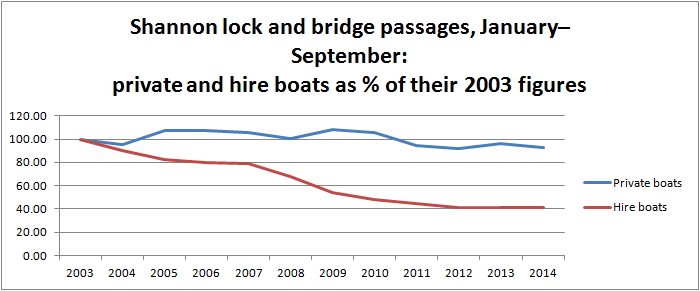
Shannon traffic 1409 -v- 2003

Percentages of 2003 levels

The nine-month figure for private boats is the second-lowest in my records (2012 was lowest) despite the good weather. The hire-boat figure is the lowest in my records, but the pace of decline seems to have levelled off.

Private -v- hired

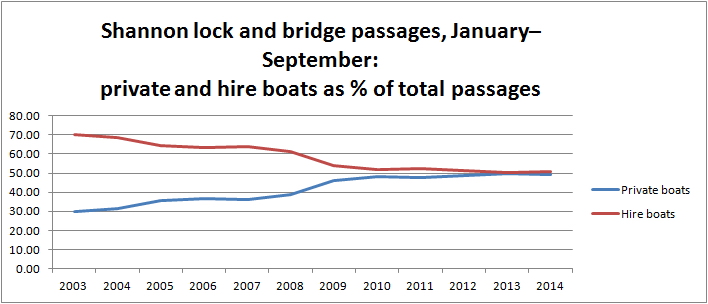
Shannon traffic 1409 private -v- hired

Still roughly 50/50

Nothing very encouraging there, alas.

Waterways Ireland pensions

Here’s a piece of uninformative information.

I’ve written before about Waterways Ireland’s pension scheme and the burden it imposes on the organisation’s current expenditure. I also pointed out that WI’s current staff would be required to pay more into their pension scheme.

The Dáil exchange to which I linked above (a Labour TD asking a question of a Labour minister) seems to discuss one part of the problem but not the other. The minister says that he is happy with the increase in pension contributions. However, he is providing an escape route for [southern] employees of Waterways Ireland: they can elect to

revert to what is called ‘Reserved Rights’ status which is effectively the standard southern public service terms.

I do not know whether that is a contributory or a non-contributory scheme; there may be different provisions for officers and servants.

There is no information about those who were formerly employed by Northern Ireland public sector bodies or those who joined Waterways Ireland without previous public sector employment north or south.

Finally, the minister provided no information about the effect of a mass withdrawal on the North/South Pension Scheme or, more importantly, on Waterways Ireland’s budget. I am unable to work out what the consequences might be; I hope that WI is not left to pay out large pensions to retired staff out of a reduced pension fund and declining grant income from the governments.

IBEC

Waterways Ireland is no longer a member of IBEC.

Broadstone

You can visit the building on the weekend of 18 & 19 October 2014 as part of Open House Dublin. And there are other sites of industrial heritage and transport interest that will be open between 17 and 19 October.

Uninformative press release aboot thon sheugh

Plans to restore the Upper Lough Erne to Clones section of the Ulster Canal are being pursued by the Department of Culture, Arts and Leisure and the Department of Arts, Heritage and the Gaeltacht

it says here. The official NSMC version is here. No mention of the inter-agency treasure-seekers; perhaps the swag is in here:

Progress on the development of the new INTERREG V and PEACE IV Programmes for the period 2014 – 2020 was discussed. The Council noted that the draft Programmes had been submitted to the EU commission by the deadline of 22 September 2014.

I see that WI employee payments for pensions are going up:

16. Ministers also acknowledged the ongoing work in relation to reform of the North South Bodies Pension Scheme, including recently approved amendments to ensure the Scheme complies with employment legislation and best practice in both jurisdictions and to increase employee contributions.

Someone with a tin ear (perhaps someone who doesn’t do crosswords) wrote this:

driving a shift to public and more sustainable modes of transport and the potential for shared cross border public transport services in border areas.

Driving would be right, especially in Donegal. But what about parity of esteem?

development of cross border Greenways

Why no Orangeways?