Tag Archives: waterways

Sinn Féin and the Clones Sheugh

Northern Ireland Assembly debate 6 November 2012, via TheyWorkForYou.com:

Phil Flanagan (Sinn Féin): […] Will the Minister provide an update on the restoration of the Ulster canal from Clones to Upper Lough Erne?

Martin McGuinness (Sinn Féin): As I said, there was a presentation on the issue at the North/South interparliamentary forum, and the planning processes are up and running. I understand that, on the Cavan side of the border, it has been successfully concluded. There is still some work to do on this side. Everyone realises, from a tourism point of view, that this is filled with all sorts of potential for us, particularly in the context not only of whatever construction jobs will be created by the project but of the prospects for utilising our waterways in a way that can bring employment to local communities.

For “everyone” read “everyone except irishwaterwayshistory.com and a few other sane people”.

Athy dry dock

I have been sent some photos of Athy dry dock and have added them to this page under the heading Grand Canal Barrow Line.

The end of a ghost

In the UK, the Statute Law Repeals Bill is working its way through the House of Lords. You can download a PDF list of the bills being repealed. In amongst the turnpikes, Indian railways, benevolent institutions and lotteries, we find Part 4: Ireland (Dublin City). Within that, Group 1 sees the repeal of these statutes:

  • 3 & 4 Will.4 c.cxv (1833) (City of Dublin Steam Packet Company Act)
  • 6 & 7 Will.4 c.c (1836) (Dublin Steam Packet Act)
  • City of Dublin Steam Packet Company’s Act 1860 (23 & 24 Vict. c.xcviii)
  • City of Dublin Steam Packet Company’s (Consolidation of Shares) Act 1861 (24 & 25 Vict. c.iii)
  • City of Dublin Steam Packet Company’s Act 1868 (31 & 32 Vict. c.xxx)
  • City of Dublin Steam Packet Company’s Act 1876 (39 & 40 Vict. c.xi)
  • City of Dublin Steam Packet Company’s Act 1884 (47 & 48 Vict. c.cxxx)
  • City of Dublin Steam Packet Company’s Act 1895 (58 & 59 Vict. c.cxxiii)
  • City of Dublin Steam Packet Company’s Act 1910 (10 Edw.7 & 1 Geo.5 c.vii)
  • City of Dublin Steam Packet Company’s Act 1916 (6 & 7 Geo.5 c.viii)
  • City of Dublin Steam Packet Company’s Act 1920 (10 & 11 Geo.5 c.i).

In a Consultation Paper published in 2008, the Law Commission explained:

The City of Dublin Steam Packet Company was founded by Charles Wye Williams in 1822. From 24 January 1839, the Post Office contracted the company to run the mail service from Dublin to Holyhead. This service was later extended such that the company ran both the day and night service.

During the First World War the company suffered heavy losses, including the sinking of its ship the R.M.S. Leinster by a German submarine on 10 October 1918, resulting in a loss of over 500 lives. A further two ships were sunk during this period. The company never fully recovered from its wartime losses and, in 1924, an order for the winding-up of the City of Dublin Steam Packet Company
was petitioned for and granted by the High Court at Dublin Castle.

In Ireland, the Statute Law Revision Act 2009 repealed the 1833 and 1836 Acts and the Statute Law Revision Act 2012 repealed all the rest — except the 1895 Act. I don’t know where to get a copy of that Act, so I don’t know why it was specifically retained. But, with that exception, it seems that the ghost of the CoDSPCo has been laid to rest.



Portadown Foundry Ltd

I am grateful for a copy of Portadown Foundry Ltd: a history of the foundry 1844–1983, by Cardwell McClure and Wilson Steen, published by the authors in October 2012. It is available from five shops in the Edenderry (Portadown) area; the Edenderry Cultural and Historical Society may be able to assist.

The book’s breadth of coverage is very impressive. It may be thought of as having three main sections. The first provides five chapters covering the five main eras of control of the foundry. The second has four chapters covering employees, surviving artefacts, sporting history and Foundry Street, where many employees lived. The final section has six chapters providing the essential contest that is often omitted in local history books. These six chapters cover:

  • Portadown and the economy of Ulster
  • Foundry-built barges and lighters (of particular interest on this site)
  • The evolution of flax and linen processing in Ulster
  • The evolution of engineering in Ulster
  • The evolution of power plant in Ulster
  • The evolution of transport in Ulster.

It is richly illustrated throughout and is well worth a fiver (sterling) of anyone’s money.


All sheugh up

Thinking about the exciting news from the North South Ministerial Council plenary session about the Clones Sheugh, I was reminded of the even more exciting news of the first meeting of the North/South Inter-parliamentary Association.

Strangely, its meeting received little publicity in the great world. I asked Messrs Google to search for it but to omit links from the Oireachtas and the Northern Ireland Assembly, as well as those from politicus.org and flickr.com. It found only 42 hits, of which the first seven were links to the site of a Labour senator called Mary Moran. (I won’t provide a link to her site as she’s obviously perfectly capable of generating all the links she wants.)

Anyway, the first meeting of the North/South Inter-parliamentary Association seems to have passed almost unnoticed. You can read about it on InsideIreland.ie, which seems to be a news site run by an advertising agency.

From Ciarán Hanna’s account, I deduce that the North/South Inter-parliamentary Association is an entirely pointless body. I note that it won’t meet again until April 2013. And perhaps the Irish government’s support for the Clones Sheugh is because it gives this pointless body something to discuss, thus keeping it from commenting on anything important.

Political parties: update

I said that I had asked many political parties whether they had asked the Department of Community, Equality and Gaeltacht Affairs [now the Department of Arts, Heritage and the Gaeltacht] for costings for the Clones Sheugh (aka the Ulster Canal). Those I asked were:

Christian Solidarity Party
Fianna Fáil
Fine Gael
Fís Nua
Green Party
Labour
People before Profit
Sinn Féin
Socialist Party
South Kerry Independent
Workers and Unemployed Action Group [WUAG]
Workers’ Party

I have so far had responses from Fís Nua, the Green Party and Labour; it seems that none of them made the request. I have emailed a reminder to the others and I await their responses.

What’s really going on

A useful post on the perils of relying on insider briefings when you want to find out about something (or at least to pretend that you know something about it).

A London pub and the history of the Shannon

Piloti’s “Nooks and Corners” column in the latest issue of Private Eye [No 1325] reports [brief extract available to non-subscribers here] that a London pub is threatened with demolition. On the Google satellite view with photos, press the button to the bottom right of the building to see a pic headed “Derelict pub”.

Piloti says that the pub was built in the 1840s [Diamond Geezer says 1839] and at that time the Marquis (or Marquess) was Henry Petty-Fitzmaurice, 3rd Marquess of Lansdowne, KG, PC, FRS. The family’s main base was in Britain but they owned large estates in Ireland, notably in Counties Limerick and Kerry; certain roads in Dublin are also named after the family.

The late Marquis has two claims on the attention of Irish waterways enthusiasts. First, the best-known of the early River Shannon steamers, the Lady Lansdowne, was named after his wife. Second, he was Lord President of the Council [the current holder of the post is Nick Clegg] when the government of Her Late Majesty Queen Victoria decided, in 1839, to spend about half a million pounds improving the Shannon Navigation.


WI & OSI

Ordnance Survey Ireland piece on Waterways Ireland’s use of OSI data.

Blunderbuses on the Shannon

Saturday 10 May 1845

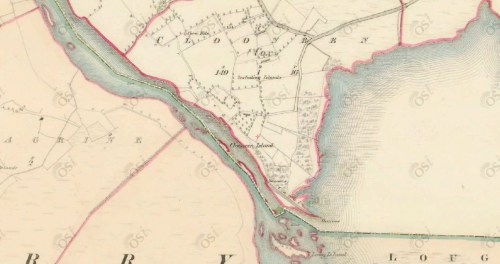
[…] On our way to Rooskey this Morning we visited Cloneen [Clooneen] & Cox shoal and they were going on very well with about 60 Men

I ordered them to double that Number to my astonishment I found 4 Policemen Barricked in one of our houses and a new Barrick erecting for 30 or 40 more Men this was being done in consequence of three villains placing themselves on the opposite bank of the River and deliberately firing four rounds of Ball from Blunderbuses some of which went into the office and from the marks made by one Ball must have been only a few inches from striking Joe Lambs head — afterwards the villains retired to the Bogs — the object of this outrage was revenge on the Men for not striking for 1/6 [8p] Pd day — the average being about 1/2 [6p] — which is considered at present ample

From David Brooke ed The diary of William Mackenzie, the first international railway contractor Thomas Telford Publishing, London 2000

What the blurb doesn’t say is that Mackenzie was the contractor for works on four areas of the Shannon, working for the Shannon Commissioners in the 1840s. He was responsible for Killaloe, Meelick, Banagher and Rooskey and also held a dredging contract.

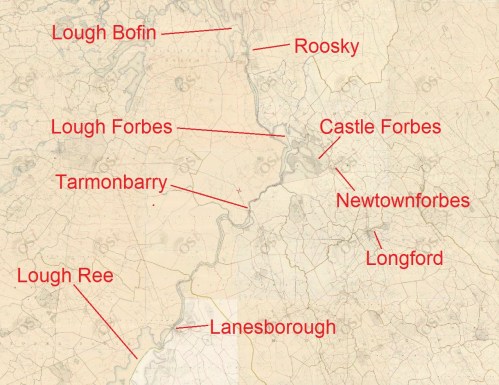
Lanesborough to Rooskey showing Lough Forbes

Clooneen (Cox) is the area at the upstream end of Lough Forbes; other Clooneens lie to the north on the east side of the river. Joe Lamb was the ganger.

Clooneen (Cox)