Category Archives: Built heritage

Thon Cavan Sheugh

Thanks to Kildare Street for this, which came up in Dáil written answers on Wednesday 22 May 2013.

Brendan Smith [FF, Cavan-Monaghan]: To ask the Minister for Arts, Heritage and the Gaeltacht the position regarding the feasibility study that has been underway for some time in relation to the proposed extension of the Erne Navigation from Belturbet to Killykeen and Killeshandra; when this study will be completed; and if he will make a statement on the matter. [24538/13]

Jimmy Deenihan [FG Kerry North/West Limerick]: I am informed by Waterways Ireland that the current position is that work is continuing on the collection of data relating to this project and Waterways Ireland is currently preparing draft options for the project. At that point consultants will then assess the environmental implications of the options. It is expected that the feasibility study will be completed as planned by the end of 2013.

That’s Lough Oughter they’re talking about. If thon Monaghan boys are getting a sheugh, Cavan boys need one too. And, of course, consultants are having a hard time so they could benefit by earning a few bob. The net benefit to the economy will be pretty well nil (any spending will simply be displaced from elsewhere).

I think that Killykeen is a forest park; it is not clear how the local economy would benefit from the arrival of a few boats. If the folk of the area want a unique water-based attraction that might bring foreign tourists, they would be better advised to have the lake made an engine-free zone, open only to boats rowed, paddled or sailed, and with safe places to camp on the banks.

You can read here about how to get a boat from Belturbet to Lough Oughter.

This day thou shouldst be with me

G K Chesterton thought that Paradise was somewhere reached by way of Kensal Green, but in fact it’s at the junction of the Shannon and Fergus estuaries. I have had a page about Paradise for some time; I have now added some black and white photos taken by Brigadier Frank Henn, whose family home it was, in 1936 and 1938.

This has come about through the kindness of Seán Matthews, who made the arrangements. Seán’s grandmother Hester Mahon married a Matthews; her sister Geraldine married a Henn and Frank is Geraldine’s son.

The black and white photographs show, better than my colour pics do, why the place was called Paradise. The copyright in those photos belongs to Brigadier Frank Henn; I am extremely grateful both to him and to Seán Matthews for making it possible for me to use them. They are spread about among the earlier material on this page.

Sinn Féin promotes a certain Sheugh

The Dáil discussed the Good Friday Agreement on Tuesday 14 and Wednesday 15 May 2013. On the Tuesday the minister, Jimmy Deenihan (FG, Kerry North/West Limerick), gave the standard line on the Clones Sheugh:

One of the projects it is currently progressing is the restoration and reopening of the Ulster Canal between Clones and Upper Lough Erne. Planning permission has been granted by Cavan County Council, Monaghan County Council, Clones Town Council and, more recently, the Northern Ireland Department of the Environment planning service. I have established an interagency group to explore funding options for advancing the Ulster Canal project, including existing funding streams and leveraging funding from other sources. The group comprises county managers from Monaghan and Cavan county councils, the director of leisure development and arts from Fermanagh District Council, representatives from the Northern Ireland Tourist Board, Fáilte Ireland, the Strategic Investment Board, Waterways Ireland and senior officials from the Department of Culture, Arts and Leisure and the Department of Arts, Heritage and the Gaeltacht. The next meeting of the interagency group will take place later this week. This interagency approach has been effective elsewhere and I suggest it could be used for similar projects in future.

Nobody else mentioned the Sheugh that day, but on the following day local man Caoimhghín Ó Caoláin (SF, Cavan-Monaghan) gave a rose-tinted account of the benefits of canal restoration:

The second outstanding issue I wish to raise is the Ulster Canal. Far-seeing individuals, not least in the local communities, saw the potential long ago of re-opening the Ulster Canal from Lough Erne in County Fermanagh, through Clones in County Monaghan and on to Lough Neagh. This was a flagship project identified in the Good Friday Agreement and confirmed in subsequent negotiations and agreements. Those far-seeing people saw the potential economic return for entire communities throughout this beautiful part of rural Ireland with the opening up of the Erne-Shannon waterway, linking Lough Erne with the River Shannon. They rightly concluded that similar benefits could be gained from re-opening the Ulster Canal, with the 13 km Erne to Clones section marked out as the first phase of the overall project.

In July 2007, nearly six years ago, the North-South Ministerial Council agreed to proceed with the Ulster Canal project. That was widely welcomed at the time, especially in the Border counties, where the peace dividend had been very slow to materialise. It was widely seen as vindication of the campaign of the local communities and the calls from elected representatives of all parties North and South, including my Sinn Féin colleagues and me, for this very positive project to be advanced. In the intervening period we have seen the economic collapse in this State and a parallel contraction in the North. Despite that, the Ulster Canal project was kept live. Nonetheless, it took until October 2011 for Waterways Ireland to lodge planning applications. Permission was granted last month for the northern section by Minister for the Environment, Alex Attwood, and earlier this month by Clones Town Council and Monaghan County Council for the section in this jurisdiction. The Minister, Deputy Deenihan, has advised that the earliest the contract could be awarded would be late 2014 with a completion date in spring 2017. I urge the Government to do all in its power to expedite this process. I also urge the Minister, Deputy Deenihan, and other colleagues to maximise the possible EU funding for the project from the PEACE IV programme. The Ulster Canal project is hugely important, not only symbolically, but will prove to be powerful in terms of economic development across this island. It is time to get the work on the ground under way.

Nobody else mentioned it.


A trip through the Butterley Tunnel

I have recently been sent links to explorations of the Butterley Tunnel on the Cromford Canal, whose Friends are here with a map here and the first of the explorations here. The second exploration [don’t try this at home, kids] is described rather more extensively in this PDF.

Coincidentally, I found that Joseph Tatlow paid a brief visit to the canal in about 1869:

After about eighteen months of office work I had a long and serious illness and was away from duty for nearly half a year. The latter part of the time I spent in the Erewash Valley, at the house of an uncle who lived near Pye Bridge. I was then under eighteen, growing fast, and when convalescing the country life and country air did me lasting good. Though a colliery district the valley is not devoid of rural beauty; to me it was pelasant and attractive and I wandered about at will.

One day I had a curious experience. In my walk I came across the Cromford Canal where it enters a tunnel that burrows beneath coal mines. At the entrance to the tunnel a canal barge lay. The bargees asked would I like to go through with them? “How long is it?” said I, and “how long will it take?” “Not long,” said bargee, “come on!” “Right!” said I.

The tunnel just fitted the barge, scarcely an inch to spare; the roof was so low that a man lying on his back on a plank placed athwart the vessel, with his feet against the roof, propelled the boat along. This was the only means of transit and our progress was slow and dreary. It was a journey of Cimmerian darkness; along a stream fit for Charon’s boat. About halfway a halt was made for dinner, but I had none. Although I was cold and hungry the bargees’ hospitality did not include a share of their bread and cheese but they gave me a drink of their beer.

The tunnel is two miles long, and was drippingly wet. Several hours passed before we emerged, not into sunshine but into the open, under a clouded sky and heavy rain which had succeeded a bright forenoon. I was nearly five miles from my uncle’s house, lightly clad, hungry and tired. To my friends ever since I have not failed to recommend the passage of the Butterley tunnel as a desirable pleasure excursion.

Joseph Tatlow Fifty Years of Railway Life in England, Scotland and Ireland The Railway Gazette, London 1920

A picnic on the Barrow in 1896

[…] I recall a little arbitration case in which I was engaged. It was during the summer, in July I think. The Grand Canal (not the canal which belongs to the Midland and is called the Royal) is a waterway which traverses 340 miles of country. Not that it is all canal proper, some of it being canalised river and loughs; but 154 miles are canal pure and simple, the undisputed property of the Grand Canal Company. On a part of the river Barrow which is canalised, an accident happened, and a trader’s barge was sunk and goods seriously damaged. Dispute arose as to liability, and I was called on to arbitrate. To view the scene of the disaster was a pleasant necessity, and the then manager of the company (Mr Kirkland) suggested making a sort of picnic of the occasion; so one morning we left the train at Carlow, from whence a good stout horse towed, at a steady trot, a comfortable boat for twenty miles or so to the locus of the accident. We were a party of four, not to mention the hamper. It was delightfully wooded scenery through which we passed, and a snug little spot where we lunched. After lunch and the arbitration proceedings had been dispatches, our pegasus towed us back.

Joseph Tatlow Fifty Years of Railway Life in England, Scotland and Ireland The Railway Gazette, London 1920

Bell, book and candle …

… shall not drive me back, but something has driven boats from the Bell Harbour in Monasterevan, which I can’t recall seeing so empty: just one cruiser and one WI workboat.

Monasterevan May 2013 03_resize

Cruiser at the Bell Harbour

Monasterevan May 2013 01_resize

WI workboat at the Bell Harbour

Actually, I’m not sure whether it is a WI workboat: I can’t see any logos or other ID on it.

Sinn Féin’s sheughs

I have remarked before that Sinn Féin seems to be devoted to the leading-edge communications technology of the eighteenth century, the canal. I have no idea why it takes such an interest in the subject, but further evidence of its devotion has emerged in the last week.

The Fermanagh Herald reported, on 5 May 2013, that Michelle Gildernew MP [whose Sinn Féin page seems to have disappeared] listed the Clones Sheugh amongst the jobs on which European taxpayers should spend money. She did so at a meeting with Colette Fitzgerald, head of the European Commission’s Belfast office; Ms Fitzgerald made polite noises but did not promise any money.

But Sinn Féin does not confine itself to Clones. Carál Ní Chuilín MLA, whose Sinn Féin web page is live but well out of date, is (as Minister of Culture, Arts and Leisure) the NI minister responsible for Waterways Ireland. We learn from the Londonderry Sentinel that she wanted Waterways Ireland to be landed with responsibility for the Strabane Sheugh.

Happily, the North South Ministerial Council shot that down, but the minister wants to see whether the unfortunate Strategic Investment Board can find any loot for the canal. It might be better if they were asked to find a use for it first: even if it were restored, it would be unlikely ever to see more than a few small boats in a year. It might provide a walking route, for which (pace the Clones dudes) neither locks nor water would be needed, but the Londonderry Sentinel leaves me unclear whether the towpath is usable. It says:

A year ago the Sentinel reported the ‘tow path’ section of the Strabane Canal was to open for the first time in 50 years in June 2012.

It doesn’t say that the towpath did reopen, which seems odd; a Belfast Telegraph article of June 2012 says that it was reopened temporarily but WalkNI says that it is being restored. So is it open or not? I’d like to know, because I favour walking routes along unrestored canals, as does the learned IndustrialHeritageIreland, which also notes encouraging interest from Monaghan County Council.

The drums, Carruthers

I pointed out recently that some newspapers seemed to have reproduced, unquestioningly, what may have been press releases about the Clones Sheugh. On 25 April the Irish Independent, and other media, had a story, attributed to the Press Association, beginning:

Part of the cross-border Ulster Canal which has not been used for 80 years is to reopen, it has been revealed.

That followed the granting of planning permission, in Northern Ireland, for those portions of the proposed canal to Clones that lie with HM Realm. A couple of weeks earlier, Sinn Féin had been calling for taxpayers’ money to be spent on the project. And Brian Cassells was quoted in the Belfast Telegraph on 27 April 2013 in praise of walking in the country. I wondered whether there was a coordinated campaign to put pressure on the Irish government to come up with the loot for the Clones Sheugh: whether the jungle drums were being orchestrated.

Paying the piper

But none of those stories made it clear that the Irish taxpayers, who had been volunteered to pay for those sheugh, could not afford it. Then, last week, we had several stories making that very point — but without any reference to the stories of the previous week:

The Indo gives the cost of the Clones Sheugh as €35m and the BelTel as £29.6m; it is not clear whether they are repeating an outdated estimate or whether Waterways Ireland’s engineers have provided a new estimate.

Please put a penny

Both stories repeated the current Irish government’s current rather confusing story about where the money was to come from:

  • sale of Waterways Ireland assets (which Irish ministers are not empowered to sell)
  • annual budgetary allocations to Waterways Ireland
  • income from commercialisation of Waterways Ireland assets, which (as I interpret it) is not the same as revenue from the sale of assets.

But it is the journalism that concerns me again here. Newspapers have printed a story saying that there is no money for the Clones Sheugh but they have ignored their own stories, of only a week earlier, saying that the project was going ahead.

Given that, I find it difficult to believe that the newspapers (and the Press Association) have anyone taking an active interest in the Clones Sheugh: researching, investigating and reporting. I suspect — and I accept, of course, that I may be entirely wrong — that on both occasions the journos were simply presented with press releases, probably pre-digested.

Calling the tune

I think it would be interesting to know who has been issuing these various press releases and why they have been doing do. So I’d like journos to tell us the context and the background: that would be more interesting to read, and more worthy of the journos’ efforts, than the reproduction of the releases’ contents.

I don’t know who sent out the first set of releases, saying that the Ulster Canal was to go ahead, but I suspect that the second set was a damage-control effort by the current Irish minister. I suspect that he wanted to dampen down unrealistic expectations without actually the Clones enthusiasts to get stuffed (whether for the short or for the long term). What happened in between the two sets of releases was that a member of the minister’s own party, Heather Humphreys [FG Cavan-Monaghan], asked a Useful Question in the Dáil. That was no doubt entirely coincidental, and not in any way prompted by the minister or by the FG managers, but it allowed the minister to get his story out.

South of the border

The occasion was a Topical Issue Debate on Cross-Border Projects on 1 May 2013. Ms Humphreys was able to associate herself with the views of the local supporters of the project (who are not paying for it), to say how important it was and to claim that getting planning permission was a significant step forward. Which it might be, but it doesn’t help the project to get past the financing obstacle, although she did say that the government was hoping to nick some Euroloot (from PEACE IV; here’s some stuff about PEACE III) for the project.

The minister responded with a history of the proposed rebuilding; then he said [I’ve added extra paragraph breaks]:

The planning applications for this project are now likely to be determined in May 2013. The compulsory purchase order, CPO, land maps are well progressed. It is estimated that the CPO process will take approximately 12 months and, depending on the funding in place, the CPO process may proceed incrementally.

A decision on the construction of the project and on whether to have a single large contract or a number of smaller contracts will also have to be made.

As the project is above the EU procurement threshold the tender process will be required to comply with the EU procurement process and will take approximately six months to complete. Taking that into consideration the earliest the contract could be awarded would be late 2014 with a contract period of 24 months giving a completion date of spring 2017. If the project is to proceed in a more piecemeal fashion the completion date could be some years later, depending on the number and timing of individual contracts. Funding for the project very much depends on the availability of funding from the Exchequer. Deputy Humphreys referred to the possibility of funding from a European source. The Taoiseach referred to a similar possibility.

I established an inter-agency group comprising county managers from Monaghan and Cavan, the director of leisure, development and arts from Fermanagh, representatives from the Northern Ireland Tourist Board, Fáilte Ireland, the Strategic Investment Board, Waterways Ireland and senior officials from the Department of Culture, Arts and Leisure, Northern Ireland and the Department of Arts, Heritage and the Gaeltacht. The inaugural meeting was held on 20 September 2012 and the next meeting will take place shortly. Its challenge is to find alternative sources of funding. I again thank the Deputy for raising the matter. With the planning permission process completed, the next stage is to acquire the land and we will proceed with that immediately.

I feel sorry for the poor folk from the NI Strategic Investment Board, who barely mention the Ulster Canal in their Investment Strategy for Northern Ireland 2011–2021: building a better future [PDF], and who take care to mention the Unionist Lagan Navigation along with the Republican Ulster Canal. They must be wondering how their involvement is expected to help the southern government to meet its commitment to pay for the Clones Sheugh.

Along the banks

Anyway, back to the Dáil. Heather Humphreys, who may not have seen many canals, responded, saying (inter alia):

The canal is an iconic, achievable project that is worthy of support.

Naturally, I disagree about the “worthy of support” bit, but even “iconic” is nonsense. The Ulster Canal was a relatively minor, small, uninteresting waterway carrying insignificant cargoes, and there is little to attract the tourist. The Royal Canal is much more “iconic”, and even that pales by comparison with some canals elsewhere.

The minister finished by saying:

Potential funding from the €150 million PEACE IV programme is very important. If we could source funding from it that would give a greater possibility of the project progressing in the near future. I hope that having completed the CPOs we can make a start on the project in 2015 or 2016. As Deputy Humphreys indicated, it is an iconic project and it would give a major boost to that part of the country which has suffered considerably from rural depopulation. The farming community is under a lot of pressure as well.

Certainly, this project would be seen to be a major asset to the local community and local economy.

It seems that the rural seclusion of the area between Lough Erne and Clones will not be broken by the sounds of JCBs just yet.

The mystery of the missing bollard

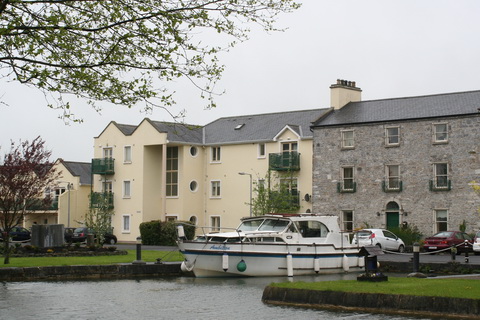
Boaters on Lough Derg were shocked today to realise that a key part of the lake’s infrastructure, the corner bollard at Dromaan, had gone missing.

The mystery of the missing bollard_resize

The vanished bollard

There it was gone

“We didn’t know it was there until it was gone,” said a weeping cruiser-owner. “Without that bollard, the outer berth on the right-hand side is useless: you can’t tie a boat there. And the middle berth is useless too. Two whole berths gone. With so many other spaces taken by harbour-hoggers and abandoned vessels, we’ll end up tying off barges or something.”

Sergeant Pluck of Whitegate said: “Is it about a bicycle?” Later, Superintendent Clohessy, from Tipp, admitted that he was baffled. The theft of a bollard had not previously been recorded. It was, he said, a quare conundrum and a right pancake.

Waterways Ireland has not commented on the matter.


The Marquis survives

I reported last October that an unused London pub, named after Henry Petty-Fitzmaurice, 3rd Marquess of Lansdowne, KG, PC, FRS, was threatened with demolition in favour of a museum extension.

I pointed out that the late Marquis had two claims on the attention of Irish waterways enthusiasts. First, the best-known of the early River Shannon steamers, the Lady Lansdowne, was named after his wife. Second, he was Lord President of the Council [the current holder of the post is Nick Clegg] when the government of Her Late Majesty Queen Victoria decided, in 1839, to spend about half a million pounds improving the Shannon Navigation.

The Indie reports today that Hackney Council’s planning committee has voted against the demolition, so the Marquis survives, at least for now.