
Category Archives: Built heritage

Northern Ireland seeks cutting-edge technology … of the 18th century

IndustrialHeritageIreland reports on two recent outbreaks of cargo cultism in Norn Iron. Folk in Tyrone want the whole of the Ulster Canal to be restored to its, er, former glory, which presumably means without any water west of Monaghan, while a Sinn Féin MLA wants to lumber Waterways Ireland with responsibility for the useless Strabane Canal on which £1.3 million has already been wasted.

What is it with Sinn Féin and canals? I realise that Irish republicanism is by definition a backward-looking creed, with little contact with reality, but why not look to (say) early nineteenth century technology, like the steam railway, rather than that of the eighteenth century?

Part of the problem, I suspect, is that Sinn Féin folk, especially those who are subjects of Her current Majesty, adopt a British conception of inland waterways. In Britain, canals dominate and boats must travel slowly, no faster than the horse-drawn vessels of the eighteenth and nineteenth centuries. But Irish waterways are dominated by lakes, whereon modern folk like to zoom around in fast boats: jetskis, speedboats and skiboats, fast cruisers. Such boats are entirely unsuitable for canals: they damage the banks and the pace bores their owners.

As it happens, we have lots of lakes where owners can zoom. [I’d prefer if they didn’t, but that’s the way it is.] And with reductions in the amount of boating activity, we don’t need any additional waterways. Sinn Féin, though, doesn’t seem to have grasped this. Stuck in the eighteenth century, it wants canals. I suppose we should be grateful it isn’t proposing to have the taxpayer stump up for coal-mines as well.
For the record

The Limerick Leader article about a proposed Limerick river bus has some statements that do not accord with my understanding.

The venture will see the river bus depart Guinness Pier – across from Athlunkard Boat Club at O’Dwyer Bridge – every two hours, bound for the power station […].

As far as I know, the pier in question was the Ranks jetty and was not used by Messrs Guinness. The Eclipse Flower, and other vessels owned by Ranks and their predecessors, sailed up the Shannon from there rather than attempt the stretch from Baal’s Bridge to Custom House Quay.

The boat will follow the route taken by barges of old – both passenger and commercial – some of which historically transported Guinness to the city up until the mid-1960s.

“It is a tried and tested route,” said Mr Flynn, stressing the viability and safety of the route, which passes Long Pavement – the edges of which have been repaired and grassed over – and finishes at the hydro-electric plant.

“Every passenger and commercial barge that came to Limerick for 50 years used that stretch of water. It is very safe. It was navigated by all the barges,” he said.

The route to Limerick through Ardnacrusha came into use only after the construction of the power station in the 1920s and was used for a little over thirty years. To the best of my knowledge, there were no passenger services in those years: passenger carrying stopped in the first half of the nineteenth century, when traffic was still using the old Limerick Navigation. There have been some trip-boats in recent years, but they did not (and do not) use “barges of old”. Some old barges, now converted and with more powerful engines, have safely navigated that stretch, but they do it when conditions are right.

During the final phases of Ardnacrusha’s construction, both old and new navigations were closed; the Grand Canal Company (GCC), the main commercial carrying company, ran to Killaloe and had its cargoes carried onward by rail to Limerick. When the new route through Ardnacrusha was opened, the GCC thought it was so dangerous that it refused to use it for about a year. It resumed operations only when a boom was put across the river above Baal’s Bridge and posts were provided upstream of O’Dwyer Bridge to which barges could tie while waiting for suitable states of the tide.

I accept that the proposed river bus will not be going downstream as far as Baal’s Bridge, but it will still be navigating on a stretch of water where Waterways Ireland advises that boats should not navigate when more than one turbine is running at Ardnacrusha. The ESB can run up to four turbines, each of which is said to add a knot to the current, and it can switch them on immediately, with no warning to any boat using the river.

Other pages on this site make it clear that I share the promoters’ enthusiasm for Ardnacrusha and the canal and river thence to Limerick. I do not say that the difficulties of that stretch cannot be overcome, but I do not think that they should be dismissed.


Sinn Féin and the Clones Sheugh

Northern Ireland Assembly debate 6 November 2012, via TheyWorkForYou.com:

Phil Flanagan (Sinn Féin): […] Will the Minister provide an update on the restoration of the Ulster canal from Clones to Upper Lough Erne?

Martin McGuinness (Sinn Féin): As I said, there was a presentation on the issue at the North/South interparliamentary forum, and the planning processes are up and running. I understand that, on the Cavan side of the border, it has been successfully concluded. There is still some work to do on this side. Everyone realises, from a tourism point of view, that this is filled with all sorts of potential for us, particularly in the context not only of whatever construction jobs will be created by the project but of the prospects for utilising our waterways in a way that can bring employment to local communities.

For “everyone” read “everyone except irishwaterwayshistory.com and a few other sane people”.

Athy dry dock

I have been sent some photos of Athy dry dock and have added them to this page under the heading Grand Canal Barrow Line.

Portadown Foundry Ltd

I am grateful for a copy of Portadown Foundry Ltd: a history of the foundry 1844–1983, by Cardwell McClure and Wilson Steen, published by the authors in October 2012. It is available from five shops in the Edenderry (Portadown) area; the Edenderry Cultural and Historical Society may be able to assist.

The book’s breadth of coverage is very impressive. It may be thought of as having three main sections. The first provides five chapters covering the five main eras of control of the foundry. The second has four chapters covering employees, surviving artefacts, sporting history and Foundry Street, where many employees lived. The final section has six chapters providing the essential contest that is often omitted in local history books. These six chapters cover:

  • Portadown and the economy of Ulster
  • Foundry-built barges and lighters (of particular interest on this site)
  • The evolution of flax and linen processing in Ulster
  • The evolution of engineering in Ulster
  • The evolution of power plant in Ulster
  • The evolution of transport in Ulster.

It is richly illustrated throughout and is well worth a fiver (sterling) of anyone’s money.


Grand trumps Royal

A victory today for St James’s Hospital, close to the former harbour of the Grand Canal, over the Mater Hospital, close to the former harbour of the Royal Canal at the Broadstone.

Perhaps, if St James’s needs space to expand, it could take over the former canal harbour; work on its latest development seems to have ceased.

Conserving heritage

The Irish Times suggests that the vigorous campaign conducted by the Heritage Council has been successful: its abolition has been cancelled.

Divided by oceans, linked by a canal

Last Monday the erudite and sapient Póló wrote about a photo he took in Armagh on a school trip in the 1950s. He put a copy of the photo on a web page in 2004 and, eight years later, he got an email from the person who now lives in a house that was shown in the photo. Póló was able to supply a better copy, pleasing his correspondent, and (as Póló said)

[…] he learned something new and I got a better dating on my trip and photos.

But it was his next paragraph that rang a bell with me:

I am always telling people, particularly those who are following up their family history, that they should have a presence, however minimal, on the web. That way people can find you and you never know what they might be bringing to the table.

Just before reading that, I’d had a message from a correspondent in Australia. He had seen my page about the old Athlone canal and reckoned that he was probably related to a previous, British, visitor to the page; I put them in touch and it seems that they are cousins. You can read the correspondence on my Athlone canal page. So a reference to an abandoned canal on an obscure Irish website has helped two folk to get in touch — and I, and other visitors to the site, have learned a bit more about the canal.

But there is more to learn. Does anyone know anything about Canal Lodge? The AthloneLive forum has disappeared, so I can’t ask there, and I have no other information to hand. I am making enquiries, but if anyone has any information about the building I would be glad to receive it and I’ll make sure it’s passed on.


A London pub and the history of the Shannon

Piloti’s “Nooks and Corners” column in the latest issue of Private Eye [No 1325] reports [brief extract available to non-subscribers here] that a London pub is threatened with demolition. On the Google satellite view with photos, press the button to the bottom right of the building to see a pic headed “Derelict pub”.

Piloti says that the pub was built in the 1840s [Diamond Geezer says 1839] and at that time the Marquis (or Marquess) was Henry Petty-Fitzmaurice, 3rd Marquess of Lansdowne, KG, PC, FRS. The family’s main base was in Britain but they owned large estates in Ireland, notably in Counties Limerick and Kerry; certain roads in Dublin are also named after the family.

The late Marquis has two claims on the attention of Irish waterways enthusiasts. First, the best-known of the early River Shannon steamers, the Lady Lansdowne, was named after his wife. Second, he was Lord President of the Council [the current holder of the post is Nick Clegg] when the government of Her Late Majesty Queen Victoria decided, in 1839, to spend about half a million pounds improving the Shannon Navigation.


Blunderbuses on the Shannon

Saturday 10 May 1845

[…] On our way to Rooskey this Morning we visited Cloneen [Clooneen] & Cox shoal and they were going on very well with about 60 Men

I ordered them to double that Number to my astonishment I found 4 Policemen Barricked in one of our houses and a new Barrick erecting for 30 or 40 more Men this was being done in consequence of three villains placing themselves on the opposite bank of the River and deliberately firing four rounds of Ball from Blunderbuses some of which went into the office and from the marks made by one Ball must have been only a few inches from striking Joe Lambs head — afterwards the villains retired to the Bogs — the object of this outrage was revenge on the Men for not striking for 1/6 [8p] Pd day — the average being about 1/2 [6p] — which is considered at present ample

From David Brooke ed The diary of William Mackenzie, the first international railway contractor Thomas Telford Publishing, London 2000

What the blurb doesn’t say is that Mackenzie was the contractor for works on four areas of the Shannon, working for the Shannon Commissioners in the 1840s. He was responsible for Killaloe, Meelick, Banagher and Rooskey and also held a dredging contract.

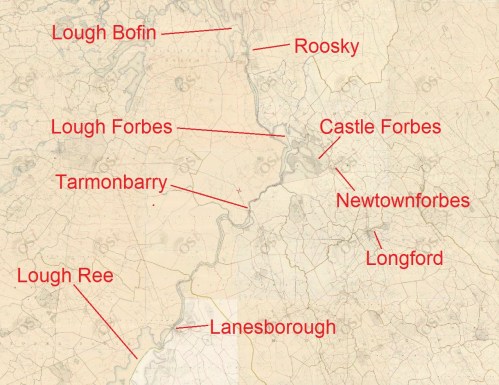
Lanesborough to Rooskey showing Lough Forbes

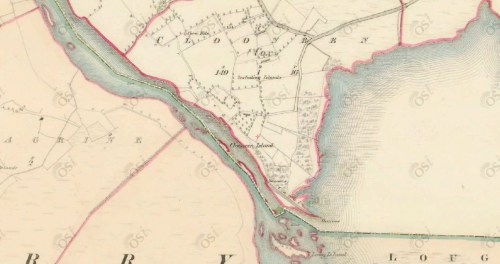
Clooneen (Cox) is the area at the upstream end of Lough Forbes; other Clooneens lie to the north on the east side of the river. Joe Lamb was the ganger.

Clooneen (Cox)