Category Archives: Charles Wye Williams

Errina Bridge

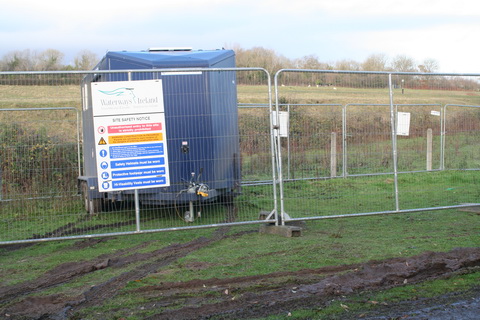
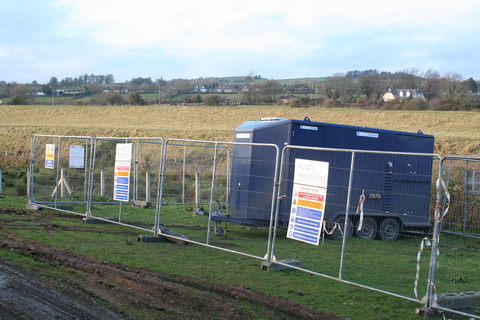
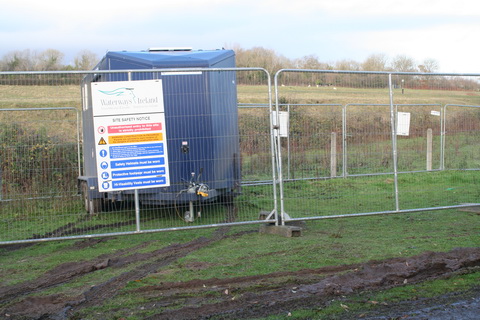
I remarked in November 2012 that Waterways Ireland had parked a canteen trailer and some pontoons at Errina Bridge, the uppermost bridge on the Plassey–Errina Canal, which is part of the old Limerick Navigation.

WI pontoons

WI pontoons

WI canteen

WI canteen

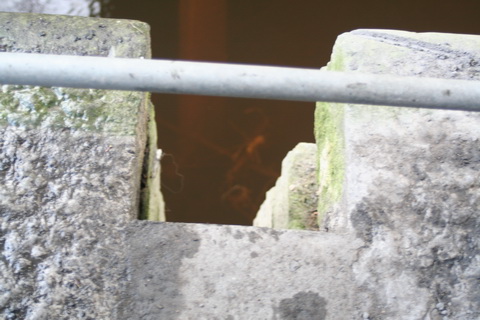
I wondered what was to be done; I noted that a stone at the top of one of the stop-plank grooves under the bridge had been removed (the stone on the far side was removed some time ago).

So I asked Waterways Ireland what was happening. They said:

The works in Clonlara are Flood relief works to protect Errina Lock from catastrophic failure. After the flooding in 2009, during which the dam in Errina Lock was overtopped by approximately 0.5 metres, it was decided to protect it from this happening again.

It has happened before too: in February 1809 the lock was destroyed by floods when heavy snows melted.

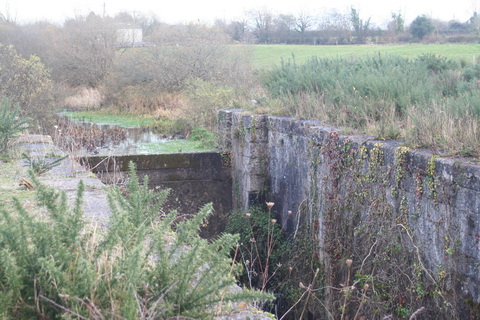
Errina Lock (looking upstream)

Errina Lock (looking upstream)

I asked WI about the nature of the works. They said:

Stop logs are to be put into the grooves under the bridge forming a dam with the same size opening as that in the concrete dam in Errina Lock. As for the stone which is removed to facilitate the installation of the timbers, this will be replaced once the timbers are in place.

That is good to know.

Errina Bridge stop-plank grooves (towing-path side, with uppermost stone removed)

Errina Bridge stop-plank grooves (towing-path side, with uppermost stone removed)

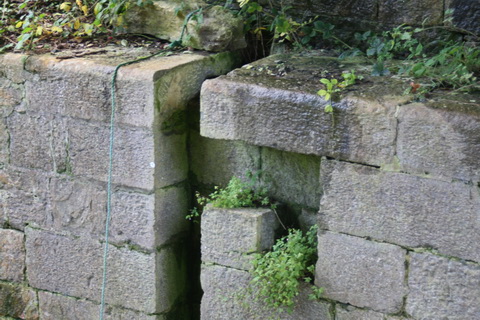
Errina Bridge stop-plank grooves (off side)

Errina Bridge stop-plank grooves (off side)

An authority on waterways has suggested that the curious shape of the grooves was designed to allow planks to be inserted from boats rather than from land.


Southron sheughs

For reasons now lost in the mists of time, I forgot to draw the attention of Learned Readers to an exchange in the Dáil on 18 April 2012, which was reported on the invaluable KildareStreet website as well as on the Oireachtas site. Jack Wall, a Labour TD for Kildare South, asked this question:

Question 702: To ask the Minister for Arts, Heritage and the Gaeltacht the position regarding the canal system under Waterways Ireland; the plans the agency has for the development of the canals; the number of lock keepers in the system; if there are any vacancies; if so, when same will be filled and the mechanism that will be adopted to do so; if the agency has any plans to refurbish existing systems that are not in use at present; if the agency has any plans to increase the number of berthings on the canals and if so, in which areas; if the traffic on the canals has shown a percentage increase over each year for the past three years; and if he will make a statement on the matter. [18431/12]

Now, that’s a bit of a portmanteau question. I wonder whether Jack Wall was prompted to ask about lock keepers but not quite well enough briefed to ask follow-up questions. The minister, Jimmy Deenihan, gave a four-paragraph answer, and I’m going to break it up so that I can discuss each element individually.

Waffle

The minister’s first paragraph was background music:

Since its formation in 1999, Waterways Ireland has continued to upgrade the facilities on the canals through the capital allocations under the National Development Plans. The canals system has benefited extremely well during that time, particularly with the number of additional mooring and landing spaces that have been made available. The provision of further mooring space will be dependent on available finance and priorities over the coming years.

I’m going to move the third paragraph up and deal with it next.

Lockkeepers

The minister said:

I am informed by Waterways Ireland that there are 20 lock keepers employed at present on the Grand Canal and Barrow Navigation. A number of staff have retired recently and decisions on their replacement will be taken having regard to the business needs of the organisation. I understand that Waterways Ireland is not planning to recruit lock keepers at this time. Any posts filled will be either by internal transfer or external recruitment, depending on the particular circumstances.

Although the minister mentions the Royal Canal elsewhere in his answer, and the question certainly does not exclude the Royal, the minister doesn’t mention it in this paragraph. In fact, there are several things the minister doesn’t mention:

  • that there are no lockkeepers on the Royal
  • that agency staff have been employed
  • that, far from considering recruiting replacement lockkeepers, Waterways Ireland might be considering reducing their numbers, or at least assigning some of them to other duties, perhaps on the Royal.

Now, I’m not saying that any of those actualities or possibilities is necessarily a bad thing. In fact, given the virtual absence of lockkeepers on the Canal & River Trust’s English and Welsh canals, it’s hard to see why the Irish canals, with much lower traffic, need so many.

But my point here is that a TD, and especially a Labour Party TD (haven’t they something to do with supporting workers?), might be presumed to be interested in the aspects that the minister did not mention. The minister’s answer was true but incomplete.

For the 2011 election Fine Gael published a document called Reinventing Government, with section headings on “More Open and Transparent Policy-Making Processes” and “New Systems of Openness and Transparency”. Where are they?

Stop digging

Here is the minister’s second paragraph:

My Department’s 2012 capital allocation for Waterways Ireland is €4.5m. This will facilitate continued investment in the development and restoration of the inland waterways. The main thrust of the refurbishment of the waterways over the next few years will be focused on the re-opening of the Ulster Canal from Upper Lough Erne to Clones. However, Waterways Ireland is also undertaking feasibility studies on the Kilbeggan Branch of the Grand Canal and on the Longford Branch of the Royal Canal. These are due to be completed by the end of 2013.

AAAARRRGGGH!

They’re thinking of digging even more sheughs!

Look. I know that engineers love to have excuses (and money) to do engineering: all that kit, wellies and hard hats, muck-shifting and the satisfying feeling that you are bringing joy (and tourists) to a small town. But it’s a waste of time and money. And there is absolutely no point in doing feasibility studies: what you want are cost-benefit analyses. Pretty well every single canal ever built with public funding in Ireland has been a waste of money and there is no reason to believe that relining the canals to Longford and Kilbeggan will be any better. I mean, look at the Naas Branch: very scenic, but hardly anyone ever goes there other than in convoy.

What you want to do is to explain, politely, to the TDs of Longford and Kilbeggan that they can have canals only if they will agree to having all other public services (including the drinking-water supply) cut off. But of course both Kilbeggan and Longford already have ways of attracting tourists. Kilbeggan has a distillery while Longford has an absence of signposts, especially to Athlone, thus causing motorists to drive around in ever-decreasing circles until they imitate the oozlum bird.

I mean, the canal age is over; this is the age of the camper van.

Traffic

Here is the minister’s final paragraph.

I am informed that boat traffic numbers on the Grand Canal and Barrow Navigation have remained fairly constant over 2009 and 2010. In 2011 the numbers increased by 30% following the re-opening of the Royal Canal and the fact that access was available to the Tall Ships event in Waterford.

Now this is really interesting, for three reasons:

  • first, Waterways Ireland keeps telling me that it cannot produce any usage figures for the canals and the Barrow. So on what traffic numbers are the minister’s statements based?
  • second, note that the basis of comparison between the earlier years (2009 and 2010) and the later (2011) is not clear. The Royal was not officially open during the earlier years, although there was some traffic. Was it counted? And does the 2011 figure that shows the 30% increase include Royal figures (in which case it would be an invalid comparison) or not (in which case the few boats doing the complete triangular route caused a huge increase in traffic)?
  • third, note that the minister does not give any actual usage figures. Could it be that they are very small?

What the canals and the Barrow need is action to increase the amount of traffic, especially in summer (when few people travel because of weed and sometimes water shortages) and winter (when few travel because it’s miserable). Adding extensions only spreads the existing traffic more thinly over a larger number of destinations. When you get to the stage of having traffic jams at locks, you can begin to think about extra destinations. Until then, put the shovels away.

A gratifying display of loyalty

His Excellency the Lord Lieutenant took a trip on the Shannon Estuary in July 1856 on the City of Dublin Steam Packet Company’s vessel Erin-go-Bragh. He was greeted by demonstrations of loyalty from the populace, had dejeuner on board off Scattery Island and heard an address from the proprietary, clergymen, merchants, traders and inhabitants of Kilrush, read to him by Colonel Vandeleur. Here is the Freeman’s Journal‘s account of the trip.

Royal water

The Royal Canal water supply applications have been approved by An Bord Pleanala. There were two separate applications [see here and here] but they were in effect treated as one. There are five PDFs available on each page and I haven’t read all of them yet. However, on a first glance, I note that:

2. The proposed development shall be operated as follows:

(a) Rates of abstraction from Lough Ennell to the Royal Canal shall be as specified  in the public notices and, in particular, shall not exceed 43,636 cubic metres of water in any 24 hour continuous period and subject to a total maximum abstraction of 6,586,363 cubic metres per annum.

(b) Abstraction from Lough Ennell to supply the Royal Canal shall cease when the  lake level reaches 79.325 mOD Malin Datum, being the crest level of Clonsingle weir, measured at Clonsingle weir by continuous monitoring.

(c) The fish pass at Clonsingle weir shall incorporate a minimum flow of 0.29m3/second.

(d) A minimum flow of 682 m3/day (0.5MGD), taken directly from Lough Owel, and excluding water from the fish farm, shall be retained in the original canal feeder.

Reason: In the interest of protecting the integrity of the Lough Ennell Special Area of Conservation and the ecological interest of the River Brosna and the canal feeder, and in the interest of protecting material assets at Lough Ennell and the River Brosna.

If I remember correctly, the amount of water available from Lough Ennell will not always provide enough (eg in a dry season) to keep the canal full. Still, this is a significant advance for Waterways Ireland and for Royal Canal enthusiasts.

Preparing for winter

WI at work in Killaloe Novemebr 2012.

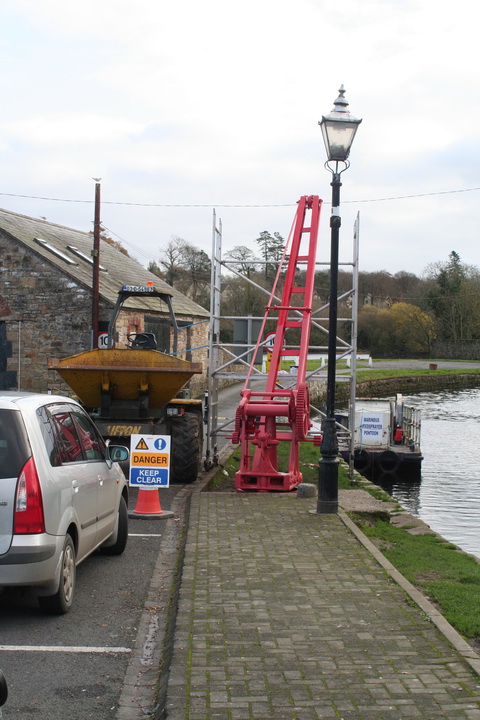
Old crane being painted


The Marindus weedspraying pontoon. This Marindus may be Marindus Engineering Ltd of Kilmore Quay, Co Wexford

Errina

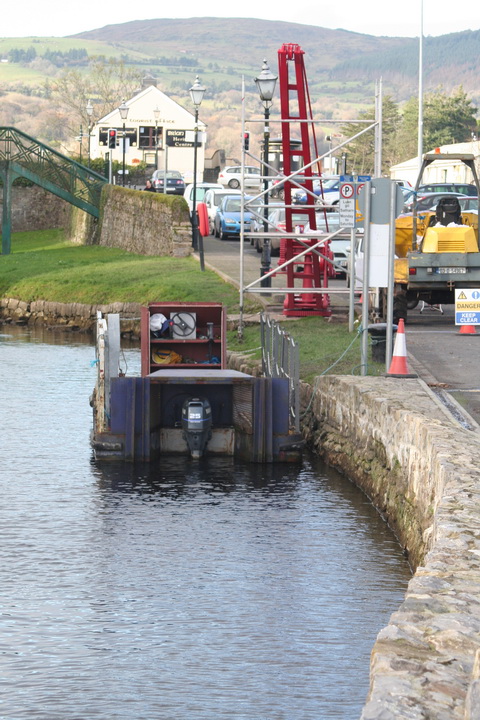
Waterways Ireland has parked a canteen trailer and some pontoons at Errina Bridge.

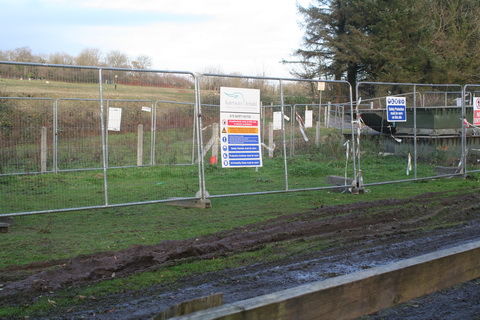
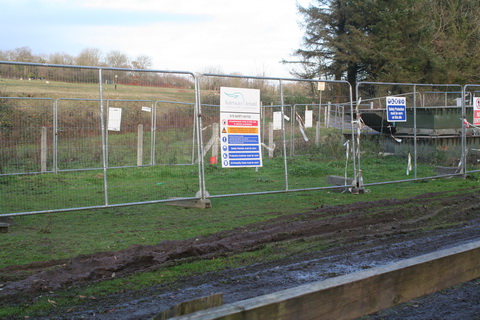
The compound, with Official Notices signed Rabbit

Pontoons

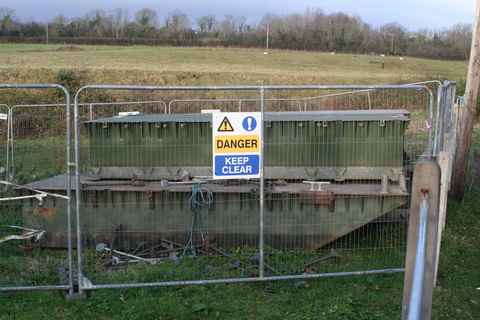
The canteen trailer


Another view of the canteen trailer

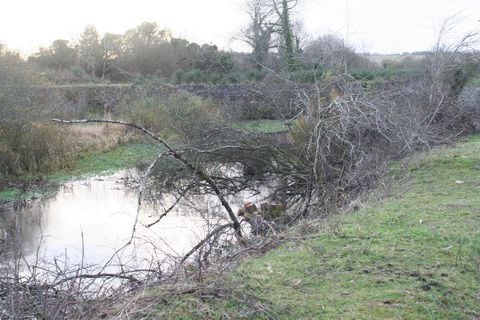
Evidence of tree cutting above Errina Lock, but that may not have anything to do with Waterways Ireland

The guardians of the lock


The Park Canal

I wrote here about the Park Canal and why it should not be restored. I did not include, because I had not then seen it, a link to this report in the Limerick Post. It shows why the gates on the second lock were not replaced. The core problem is that the banks in the upper section of the canal slope too steeply to be stable.

The slope of the banks above the railway bridge (from a boat)

Happily, this deficiency in the original construction has saved us from another foolish restoration.


The end of a ghost

In the UK, the Statute Law Repeals Bill is working its way through the House of Lords. You can download a PDF list of the bills being repealed. In amongst the turnpikes, Indian railways, benevolent institutions and lotteries, we find Part 4: Ireland (Dublin City). Within that, Group 1 sees the repeal of these statutes:

  • 3 & 4 Will.4 c.cxv (1833) (City of Dublin Steam Packet Company Act)
  • 6 & 7 Will.4 c.c (1836) (Dublin Steam Packet Act)
  • City of Dublin Steam Packet Company’s Act 1860 (23 & 24 Vict. c.xcviii)
  • City of Dublin Steam Packet Company’s (Consolidation of Shares) Act 1861 (24 & 25 Vict. c.iii)
  • City of Dublin Steam Packet Company’s Act 1868 (31 & 32 Vict. c.xxx)
  • City of Dublin Steam Packet Company’s Act 1876 (39 & 40 Vict. c.xi)
  • City of Dublin Steam Packet Company’s Act 1884 (47 & 48 Vict. c.cxxx)
  • City of Dublin Steam Packet Company’s Act 1895 (58 & 59 Vict. c.cxxiii)
  • City of Dublin Steam Packet Company’s Act 1910 (10 Edw.7 & 1 Geo.5 c.vii)
  • City of Dublin Steam Packet Company’s Act 1916 (6 & 7 Geo.5 c.viii)
  • City of Dublin Steam Packet Company’s Act 1920 (10 & 11 Geo.5 c.i).

In a Consultation Paper published in 2008, the Law Commission explained:

The City of Dublin Steam Packet Company was founded by Charles Wye Williams in 1822. From 24 January 1839, the Post Office contracted the company to run the mail service from Dublin to Holyhead. This service was later extended such that the company ran both the day and night service.

During the First World War the company suffered heavy losses, including the sinking of its ship the R.M.S. Leinster by a German submarine on 10 October 1918, resulting in a loss of over 500 lives. A further two ships were sunk during this period. The company never fully recovered from its wartime losses and, in 1924, an order for the winding-up of the City of Dublin Steam Packet Company
was petitioned for and granted by the High Court at Dublin Castle.

In Ireland, the Statute Law Revision Act 2009 repealed the 1833 and 1836 Acts and the Statute Law Revision Act 2012 repealed all the rest — except the 1895 Act. I don’t know where to get a copy of that Act, so I don’t know why it was specifically retained. But, with that exception, it seems that the ghost of the CoDSPCo has been laid to rest.


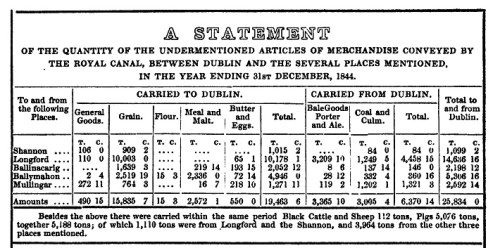
Royal Canal traffic in 1844

Royal Canal traffic in 1844 (Salt)

That table is extracted from Samuel Salt’s Statistics and Calculations essentially necessary to persons connected with railways or canals; containing a variety of information not to be found elsewhere 2nd ed Effingham Wilson and Bradshaw & Blacklock, London 1846, available from Messrs Google here.

The interesting point is how little of the Royal’s traffic travelled the whole way from the Shannon to Dublin or vice versa: only about 5% of the Dublin-bound traffic and less than 3% of the traffic westward.

Another point of interest is that traffic to Dublin was three times the traffic from Dublin.

Amongst the livestock, pigs were the dominant animals: they lost too much condition if they were walked long distances, which was the only alternative to canal transport before the railways came. Even there, I suspect that much of the tonnage described as “from Longford and the Shannon” was actually from west of the river, in Counties Mayo and Roscommon.

Boating off piste

Coast Guard rescue between O’Briensbridge and Clonlara.