Category Archives: Drainage

Maureen O’Sullivan asks sensible questions …

I am happy to report that Maureen O’Sullivan TD [Ind, Dublin Central] asked some sensible written questions in the Dáil on 15 January 2014.

Under the rather odd heading “Waterways Ireland Remit“, she asked Jimmy Deenihan [FG, Kerry North/West Limerick; Minister for the City of Culture]

[…] if he will include work on land maps to determine what land abutting the canals is owned privately, by Waterways Ireland, the Railway Procurement Agency, Iarnrod Éireann, Dublin City Council, Office of Public Works or other; and if he will make a statement on the matter.

The minister replied:

I am informed that Waterways Ireland already has an ongoing programme to modernise historic canal ownership maps and register navigation property in its ownership.

She put another question to Jimmy Deenihan under the same heading; you can see the link between the two questions:

[…] having regard to the prospective re-opening of the Royal Canal towpath at Portland Place in Summer 2014 further to the refurbishment of the collapsed wall at Portland Place and having regard also to the Spencer Dock Greenway Project and the re-lining works to be carried out at the sixth level, if he will direct Waterways Ireland to commission a strategic environment assessment for a new canal-side walkway along the south side of the sixth level of the Royal Canal at Phibsborough from Shandon Gardens to the railway bridge at the seventh lock with a new pedestrian crossing (details supplied); and if he will make a statement on the matter.

The only problem with this is that even getting an environmental assessment done is likely to strain WI’s budget at the moment, so it’s not a good time to be suggesting new expenditure. However, it didn’t matter in this case, as Jimmy Deenihan explained:

I am informed by Waterways Ireland that it does not own the lands on the southside of the Royal Canal between Shandon Gardens and the 7th lock, at Liffey Junction and therefore will not be commissioning a Strategic Environment Assessment for a new canalside walkway.

She also asked Alan Kelly [Labour, Tipperary North] about that:

[…] noting that it is the intention of the National Transport Authority to pursue a cycling and walking greenway along the Royal Canal in Dublin city, if he will ask Iarnród Eireann, the Railway Procurement Agency and Dublin City Council to assess the viability of opening a new walkway along the Royal Canal, 6th level, from Shandon Gardens to the 7th lock with a new footbridge at the 7th lock railway crossing linking to the existing Greenway route; if, in particular, this option will be explored alongside any re-lining work that might be undertaken by Waterways Ireland along that level.

He said:

The development of walking and cycling facilities within the Greater Dublin Area is a matter for the National Transport Authority (NTA) in conjunction with the relevant local authority, which is Dublin City Council in this case.

The NTA provides funding to local authorities for a range of schemes to benefit pedestrians, including new walkways, under the Sustainable Transport Management Grants Programme. Accordingly, I have sent your request to the NTA and have asked them to reply to you directly in relation to the above matter.

I’m all in favour of getting money from other people to pay for waterways.

Finally, under the heading of Inland Waterways Development, she had another question for Jimmy Deenihan:

[…] if he will explore all possible options within current fiscal constraints to advance and develop the potential of the Royal and Grand canal lines that pass through Dublin city; if he will establish an inter-agency group on the Dublin City reaches of the Royal and Grand canals; if he will explore ways to advance their development, examining funding options, including existing funding streams and the leveraging of funding from other sources and the possibility of EU funding which may be available.

I might say at this stage that I don’t see why TDs are asking ministers about stuff that they could find out themselves by asking WI directly. It’s not as though they’re going to get a lot of favourable publicity by doing so: this isn’t the PAC grilling a hospital or charity board and the meeja aren’t really interested.

Anyway, Jimmy Deenihan replied:

As the Deputy may be aware, the Dublin City Canals Study [PDF] was launched on 20th July 2010. This was prepared by consultants on behalf of Waterways Ireland, Fáilte Ireland, Dublin Docklands Development Authority and Dublin City Council. The study examined the existing activities on the Royal and Grand Canals and identified an overall vision for the development of the City Canals within the M50. I am advised that following on from the study an Operations Liaison Group plus two sub-groups (one for the Royal Canal and one for the Grand Canal) were established and continue to meet to deliver the recommendations identified, within the current fiscal constraints.

I am informed that to complement the above study, Waterways Ireland engaged additional consultants to carry out a detailed study of Grand Canal Dock and Spencer Dock with the objective of producing a Master Plan, currently at draft stage, that realises their potential as a recreational amenity and a living, vibrant part of Dublin and its Docklands. Waterways Ireland will continue to work collaboratively to unlock the pivotal role of these two major docks and to attract funding to develop a maritime quarter within the city of Dublin.

I wasn’t very impressed by the Dublin City Canals Study, which didn’t seem to me to be rooted in actual conditions in Dublin. I will look forward to seeing the master plan for the two dock areas.

Anyway, that was a more sensible set of questions from Maureen O’Sullivan, and it kept her off the subject of Effin Bridge.
Lough Derg floods: a book

If you happen to have €1400 or so to spare, you could buy Henry Trench’s 1879 book called Shannon Floods. Lough Derg level. The 25 Miles North from Killaloe with a double-page map and seven coloured plates. I have no connection with the seller — and no €1400 either, so I won’t be buying it.

Clashganny Lock on the Barrow

I would be grateful if anyone could explain the holding tank at Clashganny. Waterways Ireland’s water-level gauge [Flash thingy; takes ages to load] at Clashganny is named “Clashganny Holding Tank”.

A threat to an existing navigation

I have a page here about the River Maigue, one of Ireland’s oldest improved navigations. Incidentally, the river’s name is locally pronounced Mag, to rhyme with bag.

In 2009 I wrote to the Powers That Be to suggest that the (much to be desired) bypass of Adare, a major bottleneck on the N21 Limerick–Tralee/Killarney road, should pass to the south of the town, thus avoiding the interference with the navigation that would undoubtedly have resulted from a northern bypass. It was no doubt the strength of my case, and a recognition of the importance of the navigation, that caused the Powers to opt for a southern bypass. A proposed link to a proposed M20 Limerick–Cork motorway may have been a minor factor in their decision: as nobody was going to build a motorway to Kerry, Adare would piggyback on the motorway to Cork.

However, An Bord Pleanála overturned the decision [PDFs available here] because the M20 proposal was withdrawn. The Irish Cattle and Sheep Farmers’ Association is pleased because it wanted a northern bypass of Adare, to be linked to a new road from Limerick to the port of Foynes; its submission on the matter is here [PDF]. A Limerick ICSA chap has a letter to the editor about the Foynes link in the current issue of the Limerick Leader, although it’s not yet available online.

Now, this proposal has the drawback that it might actually be slightly sensible: a better road to Foynes might stop people agitating for a restoration of the railway line and enable a speedy ending of port activities in Limerick, thus removing large piles of scrap from the riverside. But have the ICSA not considered the damage to the turf-boat traffic to Adare if a road bridge is added to the railway bridge downstream of Adare?

Erne

As I understand it, the level of Lough Erne, and the occasional need to use its only lock, at Portora, are both determined by the operations of the Lough Erne hydroelectric scheme, although most of the lake, and the lock, are in Northern Ireland, while the hydroelectric stations, at Cliff and Cathaleen’s Fall, are both in the republic. The Erne scheme is less well known, and has been less often written about, than the Shannon scheme at Ardnacrusha, so it is good to note that two Ballyshannon men, Dessie Doyle and Brian Drummond, have written a book about the Erne scheme.

Unfortunately it is not clear from Messrs Lilliput Press’s website whether the book has already been published or is to appear some time in 2014. No publication date is given, but on the other hand it is not in the list of forthcoming books, but that list does not extend beyond November 2013. I would be glad to be able to carry reliable information, but I regret that I am unable to do so.

Draining Lough Derg

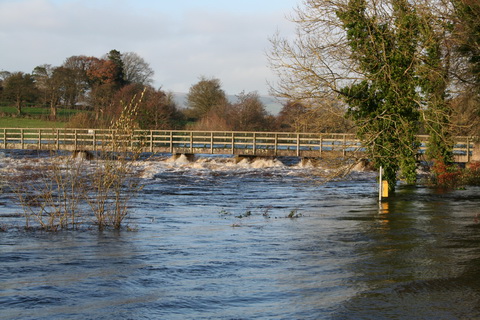
The ESB is currently letting more water down the old course of the Shannon, from Parteen Villa Weir through O’Briensbridge, Castleconnell and the Falls of Doonass. This channel gets the first 10 cubic metres per second from the Shannon; the next 400 go through Ardnacrusha and anything left over is sent down the old course.

The result is to help to reduce the water level on Lough Derg while raising it on the old course.

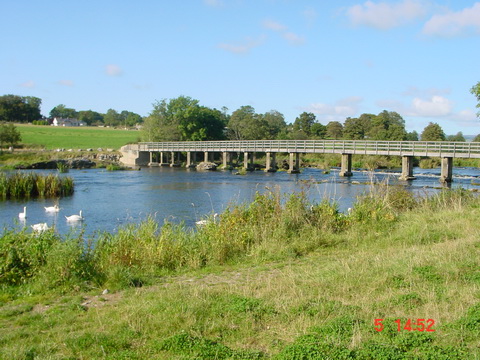
The footbridge in Castleconnell at normal summer level in 2002

The footbridge in Castleconnell at normal summer level in 2002

The footbridge on 1 January 2014

The footbridge on 1 January 2014

Before Ardnacrusha was built, the old channel took the entire flow of the Shannon, so it can take more than it has now.

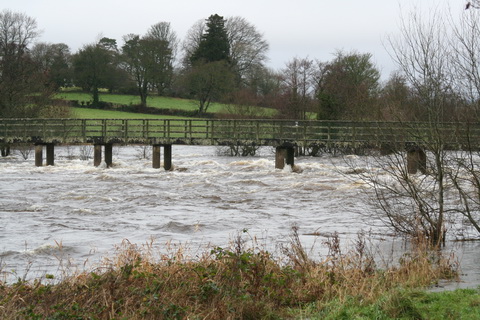
The footbridge in the floods of November 2009

The footbridge in the floods of November 2009

The level is still below that of 2009, when the land around the old channel flooded in several places. But much land is waterlogged: I saw yesterday that the upper reaches of the Nore, the Barrow and other rivers were in flood. And more rain is forecast.

Wouldn’t it be nice if some of that could be sent to Dublin instead? I see that some folk claim (on what looks like a website that hasn’t been updated for a while) that the evil Dublin folk want to extract 350 million litres of water from the Shannon every day; the original idea was to take it from Lough Ree but now it seems that Lough Derg is the preferred source.

Now 350 million litres sounds like a lot, but it’s 350 000 cubic metres per day, 14 583.3 per hour, 243.05 per minute, 4.05 per second, which is less than 1% of normal flow through the two channels draining Lough Derg. There’s a lot more at the moment, and the good citizens of Dublin are welcome to come down and fill their buckets. I suspect that Clare TD Michael McNamara has got things out of proportion.

Addendum: 350 million litres per day, over a lake whose area is 130 square kilometres, would lower the level of the lake (if my calculations are correct) by 2.69 millimetres. If no water entered the lake, the level would be down 983 mm after a year, ignoring evaporation and other abstractions and assuming that the Shannon and other tributaries no longer flowed in and that there was no rain.

Money from the bog

To a small extent reclamation is now going on in Ireland; Mr M’Nab, of Castle Connell, county Limerick, has reclaimed 80 acres of the worst red bog, devoid of vegetation and 20 feet deep. It was drained, then coated with the subsoil, and the land which was not worth 2s 6d per acre is now worth 30s per acre.

Thus Robert Montgomery Martin in his Ireland before and after the Union with Great Britain third edition with additions; J D Nichols and Son, London; James McGlashen, Dublin 1848.

I have written here about Mr Macnab (that was how the spelling settled down) and his talent for extracting money from the bog at Portcrusha, which is between Castleconnell and Montpelier, Co Limerick. It seems that his achievements are still remembered — and emulated.

Incidentally, in the same work, published in 1848, Mr Martin refers to the

… large practical mind, great experience,  and Christian philosophy …

of Sir Charles Trevelyan.

Sheughery

I wonder why Sinn Féin asks questions when it does. This one [h/t KildareStreet.com] seems to have been asked at a time that the minister might have welcomed.

Sandra McLellan [SF, Cork East]:

To ask the Minister for Arts, Heritage and the Gaeltacht the position regarding the Ulster Canal restoration project; the steps that must be taken to complete the project; the indicative timeline for the completion of the project; and if he will make a statement on the matter.

Jimmy Deenihan [FG, Kerry North/West Limerick] [the third para is the interesting one]:

As the Deputy will be aware, in July 2007 the North/South Ministerial Council (NSMC) agreed to proceed with the restoration of the section of the Ulster Canal between Clones and Upper Lough Erne. The then Government agreed to cover the full capital costs of the project, which were estimated at that time to be of the order of €35m.

It was always the intention that the Ulster Canal project would be funded from the Waterways Ireland annual allocations, as agreed through the annual estimates processes in this jurisdiction, as well as the deliberations of NSMC in relation to annual budgets. It was a key consideration throughout the process that the Ulster Canal project would be supported by a significant level of projected income from the commercialisation of certain Waterways Ireland assets. However, the economic downturn has had a negative impact on those plans.

I am continuing to explore all possible options to advance this project within the current fiscal constraints. In this regard, I established an Inter-Agency Group on the Ulster Canal to explore ways to advance the project and to examine possible funding options for it, including existing funding streams and the leveraging of funding from other sources. The Inter-Agency Group last met on 9th October and will meet again next week, on 9th December.

In the meantime, the Ulster Canal project is progressing on an incremental basis. Planning approvals have now been received for the project in both jurisdictions. Compulsory Purchase Order land maps are in preparation and consideration is being given to how the construction work and other technical aspects of the project will be structured once the necessary lands have been secured. The timeline for completion of the project will be determined when these preparatory steps have been completed.

I welcome these developments, which, I am sure the Deputy will agree, are a significant milestone for the project.

Hmm. The inter-agency group first met on 20 September 2012 and its second meeting was to take place in May 2013 or thereabouts. Now it’s going much faster, with meetings on 9 October and today, 9 December. Does this suggest that the group has found a pot of gold? Is there any link to the cancellation of SEUPB funding for the Narrow Water project?

And what has been going on in (and around) the North/South Ministerial Council? At its June 2013 meeting the Council approved or noted:

  • the business plan for 2012 (which had ended six months earlier)
  • the budget for 2012
  • the annual report for 2012
  • the draft accounts for 2012.

That suggests to me that there was either a major disagreement between the northern and southern ministers or a serious problem that rendered ministers unable to approve the WI budget and business plan until 18 months after the documents were required. Could it be that the northern minister, Carál Ní Chuilín [SF], like other NI politicians, had been looking for something from the waterways sector that hasn’t been delivered so far?

Note also that Jimmy Deenihan said

[…] consideration is being given to how the construction work and other technical aspects of the project will be structured once the necessary lands have been secured.

I understand that the design and construction of the Clones Sheugh was to be put out to tender but I wonder whether keeping the work in house might help WI to meet its increasing wage costs with a declining budget.


Setback for Sheugh

The likelihood that limitless wealth will result from the construction of the Clones Sheugh was reduced recently with the closure of the cruiser-hire base closest to the Ulster Canal: the Emerald Star (Le Boat) operation at Belturbet.

Perhaps, though, it reflects a wider decline in the hire business rather than disappointment at the delay in the canal’s reconstruction.

Levels

On 9 October 2013 minister Brian Hayes spoke in the Dáil about Shannon water levels, saying:

A meeting between the ESB, Waterways Ireland and the Office of Public Works to review the interim operating regime is due to take place shortly.

On 17 and 18 October 2013, in correspondence with Waterways Ireland, I learned that the meeting had not then taken place and that no date had been set. I have now sent WI another note asking whether the meeting has been held and, if it has, requesting a report on the proceedings and outcome.

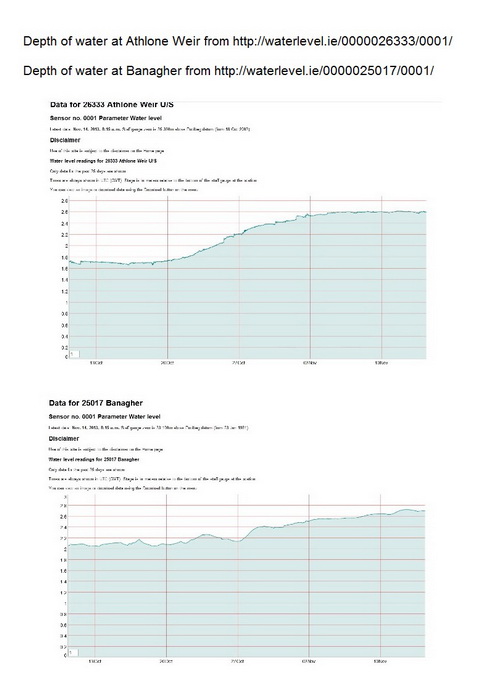
In the meantime, I have put together two charts nicked from waterlevel.ie for Banagher and Athlone:

Athlone and Banagher water levels

Athlone and Banagher water levels

Both of them show the levels for the last 35 days. I’m sure that more data and much more sophisticated analysis would be required to reach any reliable conclusion, but my untutored impression is that, in what has been a fairly dry autumn, keeping Lough Ree low didn’t do much to keep Banagher low. If that is so, and if I’m right in thinking that this autumn was dry (see below), the outcome would not show whether lowering Lough Ree would help in a very wet season; it may be necessary to repeat the experiment next year while performing rain dances. I would be glad, though, to have comments from more erudite folk and, if I get any information from TPTB, I’ll publish it here. In the meantime, this CFRAM PDF provides background reading.

On the dryness: Met Éireann’s monthly report for September 2013 is headed “Dry everywhere; warm and dull in most places” while that for October says “Rainfall was above average except in parts of the West, Northwest and North”. Its report doesn’t, AFAIK, specify any stations in the Shannon catchment (apart from Shannon Airport), but those to the west were generally below average while whose to the east were above; it may be that the Shannon rainfall was moderate.