
The water level on Lough Derg is very high, flowing over the guard lock at Killaloe.
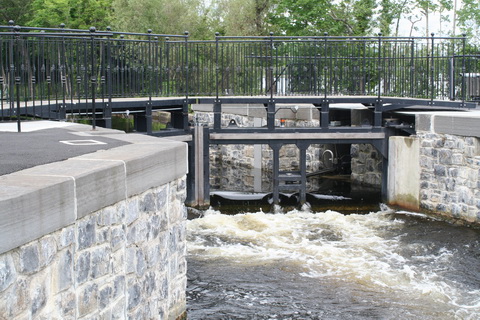
The water level on Lough Derg is very high, flowing over the guard lock at Killaloe.
Posted in Ashore, Built heritage, Charles Wye Williams, Drainage, Economic activities, Engineering and construction, Extant waterways, Industrial heritage, Operations, Restoration and rebuilding, Shannon, waterways, Waterways management, Weather
Tagged canal, Clare, floods, Ireland, Killaloe, Limerick, lock, Lough Derg, Shannon, water level, waterways, Waterways Ireland, weir
The old Limerick Navigation included a section of canal at Killaloe, with three locks. The uppermost, now disused, is still visible at Killaloe; the middle lock (Moys) is accessible by small boat; the third (Cussaun) is under water in the Flooded Area created by Parteen Villa Weir. The wall that divided the canal from the river downstream of Killaloe bridge forms an island whereon are the former eel-packing station run by the ESB, the former goods store (inhabited by Waterways Ireland) and the former marble mill (now an ESB engineering works). The island hosts the Killaloe market on Sunday mornings.
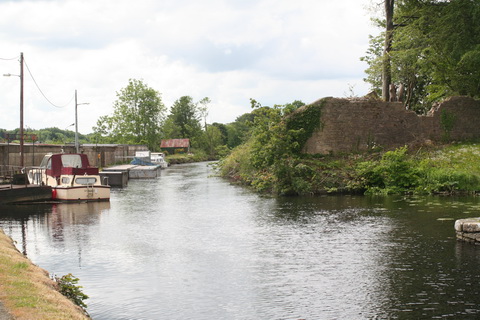
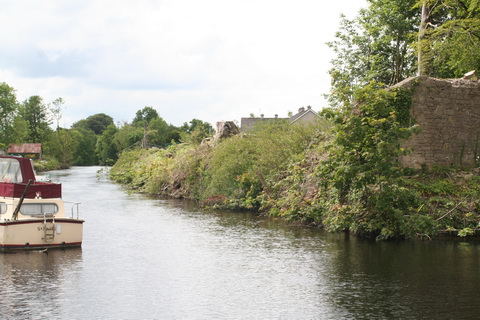
The curious can (obstructions permitting) walk a little further downstream to where the wall was breached, allowing boats to access the canal below the bridge without having to go as far as Moys Lock.

An obstruction

A section of the canal below the bridge in Killaloe ~1900 (OSI)

The west side of the canal, below the slip, was lined with trees.
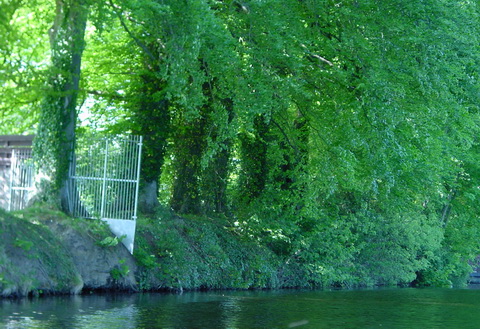
May 2008

May 2008

May 2008

November 2008

November 2008

November 2008, with homemade boat shelter
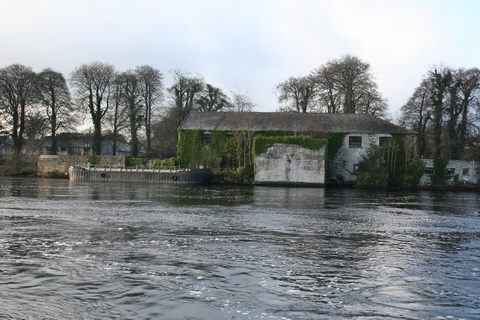
The trees behind the marble mill: seen from the far side of the river in December 2009
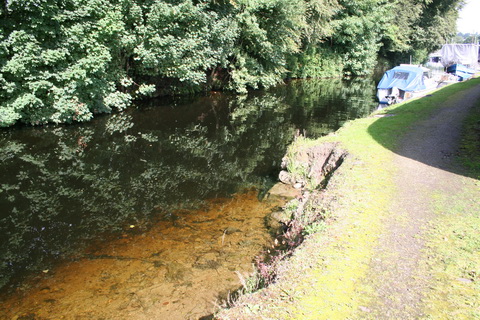
August 2010

A fallen tree blocks the canal in December 2010

April 2011

April 2011

November 2011

November 2011

November 2011
MARINE NOTICE No. 86 of 2011
Shannon Navigation
Lough Derg
Killaloe CanalCanal Maintenance – Tree Cutting
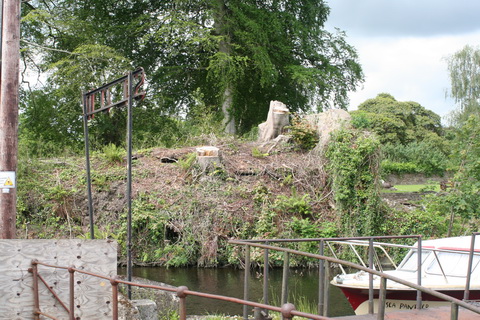
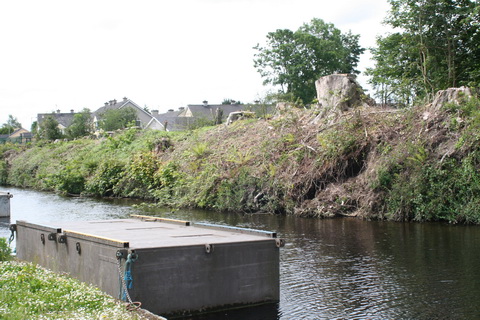
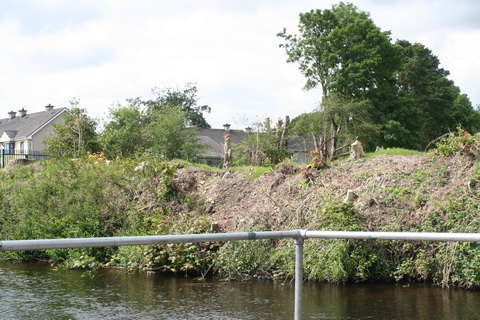
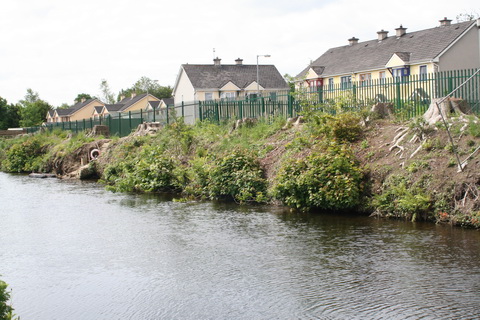
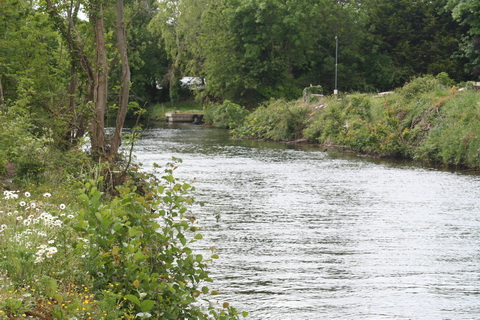
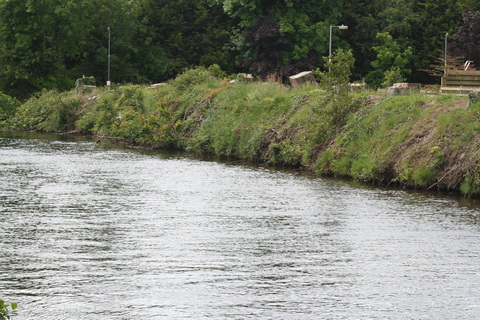
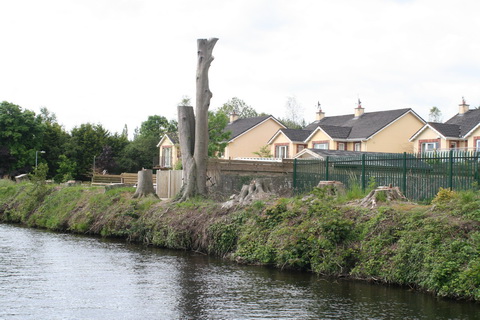
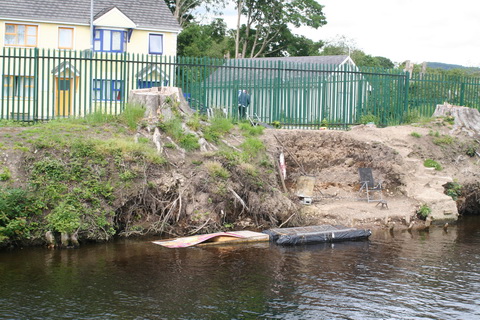
Waterways Ireland wishes to advise all masters and owners of vessels that tree cutting will take place along the Killaloe Canal banks from the vicinity of the cathedral downstream to the lower entrance from the river
Shannon, from Monday 19th Sep until about mid Oct.Access to this section of the canal will be closed during this period. […]
Marine Notice 24/2012 of 16 March 2012 said
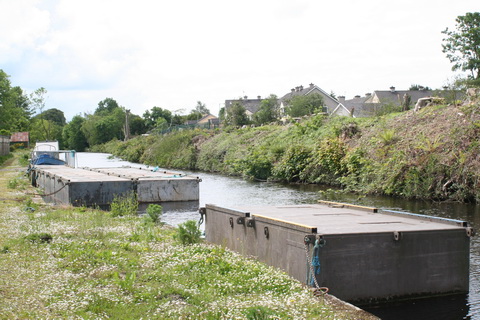
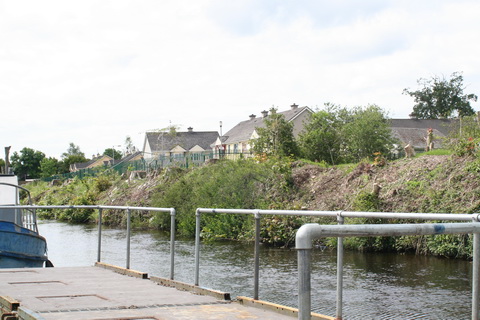
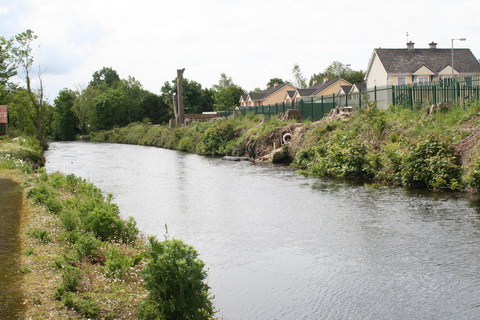
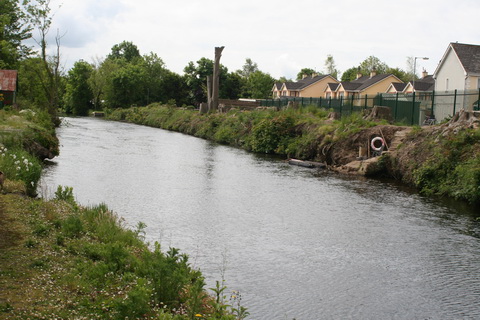
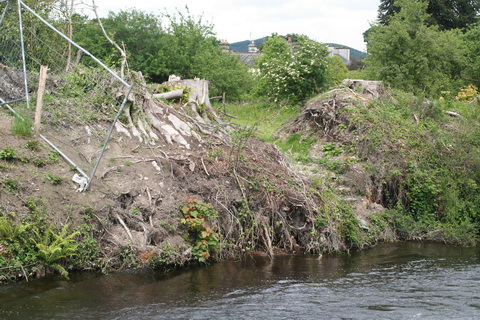
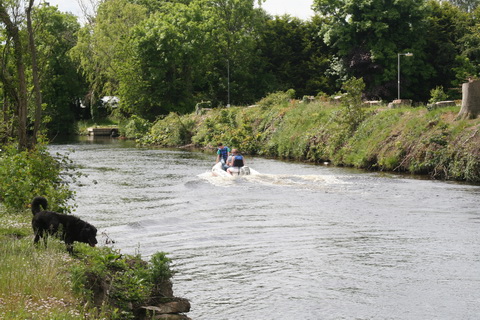
Works are still ongoing along the Killaloe Canal banks from the vicinity of the Cathedral downstream to the lower entrance from the river Shannon.
Access to this section of the canal will be closed until further notice.
That notice has not (as of 10 June 2012) been withdrawn so it must be assumed that the works continue.
The works photographed on 10 June 2012.
Posted in Ashore, Charles Wye Williams, Economic activities, Engineering and construction, Extant waterways, Industrial heritage, Ireland, Natural heritage, Operations, Scenery, Shannon, waterways, Waterways management
Tagged bridge, canal, Clare, ESB, Ireland, Killaloe, Limerick, lock, lost, Lough Derg, marble mill, Operations, quay, Shannon, trees, Waterways Ireland
The Met Éireann report [PDF] for spring (March to May) 2012 shows that rainfall measured at its Mullingar station was only 59% of the average for 1981–2010.
Watery news from the Guardian.
That is, of course, the Nenagh Guardian, not that other provincial stalwart the Manchester Guardian.
Four items in the issue of 2 June 2012 caught my eye.
First, the members of the Nenagh Canoe Club have been cleaning up … the Nenagh River, a laudable endeavour.
Second, a community project in Ballina (Killaloe’s oppo) “will see a new jetty with a thirty-year lease built on the site of the old Lakeside Marina”. The paper says that …
[…] Jim Watkins, Eoin Little and Cllr Phyll Bugler of “The Friends of the Lake” have now initiated a project, which will be funded by Leader.
I have no idea what it’s for; I would welcome more information about the project and about the Friends of the Lake, whereof I know nothing.
Third, the Lough Derg Marketing Strategy Group (which god preserve), which is coordinated by the Mid West Regional Authority (who knew?), is holding meetings about signposts. What would be really nice, though, would be if the MWRA took down the pic in its header showing adults and children in an open boat without lifejackets.
Finally, there’s a story about a proposed “fountain auditorium” planned for Birdhill [which was on the old N7, between Nenagh and Limerick, being chiefly famous for winning Tidy Towns competitions and being home to Matt the Threshers pub and eatery]. The “fountain auditorium” was, for reasons that are not entirely clear, to be a temporary operation, running until the end of 2016. It was to be located in a warehouse on the Shannonside Business Park (which is some miles from the Shannon).
The fountain auditorium was to have a pool 20m X 8m and “fountains capable of pumping water 9m into the air through more than 150 rotating nozzles”. The article says that
The proposed development is to serve as a tourist attraction centring on a fountain auditorium, in which audiences would be treated to pre-recorded shows marrying features of water, sound and synchronised lighting. The shows would have a “welcome to Lough Derg” theme, and the centre would provide visitors with information on the likes of walking and cycling routes, accommodation options, and food establishments, together with information on the history of Lough Derg.
It is not clear whether the words “fountain auditorium, in which” mean that the audience would be sitting in the pool or around it. The site was to have a “gift shop and café”. It expected to have 25,000 visitors in 2012 and 40,000 by 2016, after which it would move to permanent purpose-built premises with “a more comprehensive exhibition on Lough Derg”.
Alas! The proposed widening of the R494 road from Birdhill to Ballina, to serve the new bridge over the Shannon, would mean the loss of the space on which visitors’ coaches were to be parked. So, although the project received conditional planning permission on 16 May 2012, the promoters, Glance Promotions Ltd, withdrew their application shortly afterwards. However, that does at least suggest that they were not having any problem in providing the funding, which is good to hear in these difficult times.
* The relevance of the title of this piece will be clear to the many admirers of the oeuvre of the 4th Baron St Oswald.
Posted in Ashore, Economic activities, Engineering and construction, Extant waterways, Ireland, Irish waterways general, Operations, People, Politics, Restoration and rebuilding, Shannon, Water sports activities, waterways, Waterways management
Tagged Ballina, Birdhill, boats, canoe, fountain auditorium, Killaloe, Lakeside, lifejacket, Limerick, Lough Derg, marina, Matt the Thresher, Nenagh, river, Shannon, signposts, Tipperary, tourism, waterways
The Irish Times has a report here.
The Dublin People has the story.
Don’t those fluorescent colours look disgusting? Enough to give you a headache. Bring back the gas works, say I: at least they could cure whooping cough.
Posted in Ashore, Built heritage, Economic activities, Engineering and construction, Extant waterways, Industrial heritage, Ireland, Operations, People, Politics, Restoration and rebuilding, The turf trade, Water sports activities, waterways, Waterways management
Tagged boats, bridge, canal, Dublin, Grand Canal, Ireland, moorings, Operations, vessels, waterways, Waterways Ireland
According to this website it …
[…] had to represent an All-Island body, reflect its unique authority and represent its core values of Strength, Distinctive, Independent, Caring, Environmental and Connecting.
I can see that.
I wonder why only one of the values is a noun.
The Shannon traffic figures for the early part of the year need to be treated with caution. As at other times of the year, the figures show only vessels that passed through locks (and Portumna Bridge), so boats out on the lakes, or on the river between locks, will not be recorded. So the traffic figures don’t tell us the total amount of traffic; their main use is in showing trends from year to year.
The figures for the early months have a further disadvantage. Numbers of passages are low anyway and a single event — especially a weather event like floods, ice or gales — can have a major effect on winter and spring traffic, whereas the effect might be much smaller on the figures for the whole year.
I am grateful to Waterways Ireland for supplying the figures. I have them for each counting point, but won’t give all that detail here.
January 2012: 35
February 2012: 59
March 2012: 642
April 2012: 3316
Total: 4052
To put that in context, here are the figures from 2002 onwards:
| Year | J | F | M | A | YTD | 5YMA |
| 2002 | 10 | 6 | 1331 | 3528 | 4875 | |
| 2003 | 10 | 35 | 644 | 5515 | 6204 | 5157.4 |
| 2004 | 60 | 52 | 424 | 4768 | 5304 | 5524.6 |
| 2005 | 13 | 54 | 2162 | 3123 | 5352 | 5848.6 |
| 2006 | 37 | 55 | 591 | 5205 | 5888 | 5423.4 |
| 2007 | 42 | 85 | 698 | 5670 | 6495 | 5358.2 |
| 2008 | 28 | 44 | 1377 | 2629 | 4078 | 4991.0 |
| 2009 | 42 | 82 | 563 | 4291 | 4978 | 4849.6 |
| 2010 | 30 | 45 | 495 | 2946 | 3516 | 4363.o |
| 2011 | 48 | 66 | 512 | 4555 | 5181 | |
| 2012 | 35 | 59 | 642 | 3316 | 4062 |
The YTD column is Year To Date; 5YMA is a five-year moving average, which might remove some of the distortion caused by one-off events like ice and floods. I still wouldn’t read too much into four months’ figures, but the general trend is downwards.
Irish Times report on the oral hearing into the proposed abstraction of water from Lough Ennell. The hearing is scheduled for three days at the Mullingar Park Hotel and a decision is expected by 11 June 2012. The two cases are being heard together:
PW3005: Ladestown, Mullingar, Co. Westmeath.
Case Type: Provisional Order Water Supplies Act (Board Reference: PL25 .PW3005)
Description: Taking of a Supply of Water from Lough Ennell to Supply the Royal Canal.
and
JA0030: Kilpatrick Bridge and Clonsingle, County Westmeath.
Case Type: LA Non-Road development – Application (Board Reference: PL25 .JA0030)
Description: Royal Canal Water Supply Scheme from Lough Ennell, Ladestown.
Posted in Ashore, Built heritage, Drainage, Economic activities, Engineering and construction, Extant waterways, Industrial heritage, Ireland, Natural heritage, Operations, People, Politics, Restoration and rebuilding, Water sports activities, waterways, Waterways management, Weather
Tagged An Bord Pleanála, Ireland, Lough Ennell, Lough Owel, Mullingar, Operations, oral hearing, rain, Royal Canal, summit, water level, Waterways Ireland, Westmeath Councty Council


