Category Archives: Industrial heritage

Canal harbour, Limerick

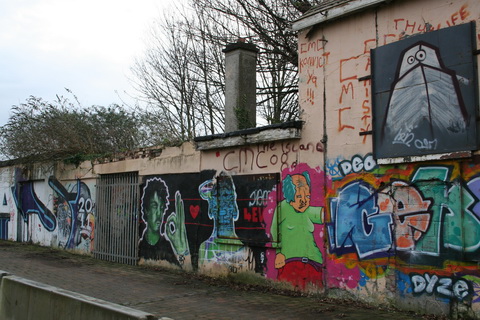
Went out without the camera today, alas, and found Waterways Ireland crews at work at the canal harbour in Limerick. One crew had launched a Pioner Multi (I didn’t see them do it, alas, but it may have come on the back of a truck with a HIAB or suchlike) and were hauling rubbish out of the water. Another were welding new railings to prevent access to the old hotel/canal manager’s house and installing a steel plate in a window aperture on one of the Shannon Navigation buildings.

I presume the new plate will soon be decorated. I rather like the artwork, I must say, and I think it a pity that Young Folk should not have somewhere to go to do the things that Young Folk like to do.

“It’s worth a bit of suffering to create some good memories”

… or why taking a boat into Dublin by canal, or to Limerick via Ardnacrusha, is a Good Thing, even if it’s a hassle at the time.

The surprising importance of the Shannon steamers in the 1830s

A short, lavishly illustrated talk in Killaloe Cathedral, Co Clare, at 6.00pm on Sunday 29 April 2012, as part of the Waterways Ireland Discover Killaloe and Ballina thingie.


A lock mystery

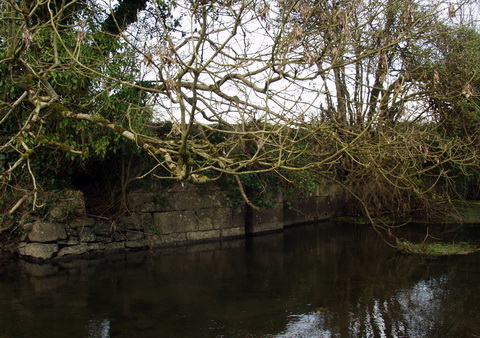
So what lock is this then?


Yes, it’s abandoned. Yes, it’s in Ireland.

The answer is here.

Drum on the Lagan

I was introduced to two places on the Lagan Navigation last weekend. The first was Drum Bridge; here is a page about it.

Sluices and streams

The heading shows I’m trying hard to find a waterways link for this ….

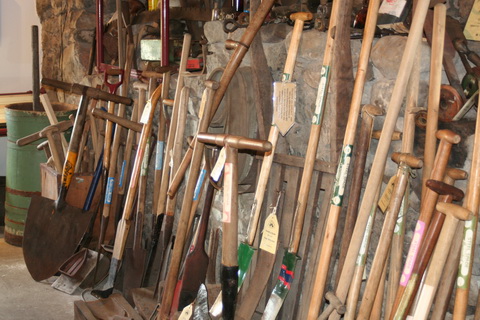
If you’re anywhere near Belfast, visit Patterson’s Spade Mill near Templepatrick on the Antrim Road. The IHAI visited it after the April 2012 AGM and it was quite fascinating. Did you know that there were once 171 different types of spades in use in Ireland, catering for different uses and different types of soils?

Some of the many types of old spades on display

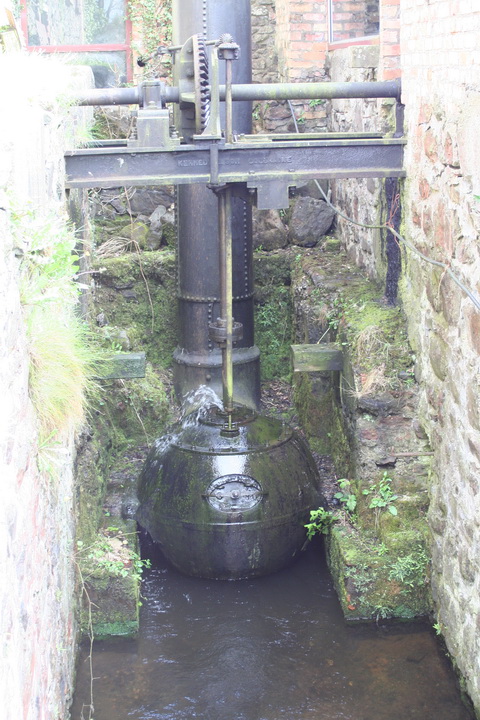
The mill is powered by water, using a turbine, and it’s the last water-driven spade mill in These Islands:

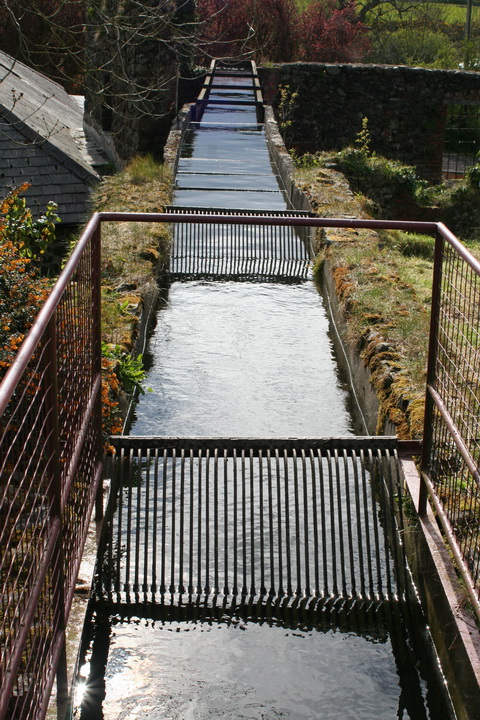
The channel taking water from the stream to the turbine. Part of the channel runs in a trough made by Portadown Foundry

The turbine

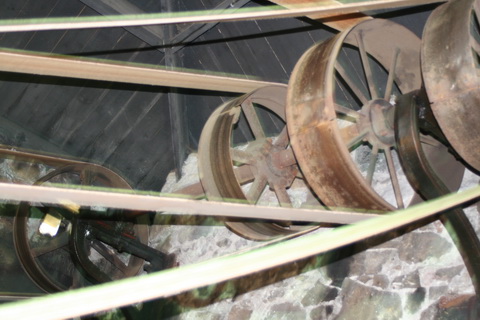
The turbine turns a shaft, which turns these wheels, and the belts power many of the machines in the mill

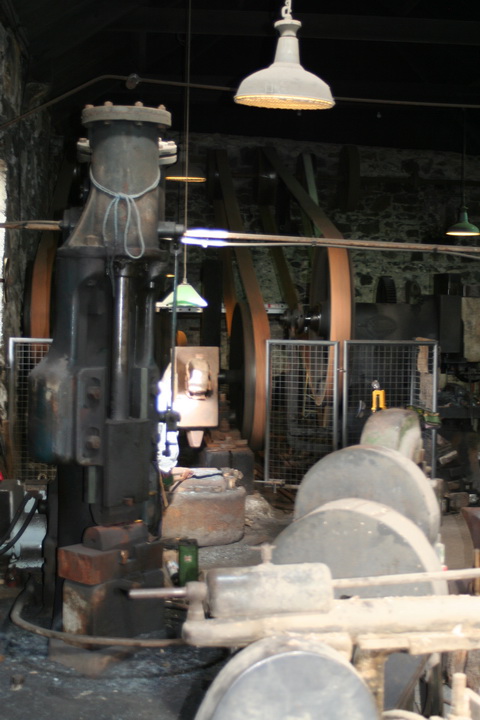
The water-powered trip-hammer towards the back

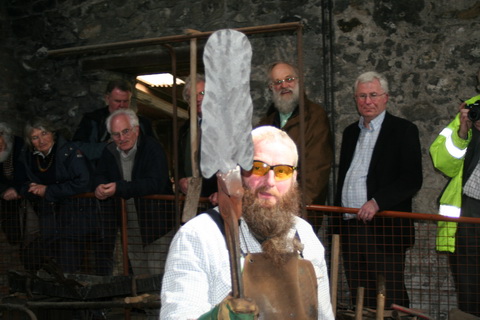
A spade after being hammered (just one of the many stages in its production)

The mill (which is original, not a reconstruction) is absolutely packed with machines and must have been a hellish place to work when in full production, with the heat from the furnace, the noise from the trip-hammer and several workers producing spades at the same time. The spade-maker above is one of the last six in Europe and really knows what he’s talking about: not just the process but the uses to which spades were put. The other guide, who took us around the other parts of the site, was also knowledgeable and helpful.

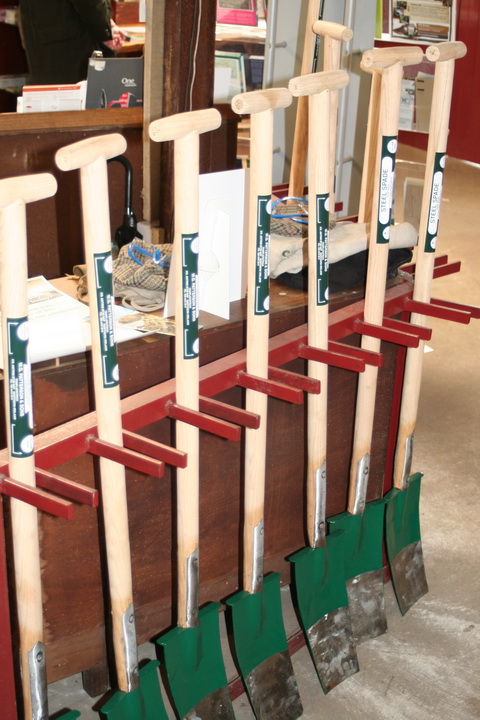
Some new spades

Highly recommended.


Skew arch bridges

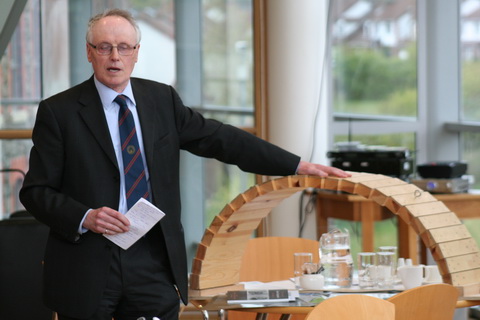
The IHAI AGM at the weekend, in Newtownabbey Borough Council’s splendidly restored Mossley Mill,  included a tour of the premises and its museum. Then Professor Adrian Long of Queen’s University Belfast gave a short talk about the FlexiArch bridge, which his team have been developing since the 1990s.

Professor Adrian Long with a wooden model of the FlexiArch bridge

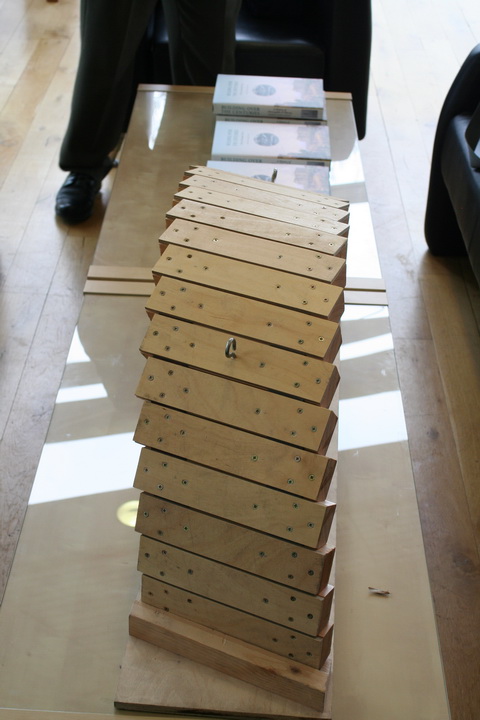
He said that their work started by asking why nobody built arched bridges any more; they developed a system that used pre-cast voussoirs (the wedge-shaped blocks) linked by a polymeric flexible membrane. The voussoirs for any bridge are cast to give the correct taper for the span and rise required for that bridge.

Arch rings arrive on site stowed flat on the back of a truck; when they are lifted off, they fall into the correct shape and are lowered into position on previously-installed footings. Each arch ring is 1m wide; several of them can be placed side by side to give whatever width is required. The end walls are added and the structure is filled and given the appropriate surface (eg tarmac).

FlexiArch is manufactured by Macrete of Toomebridge (beside Lough Neagh); their website shows several examples of installation including one at a name familiar on Irish waterways. There is a brochure [PDF] and there is a video showing the installation of a 15-metre bridge.

Wooden model as a skew arch

No, I haven’t any shares in it. I just thought it was interesting, for three reasons: first, the speed of construction is very impressive; second, there is a link to Lough Neagh; third, it might encourage the construction of more skew arch bridges over canals.


Dry docks

GRAND CANAL

At a Meeting of the Company of Undertakers of the Grand Canal, duly convened by public Advertisement, and held at the Company’s House in Dublin, on Monday, the 6th day of April, 1840,

WILLIAM MURPHY, Esq., in the chair,

The following Resolution, moved by James Pim, jun., Esq., seconded by James Dawson, Esq., passed unanimously in the afformative: —

Resolved — That the Court of Directors of this Company be authorised, if they shall see fit, to call the attention of the Government, of the Chamber of Commerce, of the Ballast Corporation, of the several Steam Companies, and of Capitalists generally, to the important advantages which the Grand Canal Company’s Floating and Graving Docks at Ringsend offer to all parties connected with the Shipping interests of the Port of Dublin, and to apprize them that this Company will at all times be ready to entertain any well considered proposition for increasing the general usefulness of these Docks, on the fairest and most liberal terms as regards the Public. Under the firm persuasion that by whatever well-arranged proceeding this important portion of the Company’s property can be best made available in increasing the Trade and promoting the prosperity of the City of Dublin, it will be rendered the most effectually conducive to the interests of the Company.

By order, JOHN McMULLEN,
Secretary of the Company.

From The Freeman’s Journal 8 April 1840.

Perhaps Waterways Ireland might follow the example of its predecessors and, rather than getting into bed with the DDDA, might consider some “well considered proposition for increasing the general usefulness of these Docks”.

 

The sluice house at Lough Owel …

… has had its windows broken. More on the Lough Owel Feeder here.

Dublin or bust

If you’re not already a reader of Barge Hawthorn’s blog, may I suggest that you start now? The account of the descent into Dublin along the Royal Canal, over three days, features mounting tension, a really superb photo of the M50 aqueduct and a happy ending when Effin Bridge lifted when required.

You can work your way backwards through earlier posts to find the how and the why.