Category Archives: Irish inland waterways vessels

News from the Suir

Some chap from Limerick has been quoted in the Nationalist (Clonmel) as supporting South Tipperary County Council’s proposed taking in charge of the towing-path between Carrick-on-Suir and Clonmel.

And Carrick-on-Suir River Rescue needs help raising funds to buy a premises.

Shannon Leisure Development Co Ltd

No, me neither, but it seems to mean CarrickCraft, which now has Marked Fuel Trader’s Licences for its bases at Banagher and Carrick-on-Shannon, thus swelling the host of the elect.

Project boat available

Suitable for conversion to comfortable houseboat. Needs work. Houseboat moorings now available at Shannon Harbour.

Dargan, O’Regan, steam and the Newry Canal

I wrote here about Simon O’Regan’s passenger-carrying screw steamer tried on the Grand Canal in Dublin in 1850. I am grateful to John Ditchfield for pointing me to an article about what happened next: steam trials on the Newry Canal in 1850, but this time with a lumber (freight) boat.

I would welcome more information about Simon O’Regan or about the use of steam power on the Newry Canal.

Across the wires the electric message came …

… “He is no better, he is much the same”, as the late poet laureate so well put it. Fuel supply on the Shannon is perhaps of less significance than the illness of one so elevated as a Prince of Wales (despite the Athlone connection), but “much the same” describes the list of holders of marked fuel [green diesel] traders’ licences: I see no change on the latest list.

Be very afraid ….

Just in from Waterways Ireland.

Waterways Ireland to Begin Enforcement of Mooring Bye-laws on Grand & Royal Canal and Barrow Navigation

Waterways Ireland will begin enforcement of the mooring Bye-Laws on the Barrow Navigation, Grand Canal and Royal Canal on the 19th March 2013. A Marine Notice will be issued on the 19th March to this effect.

The enforcement process will begin with non-permitted, sunken and abandoned boats already on the system. The first step in the process is notification. Continued non-compliance with the Bye-laws may result in the craft being removed from the navigation and stored at the owners cost.

A one year permit for passage and 5 day mooring costs €126. A year-long mooring permit for a single location costs €152. For boats already on the canal system, both permits must be applied for in advance of the 19th March 2013 and be on display on the boat by the 31st March 2013.

New boats visiting the Grand Canal, Royal Canal or Barrow Navigation for longer than 1 month may apply for the CMP in advance of arrival on the system and must apply for the Extended Mooring Permit as soon as they plan to remain for longer than five days in a single location.

The application process is simple using a form that can be downloaded from www.waterwaysireland.org or sent out by post from Waterways Ireland Tullamore (Tel no 057 9352300).

Waterways Ireland has extended the number of Authorised Officers, who under the Bye-laws have the authority to undertake enforcement.

More information is available from Shane Anderson, Assistant Inspector of Navigation: Tel no +353 (0)87 286 5726, Email shane.anderson@waterwaysireland.org .

Grand Canal Dock improvements

L & M Keating at work here.

Simon O’Regan -v- John Inshaw

Did Simon O’Regan attempt to preempt John Inshaw? Here is a page about O’Regan’s single-screw passenger steamer, demonstrated at Portobello on the Grand Canal in Dublin in 1850.

Henn, cheese, pickles and Guinness

An Affecting Charge

The following case lately came for trial before Mr Henn QC, the new Recorder of Galway:— George Hamilton, who for twenty-five years had been in the employment of the Midland Great Western Railway Company as station-master, was indicted for stealing from a hamper some goods, the property of Sir Arthur Guinness, which were addressed to Cong, in the county Mayo. For some time a course of pilfering had been carried on, and the directors, in order to find out who were the guilty parties, employed two Dublin detectives, named Stookman and Healy, who arrived in Galway on Aug 31st, and, concealing themselves in the goods-store in empty barrels, remained on the watch all night. About one o’clock next morning they heard a noise, and observed the prisoner entering the place. Having satisfied himself that he was unseen, he took out his penknife and proceeded deliberately to cut the cords of the hamper and extract some of its contents. The detectives waited until he had taken out a bottle of vinegar, a bottle of pickles, and some cheeses, and then tied up the hamper again. They then issued from their hiding-place and seized him. He begged them for God’s sake to have mercy on his wife and family, and to leave the matter between himself and the manager, but they refused to do so, and, having called the police, gave him into custody. About twenty witnesses were examined for the prosecution, and among them the clerk of the goods store, who swore that it had been locked and the key left with the prisoner.

Mr M’Laughlin QC appealed to the sympathies of the jury, and, pointing out some alleged discrepancies in the evidence, pressed them, if they had a doubt that the prisoner took the articles with a guilty intent, to give him the benefit of it.

The Recorder, in his charge, showed that the discrepancies only proved the truth of the charge, and expressed the deep pain he felt at seeing in such a position a man who had held a respectable position, with a salary of £300 a year, and had young ladies whom he saw in court dependent upon him. He finally burst into tears.

The jury retired, and after three hours’ deliberation returned into court and stated that there was no chance of an agreement. His worship sent them back to their room, and, after being absent for another hour, they brought in a verdict of not guilty, which the Recorder stated he could not endorse, but characterised as monstrous.

The Leeds Times 12 October 1878

The Recorder, Mr Henn, was the father of T R Henn and later lived in Paradise. Sir Arthur Guinness, a stout fellow, was a descendant of this chap and had a small holiday house at Cong on Lough Corrib, where his family had many boats.

The fear of Baal’s Bridge

In May 1895 the fear induced by the prospect of a passage under Baal’s Bridge, on the Abbey River in Limerick, as revealed in the commercial court in London before Mr Justice Mathew and reported by the Freeman’s Journal of 20 May 1895.

Arthur George Mumford of Colchester, Essex, was described as an agent, but was actually a marine engineer and manufacturer of steam engines. He owned a 25-ton steam yacht called Gipsy, which he decided to sell through Messrs Cox & King, the well-known yachting agents (their 1913 catalogue is here).

The buyer was Ambrose Hall, the man responsible for the statue of Patrick Sarsfield. A former mayor of Limerick, he was an alderman and a “house and land commission agent”; his address was given as Mignon House, Limerick, which I have not so far found.

Hall bought the boat for £500; it was to be delivered to him at Limerick. The original plan was to sail it around the coast of Ireland and up the Shannon estuary, but bad weather in late 1894 caused Cox & King to suggest taking it to Dublin and then down the Grand Canal and the Shannon to Limerick. Hall agreed; the boat left Dublin in January 1895. It reached Killaloe on 19 January and Limerick “a day or two afterwards”, where it was moored in the canal harbour.
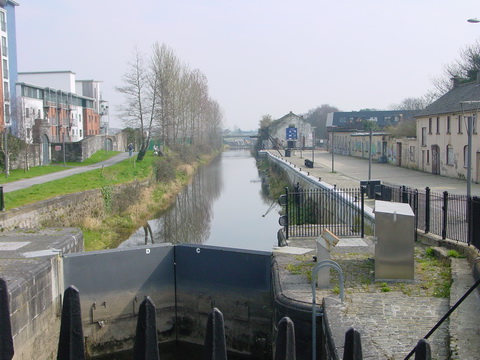
25 Grand Canal Harbour Limerick March 2007 01_resize

Canal harbour, Limerick in March 2007

Hall refused to accept the boat in the canal, saying that it should have been delivered to Limerick dock, a short distance downstream. Mumford and Cox & King sued him and the National Bank.
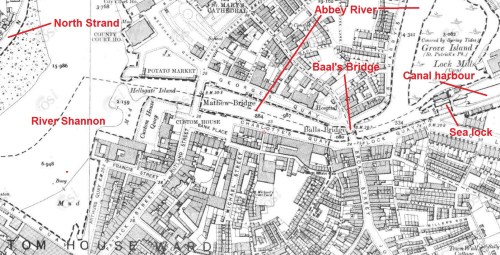
Hall and Baal

Ordnance Survey ~1900

Hall, an alderman and a former mayor, who had lived at North Strand, presumably knew the river and its difficulties.
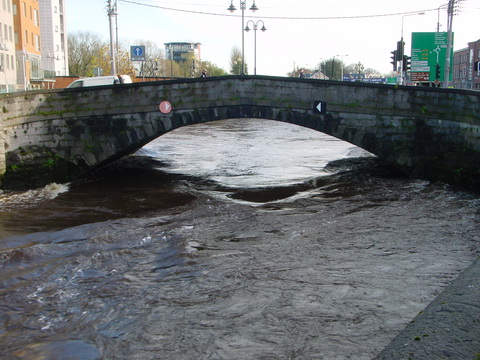
Baal's Bridge 20091128 1_resize

Baal’s Bridge looking upstream towards the canal harbour in the floods of 2009
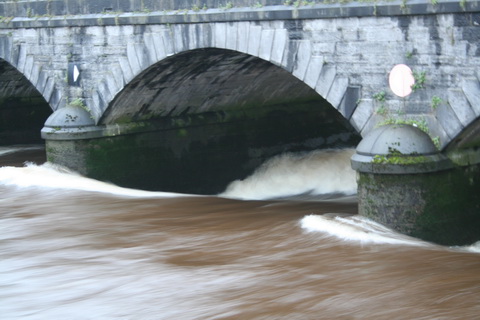
Navigation arch at Mathew Bridge 20091122_resize

The navigation arch at Mathew Bridge looking downstream in the floods of 2009

It was contended by the defendant that to get the vessel from the canal into the estuary of the Shannon there was a considerable risk involved. The passage was only a few hundred yards, but it was stated it could only be effected at certain states of the tide when it would be possible to get through Ballsbridge.

The judge sensibly suggested that it should be possible to insure the boat for the journey; the plaintiffs agreed to deliver it; Hall agreed to accept delivery and to pay £15 for the cost of the caretaker who had been looking after the boat since 23 January; the case was settled.

Clearly Ambrose Hall didn’t know Pat Lysaght.

My OSI logo and permit number for website