Category Archives: Irish waterways general

The end of an era

Ger Reid, the Ardnacrusha lockkeeper, retired at the end of December 2012. Ger has guided many boats through the locks over the years and has always been cheerful and reassuring as well as informative, helpful, reliable and competent. He will be sadly missed but I wish him well in his retirement.

Meanwhile, I have heard that Limerick City Council has decided not to renew Pat Lysaght’s contract for work on the river and has suggested that Waterways Ireland should retain him. Pat’s most important role, though, in assisting boats passing through Limerick (220 in 2012), has always been voluntary. Were Pat to cease to provide that service, I think the number of boats visiting Limerick would be greatly reduced.

Carrying on the Royal Canal

This is a point I’ve come across in passing. It’s not central to my main concerns so I won’t pursue it further for the moment, but I’m posting it here in case it helps anyone else researching the subject.

It will be recalled that, until the passing of the Canal Carriers Acts 1845 and 1847, most canal companies carried passengers but not freight on their own canals. After the passing of those acts, the Grand Canal Company set out to take over the bulk of the freight business on their own canal (and, in consequence, on the rivers connected thereto). But what of the Royal Canal, which had been taken over by the Midland Great Western Railway in 1845?

Ruth Delany, in Ireland’s Royal Canal 1789–2009 [with Ian Bath; The Lilliput Press, Dublin 2010], says on page 192:

In 1871, despite its failure to show a profit on the Grand Canal lease, the MGWR decided to try acting as carriers on the Royal, which had been permitted by legislation since 1845. Horse-drawn boats were used until 1875 when five steamers were purchased: Rambler, Rattler, Mermaid, Conqueror and Pioneer.

In a note, she says

For this period, 1849–1906, the principal source of information is found in the minutes of evidence to the Shuttleworth Commission, HC 1907 (Cd 3717), XXXIII, Part 1, 9.

Peter Clarke, in his The Royal Canal: the complete story (ELO Publications, Dublin 1992), says:

It is important to recall that at this time, the carriage of goods on the canal was undertaken by a number of boat owners who paid tolls to the railway company. The failure to have these tolls increased was what most probably prompted the railway company to establish themselves as carriers on the canal in 1870. […] Until 1876 an unknown number of railway owned horse drawn barges were used. In that year, the service was expanded when four new screw propelled boats were purchased at a cost of £5000.

His source is the Waterways Commission of 1923, Minutes of Evidence nineteenth day, p13.

Ernie Shepherd in The Midland Great Western Railway of Ireland: an illustrated history (Midland Publishing Ltd, Leicester 1994), says

The MGW decided to operare its own carrying trade in 1871 and this lasted until 1886. Horse drawn boats were used until 1875 when steamers were purchased.

On 15 August 1853 The Freeman’s Journal and Daily Commercial Advertiser of Dublin carried this notice in the Railways column.

Midland Great Western Railway (Ireland) Company — Royal Canal

Haulage of boats

The Directors will receive Proposals for the Haulage of their Trade Boats to and from Dublin and Longford and the River Shannon, from and after the 12th November next. Parties are at liberty to tender for a part or the whole of the work. Security will be required for the fulfilment of the Contract; and further particulars may be had on application at this Office.

Tenders to be sent in on or before 10th September next.

By order, Henry Beausire, Secretary.
Dublin Terminus, 10th August, 1853

This suggests that, in 1853, the MGWR had its own trade boats (lumber boats, freight-carrying barges) at work on the Royal Canal. It would be nice to know more. I have said before that we do not know anything like the full history of the Royal Canal.

Some new things arise

First, I’ve checked all the linked sites listed at the bottom of the right-hand column and removed some that have died. If you know of others to which I should provide a link, do please let me know.

Second, I’ve added a link to the excellent Grace’s Guide to British Industrial History, and I take the opportunity to draw it to the attention of folk interested in who made what. I have received much useful information from its volunteers and I have been able to contribute photos of a few artefacts. It’s well worth exploring. I have also added a link to the Railway and Canal Historical Society.

Third, I am glad to see that the Irish Times‘s conversion to the benefits of civilisation continues: yesterday it featured an Intel Pentium chip from 1994, which provided the basis for an essay on Ken Whitaker’s 1950s report, globalisation, television, women, Northern Ireland and Viagra. If only some more of the nineteenth century industrialists, entrepreneurs, engineers and modernisers had been covered.

That, fourth, reminds me that I came across a couple of interesting articles by Roy Johnston on the Victorian Web site: they’re under the heading Science, Technology, and Politics, on this page, which has several articles about Ireland. They include articles on whether Ireland was a colony, although I must confess that I have yet to be persuaded that that is a question in which I should take an interest.


Errina Bridge

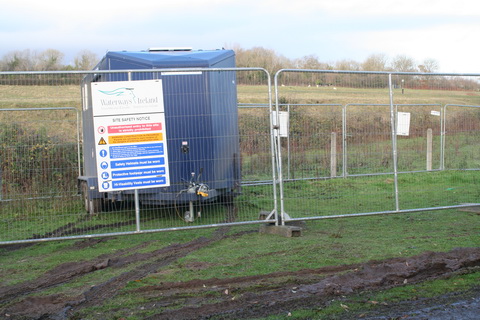
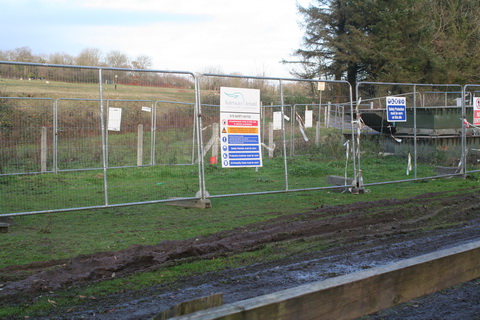
I remarked in November 2012 that Waterways Ireland had parked a canteen trailer and some pontoons at Errina Bridge, the uppermost bridge on the Plassey–Errina Canal, which is part of the old Limerick Navigation.

WI pontoons

WI pontoons

WI canteen

WI canteen

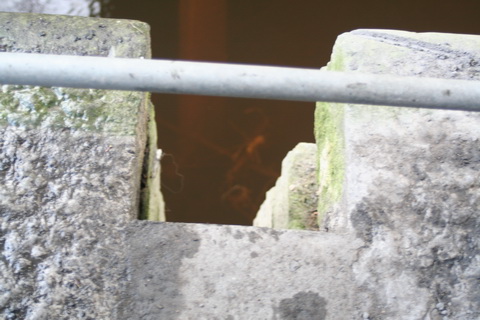
I wondered what was to be done; I noted that a stone at the top of one of the stop-plank grooves under the bridge had been removed (the stone on the far side was removed some time ago).

So I asked Waterways Ireland what was happening. They said:

The works in Clonlara are Flood relief works to protect Errina Lock from catastrophic failure. After the flooding in 2009, during which the dam in Errina Lock was overtopped by approximately 0.5 metres, it was decided to protect it from this happening again.

It has happened before too: in February 1809 the lock was destroyed by floods when heavy snows melted.

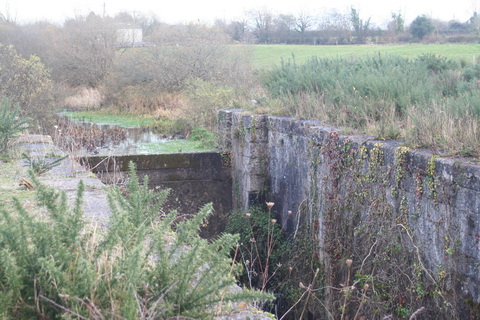
Errina Lock (looking upstream)

Errina Lock (looking upstream)

I asked WI about the nature of the works. They said:

Stop logs are to be put into the grooves under the bridge forming a dam with the same size opening as that in the concrete dam in Errina Lock. As for the stone which is removed to facilitate the installation of the timbers, this will be replaced once the timbers are in place.

That is good to know.

Errina Bridge stop-plank grooves (towing-path side, with uppermost stone removed)

Errina Bridge stop-plank grooves (towing-path side, with uppermost stone removed)

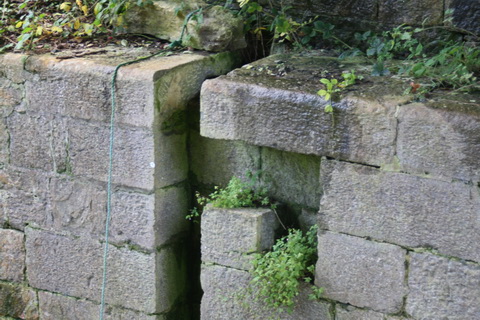
Errina Bridge stop-plank grooves (off side)

Errina Bridge stop-plank grooves (off side)

An authority on waterways has suggested that the curious shape of the grooves was designed to allow planks to be inserted from boats rather than from land.


Irish galleries please copy

I have often lamented the poor classification methods used by those who look after collections of paintings. They focus on the name of the painter, the date and the school to which he or she belonged, rather than on the really important facts: whether or not a painting shows a steamer, barge, canal or other object of industrial heritage interest. Thus, as I pointed out here, you get titles like “View looking down on a jetty and boats on a lake with a church in the distance” that ignore the most important aspect: that the pic shows a steamer on Lough Erne.

The other problem is that the paintings are in galleries scattered hither and yon, which means that a serious search for steamers, barges and canals would require hours of driving followed by hours of rummaging through archives, even though each pic would require only a few seconds’ attention to determine whether or not it is worthy of notice. The cost-benefit ratio is all wrong, but the use of technology can solve the problem.

I was delighted therefore to learn that, in HM Realm, the BBC and the Public Catalogue Foundation have put online tagged images of [almost] all the 200,000+ oil paintings in public ownership in the UK at the Your Paintings site. The collection is searchable: the search will return artists, painting titles and tags. And you can help by adding tags, if you have more information about a painting.

There is not much of Irish waterways interest, which is scarcely surprising, but there is an interesting illustration of the use of a pole on the Lagan [I’d welcome comment on what’s happening in that pic] and the barge at Edenderry. There is also some material for steam men.

It would be nice if Irish galleries would now do the same. The cost could be met by selling off the originals, which would no longer be necessary, and closing the galleries, at a saving to the public purse.

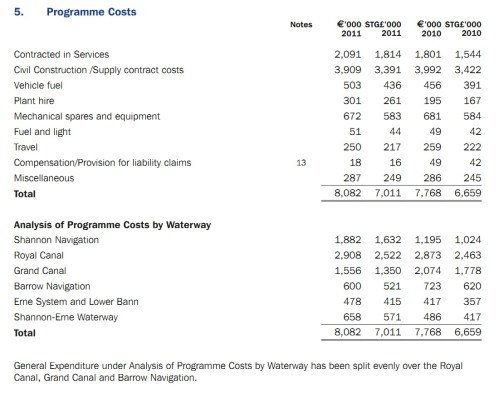
WI programme costs

From WI's annual report for 2011

From WI’s annual report for 2011

Note that programme costs do not include staff costs, as the income and expenditure account for y/e 31 December 2011 makes clear.

From WI's annual report for 2011

From WI’s annual report for 2011

The most startling thing in the programme costs is that Shannon costs have increased 57% while Grand Canal costs have decreased by 25%. I presume that the change is in the Civil Construction/Supply contract costs, as the other items don’t seem to have enough scope for such large changes. It would be interesting to know what the contracts were. The accounts of Grand Canal improvements on pages 12 and 16 don’t suggest any diminution in activity, although they are not specific enough to be definitive; the account for the Shannon on page 17 mention some new undertakings, of which the most significant was perhaps the new mooring at Killaloe, whereof the Chief Executive said in the Foreword:

From WI's annual report for 2011

From WI’s annual report for 2011

And so, I’m sure, say all of us.

But wouldn’t that be a capital cost? I can’t work out how the income and expenditure figures link to the activities covered in the descriptions of achievements.

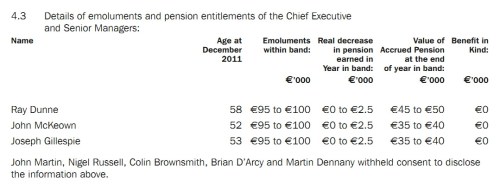
WI’s shy leaders

From WI's annual report for 2011

From WI’s annual report for 2011

WI staffing

From WI's annual report for 2011

From WI’s annual report for 2011

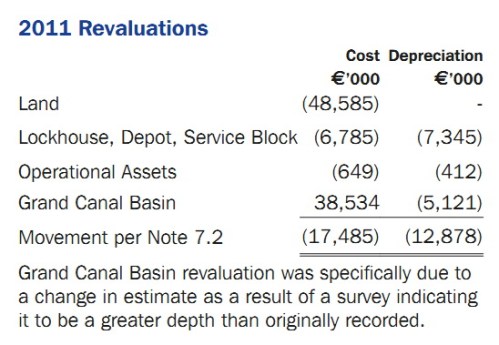
WI revaluations

From WI's annual report for 2011

From WI’s annual report for 2011

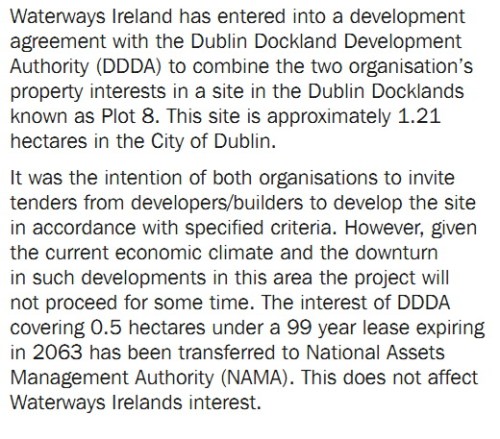
WI and NAMA

From WI's annual report for 2011

From WI’s annual report for 2011