
Request submitted to Waterways Ireland:
I would be grateful if you could tell me how many bids you received for these moorings, how many you accepted and what the lowest and highest accepted bids were.
Request submitted to Waterways Ireland:
I would be grateful if you could tell me how many bids you received for these moorings, how many you accepted and what the lowest and highest accepted bids were.
Posted in Ashore, Economic activities, Engineering and construction, Extant waterways, Ireland, Irish inland waterways vessels, Irish waterways general, Operations, waterways, Waterways management
Tagged boats, canal, Grand Canal, houseboat, IRBOA, Ireland, moorings, residential, Shannon, Shannon Harbour, waterways, Waterways Ireland
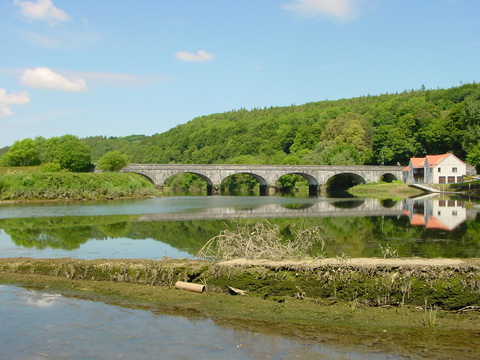
The road bridge in Cappoquin
The redoubtable F E Prothero, Rear-Commodore of the Cruising Club, wrote just over three pages about the Blackwater, from Kanturk down to the sea, in A New Oarsman’s Guide to the Rivers and Canals of Great Britain and Ireland edited by F E Prothero and W A Clark and published by George Philip and Son, London, in 1896, as a Cruising Club Manual.
Here is a PDF of the relevant pages. I have also put a link to the PDF on my page about the Blackwater, Bride and Lismore Canal.
Posted in Ashore, Built heritage, Economic activities, Engineering and construction, Extant waterways, Forgotten navigations, Industrial heritage, Ireland, Irish inland waterways vessels, Irish waterways general, Natural heritage, People, Scenery, Sources, Steamers, Tourism, Water sports activities, waterways, Waterways management, Weather
Tagged Blackwater, boats, Bride, bridge, canal, Cappoquin, F E Prothero, Ireland, Lismore, lost, M V Maeve, Tony Galagher, vessels, waterways, Youghal
I’m sure this is good news, but I have no idea what it is about. Has it to do with GPS or other newfangled gadgetry? And does it apply only to WI’s data about its estate within Her Majesty’s realm?
There was an important debate in the Northern Ireland Assembly on this subject yesterday. While the salmon received much of the attention, the state of the Lough Neagh eel fishery was also discussed.
Posted in Economic activities, Engineering and construction, Extant waterways, Foreign parts, Ireland, Irish inland waterways vessels, Irish waterways general, Natural heritage, Operations, People, Politics, The fishing trade, Tourism, waterways, Waterways management
Tagged eels, fisheries, Ireland, Lough Neagh, Northern Ireland Assembly, salmon, waterways
The joint communiqué issued after the last North–South Ministerial Ccouncil Inland Waterways Meeting, held on 14 February 2012, is available for download here [PDF]. Perhaps the most important part is the set of four recommendations from the review of Waterways Ireland under the St Andrews Agreement:
ST. ANDREWS REVIEW – WATERWAYS IRELAND RECOMMENDATIONS
6. The Council considered four specific recommendations concerning Waterways Ireland and agreed to refer the following recommendations for endorsement to the June 2012 NSMC Plenary:
– Sponsor departments to consider options around the setting up of a Board comprising less than twelve members and to present proposals for consideration at a future NSMC Inland Waterways meeting;
– Sponsor departments to implement as appropriate, through changes to the legislation or other administrative means, a de minimis provision for dealing with Waterways Ireland disposal of a waterway or part of a waterway;
– Sponsor Departments to review the current provisions in relation to Waterways Ireland’s commercial activities to ensure that these are adequate and to report to a future NSMC Inland Waterways meeting; and
– taking account of the current economic and fiscal circumstances, no further action is taken at this time to extend the remit of Waterways Ireland.
Given that British Waterways is to become a trust, with various user representatives on its board, it is hard to see why Waterways Ireland should have no board. I was not convinced by the reasons that Éamon Ó Cuív TD gave me when I asked him about it some years ago.
The Limerick Post has news here.
Posted in Built heritage, Economic activities, Engineering and construction, Extant waterways, Irish waterways general, Operations, People, Politics, Shannon, Tourism, waterways, Waterways management
Tagged boats, bridge, Clare, dredging, flow, Ireland, Killaloe, Limerick, lock, Lough Derg, Operations, Shannon, vessels, waterways, Waterways Ireland, workboat
Nice PQ from Éamon Ó Cuív here:
Éamon Ó Cuív (Galway West, Fianna Fail). Question 446: To ask the Minister for the Environment, Community and Local Government if Waterways Ireland will have to pay for the abstraction of water for use in the Royal Canal, the Grand Canal, the Shannon-Erne Waterway and other man-made waterways as a result of the reasoned opinion from the European Union in November 2011; the reply sent by him regarding same to the Union; and if he will make a statement on the matter. [8122/12]
Here is the European Commission’s press release on the subject.
Posted in Drainage, Economic activities, Engineering and construction, Extant waterways, Ireland, Irish waterways general, Non-waterway, Operations, Politics, Shannon, Sources, waterways, Waterways management
Tagged abstraction, Éamon Ó Cuív, canal, Grand Canal, Ireland, Royal Canal, Shannon-Erne Waterway, use, water, waterways, Waterways Ireland
In December I posted a piece suggesting that the amount of money received by the Revenue Commissioners in Mineral Oil Tax was far below what it should be. New readers may wish to know that, under an insane system introduced by the Irish government to give the impression of complying with a European Union ruling, owners of private pleasure-craft are allowed to buy cheap green (rebated) diesel (marked gas oil) but are supposed to pay to the Revenue the difference between the amount they paid at the pumps and the amount that would have been paid without the rebate. This difference is called Mineral Oil Tax.
Having discovered the total amount received by the Revenue, and deduced from that the number of litres on which the tax was paid, I wrote:
Let us suppose, for the sake of argument, that the average pleasure craft has a 40hp diesel engine (which is what my 1960s cruiser had). That would use two gallons or nine litres per hour. So the 313,748 litres of diesel on which Mineral Oil tax was paid [for the year 2010] would have kept one cruiser going for 34,861 hours.
On the other hand, if there are 10,000 pleasure craft in Ireland, with diesel engines averaging 40hp, then they are claiming to have cruised for an average of three and a half hours each in the whole of the year 2010.
I suspect therefore that there is significant underpayment of the Mineral Oil tax and I suggest that the system should be abolished: boat-owners should pay the full (auto diesel) price.
I later converted that post into a page, to give it more permanence. On that version, I added the suggestion that the inland hire fleet probably accounted for the vast majority of the diesel on which Mineral Oil Tax was paid. Note that the owner of a hire fleet would make a single return covering the entire fleet.
Some folk objected to my mentioning this matter at all; others suggested that I was wrong and that most boat-owners were undoubtedly law-abiding taxpayers. Accordingly, I asked the Revenue for the number of returns received in each of the two full years for which the scheme has operated. The response:
[…] the number of returns for 2009 (received in 2010) was 38 and for 2010 (received, near end of 2010 or in 2011), the figures was 41.
Most boat-owners have been dodging the tax. I rest my case.
Posted in Economic activities, Extant waterways, Ireland, Irish inland waterways vessels, Irish waterways general, Operations, Politics, Sources, Tourism, waterways, Waterways management
Tagged boat-owners, boats, government, green diesel, Ireland, mineral oil tax, private pleasure craft, rebated, Revenue, tax-dodgers, vessels, waterways

 Irish waterways history