
… but I was struck by George Monbiot‘s
[…] we pay billions to service a national obsession with sheep […].
George lives in Wales.
… but I was struck by George Monbiot‘s
[…] we pay billions to service a national obsession with sheep […].
George lives in Wales.
Posted in Ashore, Economic activities, Foreign parts, Natural heritage, Operations, People, Scenery, Sources
Tagged George Monbiot, sheep, Wales
[European Commission] May infringements package: main decisions
Reference: MEMO/13/470 Event Date: 30/05/2013
In its monthly package of infringement decisions, the European Commission is pursuing legal action against Member States for failing to comply properly with their obligations under EU law. These decisions covering many sectors aim at ensuring proper application of EU law for the benefit of citizens and businesses.
The Commission has taken today 143 decisions, including 15 reasoned opinions and 5 referrals to the European Union’s Court of Justice. Below is a summary of the main decisions. For more information on infringements procedure, see MEMO/12/12. […]
3. Reasoned opinions […]
Taxation: Commission requests United Kingdom to ensure private boats do not use lower taxed fuel
The European Commission has formally requested the United Kingdom to amend its legislation to ensure that private pleasure boats such as luxury yachts can no longer buy lower taxed fuel intended for fishing boats. Under EU rules on fiscal marking for fuels, fuel that can benefit from a reduced tax rate has to be marked by coloured dye. Fishing vessels for example are allowed to benefit from fuel subject to a lower tax rate but private boats must use fuel subject to a standard rate.
Currently the UK law does not impose fuel distributors to have two separate fuel tanks, one with marked fuel subject to a lower tax rate and the other with regular fuel subject to a standard tax rate. As a consequence, private leisure boats can not only use fuel intended for fishing vessels but also risk heavy penalties if they travel to another Member State and the ship is controlled by the local authorities.
The Commission’s request takes the form of a reasoned opinion. In the absence of a satisfactory response within two months, the Commission may refer the United Kingdom to the EU’s Court of Justice.
(for more information: E. Traynor – Tel. +32 229 21548 – Mobile +32 498 98 3871)
h/t Michael Clarke
A passing reference in a splendid article [“Ireland and the Black Atlantic in the eighteenth century” in Irish Historical Studies vol xxxii no 126, November 2000, which you may be able to read online] by Nini Rodgers alerted me to a proposed Limerick enterprise of which I was previously unaware. Dr Rodgers’s source was Faulkner’s Dublin Journal of 27–30 November 1784, to which I don’t have access, but it was probably the source for stories in the Derby Mercury of 2 December 1784 and the Chelmsford Chronicle of 10 December 1784, both of which are in the British Newspaper Archive.
The Derby Mercury put it thus:
Extract of a Letter from Dublin, Nov 27
There is at last some Probability that a vigorous Effort will soon be made for the Establishment of a West-India Trade, that may become a national Object in this Kingdom; an African Company is now projecting to be established in Limerick, where six Vessels will sail annually for the Guinea and Slave Coast, and from thence to the West-India Islands, whose Produce they will bring Home. They will at their own Out-Fit in Limerick take on board Linens and Cottons, plain and printed, Tallow, Horns, &c. The Out-Fit of these Vessels will not exceed 3,500 l. There is nothing against this Project but the Explanation of the Act of Navigation, which our Parliament alone has it in its Power to rectify.
Apart from minor points of punctuation and capitalisation, the Chelmsford Chronicle story is the same.
Limerick was, Nini Rodgers says, the first Irish port to promote a slaving enterprise. The African Company would have traded its linens, cottons, tallow and horns for slaves, sold them in the West Indies and bought sugar with the proceeds. I don’t know whether it ever got off the ground.
In general, though, Irish merchants profited from the slave trade not by buying and selling slaves but by supplying provisions to feed the slaves on the islands, allowing the plantation owners to devote their land entirely to growing sugar.
Posted in Ashore, Economic activities, Extant waterways, Foreign parts, Industrial heritage, Ireland, Non-waterway, Operations, People, Politics, Sea, Shannon
Tagged Africa, Ireland, Limerick, slave, West Indies
A new museum dedicated to the Tudor warship Mary Rose will be opened in Portsmouth on 31 May 2013. Despite what the UK Independent says, the warship did not lie “undiscovered in the Solent until its exposed timbers were seen by divers in 1971”: the rather longer Guardian story points out that the Deane brothers dived on the wreck in the mid-nineteenth century. Charles Deane also worked on the recovery of the cargo of the Intrinsic, off the coast of Clare; he allowed Thomas Steele to wear his apparatus to descend on the wreck.
In September 1840, in the same issue that reported Mr Brunel’s rash wager of £1,000 that, when his Great Western Railway was finished, he could travel from Bristol to London in two hours[i], the Mechanics’ Magazine also reported that:
Mr Steele, of the County Clare, in the prosecution of his new principle of submarine illumination of objects in dark and muddy water, has been this week down on the wreck in Mr Deane’s water-tight dress and diving helmet, making some observations and experiments[ii].
It may be, therefore, that it was a Clare man who cast the first light on the Mary Rose for almost three hundred years.
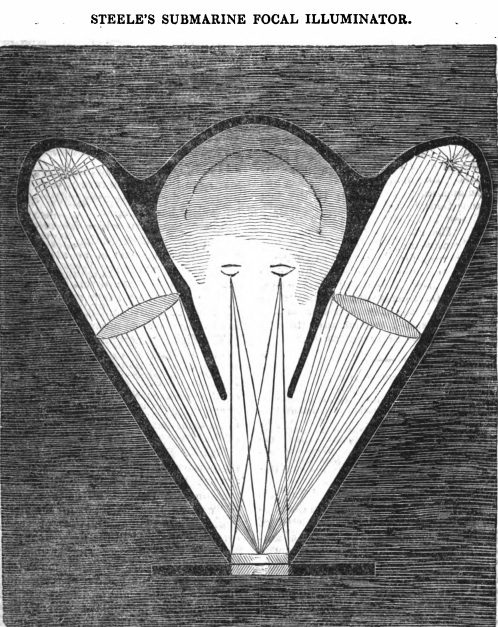
From The Mechanics’ Magazine, Museum, Register, Journal, and Gazette No 867 Saturday March 21 1840
Posted in Ashore, Built heritage, Economic activities, Engineering and construction, Extant waterways, Foreign parts, Ireland, Operations, People, Politics, Restoration and rebuilding, Shannon, Sources, Tourism
Tagged boats, Charles Deane, Clare, Intrinsic, Ireland, Mary Rose, Operations, Portsmouth, Thomas Deane, Thomas Steele
Hark! A bell!
Tis the doorbell.
A courier stands without. He bears a box.
“Ho!, trusty courier,” quoth I. “What news?”
“Sign here, please.”
I sign. I take the box. It weighs but little.
The excitement mounts. I open it.
It contains an envelope. Naught else.
I open the envelope.
It contains a Waterways Ireland smart card. Naught else.
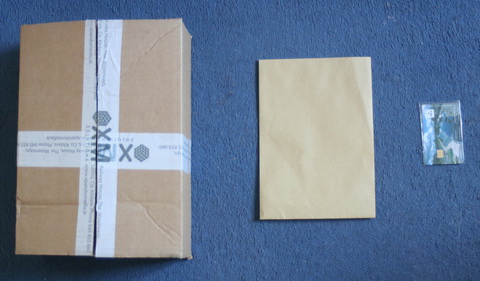
Delivery
Much air has been transported from Sallins.

 Irish waterways history