Category Archives: People

Harry Arnold …

… wins prestigious competition!

Harry Arnold has won the Irish Waterways History Christmas Caption Competition and the magnificent prize of a glass of something. “I’m over the moon,” said the excited winner: “it’s just as good as winning the lottery.”

The competition organisers dismissed rumours that they favoured overseas contestants as they would be less likely to be able to collect their prizes. “Quod scripsi, scripsi,” they said, “and our word is our bond.”

Christmas caption competition

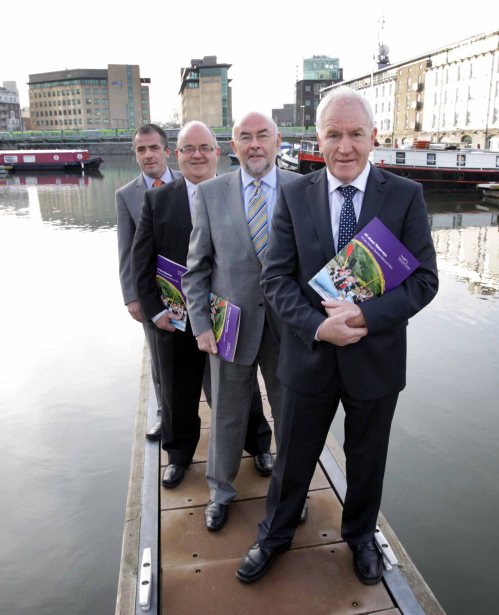
The usual prize of a glass of something or other [and I know the last two prizewinners still have a claim on me] for the best non-libellous caption for this photo, taken today at the launch of WI’s education programme for primary school children. I understand that the materials on WI’s e-learning page are complemented by “an off-line teachers resource pack”, which is what the besuited ones are clutching.

No lifejackets. Photo courtesy of Waterways Ireland, who are not to blame for my decision to use it for a caption competition

Starting at the back, the four chaps are Éanna Rowe, Waterways Ireland’s Marketing Honcho; John Martin, Heid Fector o’ Waterwyes Airlin [as we say in Ulster Scots]*; Ruairi Quinn, Minister for Education and Skills; Jimmy Deenihan, Minister for Arts, Heritage and the Gaeltacht but, on the other hand, a strong personal supporter of the Lartigue Monorail, which is a point in his favour.

Update 4 December 2012: the press release is now on the WI site.

* In its 2008 Annual Report, Waterways Ireland was, in Ulster Scots, Watterweys Airlann on the cover but Watterwyes Irelan in the Foreward bae the Cheif [sic] Executive, who signed himself as Chief [sic] Executive. By 2009, though it was still Watterweys Airlann on the cover, it was Waterwyes Airlan in the Foreward bae the Chief [sic] Executive, who signed himself as Heid Fector, a title I rather like. By 2010, though the cover remained unchanged as Watterweys Airlann, the body was Watterwyes Airlan in the Foreward, but the Heid Fector title had been dropped, alas, and John Martin was Chief Executive in two languages.

But 2008 was not the Heid Fector’s first appearance: in 2007 John Martin signed himself thus, though the foreword was called Twarthy words bae tha heid yin and the body was referred to in the text as Wattherweys [sic] Irelan.

Back in 2006, the foreword was Innin wi tha Heid Fector, and the body was Watterweys Airlann, with an accent, which I can’t reproduce, over the first e. That was the same as in 2005; in both years John Martin signed himself as Heid Fector.

I’m not sure whether I prefer Heid Yin or Heid Fector, but either seems better than Chief or Cheif Executive. But the real problem is the difficulty that this inconsistency causes for us eager students of Ulster Scots. I realise that change is inevitable in a thriving, developing language or dialect, but perhaps the cross-border bodies could give a lead in standardising the vocabulary and spelling.

WI pay 2

In an earlier posting I provided this extract from WI’s accounts to 31 December 2010:

WI salaries

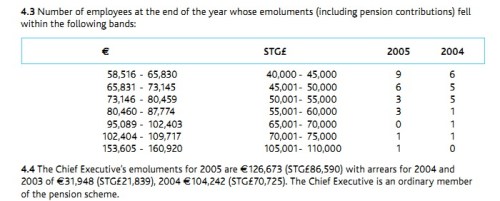
The same message appears in the annual reports for 2009, 2008, 2007 and 2006. However, back in 2005 there was a different message:

WI pay 2005


WI and the tooth fairy

There is a slightly disturbing item in WI’s 2010 accounts [PDF]:

1.5 Deferred Pension Funding

In accordance with accounting practice for  non-commercial State bodies in the Republic of Ireland, Waterways Ireland recognises an asset representing resources to be made available by the UK and Irish Exchequers for the unfunded deferred liability for pensions on the basis of a number of past events. These events include the statutory backing for the superannuation schemes, and the policy and practice in relation to funding public service pensions in both
jurisdictions including the annual estimates  process. While there is no formal agreement and therefore no guarantee regarding these specific amounts with the funding bodies, Waterways Ireland has no evidence that this funding policy will not continue to progressively meet this amount in accordance with current practice. This treatment is inconsistent with  accounting practice for UK Non-Departmental Bodies, where, due to the absence of a formal guarantee, a funding liability is not recognised until the commitment falls due.

IANAA, but an absence of evidence for the non-existence of the tooth fairy would not convince me that it does exist. I suppose it’s the same for any other unfunded pension scheme, and (unlike the UK practice) at least acknowledges the size of the problem, but it’s not exactly reassuring, either to taxpayers or to future pensioners. If I’ve misunderstood it, perhaps some kindly accountant will correct me.

WI pay

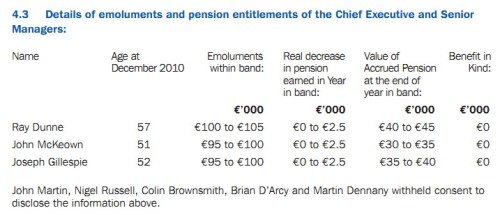
In my post about WI finances I referred to Robin Evans, chief executive of the Canal & River Trust, which runs many waterways in England and Wales. A commenter mentioned Evans’s salary. Here is what WI’s Annual Report for the year ended 31 December 2010 [PDF] says about the salaries of senior WI managers.

WI salaries

WI finances

Robin Evans, chief executive of the Canal & River Trust, was interviewed in the December 2012 issue of Waterways World. CART, a charitable trust, has taken over from British Waterways in England and Wales, but not in Scotland.

Robin Evans pointed out in the interview that, whereas waterways in Scotland get 98% of their funding from the state, CART’s English and Welsh waterways get only 35%. Amongst other things, CART is seeking donations and getting people to volunteer as lockkeepers and in other roles.

I’ll bet the Irish government is looking on with interest.

Boats to return to Corbally Branch

Well, canoes, but better than nothing.

PS for “upstream” read “downstream”, as far as I can see.

Waterways Ireland and the cuts …

WI’s tree-cutting on the Barrow.

Royal water (current status)

I have updated my page about Royal Canal feeders with some information provided by Nigel Russell of WI to the An Bord Pleanála oral hearing on the Royal water supply scheme.

Incidentally, the Department of Arts, Heritage and the Gaeltacht, WI’s parent department in RoI, was among the (few) objectors to the proposed abstraction of water from Lough Ennell, although it was in favour of ceasing to abstract water from Lough Owel [Inspector’s report pp11–12]. Indeed it seemed to have some reservations about the reopening of the Royal Canal, not on economic grounds but because “some important nature consideration issues need to be fully addressed”.

WI canal permits

Latest update here. These are the main points.

Process

Applications for extended mooring permits at nine new locations will be available for two weeks from 19 November to 3 December 2012. The locations are Rathangan and Vicarstown on the Barrow Line (with a third stretch now at Vicarstown), two at Confey and one each at Cloondara and Lock 15 on the Royal and just one, Lock 34 to Griffith Bridge, on the Grand.

The schedule:

Applications for each set of locations are open for two weeks. Completed applications will be processed in order of receipt and mooring locations allocated. If availability exists after the application timeframe for a location has closed, late applications may be considered. Once all the extended mooring locations in an area have been allocated, no more extended mooring permits will be issued for that area in 2013. It is Waterways Ireland’s intention to complete the roll out of the extended mooring permit by March 2013.

That seems to be intended to get boaters to apply ASAP; otherwise they’ll be moored in the middle of nowhere for the rest of 2013.

The application process is set out in detail, with a new item.

From 16 November 2012 permits will no longer be issued by Lockkeepers, or the Eastern Regional Office. Permits will only be issued on completion of an application form submit to and processed by the Tullamore Office.

It is confirmed that applications must be accompanied by “copies of the insurance, and payment for the permit and a damage deposit”.

Downloads

There are four downloads: the application form [DOC] and a supplementary form for consortium members [also DOC], a sample 11-page EMP licence [not permit] agreement [PDF] and a 5-page guidance document [PDF]. A consortium is defined in the guidelines as a group of more than two people who own a single vessel. Owners of unpowered vessels are advised, but not required, to have insurance.

waste

The guidelines have a new item about disposing of rubbish:

Boat owners on the canals will be required to dispose of domestic rubbish at  their own expense. On the application form you need to indicate how you intend to manage this. For example, evidence of a paid collection service or by confirming that you will take your rubbish home and dispose of it through your domestic collection service.

In a limited number of locations Waterways Ireland may offer this service for a charge. Details of this will be notified when the area opens for extended mooring permit applications.

That is as I predicted in the last issue of Afloat.

And there is a paragraph about holding-tanks:

You are asked to tell us if your boat has an operational waste holding tank.  This is not a mandatory requirement, but information is being collected for management purposes.

The licence agreement says that owners have to clean up after dogs.

Here comes the BSC

From 2015 Waterways Ireland will be introducing the requirement for boats needing permits and wishing to use the canals to have a current hull survey to provide evidence that the boat is in good condition.

Not all boats will require this.

Your attention is being drawn to this requirement now to allow you time to prepare for 2015.

That’s from the guidelines document (join the queue now for the dry docks). And these bits are from the licence agreement:

The Licensee undertakes to have regular inspections of the gas and electric services of  his Boat as required to ensure these are kept in a safe and serviceable condition. […]

All Boats must carry adequate fire fighting equipment and have same serviced as per the manufacturer’s recommendations.

Insurance

The application form requires applicants to agree to this:

I/We hereby indemnify and shall keep indemnified Waterways Ireland from and against all actions proceedings costs claims demands and liabilities howsoever arising from my/our use of the facilities provided by Waterways Ireland on the Royal Canal, Grand Canal and Barrow Navigation and shall further indemnify and keep indemnified Waterways Ireland in respect of any accident, injury, loss or damage to any person or property howsoever arising including, without prejudice to the generality of the foregoing, where such accident injury loss or damage arises by reason of any matter or thing done or omitted to be done by me/us or person authorised by me/us or the purported exercise of such use.

I would welcome guidance on whether that might invalidate insurance policies.

Moorings are not transferable

If a Boat is sold it must be removed from the Mooring within seven days and the  Licensee must advise the Licensor’s Inspectorate. The new Boat owner will be required to make an application if they wish to avail of an extended mooring permit and Waterways Ireland will refund the balance pro rata of any fee paid for an extended mooring permit to the Boat owner less a fee of €50 to cover administration costs.

That’s from the draft licence.

Buy shares in Lowtown

Also from the draft licence.

It is not permitted to re-fuel Boats at an extended mooring.

Lots of exciting reading.