Category Archives: Politics

More budget

Here’s a fun bit from the bumpf pile about the Department of Arts, Heritage and the Gaeltacht, Waterways Ireland’s parent department in roI:

From the Expenditure Report 2013 Part 1

From the Expenditure Report 2013 Part 1

As last year, waterways exist only in the context of northsouthery, which itself is the lowest of DAHG’s priorities. The interesting thing is that DAHG is having its expenditure ceiling raised by €2.2 million, but it’s not going to waterways or even to northsouthery.

Culture for Angela

Culture for Angela

So we’re going to be forcing unfortunate EU leaders to sit through plays and such. But hold on: is there a staging of An Béal Bocht available?

At least the money is not going on the Ghastly Gathering.

Anyway, there will be lots of unspecified savings to compensate, like these:

Sauve qui peut

Sauve qui peut

The two right-hand columns are headed Savings in 2013 and Full Year Savings.

And more to come:

Tomorrow, tomorrow ....

Tomorrow, tomorrow ….

Finally, here’s a bit from the MinFin:

From Michael Noonan's Financial Statement

From Michael Noonan’s Financial Statement

Wouldn’t it be nice if he took the opportunity to abolish green diesel altogether as part of the scheme?

Budget

Vast wodges of bumpf from the government’s budget site, with non-searchable PDFs, god rot ’em. An initial look suggests these points:

  • the Dept of Arts, Heritage and the Gaeltacht’s total allocation to northsouthery, which includes waterways, will be down 6% next year
  • current spending on northsouthery will be down from €38 244 000 to €36 178 000. Waterways Ireland gets the biggest wodge of that, about 60% [see my comment last year] in 2011; I guess that the cuts will be shared pro rata, but I can’t be sure
  • WI’s capital expenditure allocation will be reduced from €4 500 000 to €4 071 000, which may go towards shovels for thon sheugh
  • decisions on northsouthery have to be agreed by the NSMC [Irish government and NI executive].

More as I plough the pile, but the summary (to nobody’s surprise) is less spending on waterways. Maybe Éanna should have pushed ….

A gratifying display of loyalty

His Excellency the Lord Lieutenant took a trip on the Shannon Estuary in July 1856 on the City of Dublin Steam Packet Company’s vessel Erin-go-Bragh. He was greeted by demonstrations of loyalty from the populace, had dejeuner on board off Scattery Island and heard an address from the proprietary, clergymen, merchants, traders and inhabitants of Kilrush, read to him by Colonel Vandeleur. Here is the Freeman’s Journal‘s account of the trip.

Campaign news 2: marine casualties

There is an appalling piece of legislation called the Merchant Shipping (Investigation of Marine Casualties) Act 2000. Actually, only part of it is appalling. The first 45 of 46 sections are OK: they’re all about investigating marine casualties, which is more or less what you would expect, and that’s fine. But Section 46 is a stinker:

The Minister may, from time to time, with the consent of the Minister for Finance, advance to a person, out of monies provided by the Oireachtas, for the purposes of marine or natural resource based tourism or heritage projects, such sums, by way of grant or loan, as the Minister may determine and upon such terms and conditions as he or she considers necessary.

First of all, it has nothing whatsoever to do with investigating marine casualties and, second, it allows a minister to hand out money to his mates on whatever terms he likes. This sort of addition to an irrelevant bill is what we might expect in the USA or in Greece, but it should never have got through the cabinet, never mind the Oireachtas. It is fortunate that the Minister for the Marine and Natural Resources at the time the act was passed was a person of the utmost probity, one Frank Fahey.

In 2010 responsibility for Section 46 was transferred to Craggy Island by Section 3 (1) of SI No 677/2010 — Marine Tourism (Transfer of Departmental Administration and Ministerial Functions) Order 2010:

3. (1) The functions vested in the Minister for Transport by or under section 46 of the Merchant Shipping (Investigation of Marine Casualties) Act 2000 (No. 14 of 2000) are transferred to the Minister for Community, Equality and Gaeltacht Affairs.

And in 2011 it was transferred again, this time to the Department of, er, Agriculture by SI No 163/2011 — Marine Tourism (Transfer of Departmental Administration and Ministerial Functions) Order 2011:

3. (1) The functions vested in the Minister for Community, Equality and Gaeltacht Affairs by or under section 46 of the Merchant Shipping (Investigation of Marine Casualties) Act 2000 (No. 14 of 2000) are transferred to the Minister for Agriculture, Fisheries and Food.

The Dept of Ag later became the Department of Agriculture, Food and the Marine, although most marine functions are still in the Department of Transport.

On 13 February 2012 I wrote to the Dept of Ag thusly:

I would be grateful if you could give me a list of grants and loans made under Section 46 of the 2000 Act since it came into force, including the names of the recipients, the purposes for which the grants or loans were given and the details of your evaluations of the effectiveness of the grants or loans.

I would also be grateful if you could tell me whether your department intends to seek the repeal of Section 46.

After several reminders, I found a kindly chap who took up the matter. He has today written to say:

We sought the assistance of our Marine Agencies and Programme Division in Clonakilty, Co Cork and they have advised that the Department of Agriculture , Food and the Marine (formerly the Department of Agriculture, Fisheries and Food) has made no grants under Section 46 since responsibility for Section 46 was vested in the Department. If any grants were made under Section 46 prior to responsibility being vested in this Department the details would be held by the responsible Departments at the date of the decision. I regret that these details are not held by this Department.

In relation to the repeal of Section 46, it can be confirmed that there are no proposals at present to seek its repeal.

I am glad to learn that no grants have been made. The reply does not mention loans, so I’ve sent a follow-up question to ask about them. I’ve also asked why the blasted section is not being repealed. And I’ve written to Craggy Island (or rather its successor, the Department of Arts, Heritage and the Gaeltacht) and the Dept of Transport to ask whether they made any grants or loans when they were responsible for Section 46.

Ireland is not Greece, a minister said today. So why has Section 46 not been repealed?

Christmas caption competition

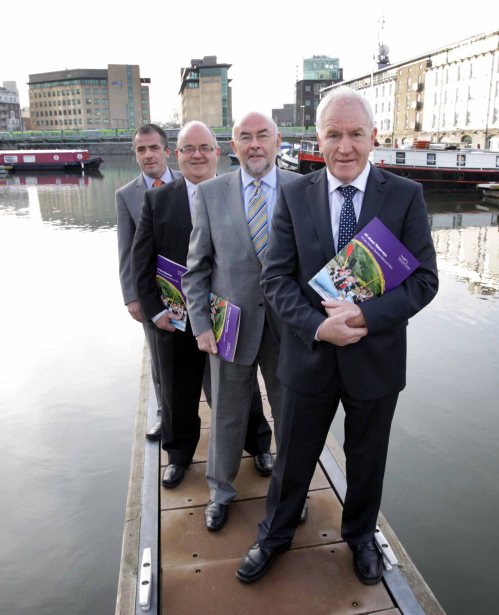
The usual prize of a glass of something or other [and I know the last two prizewinners still have a claim on me] for the best non-libellous caption for this photo, taken today at the launch of WI’s education programme for primary school children. I understand that the materials on WI’s e-learning page are complemented by “an off-line teachers resource pack”, which is what the besuited ones are clutching.

No lifejackets. Photo courtesy of Waterways Ireland, who are not to blame for my decision to use it for a caption competition

Starting at the back, the four chaps are Éanna Rowe, Waterways Ireland’s Marketing Honcho; John Martin, Heid Fector o’ Waterwyes Airlin [as we say in Ulster Scots]*; Ruairi Quinn, Minister for Education and Skills; Jimmy Deenihan, Minister for Arts, Heritage and the Gaeltacht but, on the other hand, a strong personal supporter of the Lartigue Monorail, which is a point in his favour.

Update 4 December 2012: the press release is now on the WI site.

* In its 2008 Annual Report, Waterways Ireland was, in Ulster Scots, Watterweys Airlann on the cover but Watterwyes Irelan in the Foreward bae the Cheif [sic] Executive, who signed himself as Chief [sic] Executive. By 2009, though it was still Watterweys Airlann on the cover, it was Waterwyes Airlan in the Foreward bae the Chief [sic] Executive, who signed himself as Heid Fector, a title I rather like. By 2010, though the cover remained unchanged as Watterweys Airlann, the body was Watterwyes Airlan in the Foreward, but the Heid Fector title had been dropped, alas, and John Martin was Chief Executive in two languages.

But 2008 was not the Heid Fector’s first appearance: in 2007 John Martin signed himself thus, though the foreword was called Twarthy words bae tha heid yin and the body was referred to in the text as Wattherweys [sic] Irelan.

Back in 2006, the foreword was Innin wi tha Heid Fector, and the body was Watterweys Airlann, with an accent, which I can’t reproduce, over the first e. That was the same as in 2005; in both years John Martin signed himself as Heid Fector.

I’m not sure whether I prefer Heid Yin or Heid Fector, but either seems better than Chief or Cheif Executive. But the real problem is the difficulty that this inconsistency causes for us eager students of Ulster Scots. I realise that change is inevitable in a thriving, developing language or dialect, but perhaps the cross-border bodies could give a lead in standardising the vocabulary and spelling.

WI and the tooth fairy

There is a slightly disturbing item in WI’s 2010 accounts [PDF]:

1.5 Deferred Pension Funding

In accordance with accounting practice for  non-commercial State bodies in the Republic of Ireland, Waterways Ireland recognises an asset representing resources to be made available by the UK and Irish Exchequers for the unfunded deferred liability for pensions on the basis of a number of past events. These events include the statutory backing for the superannuation schemes, and the policy and practice in relation to funding public service pensions in both
jurisdictions including the annual estimates  process. While there is no formal agreement and therefore no guarantee regarding these specific amounts with the funding bodies, Waterways Ireland has no evidence that this funding policy will not continue to progressively meet this amount in accordance with current practice. This treatment is inconsistent with  accounting practice for UK Non-Departmental Bodies, where, due to the absence of a formal guarantee, a funding liability is not recognised until the commitment falls due.

IANAA, but an absence of evidence for the non-existence of the tooth fairy would not convince me that it does exist. I suppose it’s the same for any other unfunded pension scheme, and (unlike the UK practice) at least acknowledges the size of the problem, but it’s not exactly reassuring, either to taxpayers or to future pensioners. If I’ve misunderstood it, perhaps some kindly accountant will correct me.

WI pay

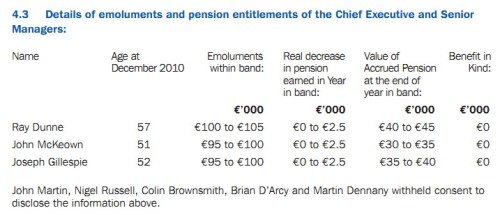
In my post about WI finances I referred to Robin Evans, chief executive of the Canal & River Trust, which runs many waterways in England and Wales. A commenter mentioned Evans’s salary. Here is what WI’s Annual Report for the year ended 31 December 2010 [PDF] says about the salaries of senior WI managers.

WI salaries

More mooring locations on the canals

From a WI presser received this afternoon:

The second set of locations offering the E.M.P include the Floating Moorings on the Grand Canal Dock beside the Waterways Ireland Visitor Centre on which a permit will be offered until March 2013. Additionally extended mooring locations will also be opened on the Grand Canal near Lock 34 in Co Offaly, Pike Bridge in Co Kildare and Abbeyshrule in Co Longford. The full details of the locations including the GPS co-ordinates, the Application Form and Guidance Notes will be available on www.waterwaysireland.org from the 3rd December.

Update 4 December 2012: the press release is now on the WI site.

WI finances

Robin Evans, chief executive of the Canal & River Trust, was interviewed in the December 2012 issue of Waterways World. CART, a charitable trust, has taken over from British Waterways in England and Wales, but not in Scotland.

Robin Evans pointed out in the interview that, whereas waterways in Scotland get 98% of their funding from the state, CART’s English and Welsh waterways get only 35%. Amongst other things, CART is seeking donations and getting people to volunteer as lockkeepers and in other roles.

I’ll bet the Irish government is looking on with interest.

Spencer Dock

The Royal Canal meets the River Liffey at Spencer Dock (more or less: older OSI maps suggest that the section between Sheriff Street and the Liffey is Royal Canal Docks, with Spender Docks north of Sheriff Street). Much development has been proposed, and perhaps undertaken, in the area, where CIE (the public transport authority) owned much land.

Now, the Sunday Business Post tells us [perhaps behind a paywall], CIE’s subsidiary Irish Rail, which runs railways, is to sell land at Spencer Dock to a “private sector buyer”. The proceeds will enable Irish Rail to get rid of another 120 workers: it planned to lay off 300 workers this year but only 89 left because Irish Rail could not afford the terms of a voluntary redundancy scheme. The departures will reduce its wage bill.

I don’t really understand why CIE doesn’t simply shut down Irish Rail altogether, with the possible exception of the Dublin commuter services. Even its main-line trains are surely unnecessary now that most major conurbations are linked by motorways, on many (if not all) of which Bus Éireann, another subsidiary of CIE, runs express services. Lunatic ideas like the Western Rail Corridor don’t help, of course, but when, as the SBP reports,

[…] a train was recently left stranded in Galway after a local supplier refused to provide further credit […]

and when the company (again according to the SBP) cannot afford toilet rolls or receipt rolls for credit card machines, it may be that the market is trying to give the owners of the business a message: “close down now”.