Category Archives: Politics

A London pub and the history of the Shannon

Piloti’s “Nooks and Corners” column in the latest issue of Private Eye [No 1325] reports [brief extract available to non-subscribers here] that a London pub is threatened with demolition. On the Google satellite view with photos, press the button to the bottom right of the building to see a pic headed “Derelict pub”.

Piloti says that the pub was built in the 1840s [Diamond Geezer says 1839] and at that time the Marquis (or Marquess) was Henry Petty-Fitzmaurice, 3rd Marquess of Lansdowne, KG, PC, FRS. The family’s main base was in Britain but they owned large estates in Ireland, notably in Counties Limerick and Kerry; certain roads in Dublin are also named after the family.

The late Marquis has two claims on the attention of Irish waterways enthusiasts. First, the best-known of the early River Shannon steamers, the Lady Lansdowne, was named after his wife. Second, he was Lord President of the Council [the current holder of the post is Nick Clegg] when the government of Her Late Majesty Queen Victoria decided, in 1839, to spend about half a million pounds improving the Shannon Navigation.


Attack on the Suir

Three men were killed and several wounded in the attack on Mr Malcolmson’s boats, near Clonmel, on Thursday evening. The populace, it is believed, were instigated to plunder the flour from no other motive but that of absolute distress. Stones flew like hail on the boatmen and police who escorted the cargoes, but not until very severe hurts were received, did the latter fire among the crowd, and on the third volley they dispersed.

The Limerick Chronicle, Wednesday 16 May 1827

Blunderbuses on the Shannon

Saturday 10 May 1845

[…] On our way to Rooskey this Morning we visited Cloneen [Clooneen] & Cox shoal and they were going on very well with about 60 Men

I ordered them to double that Number to my astonishment I found 4 Policemen Barricked in one of our houses and a new Barrick erecting for 30 or 40 more Men this was being done in consequence of three villains placing themselves on the opposite bank of the River and deliberately firing four rounds of Ball from Blunderbuses some of which went into the office and from the marks made by one Ball must have been only a few inches from striking Joe Lambs head — afterwards the villains retired to the Bogs — the object of this outrage was revenge on the Men for not striking for 1/6 [8p] Pd day — the average being about 1/2 [6p] — which is considered at present ample

From David Brooke ed The diary of William Mackenzie, the first international railway contractor Thomas Telford Publishing, London 2000

What the blurb doesn’t say is that Mackenzie was the contractor for works on four areas of the Shannon, working for the Shannon Commissioners in the 1840s. He was responsible for Killaloe, Meelick, Banagher and Rooskey and also held a dredging contract.

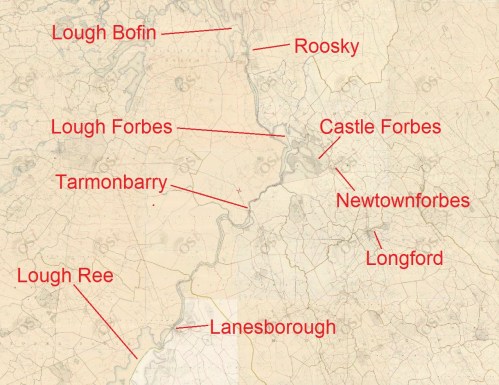
Lanesborough to Rooskey showing Lough Forbes

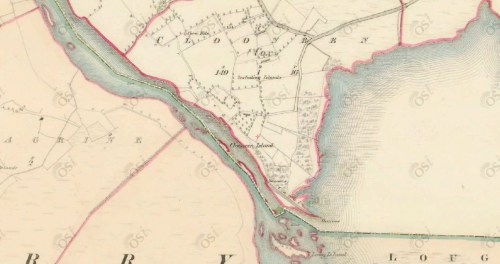
Clooneen (Cox) is the area at the upstream end of Lough Forbes; other Clooneens lie to the north on the east side of the river. Joe Lamb was the ganger.

Clooneen (Cox)

Political parties

Regular readers will know that I sent and FOI request to the Department of Community, Equality and Gaeltacht Affairs [now the Department of Arts, Heritage and the Gaeltacht] looking for files on the Clones Sheugh (aka the Ulster Canal). One of the grounds on which I was refused access was that certain files related to “the costing, assessment or consideration or any proposal of a political party carried out for or on behalf of that party”.

While my appeal against that refusal continues on its course, I thought I might as well ask the political parties directly for the information that might be in those files — in the process, of course, establishing which of them had Clones Sheugh proposals in mind.

Party time

As far as I can see, the parties that contested, or were eligible to contest, the 2011 general election were:

Christian Solidarity Party
Fianna Fáil
Fine Gael
Fís Nua
Green Party
Labour
People before Profit
Sinn Féin
Socialist Party
South Kerry Independent
Workers and Unemployed Action Group [WUAG]
Workers’ Party.

Accordingly, I decided to email them all, enquiring whether they had asked the [then] Department of Community, Equality and Gaeltacht Affairs for information “relating to the costing, assessment or consideration of the restoration of some or all of the abandoned Ulster Canal”. I added that, if they had done so, I would be grateful for a copy of the query they put to the department and of the response they received. I told them that I was sending my query to all political parties that contested the 2011 general election (or at least to all those for which I could find an email address).

That was not quite true: I omitted the South Kerry Independent Alliance, on the grounds that its interest in the Clones Sheugh was likely to be limited (I am of course open to correction on this). Furthermore, I was unable to find any website or email address for WUAG so I did not send my request to them.

Fianna Fáil logic

All of the other parties had websites and email addresses — except one: Fianna Fáil. Now, strictly speaking it falls outside the range of parties in which I might have been interested: not just for the obvious reasons but because it was in government at the time and would automatically have had full access to the civil service costings (such as they were). But I was interested to note that Fianna Fáil did not provide an email address on its website: interested enough to ring it and ask for an email address for its press office. The polite receptionist asked someone and told me that the address to be used was pressoffice@fiannafail.ie.

So I sent my query to that address. And I got back an autoresponse saying

This email is not monitored. For urgent queries you can contact the FF Press Office on 087 955 5600.

Well I never. What was the point of that?

Labour gains

Anyway, the results so far put Labour in the lead: I got an almost immediate informal response from Dermot Lacey, saying that he didn’t think Labour had contacted the department; I also got a more formal response next day, from Mags Murphy, Director of Councillor Services and Training, saying:

Labour did not include a specific commitment to the development of the Ulster Canal in our manifesto in the 2011 Election.

However, Labour is keen that all practical possibilities for cooperation, reconciliation and mutual benefit, including maximising tourism potential from a development of the Ulster Canal would be considered seriously as part of our deep commitment to the Good Friday agreement.

To this end, the Labour members of the Implementation of the Good Friday Agreement committee visited the Ulster Canal, Enniskillen and Clones with their cross-party colleagues for a range of meetings on 27 September 2012 with Waterways Ireland officials, local councillors and community groups.

Oh dear. Still, brownie points for responding.

What is the Implementation of the Good Friday Agreement committee?

Where are the others?

I am still awaiting responses from the other political parties.

Declaration of non-interest

I did not vote for any of those parties.

 

Da new kidz in da hood

A couple of canally sites I hadn’t come across:

  • da corpo’s canal (h/t IndustrialHeritageIreland)
  • Dublin canal walks. I don’t know who is behind this site, which looks like a work in the early stages of progress, but I’m all in favour of folks’ walking along Dublin canals; my own effort at encouragement is here.

Industrial Heritage Ireland, by the way, has been watching the Clones Canal campaign. This suggests that the campaign is being cranked up, although I don’t know what the poor buggers from the NI Strategic Investment Board are doing in the group: pouring money into holes in the ground is not (pace Keynes) usually seen as an investment.

It is reported, nonetheless, that IWAI folk are confident that public money will be wasted on the ghastly project, thus subsidising their hobby. And it seems that a gang of Irish parliamentarians, following the tradition established in Grattan’s Parliament, are keen to distribute pork: there is nothing in the press release to suggest that any of the poor dears have any interest in assessing the costs and benefits of the Clones Canal proposal. In the unlikely event that any of them is interested, the pages starting here might be useful. And interested parliamentarians might like to check on any cost-benefit analyses done (or revised) since it was found that the canal would cost €45m, not €35m.


Arthur’s Day

There is quite a modern branch of trade risen up in Ireland — I mean the exportation of Dublin porter. I am not a proprietor in the brewery, and, in praising the beverage, which I consider most excellent, I cannot be considered to be actuated by interested motives. But, it is a curious fact, that, a few years ago, Ireland was an importing country of porter, while, at the present moment, a very considerable export trade is growing up in Dublin.

In this point, and, perhaps, in this point only, I fully expect the learned member for Dublin [Daniel O’Connell MP] to concur with me. I only venture to entreat hon. Members opposite, who wish to give some activity to the trade of their country, to encourage the fermentation of the vat, rather than the fermentation of politics. By so doing, they may greatly improve our trade and our internal condition; and, if they will but take my advice, I, for one, shall be ready, most heartily, to drink their healths in their own porter.

Thomas Spring Rice, MP for Cambridge (and previously for Limerick), Joint Secretary of the Treasury, in a House of Commons debate on the repeal of the Act of Union on 23 April 1834. On this site, you’ll find more on Daniel O’Connell here and on Uncle Arthur here.

Kilgarvan Quay

On 3 October 1906 Mr Hugh Delaney of Borrisokane, Co Tipperary, gave evidence to the Royal Commission appointed to enquire into and to report on the canals and inland navigations of the United Kingdom. Tipperary (North Riding) County Council had asked him “to give evidence on behalf of the quay at Kilgarvan.”

His evidence became rather confused, as he and his interlocutors misunderstood each other. The source of the problem seems to have been his using the term “the canal” to refer both to the Grand Canal Company and to the canal itself. The main points of his evidence were these:

  • Kilgarvan Quay was “only of recent date: it was only opened in [October] 1891 and it has had an extraordinary effect on the traffic of the district and brought down the railway rates [from Cloughjordan] very considerably”
  • there had been no quay at Kilgarvan before that; there was deep water at the quay
  • the grand jury of the North Riding of Tipperary gave £230 towards the cost and the Grand Canal Company paid the rest, about £579
  • although it was only 104 miles from Kilgarvan Quay to James Street harbour, it took five or six days for barley to reach Dublin
  • he felt that the trip should be done in two days, using steam launches
  • he thought that transhipment at Shannon Harbour caused undue delay
  • people at Terryglass had built a quay and it made a port of call for the Grand Canal Company.

The present quay at Kilgarvan is not on the ~1840 OSI map (though there is a smaller quay near the bend in the road) but it is on the ~1900. I have a photo of the crane on my page about Shannon cranes; I’m no expert, but I wonder whether the crane might be older than the quay.

Canal mooring rules

Waterways Ireland issued two press releases about moorings today. The first was the usual one about winter moorings on the Shannon and the SEW; the second was about the canals. Here, unedited, is the text of the second.

Canal Mooring Rules Coming into Force

Waterways Ireland announced in June 2012 that the Canal Bye-laws on the Grand & Royal Canal and Barrow Navigation are to be enforced from autumn 2012, with an accompanying change in the permit system allowing for year-long mooring permits and locations.

Part of bringing in this new location-based permit has been the identification of locations suitable for extended mooring. This process is now completed and work has begun in some areas to improve accessibility.

Waterways Ireland will roll out Extended Mooring Permit applications by area, rather than giving a date when applications for the permit will open. For boat owners this will mean that enforcement of the maximum stay rule will not commence in an area until after boat owners have had the opportunity to purchase an Extended Mooring Permit.

The initial 12 month Extended Mooring Permit will cost €152 and will only be available to boats already holding a valid annual Mooring and Passage Permit.

Boats that cruise and move (staying at a mooring for up to 5 days) will not be in breach of the Bye-laws or require an Extended Mooring Permit.

Waterways Ireland has proposed a small number of draft amendments to the current Bye-laws which date from 1988. These include proposals to provide a range of charges for mooring permits that reflect the location and services provided throughout the canals and also will take into account the size of boat. These proposals include low cost rural moorings on soft banks to ensure the canals are accessible for everyone who owns a boat and requires a mooring. Boat owners allocated an extended mooring location in key areas in villages or towns or with services should be aware that if the new Bye-laws are approved Waterways Ireland will increase the charges for moorings in the future to reflect the location, services, and size of boat.

Waterways Ireland recognises the current situation whereby a small number of boat owners use their boats as their sole or permanent residence. Proposals to make provision for this use of the navigation property have been included in the Bye-law changes.

Furthermore Waterways Ireland intends to work towards the provision of a small number of serviced house boat moorings on the canal network. Such provision will be subject to finance, land availability and compliance with requisite statutory approvals.

Waterways Ireland recognises that a transition period of a number of years will be required to implement this. In the interim these boat owners should apply for an Extended Mooring Permit.

The draft Bye Law amendments are currently being considered by Waterways Ireland’s sponsor Departments. When Waterways Ireland has Ministerial consent, it will proceed to public consultation on the proposed Bye-law amendments.

Waterways Ireland will continue to contact permit holders regularly to ensure they are kept up to date with the roll-out of the new permit. All queries about the enforcement of the current bye-laws or the Extended Mooring Permit should be directed to Shane Anderson, Assistant Inspector of Navigation: Tel no +353 (0)87 286 5726, Email shane.anderson@waterwaysireland.org . Queries about houseboats should be directed to Property & Legal Section Tel no +44 (0)28 6632 3004.

These changes are necessary steps to improve the management of the canals and waterway amenities for both the navigational and recreational user, so that investment in the new infrastructure and facilities which Waterways Ireland has undertaken is maximised for every user.

The Repealer

Here is a brief account of a trip from Waterford to new Ross by steamer in 1842.

Kildare Street

In the recent past, I have made several postings referring to debates or parliamentary questions in the Dáil or Seanad. I was able to do do because of the service provided by the excellent KildareStreet.com website. The site allowed me to identify and set key words for topics that interested me (waterways, for instance); it then sent me alerts when any of those topics was mentioned. Simple, pain-free, efficient — and an excellent way of making the Oireachtas seem slightly more important. KildareStreet also provided a search function and a facility for reading and commenting on recent debates. I found the Oireachtas’s own debates website far less user-friendly.

The Oireachtas has now decided to change its system — and to make it worse. Not only is its own site inadequate (no alerts, no search, despite there being a search button) but it has ceased to supply the XML-formatted data that enabled KildareStreet.com to work and has thereby crippled what was a really useful service.

If there are any computer-literate politicians in Dáil or Seanad, I would be grateful if they would enable the KildateStreet.com service to be restored.