Category Archives: Restoration and rebuilding

Dry docks

GRAND CANAL

At a Meeting of the Company of Undertakers of the Grand Canal, duly convened by public Advertisement, and held at the Company’s House in Dublin, on Monday, the 6th day of April, 1840,

WILLIAM MURPHY, Esq., in the chair,

The following Resolution, moved by James Pim, jun., Esq., seconded by James Dawson, Esq., passed unanimously in the afformative: —

Resolved — That the Court of Directors of this Company be authorised, if they shall see fit, to call the attention of the Government, of the Chamber of Commerce, of the Ballast Corporation, of the several Steam Companies, and of Capitalists generally, to the important advantages which the Grand Canal Company’s Floating and Graving Docks at Ringsend offer to all parties connected with the Shipping interests of the Port of Dublin, and to apprize them that this Company will at all times be ready to entertain any well considered proposition for increasing the general usefulness of these Docks, on the fairest and most liberal terms as regards the Public. Under the firm persuasion that by whatever well-arranged proceeding this important portion of the Company’s property can be best made available in increasing the Trade and promoting the prosperity of the City of Dublin, it will be rendered the most effectually conducive to the interests of the Company.

By order, JOHN McMULLEN,
Secretary of the Company.

From The Freeman’s Journal 8 April 1840.

Perhaps Waterways Ireland might follow the example of its predecessors and, rather than getting into bed with the DDDA, might consider some “well considered proposition for increasing the general usefulness of these Docks”.


The sluice house at Lough Owel …

… has had its windows broken. More on the Lough Owel Feeder here.

Dublin or bust

If you’re not already a reader of Barge Hawthorn’s blog, may I suggest that you start now? The account of the descent into Dublin along the Royal Canal, over three days, features mounting tension, a really superb photo of the M50 aqueduct and a happy ending when Effin Bridge lifted when required.

You can work your way backwards through earlier posts to find the how and the why.

Impartial amusement …

… but surely floe, not flow?

Mullingar dry dock(s)

The Ordnance Survey map of around 1840 shows a dry dock at Mullingar:

Mullingar dry dock ~1840

So does the map of around 1900:

Mullingar dry dock ~1900

The photo below was taken into the sun, alas. The entrance to the dry dock is towards the top of the entrance. So why are there curved stones closer to the camera? Was there once a second dry dock? Or was a second dock planned without ever beinf constructed? Or was the dock moved from one site to the other?

Entrances?


The Ruth Delany and Peter Clarke histories say nothing about this. If you can shed light on the matter, please leave a Comment below.

NAMA and the River Suir

NAMAWineLake has a story here. More on the Suir in Clonmel here.

Elfin safety

The Railway Safety Commission, which god preserve, is seeking consultants to

 undertake a review of the self contained Heritage Railways in Ireland with respect to the management of safety associated with their railway activities.

The bumpf says:

The purpose of this competition is to engage an expert or experts to undertake a review of the self contained Heritage Railways in Ireland with respect to the management of safety associated with their railway activities. It should be noted that this excludes the Railway Preservation Society of Ireland (RPSI).

The 8 heritage railways concerned are

Difflin Lake Railway, Raphoe, Co. Donegal

Fintown Railway, Fintown, Co. Donegal

Cavan & Leitrim Railway, Dromod, Co. Leitrim

Irish Steam Preservation Society, Stradbally, Co. Laois

Waterford & Suir Valley Railway, Kilmeadan, Co. Waterford

Tralee & Dingle Railway, Tralee, Co. Kerry

Lartigue Monorailway, Listowel, Co. Kerry

West Clare Railway, Moyasta, Co. Clare.

These heritage railways all operate on their own self contained infrastructure. They are operated by a mix of paid and volunteer staff. They include steam and diesel traction and a number of passenger carrying vehicles.

Safety certification was granted to these railways on the basis of their accepted safety cases in accordance with the Railway Safety Act 2005 (the Act). As the majority of these safety certificates were issued in 2007 they now fall due for review.

Hasn’t it got cold recently? There is definitely a chill in the air.


Royal water

The summit level of the Royal Canal has been closed until further notice because of shortage of water and the 34th and 35th levels have been closed until 20 April for emergency repairs. Marine Notices here, along with a general waarning about low water levels.

Met Éireann’s Monthly Summary for March 2012 [PDF] says:

Rainfall totals were relatively low for the time of year, with percentage of normal values below 50% in most locations. Mullingar [which is on the summit level of the Royal Canal] reported its driest March since 1961 (51 years), while most other stations reported their driest March in at least 7 years. Number of wet days recorded (days with 1 mm or more) was below average everywhere, with most stations measuring their lowest March maximum daily rainfall in seven to 39 years.

Can we have our normal weather back please? Or will that be coming in the “summer” months?

Waterways trees

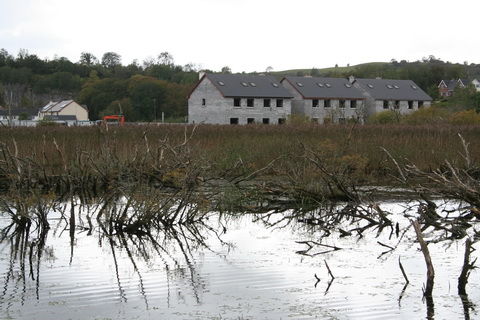
Nama to Nature has been planting trees at Keshcarrigan on the Shannon–Erne Waterway, along which far too many developers wanted to sell houses that would have fast boats parked outside. I don’t know whether my photo shows the Waterways estate or a different one.

Keshcarrigan September 2011


h/t Ireland after NAMA.

Support the Clones Canal

It was suggested to me today that, because some boating organisations want the Clones Canal, the project must be worthy of support. I find that argument less than convincing. If I offer someone the benefit of a sum of money, without charge, I will not be surprised if that person likes the idea — but that won’t show that it’s a good deal for whoever bears the cost.

In this case, owners of boats are being offered the benefit of €45 million, so it’s not surprising that they like the idea. But I think they should be offered a practical method of demonstrating the depth of their support.

Accordingly, I propose that owners of registered boats on  the Shannon and the Erne be offered the opportunity to pay half the €45 million cost (the other half could be raised from a levy on the publicans of Clones, the other main beneficiaries). If there are 10,000 boats, the charge per owner, spread over three years, would be no more than €750 a year. Willingness to pay would provide more convincing evidence of support and would also make the project better value for the taxpayer.