Category Archives: Scenery

Not Grand

Limerick’s SmarterTravel initiative aims to promote cycling, walking, car sharing and public transport. It has a little leaflet (I can’t find a downloadable version) describing five walking and cycling routes and including information on bus routes, a cycle to work scheme and car sharing.

One of the cycling and walking routes is along the towing path of the Limerick Navigation from Limerick to Plassey. It is described thus:

The Tow Path was part of the Grand Canal system stretching to Dublin and was used by the Guinness brewery to bring stout to Limerick.

The towing-path was not part of “the Grand Canal system”, although I suppose it might be described as a facility used by the Grand Canal Company. The Park Canal in Limerick, and the towing-path on the river navigation to Plassey, were not built or owned by the Grand Canal Company; they were part of the independent Limerick Navigation until subsumed into the Shannon Navigation in the 1840s. The Grand Canal Company was permitted to use its vessels on the navigation when it began carrying cargoes, which it did for, amongst others, Guinness; Guinness itself did not own or operate boats on the Shannon Navigation or the Limerick Navigation.


Bottles in Limerick

Limerick has a new Economic and Spatial Plan, with lots of downloadable files and the general tone of a letter to Santa Claus. It has lots of adjectives, though, and fashionable concepts; all it lacks is money.

It wants a renaissance of the Limerick waterfront. It seems, though, that that doesn’t mean lots of dockers unloading timber, turf boats from Poulnasherry Bog, ships taking the ground at low tide, gales throwing vessels against the bridge, mills at Curragour, tolls on the bridges or other features of past life along the quays. Instead there will be things like this:

A New Public Waterfront

 Arthur’s Quay Park will be transformed into a signature Waterfront public space that draws visitors, hosts special events and provides a key stopping point within the City Centre and along the Waterfront and Riverwalk;

 This new Riverside Park will run the length of the City Centre from Sarsfield Bridge through where Sarsfield House currently stands, along between the Hunt Museum and the River and over a new pedestrian bridge into a pedestrianised Potato Market area linking up to the upgraded King John’s Castle tourist attraction;

 A new appropriately sized iconic building could be developed in the new Riverside Park on the former Dunnes Stores Site to accommodate tourism/cultural uses;

 New landscape, trees, surfaces, lighting, furniture, public art and interpretation should be structured to create a landmark WaterfrontPark, designed to international standards reflecting the prominence of this location within Limerick;

 A new space should be defined to host public events including celebrations, performance, festivals and start and finish points to Limerick based marathons and races;

 Clear, high quality pedestrian connections from Patrick Street and O’Connell Street and Henry Street would draw people to the Park;

 Signage and materials should identify the water’s edge as part of the continuous Riverwalk linking bridges across the Shannon and the two sides of the Shannon River;

 A new public open space should be created at the Sarsfield House site in the event of government office relocation, to reveal the view north along the Shannon to King’s Island from the City Centre and extend Arthur’s Quay Park;

 The Waterfront and public space at the Hunt Museum should be strengthened to provide an intimately scaled green space with external seating from the Hunt Museum restaurant and destination in its own right along the Riverwalk.

What is being proposed here (page numbered 99; page 124 of 172 in An Economic and Spatial Plan for Limerick [PDF]) is that Sarsfield House should be demolished and the area above the Custom House moorings would be opened up, with citizens not just permitted but encouraged to enter. Later on (page 108; PDF page 133 of 172) we read this:

Limerick Quays will be defined as the principal visitor and entertainment zone in the City  Centre – passive and active – accommodating a new visitor destination, walking, as well as eating and drinking in bars and restaurants that will activate the quays overlooking the River. This will be fully pedestrianised.

Now, that’s all very nice in theory, but what it means in practice is that any boats moored at the only safe moorings in Limerick, at Custom House Quay, will be within range of any bottles that may be thrown by the less domesticated portion of the citizenry, on their way home from getting tanked up in the bars and restaurants.

But perhaps the planners have thought of that and solved it in their own way. Figure 36: City Centre Proposals – Aerial View 1 on page 116 (141/172) is an aerial photo with coloured bits added; it shows the Custom House moorings. But Figure 37: City Centre Proposals – Aerial View 2 on page 117 (142/172), taken from a different angle, shows the pontoon at the corner of the weir, and the water space in the corner behind the Custom House, but the mooring pontoons have disappeared.

 

Nothing to do with waterways …

… but I was struck by George Monbiot‘s

[…] we pay billions to service a national obsession with sheep […].

George lives in Wales.


Thon Cavan Sheugh

Thanks to Kildare Street for this, which came up in Dáil written answers on Wednesday 22 May 2013.

Brendan Smith [FF, Cavan-Monaghan]: To ask the Minister for Arts, Heritage and the Gaeltacht the position regarding the feasibility study that has been underway for some time in relation to the proposed extension of the Erne Navigation from Belturbet to Killykeen and Killeshandra; when this study will be completed; and if he will make a statement on the matter. [24538/13]

Jimmy Deenihan [FG Kerry North/West Limerick]: I am informed by Waterways Ireland that the current position is that work is continuing on the collection of data relating to this project and Waterways Ireland is currently preparing draft options for the project. At that point consultants will then assess the environmental implications of the options. It is expected that the feasibility study will be completed as planned by the end of 2013.

That’s Lough Oughter they’re talking about. If thon Monaghan boys are getting a sheugh, Cavan boys need one too. And, of course, consultants are having a hard time so they could benefit by earning a few bob. The net benefit to the economy will be pretty well nil (any spending will simply be displaced from elsewhere).

I think that Killykeen is a forest park; it is not clear how the local economy would benefit from the arrival of a few boats. If the folk of the area want a unique water-based attraction that might bring foreign tourists, they would be better advised to have the lake made an engine-free zone, open only to boats rowed, paddled or sailed, and with safe places to camp on the banks.

You can read here about how to get a boat from Belturbet to Lough Oughter.

This day thou shouldst be with me

G K Chesterton thought that Paradise was somewhere reached by way of Kensal Green, but in fact it’s at the junction of the Shannon and Fergus estuaries. I have had a page about Paradise for some time; I have now added some black and white photos taken by Brigadier Frank Henn, whose family home it was, in 1936 and 1938.

This has come about through the kindness of Seán Matthews, who made the arrangements. Seán’s grandmother Hester Mahon married a Matthews; her sister Geraldine married a Henn and Frank is Geraldine’s son.

The black and white photographs show, better than my colour pics do, why the place was called Paradise. The copyright in those photos belongs to Brigadier Frank Henn; I am extremely grateful both to him and to Seán Matthews for making it possible for me to use them. They are spread about among the earlier material on this page.

A picnic on the Barrow in 1896

[…] I recall a little arbitration case in which I was engaged. It was during the summer, in July I think. The Grand Canal (not the canal which belongs to the Midland and is called the Royal) is a waterway which traverses 340 miles of country. Not that it is all canal proper, some of it being canalised river and loughs; but 154 miles are canal pure and simple, the undisputed property of the Grand Canal Company. On a part of the river Barrow which is canalised, an accident happened, and a trader’s barge was sunk and goods seriously damaged. Dispute arose as to liability, and I was called on to arbitrate. To view the scene of the disaster was a pleasant necessity, and the then manager of the company (Mr Kirkland) suggested making a sort of picnic of the occasion; so one morning we left the train at Carlow, from whence a good stout horse towed, at a steady trot, a comfortable boat for twenty miles or so to the locus of the accident. We were a party of four, not to mention the hamper. It was delightfully wooded scenery through which we passed, and a snug little spot where we lunched. After lunch and the arbitration proceedings had been dispatches, our pegasus towed us back.

Joseph Tatlow Fifty Years of Railway Life in England, Scotland and Ireland The Railway Gazette, London 1920

Swinging moorings

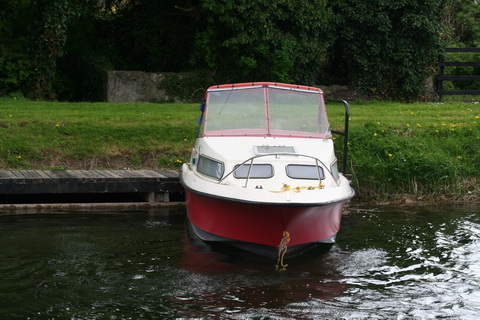
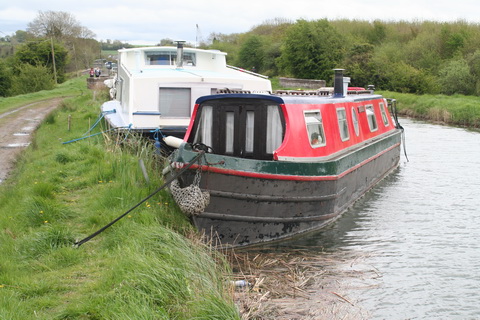
If you own either of these boats, you might like to check your mooring lines.

Barrow Otter between the aqueducts

Barrow Otter between the aqueducts

Small boat at Robertstown_resize

Small boat between the Robertstown slipway and Lowtown

Incidentally, the roadway between Robertstown and Lowtown is in dreadful condition.


Lake flights resume …

… at Mountshannon.

The Shannon River in 1902

Last week I gave the dimensions of the Shannon River:

Length: 770 feet

Breadth: 3 feet 6 inches

Depth: 1 foot 3 inches

Longest straight stretch: 90 feet

Tunnels: 6, totalling 356 feet, the longest 100 feet.

I added that it had a monorail link.

And so it did, in Bombay in 1902, at Lady Northcote’s Fancy Fete and Shannon River Show, with boats, a mono-rail, frocks, shamrocks and Art. Irresistible.

Royal Canal, Dublin

Some superb pics here, by Conor Nolan, of converted working boats on the final descent into Dublin on the recently reopened Royal Canal.