Category Archives: Scenery

A load of old bollards

Our London Correspondent reports that the latest and most fashionable souvenir to go on sale there is a reproduction cast-iron “paperweight/doorstop/bookend based on the mooring bollards of Regents Canal”. Available in black or fluorescent red, these items were designed by a designer who was being worked with by another chap who was commissioned by a Creative Agency. The result is a “desirable antidote to the overly-commercial, tacky souvenirs” available elsewhere, it says here.

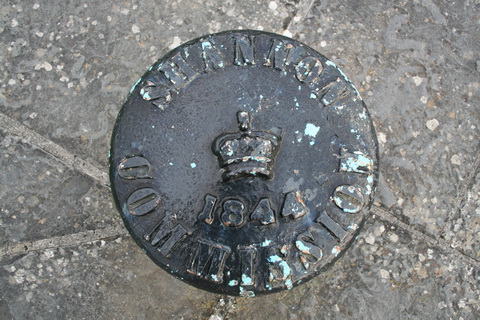
Shannon Commission bollard 1844_resize

A bollard at Meelick

Well, that’s nice. Maybe Waterways Ireland could commission the same creative types to design a range of reproductions of Irish waterways bollards; folk could be encouraged to collect the entire set.

But one minor drawback does strike me. The artistic merits of these reproduction bollards are of course obvious, but as souvenirs they have one minor drawback. A souvenir is something you buy, while on holiday, to take home to someone else. Nowadays, the steamer services are not what they once were and many folk travel on these new-fangled flying-machines. But according to that nice Mr O’Leary, who operates some such machines, you may take only 10 kg of cabin baggage. These bollards, though, weigh about 1.5 kg each, which rather limits the number of bollards you can carry as souvenirs.

L+M Keating again

Here are some photos of recent L+M Keating projects.

The Fergus estuary

I have a page about the Fergus estuary here with links from that page to others about places on the estuary (including Paradise).

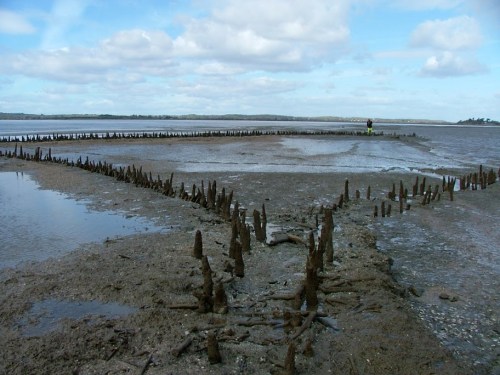
Mediaeval fishweir at the Boarland Rock in the Fergus Estuary © Dr Aidan O’Sullivan, UCD 2008

Mediaeval fishweir at the Boarland Rock in the Fergus Estuary © Dr Aidan O’Sullivan, UCD 2008

The UCD School of Archaeology has, for many years, been investigating the Fergus estuary and has found remarkable evidence of settlement and activities on the estuary stretching back to the Iron Age (about 100 BCE) and the Bronze Age (almost 800 BCE). Read about the project here and see more photos of mediaeval fishweirs and earlier artefacts here.

The photo above is used in accordance with the terms set out here.

Northsouthery 121212

The North/South Ministerial Council reports here [PDF] on the most recent inland waterways meeting, which was held on 121212. Not much happened (or at least not much that is being revealed to the citizens and subjects). Sponsor departments are to think about having a board; there is still no money for the Clones Sheugh but an interagency groups is to find some [hint: look under the end of a rainbow] and it was John Martin’s last appearance as he will be retiring in March and the search for a new CEO has a process (which is important).

The interesting bit is that WI is to transfer some property at Harvey’s Quay, Limerick, to Limerick City Council, which is making a boardwalk. And something similar is happening in Tullamore. You’re nobody nowadays unless you have a boardwalk; their usefulness in Irish weather is not proven.

Finally, I noted a certain modesty in WI’s aims for 2013, no doubt in keeping with the tenor of the times:

Ministers discussed the main priorities for Waterways Ireland in 2013 and noted progress on the 2013 Business Plan and Budget. The priorities for 2013 include:

• ensure the navigations are open and all existing facilities operational during the main boating season from April to October
• to actively promote the waterways to extend and expand recreational use of the waterways in all its forms.


Mountshannon

In the Foreword to his latest book, Portraits of Mountshannon (East Clare Heritage, Tuamgraney 2012), Ger Madden writes of the changes to Mountshannon since 1993:

The Aistear, the children’s playground, the pre-school building, the floating jetties at the harbour, additional restaurants and shops have been hugely positive and successful. The same cannot be said for housing. Ten years of reasonable prosperity for some, has resulted in new private holiday homes built on the fringes of the village and others planned. They are not associated with the needs of the community. The majority of the owners have not the slightest interest in the history, culture or welfare of the community they have chosen to display their wealth.

Any such owners wishing to develop an interest in the history of Mountshannon could not do better than to start with Ger’s book. It’s A4 landscape, with an aerial colour photo of Mountshannon on the front and a map on the back. Inside, the foreword gives a brief overview of Mountshannon’s history. Then follow 52 pages, each with a black and white photo and each covering a building, a tree or a place of interest in and around Mountshannon. Their locations are shown on the map on the back cover.

But, although architectural information is provided, the book is not about the buildings per se. Each page is a window into Mountshannon’s history and, together, they provide a rich account of the place and its people over the centuries. Part of the interest is in the fact that buildings you might pass by without noticing turn out to have interesting stories attached to them. Nor are they all about the distant past: I was glad to see that Mountshannon’s more recent claim to fame, as the last telephone exchange in the country to be automated, was recognised here (although I suppose that too may seem like the distant past to younger readers).

I highly recommend the book. If you’re in the area, you’ll probably know better than I where to get copies; if you’re not, you might ask East Clare Heritage.

Ger runs boat trips to Holy Island during the summer.


Around the world with Irish waterways

Yesterday was one of those days: I managed to track down sources for several pieces of information I’ve been hunting for some time, but in the process I came across a few interesting links, from Gordon of Khartoum to the War between the States.

The starting point was William Watson, manager of the Inland Department and later Chairman of the City of Dublin Steam Packet Company. He worked with Robert Mallet on the design of an innovative boat for use on Irish inland waterways. Robert Mallet married a Cordelia Watson in 1831. (I thought that might be a daughter of William of the CoDSPCo but it’s pretty clear from the excellent Mallett Family History site that that was not so.)

One of Mallet’s inventions was a large mortar designed for use in the Crimean War. And one of Mallet’s sons, John William Mallet, went to the USA and became professor of chemistry at the University of Alabama. He joined the Confederate forces, rising to the rank of lieutenant-colonel in the artillery and superintendent of the Confederate ordnance laboratories.

Meanwhile Watson’s son Charles Moore went east rather than west. Colonel Sir Charles Moore Watson KCMG, CB, MA, of the Royal Engineers, Watson Pasha, was a general in the Egyptian Army and Governor-General of the Red Sea Littoral. Watson’s base was at Suakin on the Red Sea. The Dubliner was succeeded in that post by a Kerryman, Horatio Herbert Kitchener, from Ballylongford near Saleen on the Shannon Estuary, on which the City of Dublin Steam Packet Company operated.

Watson was “Gordon’s principal friend in Egypt”:

It is certain that Watson was, above all others, the one man in Cairo whom Gordon cared about most, and that he was the last to see Gordon off when he started [for Khartoum].

Gordon died at Khartoum; the relief expedition, led by another Irishman, Sir Garnet Wolseley, arrived two days too late.

A younger brother of Sir Garnet, Frederick Wolseley, went to Australia. His Sheep Shearing Machine Company made a brief expedition into the manufacture of motor-cars, under one Herbert Austin, who later founded his own company. Austin and Wolseley both ended up in British Leyland Motor Corporation, which made diesel engines, some of which were marinised and used in boats on the Irish inland waterways … which brings us back to where we started.

Please, sir, I want some more

I have written from time to time about the Heritage Council and the budget cuts it has suffered. Here’s a comment from December 2010; here I said that the Council’s vigorous lobbying campaign had succeeded in ensuring its own survival; last month it became clear that, although the Council had survived, its main grants scheme had not.

The dauntless Michael Starrett returns to battle in today’s Irish Times [incidentally, if the Irish Times tries to charge me for linking to their site, I’ll set McGarr Solicitors on them]. He argues that natural and cultural heritage are the core of the tourism product and that they are being damaged by the withdrawal of (inter alia) the Council’s programme of (mostly small) grants to (mostly small) community projects.

This line of argument accords with that used by the Council in its successful campaign to ensure its own survival. It was made explicit in the report Economic Value of Ireland’s Historic Environment [PDF] produced by Ecorys and Fitzpatrick Associates for the Heritage Council and launched in May 2012. However, there are some difficulties with its use in the present context.

The first is that some folk might feel that heritage (natural or built) should be appreciated for itself, not for its economic value. That’s fine as long as people do it on their own time; I lose sympathy when that argument is used to extract money from taxpayers while hiding the economic cost and distracting attention from the beneficiaries of that spending.

The second difficulty is that the Economic Value of Ireland’s Historic Environment concentrates on larger sites and attractions:

Reflecting these various criteria, Ireland’s historic environment has been defined for the purposes of this study as comprising the following sets of built heritage assets – those which are statutorily protected, together with components of the broader built heritage:

– World Heritage Sites
– Recorded Monuments, as defined by the Department of Arts, Heritage and the Gaeltacht
– Protected Structures included in planning authorities’ development plans
– Architectural Conservation Areas included in planning authorities’ development plans
– Designed landscapes surveyed by the Inventory of Architectural Heritage, and
– Other structures erected pre-1919, of which a note says “This is an increasingly accepted definitional component for the broader built heritage, although it is  acknowledged that some Protected Structures may have been built post 1919. Up to 1919 most houses in Ireland and Great Britain were built by skilled craftsmen using traditional indigenous building materials. Although the majority of older buildings are not listed/ statutorily protected, the majority provide flexible domestic and office accommodation. Major investment in money, energy and materials is embodied in these structures.”

The economic impact of the sector is the sum of three things:

  • Direct repair and maintenance output in relation to pre-1919
    building stock
  • Direct tourism expenditure by tourists principally attracted to
    Ireland by the Historic Environment (HE)
  • Direct employment, expenditure and income by the public sector (eg the Office of Public Works), subtracting overlap with the repair and maintenance category and the tourism expenditure category.

Eight of the ten case-studies considered in the report are about large sites, some of them commercial operations and others state-owned. The two exceptions are the Irish Landmark Trust and the Heritage Council’s grant scheme for traditional farm buildings.

Now, as far as I can make out, a lot of the recipients of Heritage Council grants (generally, not just those for farm buildings) would have fallen into the “Other structures erected pre-1919” category. I have not been able to discover, from the report, how much of the Historic Environment’s contribution to Gross Value Added is attributable to that category, or to any other category that might include the Council’s recipients of small grants.

In effect, the report seems to me to made some very broad-brush claims about the annual value of the Historic Environment, and those claims are being used to cast a halo effect over the entire sector. But it is not, it seems to me, proven that spending on any particular sub-sector is a good investment. (If I am wrong on that, I would welcome comments.)

Furthermore, I suspect that most of the contribution of the small projects supported by Heritage Council grants would come from the spending on repair and maintenance (where the total contribution is arrived at after some pretty heroic assumptions) rather than from that by tourists. Approaching it from the bottom up, I suspect that very few tourists are attracted to Ireland by the fact that the Heritage Council has grant-aided the clearing of an individual graveyard or the removal of rhododendron from a woodland.

So the argument that is being presented today, that (to quote the headline) “Tourism will suffer without real support for heritage” where “heritage” means “small local projects”, is not convincing. And it is rendered even less convincing by the fact that Heritage Council grants schemes explicitly gave low priority to tourism projects. But that is not to say that the small schemes are without value: there could and, I would argue, should be an effort to use them as part of the tourism marketing effort.

But there is a real difficulty here. How do you market small-scale tourism attractions? How does a small enterprise, or a small community, sell its heritage? How do the overseers of the national tourism product get tourists out of the well-known areas and off the beaten track, to places where they can meet real people and see real stuff? Maybe that’s what The Ghastly Gathering is about [I’m sorry: I can’t bring myself to read it].

Towards the end of his article, Michael Starrett talks in terms of landscapes, and I think he is right to use a term that is broader than a single site or location for a project. To have an impact, to be marketable, small projects need to be linked. Some of those links could be geographical, within a single area or landscape; some could be temporal, some familial, yet others commercial or otherwise thematic (for instance, the fascinating history of the Irish egg trade). I think that the small projects can help to attract tourists, but they need to be organised.

 

Melancholy loss of life on the River Shannon

Last Wednesday we were witness to a most melancholy spectacle. We saw three bodies floating on that part of the river Shannon which lies opposite to Castle Lough, in this county. Having rowed in to shore, we gave notice to some persons there, who, without hesitation, prepared themselves, and joined in the sad task of snatching from the watery element the livid bodies of three unfortunate fellow creatures. When we stretched them on the bank they were recognised by one of the Steam Packet Company to be the bodies of Thomas Minshoe, George Halbert, and Robert Williams, three of the unfortunate five that were drowned some few days ago, while on a party of pleasure. The bodies were far advanced in a state of putrefaction and were a revolting spectacle to look on.

A messenger being despatched to Nenagh for the coroner, James Carroll, Esq, that officer, with his usual promptness, reached here in a short time; and having empanelled a jury, “Accidentally drowned during a squall” was the verdict.

It appeared from evidence that the deceased, with others, left Killaloe on Sunday, the 20th ult, for the purpose of having a day’s amusement on the Upper Shannon. They put in at Castle Lough to take refreshment; during the time they were on shore, the wind freshened and blew a gale, upon which they determined to leave the boat at anchor, and proceed home by land, which they accordingly did. On the following morning they returned and found that the ropes, which were for the purpose of lowering the sails, had been stolen. The day being fine and the weather not likely to change, they made light of the inconvenience, and ventured homeward.

After hoisting sails and reaching the centre of the river (which, at this point, is not two miles broad), a squall came on. Having endeavoured in vain to lower sails, which was completely impracticable, on account of the loss of the ropes, the boat suddenly ducked beneath the weight of canvass, and consigned the poor fellows to an early grave. Thomas Minshoe and George Halbert are natives of Liverpool, and Williams from Wales.

No coffins being convenient, three fishermen were appointed to watch the bodies on the shore until the next day. When we saw them coffined, we observed that the ear had been eaten off Williams by, we suppose, a dog, and a part of Minshoe’s left leg. They were interred at Killaloe on the afternoon of Thursday.

1 September 1837

Where is this?

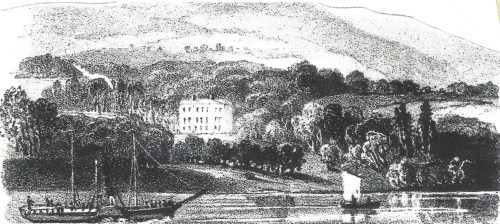
Paul Gauci's 1831 drawing of a Shannon steamer

Paul Gauci’s 1831 drawing of a Shannon steamer

This drawing of a steamer is from an 1831 book called Select Views of Lough Derg and the River Shannon by Paul Gauci. I haven’t seen the book myself, but this illustration is used in a couple of places, including Ruth Delany’s book The Shannon Navigation [The Lilliput Press Ltd, Dublin 2008]. Andrew Bowcock, in his article “Early iron ships on the River Shannon” in The Mariner’s Mirror Vol 92 No 3 August 2006, says of the steamer shown that

The funnel looks to be almost over the paddle shaft, which is artistic license.

But my question is not about the vessel but about the house in the background. If it is drawn without artistic licence, where is it?

It is a very large house, seven bays by three storeys, quite close to the water. Using the Historic 6″ Ordnance Survey map [~1840], I have followed the banks of the Shannon from Shannon Harbour down Lough Derg to Killaloe, then from Limerick down the estuary as far as Tarbert, across the estuary to Doonaha and back up on the Clare side to Limerick, then from Killaloe up the Clare and Galway shores back to Shannon Harbour. Anywhere I found a large house within what seemed the right distance of the shore, I looked it up in the Landed Estates Database and in the National Inventory of Architectural Heritage, with some supplementary googling.

I haven’t been able to find images of all the houses marked on the OSI map, but I found enough to show that houses of the size shown by Gauci were very rare. Within those few, I ruled out some (like Tervoe) because they didn’t seem to match Gauci’s drawing (although alterations could have accounted for that). I ended up with only one house that looked at all like Gauci’s, but the background may not match.

If you can identify the house, I would be glad if you could leave a Comment below.

Ballycorick

I’ve updated my page on Ballycorick to take account of information provided in a Comment by Kenin Murphy, to whom I am grateful.