Category Archives: Shannon

Urgent message for Athlone folk

If you’re anywhere near Athlone, hie thee to the Lough Ree Yacht Club at 8.00pm on Wednesday 22 October 2014 for the Old Athlone Society meeting. It features Paul Clements, who has just written a biography of Richard Hayward, author (amongst many other roles) of (amongst many other books) Where the River Shannon Flows, a book that should be in every Irish waterways person’s library.

The evening includes a showing of the film of the same name, which (though short) is highly evocative. WW2 was declared as the filming team reached Portumna. There is some very good footage of the Foynes flying-boats.

h/t gjb

Longford

Longford is a town about five miles from Clondra, the junction of the Royal Canal with the River Shannon near Tarmonbarry.

Some of the local cargo-cultists seem to believe that, if the Longford branch of the Royal Canal is restored, fleets of vessels (probably from Limerick) will bring untold prosperity to the town. And the unfortunates of Waterways Ireland have been told to produce a feasibility study on the matter. According to the minister for waterways, the study will be available on the Waterways Ireland at the end of October.

Irrespective of whether the restoration is feasible, the question is whether it would be sensible. I see two possibilities:

(a) some of the thousands of vessels already using the Royal Canal will be attracted to Longford, where the attractions of the night-life will entice them to spend more money than they would otherwise have spent in, say, Clondra. If they don’t spend more than they would otherwise have spent, the spending is simply displaced from one place (eg Clondra) to another (Longford). If that is so, it might be worth the while of the publicans of Longford to pay for the restoration, because they will benefit from it, but there is no benefit to the taxpayer in paying for it because the spending is simply moved from one place to another

(b) the attractions of Longford are so great that thousands of visitors who would not otherwise have visited the Royal Canal will now do so. Again, the displacement argument applies, so these thousands of visitors must come from overseas, attracted by the reputation of Longford for metropolitan sophistication. Or something. Now, if that reputation were enough to attract overseas tourists, they would already be visiting Longford in their droves. Are they?

I am sure that Longford has many attractions apart from the alternator repair shop.


Heather Humphreys on waterways

From the Financial Resolutions speeches:

I am committed to developing North-South co-operation within the broader arts, heritage and commemorative activities of my Department as well as through the funding of North-South bodies. A provision of more than €38 million is made available to support the two North-South implementation bodies — An Foras Teanga and Waterways Ireland. These budgets will be subject to the approval of the North South Ministerial Council in due course. The provision will enable Waterways Ireland to keep the waterways open for navigation during the main boating season and promote increased use for recreational purposes while developing and promoting our waterways to attract increased numbers of overseas visitors.

Nothing new there, I think, but note the repetition of a point I highlighted last year:

The provision will enable Waterways Ireland to keep the waterways open for navigation during the main boating season […].


Shannon traffic figures to September 2014

I am grateful to Waterways Ireland for letting me have the Shannon traffic figures for September 2014.

Regular readers may wish to skip this section

All the usual caveats apply:

  • the underlying figures do not record total waterways usage (even for the Shannon) as, for instance, sailing, fishing or waterskiing on lakes or river stretches, which did not involve a passage through a lock or Portumna Bridge, would not be recorded
  • the passage records would not show, for instance, a change in the balance of types of activities from those in larger cruising boats to those in smaller (sailing, fishing, waterskiing) boats
  • figures like these will not necessarily be representative of those for the year as a whole. The winter months, January to March, see little traffic in any year; for April, May and June, the weather can have a large influence on the amount of activity especially, I suspect, in private boats.

On the other hand, the figures do include the Shannon’s most significant tourism activity, the cruiser hire business. And they are our only consistent long-term indicator of usage of the inland waterways.

All boats

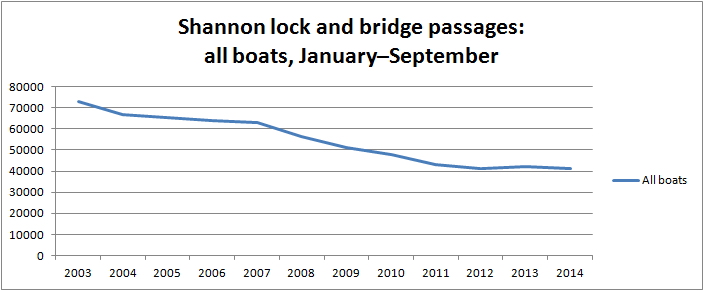
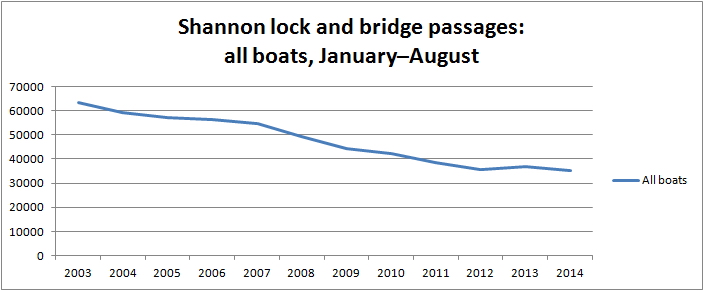
Total (private + hired) traffic for the first nine months of each year

Not a lot to say: slightly down on last year, but the numbers for the last three years have been fairly even.

Private boats

Shannon traffic 1409 private

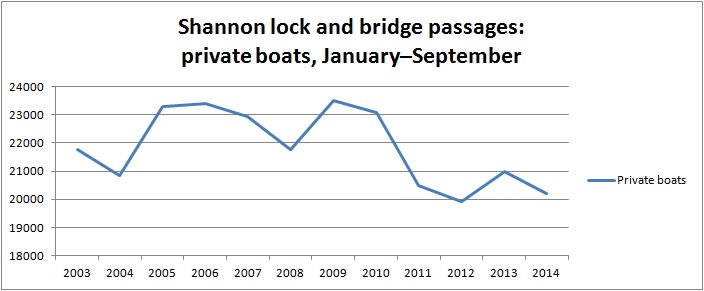
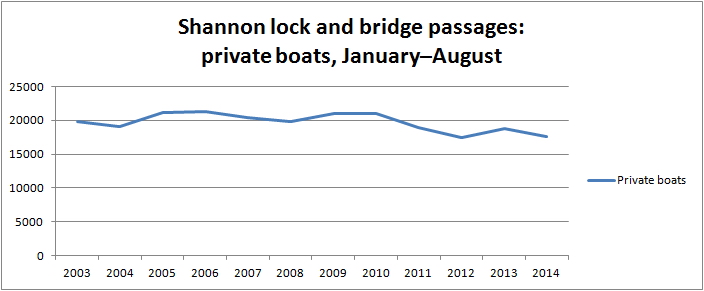
Private-boat traffic for the first nine months of each year

Note that the vertical scale is truncated, which exaggerates the scale of the changed. The good weather, especially in July and September, doesn’t seem to have resulted in a continuation of last year’s improvement.

Hire boats

Shannon traffic 1409 hired

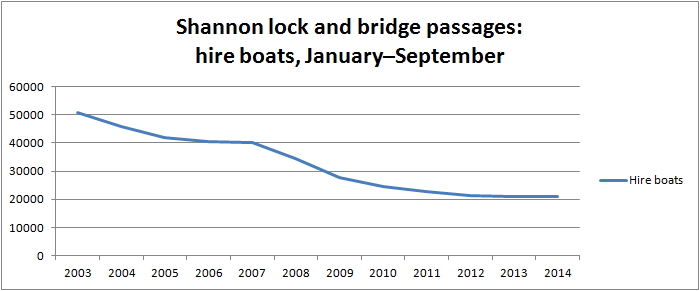
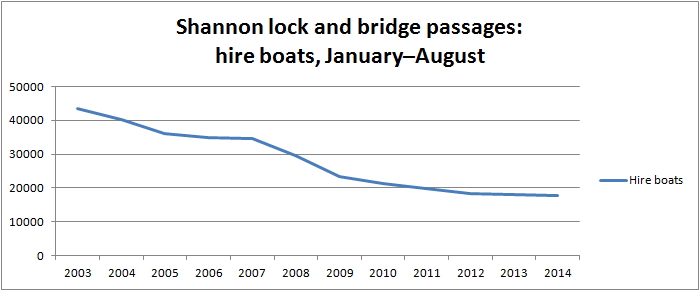
Hire-boat traffic for the first nine months of each year

Not much change from last year, but it’s the lowest nine-month figure in my records.

Percentages of 2003 levels

Shannon traffic 1409 -v- 2003

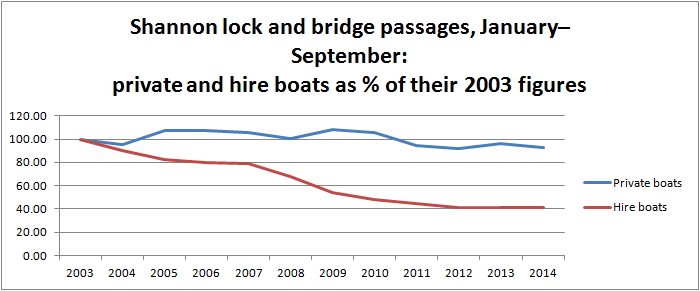
Percentages of 2003 levels

The nine-month figure for private boats is the second-lowest in my records (2012 was lowest) despite the good weather. The hire-boat figure is the lowest in my records, but the pace of decline seems to have levelled off.

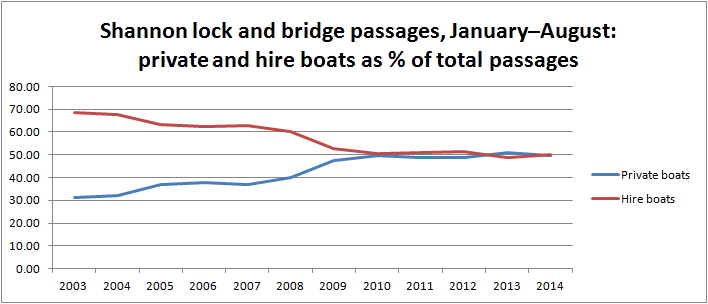
Private -v- hired

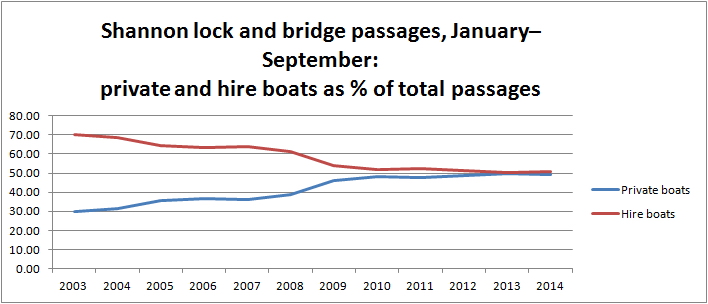
Shannon traffic 1409 private -v- hired

Still roughly 50/50

Nothing very encouraging there, alas.

Trip boat crewing arrangements

The invaluable KildareStreet alerted me to this:

Joint Oireachtas Committee on Jobs, Enterprise and Innovation: Scrutiny of EU Legislative Proposals 7 Oct 2014 3:00 pm

Marcella Corcoran Kennedy [FG, Laois-Offaly]

Schedule A: COM (2014) 452 is a proposal for a Council directive implementing the European agreement concluded by the European Barge Union, EBU, the European Skippers Organisation, ESO, and the European Transport Workers Federation, ETF, concerning certain aspects of the organisation of working time in inland waterway transport. Is it agreed that this proposal warrants further scrutiny? Agreed.

Given that Ireland has no inland waterway transport, I wondered why the committee was bothering about it, but it seems that the EU proposal would also cover trip boats.

The text of the proposal can be downloaded here [PDF; make sure you click on the Union Flag because the tricolour beneath it is the Italian, not the Irish, flag] and the Annex here [{DF; same warning]. As far as I can see, the Proposal is legal gobbledegook and the meat is in the Annex, which might affect hours of work on inland passenger vessels. although I don’t know what the current regulations are so I can’t say what changes are proposed.

Barrow Line meets Barrow Navigation

Seen from the air, 1947. Several of Limerick too. What’s the boat at bottom left in this pic of Athlone? A search for “Ireland” gives 2642 results, which is more than I can go through. If you find anything interesting, I’d welcome a link, which I’ll add here.

Murder on a Grand Canal Company boat

At the inquest on the body of Myles Crofton, who was, as alleged, murdered on board one of the Grand Canal Company’s boats on the Limerick Canal, the jury returned the following verdict:— “That the deceased, Myles Crofton, aged 45 years, dies at Killaloe on Sunday, the 29th November, 1891, from certain wounds inflicted on him in boat No 17, plying on the canal, but we find there is not sufficient evidence before us to enable us to say who the guilty person or persons are that inflicted said wounds. We unanimously wish to put before the Grand Canal Company the unhappy position of the wife and large family of the deceased, and to pray the merciful consideration of the company on their behalf.”

Freeman’s Journal 5 December 1891

From the issue of 1 December 1891 we learnt hat, on 30 November 1891, two Grand Canal Company boatmen, and a third man, were charged with the murder. The boat had left Limerick for Killaloe on Saturday 28 November with Crofton, two other crewmen and a fourth person, not a boatman, on board. When it reached Killaloe, Crofton was found to be unconscious “with seven wounds about the head and over both eyes”. The police were called and the dispensary doctor attended but Crofton died next morning “in great agony”. The other three were remanded to Limerick Jail for a week. Crofton left eight children.

On Tuesday 29 December [FJ 30 December 1891] the three men were brought before the magistrates. They were defended by P S Connolly, solicitor. District Inspector M’Donald said that one of the accused had made an important statement but, as he had not yet received instructions from Dublin Castle, he requested an adjournment which, despite Mr Connolly’s opposition, was granted. On the following day [reported in FJ 31 December 1891] the DI said that one of the men, George Farrell, had been released from prison and was prepared to give evidence against Frank Egan.

On being sworn, Farrell deposed he had heard a row in the cabin of the boat between Frank Egan and the deceased, Myles Crofton, and afterwards saw them fighting with their fists. Subsequently he saw Egan strike the deceased with his boot.

Dr John Keogh, who had attended Crofton before he died [was he the dispensary doctor?], said that the wounds were caused by violence, not by accident.

The Belfast News-Letter [1 January 1892] had a slightly different account:

[…] one of the men turned Queen’s Evidence, and confessed that while going down [sic] the Shannon a comrade named Miles [sic] Crofton was repeatedly assaulted while all the party were drinking.

Egan was committed for trial; Farrell had already been released and now the third, Nutterfield [Yorkshire Post and Leeds Intelligencer 1 January 1892] or Netherfield [Hampshire Telegraph and Oxford Journal, both 2 January 1892], was also released.

I have not been able to find anything about Egan’s trial, if there was one, or subsequent fate.

 

Shannon traffic figures to August 2014

I am grateful to Waterways Ireland for letting me have the Shannon traffic figures for August 2014.

Regular readers may wish to skip this section

All the usual caveats apply:

  • the underlying figures do not record total waterways usage (even for the Shannon) as, for instance, sailing, fishing or waterskiing on lakes or river stretches, which did not involve a passage through a lock or Portumna Bridge, would not be recorded
  • the passage records would not show, for instance, a change in the balance of types of activities from those in larger cruising boats to those in smaller (sailing, fishing, waterskiing) boats
  • figures like these will not necessarily be representative of those for the year as a whole. The winter months, January to March, see little traffic in any year; for April, May and June, the weather can have a large influence on the amount of activity especially, I suspect, in private boats.

On the other hand, the figures do include the Shannon’s most significant tourism activity, the cruiser hire business. And they are our only consistent long-term indicator of usage of the inland waterways.

All boats

Shannon traffic all boats to August 2014

Total (private + hired) traffic for the first eight months of each year

I thought that the good weather in July might have brought more boaters out in August (when the weather was not so good), but it didn’t. This is the lowest eight-month figure in my series; traffic is just under 56% of what it was in 2003.

Private boats

Shannon traffic private boats to August 2014

Private-boat traffic for the first eight months of each year

Nothing much to cheer about there. Traffic was very slightly higher than in 2012.

Maybe lots of people have taken up sailing, and thus been confined to the lakes, instead of cruising. If, gentle reader, you can think of a way of measuring sailing usage, let me know.

Hire boats

Shannon traffic hire boats to August 2014

Hire-boat traffic for the first eight months of each year

As I said last month, the pace of decline seems to have slowed, but this is still the lowest figure in my series.

Percentages of 2003 levels

Shannon traffic private and hired as % of 2003 to August 2014

Changes since 2003: private and hired boats

The eight-month figures for private traffic are a bit worse than the seven-month, but perhaps September’s extraordinarily good weather will prompt an increase. There is no good news for the hire business, but perhaps the profitability of the remaining operators will be improved.

Private -v- hired

Shannon traffic private -v- hired to August 2014

Still roughly 50/50

What is the Shannon’s USP?


Stealth seaplanes?

I have made several visits to Mountshannon this year, but unfortunately none of them coincided with an appearance by any of the “brand new fleet of aircraft, operating from destinations nationwide” that Harbour Flights promised would arrive “early in the new year” of 2014.

A puzzle in waterways history

According to the Lagan Canal Trust,

The Lagan Navigation also forms part of a wider all Ireland waterway network. This network of waterways once traversed through the towns and cities of Ireland delivering goods and produce, helping to shape the economic fortunes of the country.

I would be grateful for information about any goods or produce that were ever carried from the Shannon, or from the Royal or Grand Canals or the River Barrow via the Shannon, through the Junction Canal in the Ballinamore & Ballyconnell Drainage District [later called the Ballinamore & Ballyconnell Canal and later still the Shannon–Erne Waterway] and then the Ulster Canal to Lough Neagh or any of the waterways connected therewith. Or, of course, in the opposite direction.

As far as I can tell, outside the sales blurbs written by engineers seeking employment and waterway owners seeking subsidies, there was never a connected all-Ireland waterways network; nor was there ever any need or demand for such a thing.

Any more than there is now.