Category Archives: Steamers

The end of a ghost

In the UK, the Statute Law Repeals Bill is working its way through the House of Lords. You can download a PDF list of the bills being repealed. In amongst the turnpikes, Indian railways, benevolent institutions and lotteries, we find Part 4: Ireland (Dublin City). Within that, Group 1 sees the repeal of these statutes:

  • 3 & 4 Will.4 c.cxv (1833) (City of Dublin Steam Packet Company Act)
  • 6 & 7 Will.4 c.c (1836) (Dublin Steam Packet Act)
  • City of Dublin Steam Packet Company’s Act 1860 (23 & 24 Vict. c.xcviii)
  • City of Dublin Steam Packet Company’s (Consolidation of Shares) Act 1861 (24 & 25 Vict. c.iii)
  • City of Dublin Steam Packet Company’s Act 1868 (31 & 32 Vict. c.xxx)
  • City of Dublin Steam Packet Company’s Act 1876 (39 & 40 Vict. c.xi)
  • City of Dublin Steam Packet Company’s Act 1884 (47 & 48 Vict. c.cxxx)
  • City of Dublin Steam Packet Company’s Act 1895 (58 & 59 Vict. c.cxxiii)
  • City of Dublin Steam Packet Company’s Act 1910 (10 Edw.7 & 1 Geo.5 c.vii)
  • City of Dublin Steam Packet Company’s Act 1916 (6 & 7 Geo.5 c.viii)
  • City of Dublin Steam Packet Company’s Act 1920 (10 & 11 Geo.5 c.i).

In a Consultation Paper published in 2008, the Law Commission explained:

The City of Dublin Steam Packet Company was founded by Charles Wye Williams in 1822. From 24 January 1839, the Post Office contracted the company to run the mail service from Dublin to Holyhead. This service was later extended such that the company ran both the day and night service.

During the First World War the company suffered heavy losses, including the sinking of its ship the R.M.S. Leinster by a German submarine on 10 October 1918, resulting in a loss of over 500 lives. A further two ships were sunk during this period. The company never fully recovered from its wartime losses and, in 1924, an order for the winding-up of the City of Dublin Steam Packet Company
was petitioned for and granted by the High Court at Dublin Castle.

In Ireland, the Statute Law Revision Act 2009 repealed the 1833 and 1836 Acts and the Statute Law Revision Act 2012 repealed all the rest — except the 1895 Act. I don’t know where to get a copy of that Act, so I don’t know why it was specifically retained. But, with that exception, it seems that the ghost of the CoDSPCo has been laid to rest.


Portadown Foundry Ltd

I am grateful for a copy of Portadown Foundry Ltd: a history of the foundry 1844–1983, by Cardwell McClure and Wilson Steen, published by the authors in October 2012. It is available from five shops in the Edenderry (Portadown) area; the Edenderry Cultural and Historical Society may be able to assist.

The book’s breadth of coverage is very impressive. It may be thought of as having three main sections. The first provides five chapters covering the five main eras of control of the foundry. The second has four chapters covering employees, surviving artefacts, sporting history and Foundry Street, where many employees lived. The final section has six chapters providing the essential contest that is often omitted in local history books. These six chapters cover:

  • Portadown and the economy of Ulster
  • Foundry-built barges and lighters (of particular interest on this site)
  • The evolution of flax and linen processing in Ulster
  • The evolution of engineering in Ulster
  • The evolution of power plant in Ulster
  • The evolution of transport in Ulster.

It is richly illustrated throughout and is well worth a fiver (sterling) of anyone’s money.


A London pub and the history of the Shannon

Piloti’s “Nooks and Corners” column in the latest issue of Private Eye [No 1325] reports [brief extract available to non-subscribers here] that a London pub is threatened with demolition. On the Google satellite view with photos, press the button to the bottom right of the building to see a pic headed “Derelict pub”.

Piloti says that the pub was built in the 1840s [Diamond Geezer says 1839] and at that time the Marquis (or Marquess) was Henry Petty-Fitzmaurice, 3rd Marquess of Lansdowne, KG, PC, FRS. The family’s main base was in Britain but they owned large estates in Ireland, notably in Counties Limerick and Kerry; certain roads in Dublin are also named after the family.

The late Marquis has two claims on the attention of Irish waterways enthusiasts. First, the best-known of the early River Shannon steamers, the Lady Lansdowne, was named after his wife. Second, he was Lord President of the Council [the current holder of the post is Nick Clegg] when the government of Her Late Majesty Queen Victoria decided, in 1839, to spend about half a million pounds improving the Shannon Navigation.


How to collide

Cases, however, occasionally arise in river navigation, wherein it is not possible to avoid collision, either with vessels, barges, or boats; as, for instance, in the pool, near the Tower, &c, owing to the very crowded condition in which such places are generally found; being surrounded on every side by one or the other. In such a dilemma the only alternative is to stop the [paddle-]wheels, and let the vessels close together as easy as possible, taking care to guard the sides and paddle boxes with fenders, and using every endeavour to boom each other off; after which, let the Steamer drift with the tide, but watch an opening among the vessels for escape, and, so soon as it offers, set her on at rather better than half speed, in order to insure a command of her.

It is somehow consoling to know that even Commanders RN have been known to collide ….

The quotation is from Commander Robert Otway RN An Elementary Treatise on Steam, more particularly as applicable to the purposes of navigation, with a familiar description of the engine; Shewing the manner of its management in giving the Rotatory Motion; how started, eased, and stopped; the Nature and Properties of Steam, on both High and Low-pressure principles; its introduction into, and discharge from, the Cylinders, illustrated; as, also, how to ascertain the quantum of Actual Pressure at which the Engine is working; and the manner of Condensing Steam explained; together with a General Account of the operations of the Engine-Room; shewing the Accidents to which Steam Boilers are liable, and means of prevention; and, further, the Economy of Coals, how to be effected, &c, &c G Poore, Plymouth 1837.

This is a very readable book, available here as a free Google PDF, giving an interesting insight into the problems of the early naval steamers — and of their engineers.

Theatre steam

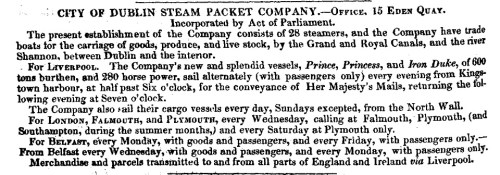
The Abbey Theatre has announced that it has bought Nos 15–17 Eden Quay, Dublin 1. No 15 was the address of the main offices of the City of Dublin Steam Packet Company.

From the Dublin Almanac of 1845

The company crest is said to be still on the wall. Abbey Street Old seems to run between the two premises; no doubt there will be some means of avoiding any problem.

I wish the Abbey Theatre well in its extension, but I hope it will find some way of honouring the memory of the City of Dublin Steam Packet Company and of the underrecognised Charles Wye Williams.

Kilgarvan Quay

On 3 October 1906 Mr Hugh Delaney of Borrisokane, Co Tipperary, gave evidence to the Royal Commission appointed to enquire into and to report on the canals and inland navigations of the United Kingdom. Tipperary (North Riding) County Council had asked him “to give evidence on behalf of the quay at Kilgarvan.”

His evidence became rather confused, as he and his interlocutors misunderstood each other. The source of the problem seems to have been his using the term “the canal” to refer both to the Grand Canal Company and to the canal itself. The main points of his evidence were these:

  • Kilgarvan Quay was “only of recent date: it was only opened in [October] 1891 and it has had an extraordinary effect on the traffic of the district and brought down the railway rates [from Cloughjordan] very considerably”
  • there had been no quay at Kilgarvan before that; there was deep water at the quay
  • the grand jury of the North Riding of Tipperary gave £230 towards the cost and the Grand Canal Company paid the rest, about £579
  • although it was only 104 miles from Kilgarvan Quay to James Street harbour, it took five or six days for barley to reach Dublin
  • he felt that the trip should be done in two days, using steam launches
  • he thought that transhipment at Shannon Harbour caused undue delay
  • people at Terryglass had built a quay and it made a port of call for the Grand Canal Company.

The present quay at Kilgarvan is not on the ~1840 OSI map (though there is a smaller quay near the bend in the road) but it is on the ~1900. I have a photo of the crane on my page about Shannon cranes; I’m no expert, but I wonder whether the crane might be older than the quay.

The Repealer

Here is a brief account of a trip from Waterford to new Ross by steamer in 1842.

Praise for Kilrush

Kilrush across the creek

It was highly gratifying to witness the animation that prevailed in Kilrush — the neatness of the little shops, the flagged pathway, and the absence of accumulated dirt, so prominent and offensive a peculiarity of most small towns in Ireland. The people about Kilrush (whose population is 5000) are handsome, and appear considerably more intelligent than in many other places.

Jonathan Binns The Miseries and Beauties of Ireland Vol II Longman, Orme, Brown and Co, London 1837


The Lagan and Lough Neagh in 1830

Philip Dixon Hardy wrote in The Northern Tourist, or Stranger’s Guide to the north and north west of Ireland: including a particular description of Belfast, the Giant’s Causeway, and every object of picturesque interest in the district referred to William Curry, Jun and Co, Dublin 1830:

The river Lagan, although of very considerable breadth in the immediate vicinity of Belfast, and running nearly thirty miles, is yet by far too inconsiderable to be of any great advantage to the town in the way of trade or commerce. By its means, however, a regular communication is kept up between Belfast, Lisburn, and Lough Neagh. Since the year 1755, upwards of £100,000 have been expended in forming a canal, by the assistance of cuts in various places along the line of the river, where it was found too shallow for lighters to pass.

The Lagan Navigation Company have now the direction of the entire line, and have made such judicious improvements, as materially to promote the desired object — a speedy transit of goods and merchandise. This, however, can, after all, be only partially accomplished, as, from the circumstance of the Company not being able to have a horse-track-way along the entire line, nor to introduce steam power, the journey can be performed in a much shorter space of time by waggons and drays going direct. On Lough Neagh there is a small steam-vessel, by which the goods taken up in the lighters are rapidly conveyed to the different towns which lie in various directions round that extensive sheet of water.

W A McCutcheon, in The Canals of the North of Ireland David and Charles, Dawlish 1965, confirms the point about the trackway:

As a result [of various improvements in the early 1800s] traffic greatly increased, though water supply problems remained, and there was a horse-towing path for only part of the length of the navigation.

He gives no details, though, so I don’t know why the trackway was incomplete, how lighters travelled on those stretches that had no trackway or when and how the deficiency was remedied. My guess is that those stretches were along the river rather than the artificial cuts and that the riparian landowners were unhelpful, but I would welcome further information.

McCutcheon does not mention the steamer on Lough Neagh. However, D B McNeill mentions it in Coastal Passenger Steamers and Inland Navigations in the North of Ireland Belfast Museum and Art Gallery Transport Handbook No 3 1960:

The first steamer on the lough was the Lagan Navigation Company’s Marchioness of Donegall. She was built by Ritchie and MacLaine of Belfast, her engines were obtained from David Napier of Glasgow and she was launched at Ellis Gut in November, 1821. She was the first inland navigation steamer in Ireland and was used for towing the Lagan canal boats across the lough. When new, she was reputed to have had a speed of two knots. She was uneconomical and her owners tried to sell her in 1824, but there were no buyers. It is believed the Marquess of Donegall used her occasionally as a yacht. She was broken up sometime about 1840 and her engines were stored in Belfast.

In his Irish Passenger Steamship Services Volume 1: North of IrelandAugustus M Kelley Publishers, New York 1969 he says that the Marchioness was a wooden paddle steamer, built in 1821 and broken up in 1843, 73′ long with a beam of 16′, with a simple single-cylinder engine. He says that the engine cost £1,400, provided 30hp and gave her a speed of 6 knots. A passenger service was considered but never provided, but picnic parties could charter the boat for five guineas a day.


Praise for Athlone

From William Henry Smith CE A Twelve Months’ Residence in Ireland, during the famine and the public works, 1846 and 1847. With suggestions to meet the coming crisis: practical suggestions to English and Irish landholders, on improved agriculture, reclamation of bogs, mosses and other waste lands; physical and social aspect; the famine and public works; monetary suggestions for Irish property; harbours and fisheries [Longman, Brown, Green, & Longmans, London; Hodges and Smith, Dublin 1848]:

As it is, there are some very fine solid works here; the bridge, the locks, and the weir, do great credit to all parties, both in the skill of design, and care in execution; they are the only great improvements, west of Dublin, possessing a really English character of magnitude, usefulness, and finish.