Category Archives: The cattle trade

The end of a ghost

In the UK, the Statute Law Repeals Bill is working its way through the House of Lords. You can download a PDF list of the bills being repealed. In amongst the turnpikes, Indian railways, benevolent institutions and lotteries, we find Part 4: Ireland (Dublin City). Within that, Group 1 sees the repeal of these statutes:

  • 3 & 4 Will.4 c.cxv (1833) (City of Dublin Steam Packet Company Act)
  • 6 & 7 Will.4 c.c (1836) (Dublin Steam Packet Act)
  • City of Dublin Steam Packet Company’s Act 1860 (23 & 24 Vict. c.xcviii)
  • City of Dublin Steam Packet Company’s (Consolidation of Shares) Act 1861 (24 & 25 Vict. c.iii)
  • City of Dublin Steam Packet Company’s Act 1868 (31 & 32 Vict. c.xxx)
  • City of Dublin Steam Packet Company’s Act 1876 (39 & 40 Vict. c.xi)
  • City of Dublin Steam Packet Company’s Act 1884 (47 & 48 Vict. c.cxxx)
  • City of Dublin Steam Packet Company’s Act 1895 (58 & 59 Vict. c.cxxiii)
  • City of Dublin Steam Packet Company’s Act 1910 (10 Edw.7 & 1 Geo.5 c.vii)
  • City of Dublin Steam Packet Company’s Act 1916 (6 & 7 Geo.5 c.viii)
  • City of Dublin Steam Packet Company’s Act 1920 (10 & 11 Geo.5 c.i).

In a Consultation Paper published in 2008, the Law Commission explained:

The City of Dublin Steam Packet Company was founded by Charles Wye Williams in 1822. From 24 January 1839, the Post Office contracted the company to run the mail service from Dublin to Holyhead. This service was later extended such that the company ran both the day and night service.

During the First World War the company suffered heavy losses, including the sinking of its ship the R.M.S. Leinster by a German submarine on 10 October 1918, resulting in a loss of over 500 lives. A further two ships were sunk during this period. The company never fully recovered from its wartime losses and, in 1924, an order for the winding-up of the City of Dublin Steam Packet Company
was petitioned for and granted by the High Court at Dublin Castle.

In Ireland, the Statute Law Revision Act 2009 repealed the 1833 and 1836 Acts and the Statute Law Revision Act 2012 repealed all the rest — except the 1895 Act. I don’t know where to get a copy of that Act, so I don’t know why it was specifically retained. But, with that exception, it seems that the ghost of the CoDSPCo has been laid to rest.
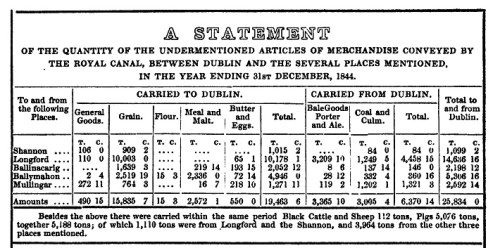


Royal Canal traffic in 1844

Royal Canal traffic in 1844 (Salt)

That table is extracted from Samuel Salt’s Statistics and Calculations essentially necessary to persons connected with railways or canals; containing a variety of information not to be found elsewhere 2nd ed Effingham Wilson and Bradshaw & Blacklock, London 1846, available from Messrs Google here.

The interesting point is how little of the Royal’s traffic travelled the whole way from the Shannon to Dublin or vice versa: only about 5% of the Dublin-bound traffic and less than 3% of the traffic westward.

Another point of interest is that traffic to Dublin was three times the traffic from Dublin.

Amongst the livestock, pigs were the dominant animals: they lost too much condition if they were walked long distances, which was the only alternative to canal transport before the railways came. Even there, I suspect that much of the tonnage described as “from Longford and the Shannon” was actually from west of the river, in Counties Mayo and Roscommon.

A London pub and the history of the Shannon

Piloti’s “Nooks and Corners” column in the latest issue of Private Eye [No 1325] reports [brief extract available to non-subscribers here] that a London pub is threatened with demolition. On the Google satellite view with photos, press the button to the bottom right of the building to see a pic headed “Derelict pub”.

Piloti says that the pub was built in the 1840s [Diamond Geezer says 1839] and at that time the Marquis (or Marquess) was Henry Petty-Fitzmaurice, 3rd Marquess of Lansdowne, KG, PC, FRS. The family’s main base was in Britain but they owned large estates in Ireland, notably in Counties Limerick and Kerry; certain roads in Dublin are also named after the family.

The late Marquis has two claims on the attention of Irish waterways enthusiasts. First, the best-known of the early River Shannon steamers, the Lady Lansdowne, was named after his wife. Second, he was Lord President of the Council [the current holder of the post is Nick Clegg] when the government of Her Late Majesty Queen Victoria decided, in 1839, to spend about half a million pounds improving the Shannon Navigation.


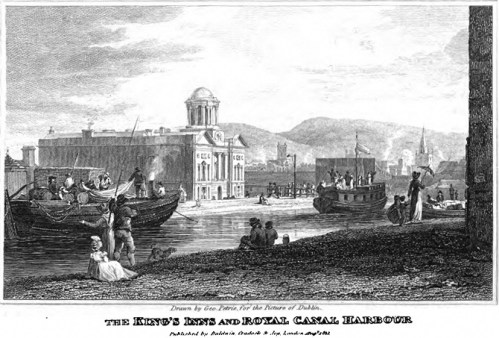
The Broadstone in 1821

The Broadstone Harbour with King’s Inns in the background, early 1820s

This is a drawing by George Petrie, made for J. J. McGregor’s New Picture of Dublin of 1821. The details of the vessels are interesting. More on the Broadstone here.

Theatre steam

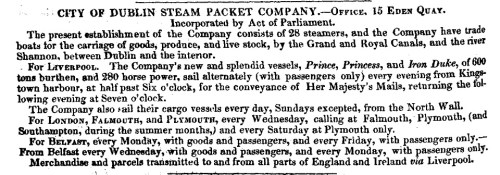
The Abbey Theatre has announced that it has bought Nos 15–17 Eden Quay, Dublin 1. No 15 was the address of the main offices of the City of Dublin Steam Packet Company.

From the Dublin Almanac of 1845

The company crest is said to be still on the wall. Abbey Street Old seems to run between the two premises; no doubt there will be some means of avoiding any problem.

I wish the Abbey Theatre well in its extension, but I hope it will find some way of honouring the memory of the City of Dublin Steam Packet Company and of the underrecognised Charles Wye Williams.

Praise for Kilrush

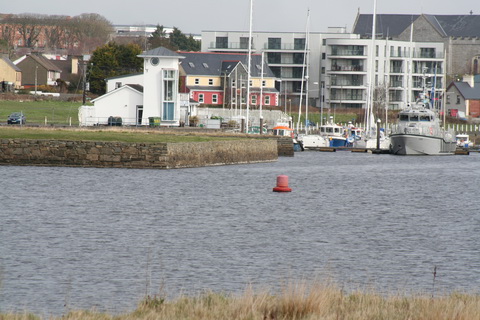
Kilrush across the creek

It was highly gratifying to witness the animation that prevailed in Kilrush — the neatness of the little shops, the flagged pathway, and the absence of accumulated dirt, so prominent and offensive a peculiarity of most small towns in Ireland. The people about Kilrush (whose population is 5000) are handsome, and appear considerably more intelligent than in many other places.

Jonathan Binns The Miseries and Beauties of Ireland Vol II Longman, Orme, Brown and Co, London 1837


Praise for Athlone

From William Henry Smith CE A Twelve Months’ Residence in Ireland, during the famine and the public works, 1846 and 1847. With suggestions to meet the coming crisis: practical suggestions to English and Irish landholders, on improved agriculture, reclamation of bogs, mosses and other waste lands; physical and social aspect; the famine and public works; monetary suggestions for Irish property; harbours and fisheries [Longman, Brown, Green, & Longmans, London; Hodges and Smith, Dublin 1848]:

As it is, there are some very fine solid works here; the bridge, the locks, and the weir, do great credit to all parties, both in the skill of design, and care in execution; they are the only great improvements, west of Dublin, possessing a really English character of magnitude, usefulness, and finish.

The Underpants Gnomes and the Shincliffe Traveller

Here is an article from 1792 about the virtues of the River Shannon. It was written by an unidentified Traveller from Shincliffe, near Durham. It is interesting as an earlyish example of the Irish waterways cargo cult which, it has been pointed out to me, resembles the business plan of the underpants gnomes.

Bring back the Black

The Black Bridge at Plassey has been closed since the floods of November 2009. Its reopening seems to have a low priority; I suspect that is because the importance of the bridge in Ireland’s technological, economic, entrepreneurial and political history is not widely appreciated. Here is a page explaining some of the background and suggesting a context within which reopening might be justifiable.

Marl update

I have added more information, from Arthur Young in 1780, to my piece on dredging for marl on Lough Derg. Young provides a few more details on the process.