
From Robert Mallett MRIA, MSCEI “On certain improved Methods of constructing Valves or Sluices, as applied to Canal and Dock Gates, &c, and similar Works of Hydraulic Engineering” in The Architectural Magazine 1837.
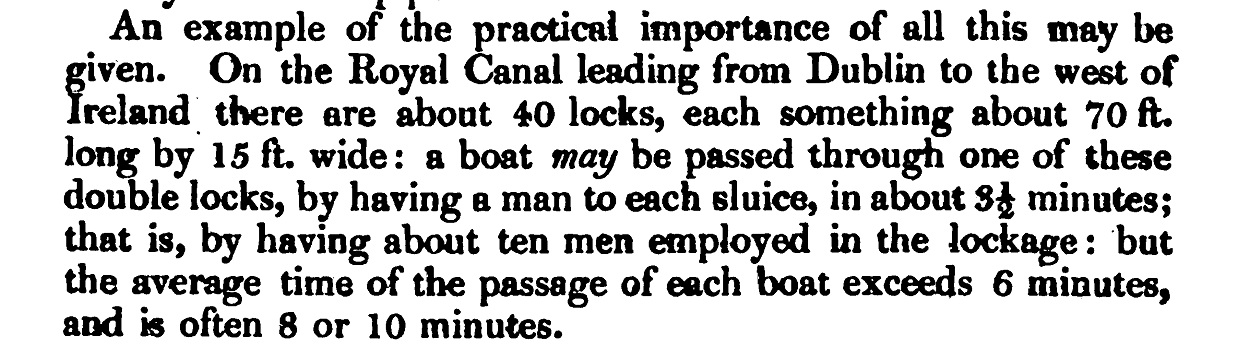
A target for WI to aim for?
From Robert Mallett MRIA, MSCEI “On certain improved Methods of constructing Valves or Sluices, as applied to Canal and Dock Gates, &c, and similar Works of Hydraulic Engineering” in The Architectural Magazine 1837.
A target for WI to aim for?
A poem by Sir Aubrey de Vere, father of the more famous Aubrey Thomas de Vere. The family estates were at Curraghchase, now a forest park, on the south side of the Shannon estuary and now best known as the home of Caroline Rigney, producer of some of Ireland’s best bacon. Sir Aubrey’s wife was one Mary Rice, of the Mount Trenchard family, one of whose members had a major role in the development of the Shannon in the 1840s.
How beautiful the tints of closing even!
The dark blue hills, the crimson glow of heaven,
The shadows purpling o’er the wat’ry scene,
Now streaked with gold — now tinged with tender green;
And yon bright path that burns along the deep,
Ere the sun sinks behind his western steep,
Soft fades the parting glory through the sky,
Commingling with the cool aerial dye;
While every cloud still kindling in the beam,
In mirrored beauty prints the waveless stream,
Light barques, with dusky sails, scarce seen to glide,
Bend their brown shadows o’er the glowing tide;
And hark! at intervals the sound of oars
Comes, faint from distance, to the silent shores,
Blent with the plaintive cadence of the song
Of boatmen, chanting as they drift along.
But see the radiant orb now sinks apace —
Gradual and slow, he stoops his glorious face;
And now — but half his swelling disk appears —
And now, how quickly gone! he scarcely rears
One burning point above the mountain’s head —
And now, the last expiring beam has fled.
The “light barques” probably included some turf boats.
There are more poems by Sir Aubrey here.
Posted in Ashore, Built heritage, Charles Wye Williams, Economic activities, Engineering and construction, Extant waterways, Ireland, Irish inland waterways vessels, Irish waterways general, Natural heritage, People, Politics, Restoration and rebuilding, Scenery, Shannon, shannon estuary, Sources, The turf trade, Tourism, waterways, Waterways management, Weather
Tagged bacon, boats, Clare, Curraghchase, de Vere, Dublin Penny Journal, estuary, Limerick, Shannon, waterways, workboat
Following the Executive’s Draft Budget, the Department of Culture, Arts and Leisure (DCAL) published a consultation paper on its own spending and saving proposals over the period 2011-15 on 31 December 2010. The public consultation period on these ran in tandem with the wider consultation on the Executive’s Draft Budget.
The document records all the representations it received about specific business areas. So which body was the only one to make a representation about the budget for Waterways Ireland?
The Royal Society for the Protection of Birds, which
Supported the continued funding of Inland Waterways and Inland Fisheries.
A year ago, in March 2011, I wrote about Waterways Ireland’s attempt to reorganise the liveaboard boats on the Grand Canal at Sallins. That attempt ultimately failed, and WI’s provision of houseboat moorings at Shannon Harbour was likewise unsuccessful: usually reliable sources tell me that two spaces have been allocated, but to non-residential boats.
Amongst the concentrations of boats parked on the Grand Canal (most of them disregarding the five-day rule), the proportions of residential boats are [I think: I know of no reliable statistics] higher at Hazelhatch and Sallins, both at the eastern end, rather lower at Lowtown and lowest at Tullamore and Shannon Harbour.
It seems that WI’s focus has shifted away from the residential boats, which it tried to tackle last year, to the non-residential boats: it has recently issued Marine Notices warning that the five-day rule will be enforced at hard-edged [ie the best] moorings on Tullamore’s “spur line” and between the 35th Lock and Griffith Bridge at Shannon Harbour. However, no notices have so far been issued about Lowtown, Sallins or Hazelhatch.
I think WI is right to separate the residential issue from the parking, but it will be interesting to see what is planned for the eastern end of the canal.
Incidentally, all of this smacks of Kremlinology, trying to deduce policy positions from minor clues, and is necessarily speculative. It would be really nice if WI published policy proposals on its website, invited comments and then formally promulgated the final policies.
Posted in Economic activities, Extant waterways, Ireland, Irish inland waterways vessels, Irish waterways general, Operations, Sources, Tourism, waterways, Waterways management
Tagged boats, bridge, canal, Dublin, Grand Canal, Hazelhatch, Ireland, kremlinology, liveaboard, lock, Lowtown, Operations, residential boating, Sallins, Shannon Harbour, Tullamore, waterways, Waterways Ireland
You will be pleased to learn that, on 28 May 2010, Arthur Scott (Director of the Culture Division) and Rosalie Flanagan (Permanent Secretary) of the Department of Culture, Arts and Leisure each received from Waterways Ireland a waterways mug and a book on the Royal Canal, total value £20 each. Later in the year, however, Rosalie Flanagan declined an invitation, estimated to be worth £8, to the opening of the Royal Canal on 1 October 2010.
Mrs Flanagan and husband are members of the Belfast Boat Club but do not hold any position on the Club’s Committees or Council. Orla Bateson, Head of DCAL’s Research & Statistics Branch, is a committee member of Intercity Paddlers, a Belfast canoe club.
The Department of Culture, Arts and Leisure is the Northern Ireland department that shares with the Department of Arts, Heritage and the Gaeltacht the responsibility for two north–south bodies, one of which is Waterways Ireland. DCAL’s organisation is described here. And on this page, you can find the minutes of departmental board meetings.
In the minutes of the meeting held on 14 December 2011, we read:
6.0 N/S Bodies Governance (Arthur Scott) (DB 90-11)
6.1 Arthur Scott spoke to paper DB 90-11 which highlights the key differences between the DCAL Sponsorship Manual and the Financial Memorandum for N/S [North/South] Bodies and the challenges this presents for DCAL officials in seeking to draw appropriate levels of assurance for the DCAL Accounting Officer (AO). The Board were asked to note the key actions being taken to address these challenges. These included:
6.1.1 Ongoing work with Department of Arts, Heritage and the Gaeltacht (DAHG) to change the focus / nature of Waterways Ireland (WI) monitoring meetings.
6.1.2 Introduction of additional meetings between sponsor departments and the N/S Bodies to gain a better understanding of key issues and to be able to probe officials from the bodies about these.
6.1.3 A commitment by both AO’s to attend meetings about priority issues.
6.1.4 Briefing Ministers about key issues ahead of N/S Ministerial Council meetings.
6.2 The Board discussed governance and accountability arrangements and whether the Sponsorship Manual should apply the same way to N/S Bodies as it does with DCAL’s ALBs [arms-length bodies, I presume]. The Board agreed that the ALB Sponsorship Manual for DCAL, as it stands, should not apply to N/S Bodies. Instead, a separate document is required with a starting point being the Financial Memorandum.
Action: Sinead McCartan to remove references to N/S Bodies from Sponsorship Manual.
6.3 Rosalie Flanagan said she would meet with her counterpart in DAHG, Joe Hamill, to discuss the Financial Memorandum and how DAHG draw their required assurances from it.
And in those for the following meeting, held on 21 January 2012, we read:
11.0 Quarterly Assurance Statements (Sinead McCartan – DB 7-12) […]
11.3 In relation to the delayed progress on the risk assessment exercise for N/S Bodies as highlighted on the Corporate Services Division QAS, Rosalie Flanagan confirmed that she has met with counterparts in the South and it is proposed that a new governance framework will be prepared for Ministers’ consideration.
Action: Arthur Scott to incorporate the findings of the N/S risk assessment into the development of a new governance framework.
It seems that DCAL is pushing for tighter control over Waterways Ireland. If DAHG published its minutes [if it does, I can’t find them], we might be able to see what it feels about the matter.
Posted in Economic activities, Engineering and construction, Extant waterways, Foreign parts, Ireland, Irish waterways general, Operations, People, Politics, Sources, Ulster Canal, waterways, Waterways management
Tagged dcal, department of arts heritage and the gaeltacht, department of culture arts and leisure, Ireland, North/South Ministerial Council, Northern Ireland, northsouthery, Waterways Ireland
A correspondent writes:

Trees in the cut (photo reproduced by kind permission of the copyright owner)
I walked the stretch of the Royal Canal from Drumcondra to Leixlip last Sunday. Just before Callaghan Bridge there was considerable work being done felling trees along the bank. Hopefully no boater tried to pass this way over the weekend […]. Several trees lay across the width of the canal, and a very large section of what looked like plywood was also floating on the surface.
I understand from WI’s website that winter closures affect locks from the 8th eastwards, but no Marine Notice suggests closures just west of the 12th (although closures were expected from the 33rd westward). Perhaps anyone planning to navigate on the long level between the 12th and 13th should check with Waterways Ireland.
Posted in Ashore, Engineering and construction, Extant waterways, Ireland, Irish inland waterways vessels, Natural heritage, Operations, Scenery, waterways, Waterways management
Tagged 12th, Blanchardstown, Callaghan Bridge, deep sinking, Dublin, Leixlip, long level, Royal Canal, trees, Waterways Ireland

 Irish waterways history