Category Archives: Waterways management

Lough Derg water

The lake level seems to be down about a foot. Two rumours purport to account for this: either (a) the powers-that-be want us to get used to a new, lower level, so that we won’t notice when Dublin starts extracting water, or (b) the ESB is generating as much electricity as it can before it starts getting charged for water. Such charges would be covered by the same European Commission reasoned opinion as that mentioned here that might see Waterways Ireland being charged to fill the Grand, Royal and SEW.

Or, of course, it could just be that there hasn’t been much rain. According to Met Éireann’s seasonal summary for winter 2012 [two-page PDF]:

Majority of rainfall totals were below normal for winter across the southern half of the country and in some parts of the east. Rainfall totals were below average in the majority of these parts during December and January, while all stations reported dry conditions in February. Most stations the east and south reported a below average number of wetdays (days with 1 mm or more) and the driest winter since 2006 (6 years).

Ardnacrusha usually runs fewer turbines in summer.
How much Dáil time …

… is wasted in asking and answering questions over and over again? I’d have thought that Caoimhghín Ó Caoláin TD (Cavan-Monaghan, Sinn Fein) would have realised that the government has discovered neither oil nor a crock of gold and that there is no money for a canal to Clones. The task of finding some is to be delegated to an “inter-agency group”, poor dears. I’d have thought it might be better to give the job to people with experience of unconventional fund-raising; there must be some such people around.

Stolen engines

KBSR's Noosacat


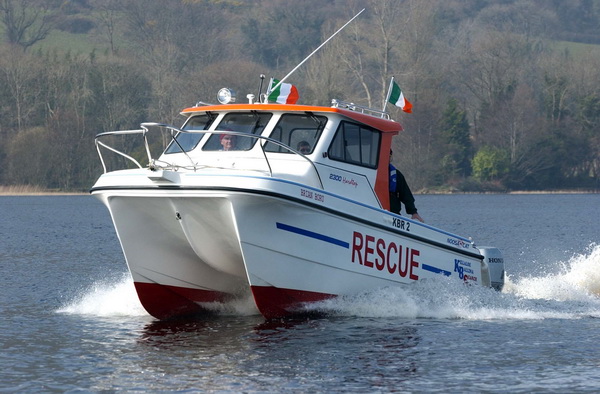
If you’re offered any cheap 90hp outboards, be suspicious: two of them have been stolen from Killaloe-Ballina Search and Recovery Unit’s Noosacat.

Give Tullamore its due

In this post I quoted the Offaly Express report about the Tullamore Dew Heritasge Centre:

As part of a wider redevelopment of the area by Tullamore Town Council, visitors will approach the new Centre along a canal-side boardwalk from which they enter a reclaimed and renovated vintage barge which will house the ticket office and a presentation on the local history of the canal produced in association with Waterways Ireland.

I wondered where the barge would be tied.

It seems that some significant work is to be done, to judge by this Marine Notice from Waterways Ireland:

The Grand Canal

MARINE NOTICE 16/2012

Tullamore Canal Corridor Project – Preliminary Notice

Waterways Ireland wishes to advise masters and owners that planned improvement works in the vicinity of the Tullamore Dew Heritage Centre in Tullamore will require the closure of the canal from 5 November 2012 until 4 March 2013.

Masters and owners are requested to take account of this closure should they have plans to cruise beyond Tullamore during this period.

Incidentally, I’m all in favour of anything that promotes the canal and sells Irish whiskey, but are all new heritage centres going to be marketing devices and shops?


NAMA, DDDA and the Grand Canal Basin graving dock

One of the graving docks


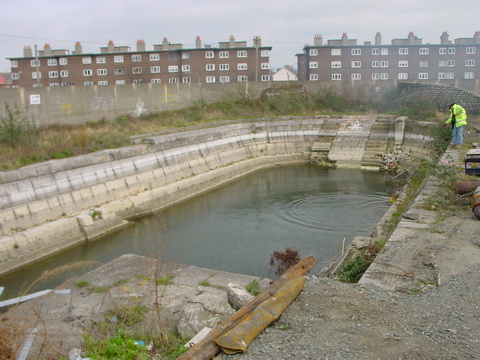
Interesting contextual material from Nama Wine Lake here. IWAI Dublin Branch page on the graving docks here.

Public sector cutbacks

The Department of Arts, Heritage and the Gaeltacht, which is ultimately in charge of waterways, has published an organisation chart [one-page PDF]. It shows that the department has a minister and a minister of state and a secretary general.

At the next level down there are five main divisions:

  • Corporate Affairs
  • Arts, Film, Music, Cultural Institutions
  • Heritage
  • Gaeilge, Gaeltacht & Islands
  • Central Translation Unit & Placenames.

Each of the first three is headed by an assistant secretary; the fourth has a Director of Irish and the fifth a plain director. The department is spread between offices in Galway, Killarney, Wexford and four locations in Dublin.

So where, I hear you ask, are waterways looked after? We have to come down to the next level, the principal officers, to find out. And there, we find that Corporate Affairs has three POs, one of whom is responsible for

HR, Strategic Planning, Corporate Governance, N/S Co-ordination & Waterways Irl.

That’s quite a lot of things for one person to be responsible for.


Date

Killaloe & Ballina are having one of Waterways Ireland’s Discover Days on Sunday 29 April 2012.

Includes “visitor attractions, water activities, arts and crafts, face painting, live music, a historical walking tour, boat trips and other land and water activities”.

More info as it becomes available.

Barrow Corridor Study

The Barrow Corridor Study is now available on the Waterways Ireland — in twelve separate chapters, alas. Catering for folk with two-stroke modems is a good thing, but what about catering as well for those of us with broadband and pains in our mouses?

Long-term serviced moorings at Shannon Harbour

Request submitted to Waterways Ireland:

I would be grateful if you could tell me how many bids you received for these moorings, how many you accepted and what the lowest and highest accepted bids were.


Waterways for peace

From The Northern Ireland Peace Monitoring Report: Number One by Paul Nolan, published by the Community Relations Council, 6 Murray Street, Belfast BT1 6DN, on 29 February 2012, and downloadable here:

The North–South Ministerial Council sits at the apex of six cross-border bodies, the remit of which is to ‘develop consultation, co-operation and action within the island of Ireland’ on matters of mutual interest. In practical terms this means the management of overlapping concerns on areas such as trade, tourism, waterways, fisheries and transport. Very little political controversy attends the operations of these bodies, and for the most part their activities are conducted in a brisk and business-like way.

The general conclusions of the report are more depressing. The Council lists these ten key points:

1. The political institutions are secure
2. The level of violence is down
3. Paramilitarism still remains a threat
4. The policing deal is not secure
5. The recession is impacting upon the equality agenda
6. Youth unemployment is potentially destabilising
7. A new confident and neutral urban culture has emerged
8. Northern Ireland is still a very divided society
9. There is no strategy for reconciliation
10. No solution has been found for dealing with the past.

But then the southern state hasn’t managed 10 either.