Goodbye pork pie — what?

It’s a conspiracy, I tell you. Jacob Rees-Mogg wants to keep all the cheese and all the pork pies for himself (though you’d have thought the Brexiteers produced enough pork pies of their own).

No more Wensleydale, Caerphilly, Lancashire, real Cheddar or the other [animal-based edible] delights of foraging across the water.

Goodbye pork pie hat.

But on the water, this will mean that boaters on the Shannon–Erne Waterway will have to be careful not to move animal products from one side of the boat to the other. Travelling to the Erne, Free State products may have to be kept on the starboard side and Brexitanian products on the port; they’ll have to be swapped over for the return journey.


The rules of the road

Another subject which has engaged our attention has been the frequent accidents that have of late occurred from steam-vessels coming into collision with other vessels, and it appears that from the recent introduction of this mode of navigation no defined rules have been adopted to guard against such occurrences.

A Select Committee of the House of Commons was appointed in the year 1831 to consider the question of steam navigation, and the numerous accidents arising from the employment of steam-vessels. This branch of the subject came under their consideration, and in the Report which they laid before the House thet expressed their opinion of the necessity of establishing some regulations, which they briefly suggested; these, however, have never been adopted, and the evil continues to increase.

With sailing vessels the rule which has been laid down and admitted in courts of law, viz, that, when two vessels meet upon contrary tacks, the one on the larboard tack shall bear up, and that upon the starboard tack shall keep her wind, has been attended with the best effect.

We are aware that the same rule is not strictly applicable to steam-vessels, and that there exists great difficulty in treating a subject involving the varying nature of the circumstances in which steam-vessels are placed in a river as regards the state of the tide, the depth of water in the river, the draught of water of the steam-vessel, and particularly the more or less crowded state of the river, from the number of other vessels in motion, and their relative position.

But rules upon this subject have been laid down, and are enforced, in the Firth and River of Clyde; and we consider it of the highest importance that some “rule of the road” should be established, to be acted upon whenever circumstances will admit. We therefore annex to our Report a set of rules which have been laid before us, and which, we think, may be adopted with advantage.

[…]

Appendix C. Proposed Regulations for the Navigation of Steam Vessels

I. In the Thames, and in all the rivers and channels of the United Kingdom, and in all cases of wind, weather, and tide, steam vessels are to endeavour to keep on that side of the river or channel which lies on their starboard hand.

II. When two steam vessels are standing in contrary or nearly contrary directions, if their courses should lead them near each other, each vessel shall keep towards the starboard side of the river or channel, and thus leave each other on the larboard hand.

III. Whenever  a steam vessel may have to meet or to cross the course of a sailing vessel, or of a rowing boat, the steamer shall in all cases yield to the sailing or rowing vessel, whatever may be the state of the wind, weather, or tide.

IV. In passing any small rowing or sailing boat every steamer shall, if necessary, slacken or stop her paddles, so as not only to prevent the danger of too near an approach, but even so as to avoid giving them any just cause of alarm.

V. Although a vessel propelled by steam in any of the four above cases, may also have had recourse to the assistance of her sails, this circumstance shall in no wise alter the foregoing restrictions; for otherwise she would only have to hoist some small sail to evade them.

VI. All these regulations shall be equally in force at night as well as by day. And for their more effective execution at night every steam vessel, when in Pilotage water, shall carry between sun-set and sun-rise three sufficiently strong lights, in lanterns, so as to be seen in all directions, and attached to a yard which must be kept square, and raised at least six feet above the tops of the paddle-boxes; this yard may be attached to the mast, or otherwise raised to the requisite height above the vessel’s bow for that purpose.

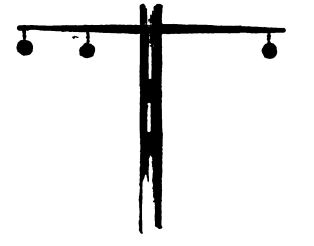
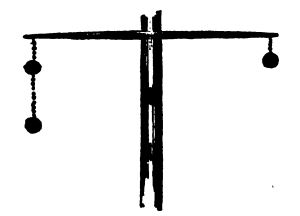
VII. These three lights shall be arranged in the following manner:— One light on each yard arm at the distance of six feet from the mast, that is, twelve feet apart; and on the larboard yard arm one additional light, which shall be placed horizontally with respect to the other light, or vertically under it, according to the following conditions:

(1) All steam vessels which may be coming up any river or channel shall show the additional light three feet directly under the light at the larboard yard arm, viz:—

(2) All steam vessels which may be going down any river or channel shall show the additional light at the same height as the two other lights, and at the distance of three feet inside the larboard light, or half-way between it and the mast, viz:—
VIII. For any infraction of the foregoing regulations a fine, varying according to the culpability of the offender, but not exceeding five pounds, should be summarily levied upon the party and, as the only means of making those regulations effectual, one-half of the fine should be payable to the common informer.

Report from the Commissioners appointed to inquire into the Laws and Regulations relating to Pilotage in the United Kingdom Presented to both Houses of Parliament by Command of His Majesty. HMSO, London 1836

Dear Her Majesty’s Government …

… here is today’s lesson.

This is a brewery.

Weberbauersche Brauerei in Breslau
~1880 [Wikimedia Commons]

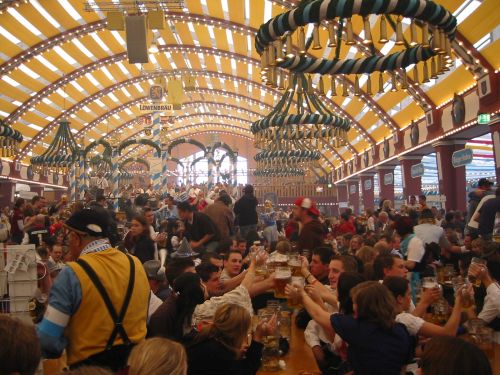
This is a piss-up.

Oktoberfest 2005. By Andreas Steinhoff, Attribution, https://commons.wikimedia.org/w/index.php?curid=843961

What you do, see, is ….


Oh, forget it.


Now I see …

… why Gerry has so many barges.

More yacht porn here.


News for Fido

Fido tells me that we have had a response from Clare County Council (but none from Waterways Ireland, although admittedly they’re not responsible).

Fido says that Clare County Council says

Your observations and comments will be brought to the attention of the Beach Management Committee.

The search facility on Clare County Council’s website hasn’t heard of a “beach management committee” so I can’t tell you anything more about it. If anyone has information, please leave a Comment below.

In other news, Fifi, the Rottweiler, says that she is going to form a Ladies’ Committee to lobby for private facilities for lady dogs. She says that the powers-that-be seem to think they’ve done enough for dogs when they’ve put up a few lampposts, but that does nothing for the ladies.

Before Viagra …

MATrimony

It is much to be regretted, but indisputably certain, that many persons of both sexes are deterred from entering the married state, by infirmities which delicacy forbids them to disclose; and many married persons are rendered miserable for want of those pledges of mutual love, without which happiness is at least precarious; these circumstances are occasioned by relaxation and weakness; and it is certain that DOCTOR SMITH’S BALM OF GILEAD is the best, if not the only remedy, ever discovered for this species of debility.

When taken into the stomach, it immediately diffuses itself like a vapour through every pore, producing effects at once delightful, salutary, and permanent; it gives tone to the nerves, exhilirates [sic] the spirits, invigorates the body, and re-animates the whole man. Those deluded individuals who have injured their health by secret sensuality in their youth, or by excesses of intemperance in riper years; the nervous and debilitated of every class; the relaxed, the languid, and the exhausted, will find in this Medicine a balm, a comfort, a consolation, and remedy for all infirmities.

Prepared and Sold by Dr Smith, at his House, No 46, Marlborough-street, Dublin, where he may be consulted every day personally, or by letter, post-paid; and at PRICE’S Medical Repository, 86, Grafton-street. Price 10s, 35s and £5.

See Practical Observations (Second Edition) on Tabes Dorsalis, or Nervous Atrophy, by E Smith MD. Price 1s 6d.

Observe — DOCTOR SMITH has withdrawn his Medicine, &c from BULL’S, 79, Dame-street.

Looking after Fido

I have today sent this email to both Waterways Ireland and Clare County Council.

This email is being sent to Waterways Ireland (Scarriff office) and Clare County Council.

Let us suppose that, during the summer season (15 May to 15 September), I set  off on my boat, with my dogs, from somewhere at the northern end of Lough Derg; I moor in Mountshannon at 11.15am.

Under Clare County Council’s beach bye-laws (number 16), I may not take my dogs ashore until 6.00pm: they will be confined to Waterways Ireland’s piers and pontoons. The entire area of the car park, the access from the piers to the roads, is off limits to dogs between 11.00am and 6.00pm.

Perhaps you might, for the convenience of visiting dog-owners, designate a corridor through which dogs (on leads) might be taken to land. After all, the area in question is not actually a beach: it is a car park.


The Mountshannon dog-prison

Let us suppose that you are on a boat, with your dog, and perhaps some humans, and that you decide to visit Mountshannon, Co Clare, in the summer.

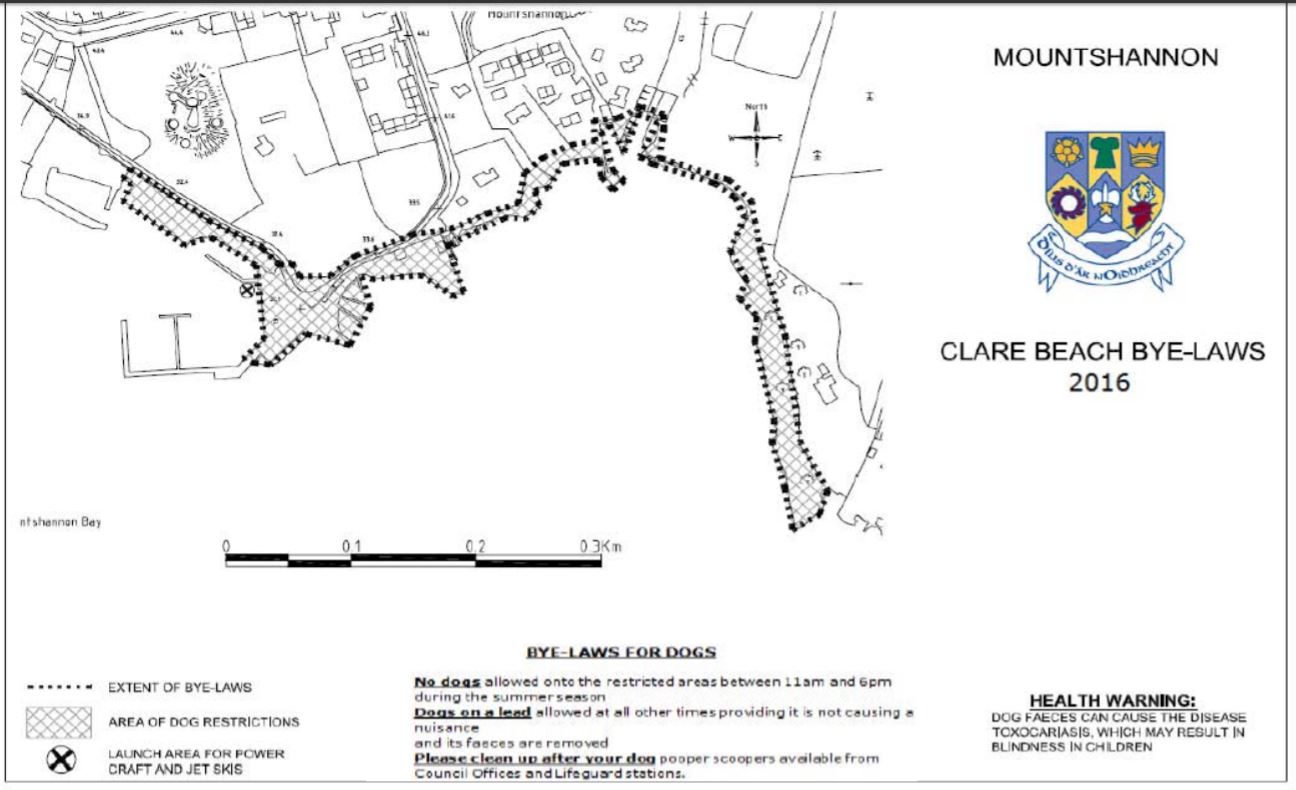
Here is a map of Mountshannon. I have stolen it from Clare County Council’s Beach Bye-Laws document, which you can download here [PDF].

Mountshannon, Co Clare

Bye-Law 16 applies to this “beach”:

16) Between the hours of 11am and 6pm during the Summer Season, it shall be prohibited to bring any dog onto any part of the beach except the exempted areas delineated on the schedule of maps attached hereto. Before 11am and after 6pm, a dog may be brought onto the non-exempted areas of the beach on the conditions that:

  • the dog is on a leash;
  • it is not causing annoyance, danger or nuisance to any person using the beach or worrying, chasing, injuring or disturbing any animals, birds or other creatures on the beach; and
  • its faeces is removed and deposited in a suitable receptacle.

There are some exceptions: guide dogs and those employed by the constabulary and the excise-persons.

The area from which dogs are excluded is shown by the hatching on the map. It covers the only exit from the piers to the shore. Thus it is not permissible to take little Fido to the land between 11.00 and 18.00 in the summer.

Little Fido had better be good at crossing his legs.


A lake museum?

Nah, it’d never work.

Headlines

From the Irish Times website at 0855 on 17 March 2019:


It seems that the second headline is about some sporting persons rather than another mass murder. Perhaps the sports department’s headline writers would benefit from sensitivity training. Or something.