News from the Windsor and Eton Express

A memorial to the lord lieutenant from the gentry and landed proprietors of Sligo, Leitrim, Fermanagh, and Cavan, lies in Enniskillen for signatures. It prays that a canal may be formed which will connect Lough Earne [sic] with Lough Allen, and that again with Lough Gill, which is navigable to Sligo. This, with the canal already sanctioned between Lough Erne and Neagh, will open a communication across the kingdom, from Sligo to the ports of Newry and Belfast. In a commercial point of view, this undertaking is of the greatest importance to Ireland.

Windsor and Eton Express Saturday 28 May 1825

And quite right too

From the Dublin Weekly Register Saturday 15 June 1822:

A boy of the name of Thomas Brady was brought into custody to the Head Police Office, on Sunday morning, by James Devereux, Ranger of the Grand Canal, having been found bathing in the canal, at Charlemont-bridge, about the hour of five o’clock on the same morning. He has since been committed to Newgate.

Interesting information about the Ulster Canal …

… as distinct from ministerial reelection photo opportunities.

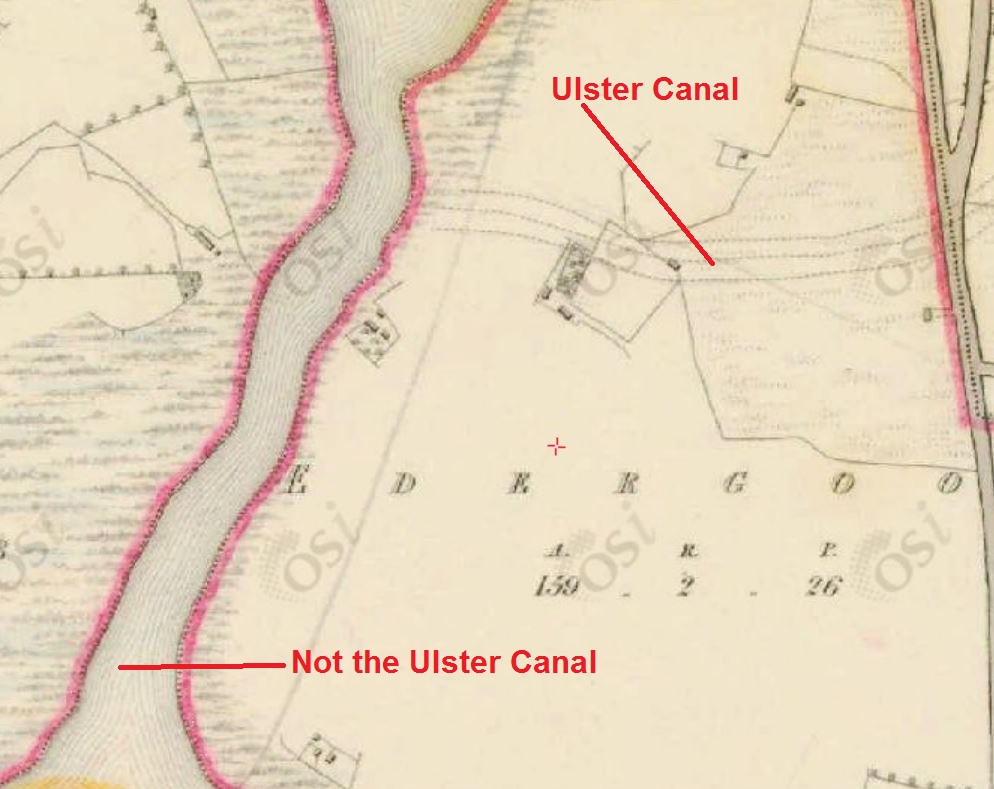
By the way, some folk get confused about the location of the Ulster Canal; this map may help:

Saunderson's Sheugh -v- the Ulster Canal (OSI ~1840)

Saunderson’s Sheugh -v- the Ulster Canal (OSI ~1840)

Anyway, for folk who are interested in weightier matters than ministers talking through portions of their anatomies that they can’t distinguish from their elbows, here is some speculation about opening bridges on the Ulster Canal.

That’s the Ulster Canal Ulster Canal, not the Saunderson’s Sheugh “Ulster Canal”, by the way.

My OSI logo and permit number for website


The industrial heritage of Mullingar …

in song.

Mick the Coach

A familiar face in unfamiliar surroundings ….

For railway enthusiasts

The economics of the current Irish railway system have received insufficient attention. If they had, the entire system (with the possible exception of some commuter lines) would have been closed down years ago and we wouldn’t have the current mad proposal to reopen the railway line to Foynes [h/t COM] at the same time as a road improvement scheme is being studied.

Happily, however, the railways of the neighbouring island have recently been the subject of considerable attention. Duncan Weldon considers here the “economic, financial and business questions raised” by the railway systems of the island of Sodor, concluding:

Economists do not fully understand the long term drivers of productivity growth. But the lesson of Sodor is this: over investing in a technologically backward, sheltered and protected from competition railway is not the road to prosperity.

And yet despite stagnant living standards the people/engines of Sodor appear content. Indeed it is unclear if they get paid at all — instead they seek meaning and joy in a Stakhanovite desire to be “really useful engines”. The great trick of Sir Toppham is employ engines who essentially evoke the image of the New Soviet man in the service of a proto-capitalist, semi-feudal enterprise.

Responding, James Kwak said:

Sodor Railways seems to be the epitome of a fat, dumb, and happy company. Labor is incompetent, yet management does nothing about it, and in return labor is eternally loyal to management. Who loses? Customers and shareholders.

However, Dan Davies offers a different perspective here. But Tracy Van Slyke has spotted other issues. I wonder whether any university offers courses in TtTE Studies.

But back to Foynes. I see that Councillor Emmett O’Brien believes that

[…] the tourism potential of this line could be explored with the possibility of steam train tourism linking Adare to Askeaton and Foynes.

The appropriate information is here.

Ballygalane on the Blackwater

Lismore Canal lock 28_resize

The Lismore Canal lock

The only lock on the Lismore Canal is at Ballygalane, on the River Blackwater. Here is a new page about the canal, with photos of some of its important features.

Waterside Belturbet

Here is a small amount of information about Belturbet and some of its industrial heritage. The photos were taken on a brief visit in July 2011.

Big it up for the Kingstown Blazers

Hats off to the Irish Sailing Association for its successful campaign to persuade owners of diesel-powered pleasure craft to pay the Mineral Oil Tax. The ISA reckoned that, if more folk paid up, the nasty foreigners might allow boaters to continue to use patriotic green diesel:

It may already be too late to save the present diesel supply system in Ireland, but the very least we can do is to strengthen the country’s case by paying the tax. If we don’t do that, we won’t have a leg to stand on.

There have been other press releases since then, and the ISA has said that

The issue for leisure sailors is not the price of diesel but its availability.

Which suggests that it’s only a series of misfortunes that has prevented 99.75% of owners from paying the tax they should have paid. Perhaps the dog ate their chequebooks.

But the ISA put its shoulder to the wheel, its nose to the grindstone and its money where its mouth was, calling on other people to pay up. And, by golly, they did. It is no doubt as a result of the ISA’s call that the number of folk paying Mineral Oil Tax in 2015 (for 2014) was …

30%

… up on the previous year’s figure.

Admittedly that just meant it went from 20 to 26, so the non-compliance rate is still around 99.75%, but let us not mock honest effort. If the number continues to increase at six a year, there will be full compliance by the year 3677, which will be good; I look forward to recording the event.

For the record:

Year Payers Litres Amount
2010 for 2009 38 n/a n/a
2011 for 2010 41 n/a n/a
2012 for 2011 22 141,503.29 €53,398.58
2013 for 2012 23 301,674 €113,841.45
2014 for 2013 20 279,842.4 €105,561.74
2015 for 2014 26 289,151 €108,934.80

The income generated by the tax is about 10% of the amount the ISA gets from the state every year.

 

Was the Brickey a navigation?

The Brickey is a small river that flows into Dungarvan Bay. Small boats used its lower, tidal reaches, but in the eighteenth century there was a proposal to link the Brickey to the Finisk, another small river that flows into the Blackwater south of Cappoquin.

Waterford County Museum, and others, believe that work began on that project in the mid nineteenth century and that a driveable track along the south bank of a stretch of the river was built as a towpath.

I have visited the river and looked online for further information; my conclusions (with maps and photographs) are here. However, I would welcome further information.