Tag Archives: barge

The mysterious Pill

Some questions and speculations about trade on St John’s Pill in Waterford.
No worst, there is none.

Pitched past pitch of grief,
More pangs will, schooled at forepangs, wilder wring.
Comforter, where, where is your comforting?

And no more licensed marked fuel traders [.xls] on the Shannon either.

The Exchequer Bill Loan Commission

I noted the other day that the North South Ministerial Council’s inland waterways meeting discussed how it might get the Irish government off the hook of its rash promise to fund the Clones Sheugh. It noted that:

[…] sponsor departments have agreed to examine the potential social benefits and leveraged funding opportunities in that context.

The interesting point is that the blasted thing wonderful investment opportunity was originally funded, using the same excuse, by a loan from the Exchequer Bill Loan Commission set up under the Poor Employment Act 1817. John Strettell Brickwood, Secretary to the Exchequer Loan Commissioners for Public Works [sic], said* that the Commission’s first £1.5 million was allocated in 1817 and that by 1835 £5.5 million had been advanced.

Of that, £200,000 (at 3¼% interest) was allocated to Ireland in 1827 and the Ulster Canal was allocated £120,000 of that; it drew down £40,000 in 1833 and the same again in 1835. Mr Blackwood said that the Ulster Canal money was issued under an express act of parliament, leaving the commissioners no discretion. There would be no repayment until the canal was complete, with the interest and principal payable only from the prospective income.

Isn’t economic development wonderful?

First and Second Reports from the Select Committee appointed to inquire into the amount of advances made by the Commissioners of Public Works in Ireland with the Minutes of Evidence, Appendix and Index Ordered, by the House of Commons, to be Printed, 26 June and 27 August 1835


Wireless telegraphy

I mentioned here that I thought that, during the major search operation on Lough Derg on 21 June 2013, life would have been easier for everybody if each boat had had a handheld VHF and someone able to operate it. However, I should make it clear that I don’t know what equipment and what sort of organisation and safety procedures the rowing group had, so I’m not going to comment on them. Instead, I’m going to make a general point about what I think are obstacles to the more widespread use of VHF.

Buying a set

Handheld VHF sets can be bought for as little as £50 in the UK or €75 in Ireland. So the technology is now very cheap and, for short range work as on Lough Derg, a handheld VHF should be adequate.

So let’s say you do a bit of searching on tinterweb, say half an hour or so; you find a cheap set from a reliable retailer, give your credit card details and then sit back and wait for the set to be delivered. Elapsed time less than a week, your time say half an hour, the price from say €75 upwards. Getting the hardware is easy and cheap: quite a change from when the Wireless Telegraphy Act 1926 (still applicable) was passed.

But if you want to be legally entitled to use a VHF set, matters are much more complicated.

Hunt the department

Let us suppose that you are a poor benighted foreigner who has decided to hire a boat on the Shannon. You know there is Coast Guard VHF cover there and you think that it would be sensible to bring your handheld set and use it while in Ireland. But, being a poor benighted foreigner, you want to do it all legally.

Your first challenge is to find which Irish government department deals with the matter. Maybe it’s the Department of Communications? You have an old booklet somewhere saying its full name is the Department of Communications, Marine and Natural Resources, which sounds promising. However, you notice that the department seems to have dropped “marine” for “energy” and searching its site for “marine vhf” returns no results.

If, at this point, you were tempted to look at the website of the Commission for Communications Regulation, and thought of looking under Radio Spectrum/Licensing, you would find a link that took you to the right place. But let’s suppose instead that, in reviewing an official list of Irish government departments, you noticed that the word “marine” is now (for some reason) part of the title of the Department of Agriculture, along with “food”.

So you troll on over to the farmers’ friends. The main headings on the site’s front page don’t include marine, though; fisheries is the closest topic. If you use the search facility to find “marine” you get 10800 results, which is rather too many to be useful, but you find that there is a Marine Agencies and Programmes Division, which has a list of Useful Links. Unfortunately none of them are to the department that actually deals with most marine matters: the Department of Transport [and Tourism and Sport], which is at both www.transport.ie and www.dttas.ie.

Things are looking up.

Hunt the unit

Your next challenge is to find the section or unit within the Department of Transport Etc that looks after marine VHF. You could use the department’s search engine, which (at least on my computer) is great for showing the word “Loading” but not for anything else. Or you could click on the word “Maritime”, which takes you to a page whereon you read:

Maritime Safety Directorate (MSD)

The Maritime Safety Directorate (MSD) is comprised of two main sections; the Marine Survey Office (MSO) which includes the Marine Radio Affairs Unit (MRAU) and the Maritime Safety Policy Division (MSPD).

Sure enough, clicking on Maritime Safety Directorate in the left-hand column gives you another page whereon you read:

The Maritime Safety Directorate comprises of two main sections: the Maritime Safety Policy Division (MSPD) and the Marine Survey Office (MSO), which includes the Marine Radio Affairs Unit (MRAU). The Mercantile Marine Office (MMO) also works to the Directorate.

This doesn’t quite correspond to the list of headings in the left-hand column on that page, which makes no mention of a Maritime Safety Policy Division and has lots of other stuff that doesn’t seem to fit in the two (and a half?) main sections, but at least there is a link for the Marine Survey Office (MSO), and on that page there is a link to the Maritime Radio Affairs Unit (MRAU), so you click that and finally you’ve arrived.

Hunt the information

The MRAU has a top-level page and two lower-level pages. The top-level page has an email address, which is good, and a list (dated 6 April 2011) of nine PDFs of Marine Notices relevant to radio. They are identified by numbers rather than by names: there is nothing to indicate what any of them is about,  so the eager seeker after knowledge will have to read all of them. Some are about EPIRBs and suchlike; as far as I can see, the only three relevant to our poor benighted foreigner, wanting to use a handheld VHF, are this one [PDF], that one [PDF] and the other one about fees [PDF].

Selecting the Contact Us page gives you names and phone numbers as well as email addresses. So the page with the detailed information must be the other one headed Forms (and not this one, which seems to be orphaned). Each of the links on the Forms page takes you, for some reason, to another page, from which you can download a document: most are indeed PDFs but two are Word DOC files.

The documents cover three topics:

Thre is also e FAQ [PDF], which outlines the rules. It also suggests that one document is missing from those downloadable: it may be called Ships Radio
Operators Certification and may be an application form.

The FAQ does not explain the different types of licences that are mentioned in Marine Notice 35 of 2010:

An Irish Certificate of Equivalent Competency (CEC) or Irish Certificate of  Competence (COC) issued by the Department of Transport, Ireland, when such
certificate states that the holder has a valid Global Maritime Distress and Safety System (GMDSS), General Operator Certificate (GOC) or Restricted Operator Certificate (ROC) qualification. An Irish CEC or Irish COC must be accompanied by the persons separate valid GMDSS, GOC or ROC qualification.

I have no idea whether I have a CEC, a GOC, a ROC or a … the other thing. And I can’t make out which of them a new applicant (or a poor benighted foreigner) should apply for.

Then Marine Notice 12 of 2004 adds another variant, the SRC:

Radio Operators on board Irish recreational craft, and on board certain other Irish craft  that are required to comply with Merchant Shipping legislation regarding the carriage of maritime radio equipment, must hold as a minimum qualification the Radio Operator’s Short Range Certificate of Competency(SRC) issued by the Commission for Communications Regulation, or an equivalent certificate that is recognised by the Commission as being the equivalent of the Irish SRC.

Is ComReg still involved? I didn’t think so.

But the main point of this marine notice is to say that the only poor benighted foreigners whose short range certificates of competency are recognised in Ireland are the Finns and the Germans; only they can get the Authority to Operate. What should other foreigners do? I don’t know and I can’t see the answer anywhere.

Information

So far, then, it seems to me that (for someone outside the system) it is hard to find the bit of the Irish government web presence that holds the information. (That, of course, is not the fault of the Department of Transport.) Once you’ve got to the relevant part of the Department of Transport website, you have to read far too many documents to find the information you want; it’s not easy to understand and it may be incomplete.

Getting a certificate and a licence

As far as I can see, the process is this:

  • attend a course from one of the approved providers [DOC]. It’s not clear to me which course our poor benighted foreigner [or other would-be operator] would have to do; BIM offers courses ranging from two to ten days, but doesn’t show the costs; I suspect that courses for pleasure-boat operators, especially those from private-sector providers, take rather less time, but I don’t know the cost. The elapsed time could be several months, depending on local supply of and demand for courses
  • take an exam from one of the approved examiners [DOC]. Again, I don’t know the duration (it used to be less than half a day), the cost or the elapsed time (how long you would have to wait until a course is available locally). As far as I can see, the syllabus is not published, so you have no choice but to go to one of the approved providers; that sounds like an anti-competitive practice
  • apply to the department for a certificate. That, it seems, has to be done on paper; the fee [PDF] depends on the certificate you need, which I don’t know, but is either €50 or €60
  • when you’ve got the certificate, you apply for a licence for your, er, ship, using this form [PDF] and paying €100. You give details of the radio operator’s certificate; if it’s a non-Irish certificate you provide a copy, and I guess that you have already applied for an Authority to Operate [PDF].

So your cost is €150 or €160 plus the course fee plus the exam fee; the elapsed time could be several months. All for permission to operate a piece of equipment that is rather less complex than a modern smartphone.

Costs and benefits

Years ago, there was some abuse of VHF channels, which were sometimes used for casual chit-chat. From what I can hear, that is no longer a problem; folk probably send text messages instead. I don’t see any reason to fear an increase in the number of VHF users, and indeed I see many reasons to promote such an increase.

Some of the recent reports of the Marine Casualty Investigation Board on small-boat accidents describe cases in which handheld VHFs could have summoned assistance faster — and would, I think, have been more useful than orange smoke flares. In other cases, folk summoning assistance have relied on mobile phones.

It seems to me that the present system, designed almost ninety years ago for an entirely different context, for large and cumbersome equipment on large vessels, is unsuited to modern leisure boating, with large numbers of small boats that could carry small, cheap, battery-powered handheld VHF sets.

At present, the rational decision for a boat-owner is to buy a cheap VHF without bothering to get either a certificate for the operator or a licence for the vessel. This is the rational decision because the official channels for getting certificates and licences are slow, expensive and cumbersome. It may therefore be — who knows? — that the populace has already decided to ignore the regulations.

For leisure boating within some sensible distance of the shore, I suggest that the current regulations be either drastically simplified or, perhaps better, scrapped altogether. That might mean giving the International Telecommunication Union a kick up the transom, but the present system is counterproductive: it seems to limit the use of handheld VHFs in cases where they could be very useful, if only to allow search and rescue volunteers to stand down earlier.


The multitudinous seas incarnadine …

… making the green one read? The green one being the list of licensed marked fuel (green diesel) traders [xls], which shows no new licensed traders on the Shannon, the Erne or (since list week’s addition of Lowtown Marine) the Grand Canal.

Not Grand

Limerick’s SmarterTravel initiative aims to promote cycling, walking, car sharing and public transport. It has a little leaflet (I can’t find a downloadable version) describing five walking and cycling routes and including information on bus routes, a cycle to work scheme and car sharing.

One of the cycling and walking routes is along the towing path of the Limerick Navigation from Limerick to Plassey. It is described thus:

The Tow Path was part of the Grand Canal system stretching to Dublin and was used by the Guinness brewery to bring stout to Limerick.

The towing-path was not part of “the Grand Canal system”, although I suppose it might be described as a facility used by the Grand Canal Company. The Park Canal in Limerick, and the towing-path on the river navigation to Plassey, were not built or owned by the Grand Canal Company; they were part of the independent Limerick Navigation until subsumed into the Shannon Navigation in the 1840s. The Grand Canal Company was permitted to use its vessels on the navigation when it began carrying cargoes, which it did for, amongst others, Guinness; Guinness itself did not own or operate boats on the Shannon Navigation or the Limerick Navigation.


The decline of the Shannon

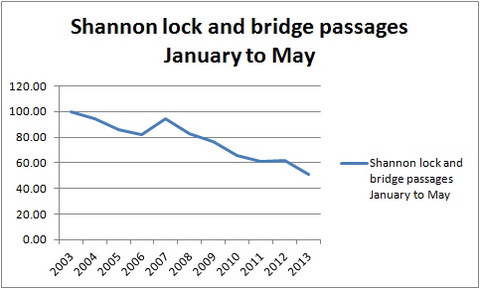
The number of lock and bridge passages for the Shannon, in the first five months of 2013, has been just a little over half what it was in 2003.

Shannon passages

Shannon passages as percentages of the 2003 total

The usual caveats apply: the underlying figures (kindly supplied by Waterways Ireland) do not record total waterways usage as, for instance, sailing, fishing or waterskiing on lakes or river stretches, which did not involve a passage through a lock or Portumna Bridge, would not be recorded. The passage records are our only consistent long-term indicator of usage of the Shannon but they would not show, for instance, a change in the balance of types of activities from those in larger cruising boats to those in smaller (sailing, fishing, waterskiing) boats. On the other hand, they do include the Shannon’s most significant tourism activity, the cruiser hire business.

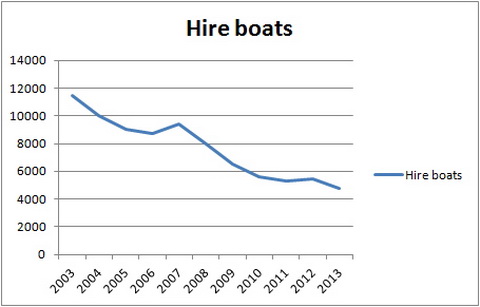
Cruiser hire activity, January to May 2003–2013

Cruiser hire activity, January to May 2003–2013

Over eleven years, the number of hire-boat passages has fallen from 11440 to 4781, a drop of almost 60%.

There are some minor inconsistencies in the Waterways Ireland figures, but they’re not large enough to affect the general picture.

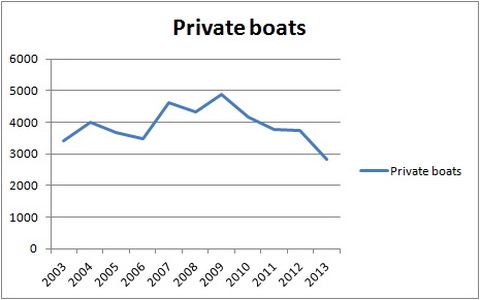
Another caveat is that the picture to the end of May doesn’t predict the outcome for the year. Things like the weather and the date of Easter can cause boating activity to occur earlier or later in the year. In the first year of this series, 2003, private boaters seem to have been slow to get started; the number of passages in the first five months was lower than that for 2004. However, private boaters’ total for 2003 was higher than that for 2004.

Private boats January to May 2003–2013

Private boat activity, January to May 2003–2013

But 2013 is the first year in the series in which private boat passages have fallen below 3000.

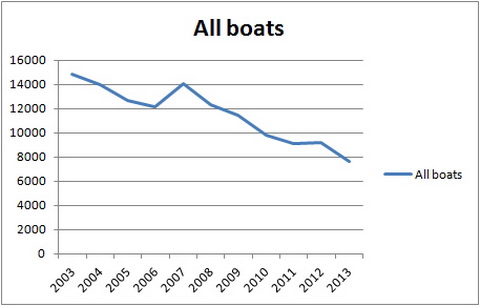
Total Shannon passages, January to May 2003–2013

Total Shannon passages, January to May 2003–2013

And there are the totals: 51.15% of the 2003 figure.

We’re still in the first shoulder season; if the peak season is better than usual (and if the weather is good), the final figures for 2013 may end up looking more cheerful.

One small point, if I may: this sort of decline makes it pretty well impossible to justify increasing the cruising area by building sheughs in Cavan, Monaghan, Longford or anywhere else.

Addendum: if this story is true, we won’t be needing any increase in waterways capacity for quite some time to come.

It’s back!

The unmissable weekly read: the list of holders of marked fuel traders’ licences [xls] has returned! Life just wasn’t the same without it.

The list of Shannonside fuel traders is the same, though, at least as far as I can see.

Delays at Robertstown

Some barges have found it slow going past Robertstown on the Grand Canal this week, with low water on the summit level between Locks 18 and 19. But they’re not the only ones moving slowly at Robertstown, to judge from the written answer [thanks, KildareStreet.com] to Bernard Durkan [FG, Kildare North] in the Dáil on 28 May 2013. He asked …

[…] if consideration will be given to offering grant aid towards the holding of the annual Canal Festival at Robertstown, Naas, County Kildare; and if he will make a statement on the matter.

The minister, Jimmy Deenihan [FG, Kerry North/West Limerick], said:

I am advised by Waterways Ireland that it supports events taking place along the navigations throughout the year through the Waterways Ireland Sponsorship Programme. Applications open in October each year for the following year to maximise opportunities for promotion. Following an evaluation process, financial, operational or promotional support, or a combination of these, may be offered to events meeting the criteria.

If the festival organisers wish to seek sponsorship from Waterways Ireland they should apply for 2014 programme when it is advertised later this year. I am informed that Waterways Ireland did not receive an application for sponsorship from representatives of the 2013 Canal Festival at Robertstown and wish to advise that Waterways Ireland is unable to offer support to events outside the Sponsorship Programme process.

The festival website is here and there are some pics of a 1981 festival here.

Forward, forward let us range …

… Let the great world spin for ever down the ringing grooves of change.

Excitable chap, Tennyson. But there are no ringing grooves in the list of licensed traders in marked fuels along the Shannon.

Nonetheless, the excitement of reading 211 pages of traders’ names and addresses, at four to the page, never palls. I have to read them, alas, as the data entry is so inconsistent that searching could not be relied upon (Mullinger, anyone?). It would be nice if someone cleaned up the data.

The entries are arranged in order of county, or more specifically in alphabetical order by entry in the County field. Thus all the traders in Dublin postal districts come at the end. But the list is headed by two traders who have no entries in the county field. One is Tigh Phlunkett of Leitir Moir; the other is Homefuels Direct Ltd of Stockton on Tees, the only non-Irish licence-holder.

There. Wasn’t that interesting?