
A short, lavishly illustrated talk in Killaloe Cathedral, Co Clare, at 6.00pm on Sunday 29 April 2012, as part of the Waterways Ireland Discover Killaloe and Ballina thingie.
Posted in Ashore, Built heritage, Drainage, Economic activities, Engineering and construction, Forgotten navigations, Industrial heritage, Ireland, Operations, People, Politics, Sources, The turf trade, waterways, Waterways management
Tagged boats, bridge, canal, harbour, Ireland, Lough Key, Rockingham, Shannon, vessels, waterways, workboat
The IHAI AGM at the weekend, in Newtownabbey Borough Council’s splendidly restored Mossley Mill, included a tour of the premises and its museum. Then Professor Adrian Long of Queen’s University Belfast gave a short talk about the FlexiArch bridge, which his team have been developing since the 1990s.
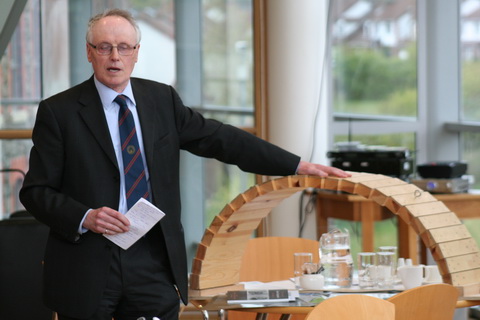
Professor Adrian Long with a wooden model of the FlexiArch bridge
He said that their work started by asking why nobody built arched bridges any more; they developed a system that used pre-cast voussoirs (the wedge-shaped blocks) linked by a polymeric flexible membrane. The voussoirs for any bridge are cast to give the correct taper for the span and rise required for that bridge.
Arch rings arrive on site stowed flat on the back of a truck; when they are lifted off, they fall into the correct shape and are lowered into position on previously-installed footings. Each arch ring is 1m wide; several of them can be placed side by side to give whatever width is required. The end walls are added and the structure is filled and given the appropriate surface (eg tarmac).
FlexiArch is manufactured by Macrete of Toomebridge (beside Lough Neagh); their website shows several examples of installation including one at a name familiar on Irish waterways. There is a brochure [PDF] and there is a video showing the installation of a 15-metre bridge.
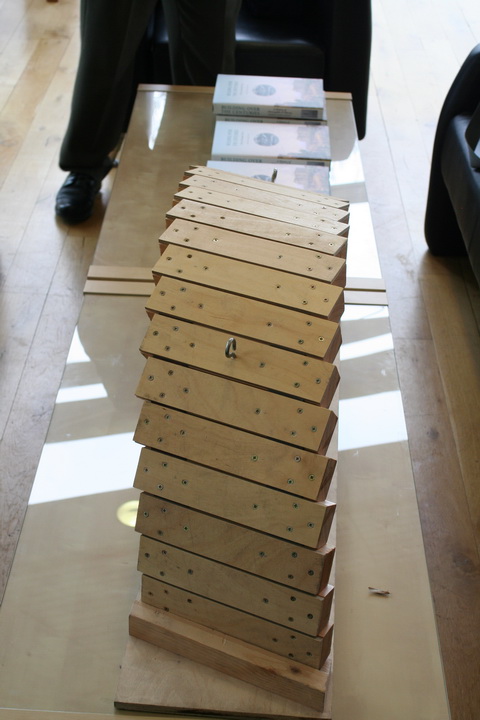
Wooden model as a skew arch
No, I haven’t any shares in it. I just thought it was interesting, for three reasons: first, the speed of construction is very impressive; second, there is a link to Lough Neagh; third, it might encourage the construction of more skew arch bridges over canals.
Posted in Ashore, Built heritage, Economic activities, Engineering and construction, Extant waterways, Foreign parts, Industrial heritage, Ireland, Irish waterways general, Operations, Restoration and rebuilding, Sources, waterways, Waterways management
Tagged Adrian Long, arch, bridge, canal, flexiarch, Grand Canal, IHAI, Ireland, Lough Neagh, macrete, QUB, Royal Canal, skew, span, Ulster Canal, waterways
… has had its windows broken. More on the Lough Owel Feeder here.
Posted in Ashore, Built heritage, Drainage, Economic activities, Engineering and construction, Extant waterways, Industrial heritage, Ireland, Operations, Restoration and rebuilding, waterways, Waterways management
Tagged boats, bridge, canal, feeder, fishfarm, Ireland, Lough Ennell, Lough Owel, Mullingar, Operations, Royal Canal, supply, water level, waterways, Waterways Ireland, Westmeath County Council
I have uploaded an old article of mine based on an interview with Willie Leech of Killucan, whose father ran the last trading boats on the Royal Canal.
Posted in Economic activities, Extant waterways, Industrial heritage, Ireland, Irish inland waterways vessels, Operations, People, Sources, The turf trade, waterways
Tagged boats, bog ore, bridge, canal, Cloncurry, flyline, gas company, Grand Canal, horse, Ireland, Killucan, L T C Rolt, Leech, Royal Canal, Summerhill, timberhead, town gas, trackline, tug, vessels, waterways
Here is a page about feeders to the Royal Canal. My confidence in the accuracy of this list is low, so comments would be welcome.
Posted in Ashore, Built heritage, Drainage, Economic activities, Engineering and construction, Extant waterways, Industrial heritage, Ireland, Irish waterways general, Operations, Sources, waterways, Waterways management, Weather
Tagged Ballynacargy, Balroe, Baltrasna, bridge, canal, Dublin, feeder, Ferns, Ferrans, Inny, Ireland, Kilcock, lock, Lough Ennell, Lough Owel, Mullingar, Operations, Pig's Nostril, Riverstown, Royal Canal, Ryewater, Saunders, Scally, Thomastown, water level, water supply, waterways, Waterways Ireland
John W Freeman of Donadea, near Naas, Co Kildare, has very kindly sent me a copy of his third book, Reflections through a Parish Window, which he published in November 2010, and tells me that he is at work on his fourth book. As usual, his third has several items of waterways interest from the land between the canals: Donadea is south of the Royal and north of the Grand.
John gives special thanks to Essie Conroy of Lowtown (19th Lock), who died in September 2010. There is an article (p111 et seq) about her grandparents, Murt and Mary Murphy; Murt, originally from Ballycowan near Tullamore, died in 1922 aged 73. The Lowtown section also includes photos of a model flyboat, the wooden canal boat 104B (Maid of Erin, owned by Roches of Tullamore) and Essie Conroy with one of Ted Barrett’s boats at Lock 19. Her husband John Conroy is pictured on p123.
There is a photo of another wooden canal boat at Lowtown. It has the name Ocean Star written across its stern and what look like horizontal wooden slots on both sides of the rudder. The crew are named as William Connolly and his son Patrick, with Thomas Murphy (Essie Conroy’s father) standing on the bow holding a rope.
Other Grand Canal items include a photograph of 31M at Landenstown (p56) and two photos of Robertstown, one undated (p120) and the other taken in 1895 (p116). There is a photo of the Royal at Kilcock (p64), perhaps taken in the 1980s, and a short article about the Royal with a photo of Lock 1 (pp137–8). There is even a photo of Guinness Liffey barges of, I think, the first fleet (p68).
Perhaps the most surprising item is a photograph from the Irish Press of 23 October 1947 with this caption:
Propeller-driven “water-bike”, built by motor and cycle mechanic Patrick Kennedy, of Corduff, Co Kildare, to contact his clients in their village homes along the Grand Canal. Comfortably seated on the kitchen chair “tandem seat” is Christie Brereton, Patrick’s assistant, enlivening the pair’s progress with his accordion. These mechanics say that they will perfect this style of transport for river and lake travel.
The photograph is a little blurred, but the two men can be seen clearly, with Patrick in front clasping the handlebars. The structure of the craft seems to include at least two 40-gallon drums but the steering and propulsion methods are not specified. If anyone has any more information about this craft, do please leave a Comment below.
All in all, a lot of very interesting material once again, and I am looking forward to John’s fourth book.
Posted in Ashore, Built heritage, Economic activities, Engineering and construction, Extant waterways, Industrial heritage, Ireland, Irish inland waterways vessels, Natural heritage, Non-waterway, Operations, People, Scenery, Sources, waterways
Tagged boats, bridge, canal, Grand Canal, Ireland, Operations, Royal Canal, vessels, waterways

 Irish waterways history