
Tag Archives: Dublin

Horses on board

An ad from the Freeman’s Journal of 11 September 1876 provides a snippet of information about horse haulage on the Royal Canal, with a point that I cannot recall seeing anywhere else about Irish waterways. Here’s a French example and here’s an American from this excellent page.
Northsouthery and sheughery

The North South Ministerial Council secretariat has been remarkably quick to publish the joint communiqué from today’s plenary meeting. They must have adopted the Quaker practice of agreeing the minutes before the meeting ends (as opposed to the diplomatic practice of agreeing them before the meeting starts). The short version is that nothing happened; the only excitement was another brainfart from Our Glorious Leader, which occurred before the NSMC meeting.

Cavan-Monaghan FF TD Brendan Smith has been wasting civil service time again, asking about the Clones Sheugh:

Brendan Smith [FF Cavan-Monaghan]: To ask the Minister for Arts, Heritage and the Gaeltacht if he will indicate the current stage of the proposed restoration of the Ulster Canal; and if he will make a statement on the matter.

Jimmy Deenihan [FG Kerry North/West Limerick]: As the Deputy will be aware, in July 2007 the North/South Ministerial Council (NSMC) agreed to proceed with the restoration of the section of the Ulster Canal between Clones and Upper Lough Erne. The then Government agreed to cover the full capital costs of the project, which were estimated at that time to be of the order of €35m.

It was always the intention that the Ulster Canal project would be funded from the Waterways Ireland annual allocations, as agreed through the annual estimates processes in this jurisdiction, as well as the deliberations of NSMC in relation to annual budgets. It was a key consideration throughout the process that the Ulster Canal project would be supported by a significant level of projected income from the commercialisation of certain Waterways Ireland assets. However, the economic downturn has had a negative impact on those plans.

In the meantime, the Ulster Canal project is progressing on an incremental basis. Planning approvals have now been secured for the project in both jurisdictions. I welcome these developments, which, I am sure the Deputy will agree, are a significant milestone for the project.

I am continuing to explore all possible options to advance this project within the current fiscal constraints. In this regard, an Inter-Agency Group on the Ulster Canal has been established to explore and examine ways to advance the project and to examine possible funding options for it, including existing funding streams and the leveraging of funding from other sources, including EU funding options.

What news of the Inter-Agency Group? Has it found a rainbow with a pot of gold buried beneath it?

I do not find the minister’s statement that …

It was always the intention that the Ulster Canal project would be funded from the Waterways Ireland annual allocations, as agreed through the annual estimates processes in this jurisdiction […].

… to be entirely consistent with the historical record or even with his further statement that …

It was a key consideration throughout the process that the Ulster Canal project would be supported by a significant level of projected income from the commercialisation of certain Waterways Ireland assets. However, the economic downturn has had a negative impact on those plans.

The plan seemed to be to sell the WI assets, thus using capital to fund what might laughingly be described as a capital asset (as opposed to a millstone around WI’s neck), rather than to rely on income from the use of its surplus assets. Maybe allowing the Corpo to run the Dublin “docklands” [Irish Times report, which will disappear behind a paywall at some stage; the Corpo’s website doesn’t yet cover this] will restore the overvaluations of the recent bubble and allow WI to flog off its three sites and splurge on the Clones Sheugh.

That seems to be what ThemUns in the Northern Ireland Assembly are expecting, if we are to judge by the discussion held on 21 October 2013, when several shinners, and a few others too, enthused about the “potential” of canals:

Phil Flanagan [SF] asked the Minister of Culture, Arts and Leisure [SF] for an update on the current funding position on the re-opening of the Ulster canal.

Carál Ní Chuilín [SF]: I thank the Member for his question. Work by Waterways Ireland on the restoration of the Ulster Canal has been solely focused on the section from Upper Lough Erne to Clones. The project will be advanced in line with available resources. The Ulster canal interagency group has been tasked to examine all possible options for financing the project. DCAL economists are reviewing the business case to update the estimated costs and identify social as well as economic benefits for the first section of the canal. The Ulster canal interagency group is exploring funding options with the Special EU Programmes Body.

Phil Flanagan [SF]: Go raibh maith agat, a LeasCheann Comhairle. Gabhaim buíochas leis an Aire as ucht a fhreagra. I thank the Minister for her answer. I welcome the Minister’s continuing commitment to the Ulster canal, particularly the section from Upper Lough Erne to Clones. However, one of the difficulties that it faces is an absence of funding. Will the Minister provide more information on potential funding options for completing the work on that section of the canal?

Carál Ní Chuilín [SF]: The work of the interagency group is focused not just on funding options but on what we can do with current available funding. It is really important that we look at the Ulster canal with a view to how we can open up waterways to improve tourism and the local economy. It is important that we get started on the restoration of the Ulster canal in that area because it has experienced a lack of investment for decades.

We are looking not just towards the Irish Government, within DCAL and towards Europe but at other opportunities, possibly through the Lottery Heritage Fund and many others to see whether we can get this started by looking at options to bring the work forward, rather than waiting until all the money is in. We can do that only on the basis of secured funding. Once that happens, I will be happy to make a statement to the House that will be a bit of good news that the Member and other Members for that area have been waiting to hear for a long time.

I suspect that “what we can do with current available funding” is “buy a shovel”, there being no large amounts available from the Free State. But perhaps the reason that the Clones area “has experienced a lack of investment for decades” is that it is not possible to make any adequate (legal) return on investment there; a policy of assisted emigration might be best. But it is gratifying to learn that SF is trying to get the Free State government off the hook of its rash promise to pay for the sheugh and is hoping to raise the money from within HM Realm.

There was a hint of a sensible question from the UUP.

Tom Elliott [UUP]: I thank the Minister for that update. Will she tell us how much the overall project was estimated to cost, based on the business case, and what income it projected?

Carál Ní Chuilín [SF]: Overall, it goes into tens of millions of pounds. I believe that the business case needs to be updated, and that will be part of discussions involving me, Minister Deenihan, and Minister McGinley. Some of the work that is being done by DCAL economists is bringing a fresh approach to the economic appraisal. We are sharing that with our Irish Government colleagues and the interagency group. That is because I believe that, rather than waiting for all the money to be secured at once, we need to look at the potential for phased approaches. It is good news that we now have full planning permission across all the councils and from our Planning Service here.

We now need to look at what capital moneys are available, what we can do and our plan to secure additional funds for that area. As I said to Phil Flanagan, it is really important — I am sure that the Member is more aware of this than I am — that we get parts of that canal opened and try to get some construction work done on it.

Unfortunately Mr Elliott did not insist on getting an answer to his question about the projected income, which I expect to be nil.

Joe Byrne [SDLP]: Can this issue be raised at the next meeting of the North/South Ministerial Council? What potential does she expect could accrue to the areas of Fermanagh and Tyrone in future tourism?

Carál Ní Chuilín [SF]: The Member should take comfort in knowing that this is always raised at the North/South Ministerial Council. Certainly, within the waterways sectoral aspect of DCAL’s North/South arrangements, it is constantly brought up. The key here is to look at what we can do now for rural communities and what moneys are available. I appreciate that, when the Irish Government said that they would fully fund the project, they were in different economic circumstances. However, they still remain committed to doing something.

In DCAL, I am looking at a new economic appraisal to see what the real costs are and what parts of the work I could try to start, possibly in conjunction with Ministers Deenihan and McGinley. There is a lot of expectation around the project, and rightly so, no more so than among the people who live and work in the surrounding area and those who are waiting for work on the restoration of the canal.

Anna Lo [Alliance]: Parts of the UK and many other countries have reinvented canals as tourist facilities and attractions. What lessons does the Minister intend to adopt from other people’s experiences?

Carál Ní Chuilín [SF]: Certainly, we regularly receive reports from Waterways Ireland about tourist potential. The royal canal has brought great potential. There are festivals across all the canals and waterways the length and breadth of this island. Unfortunately, those are some of the very few opportunities that people who live in rural communities near waterways have of generating a local economy. So the tourist potential is absolutely huge. Not only is it huge for people who live on this island; it is huge for those who want to visit here and travel. There is big interest, particularly in Europe, in canals and waterways. It is incumbent on us to do what we can to get the project financed. We need to make a start on it. We do not have all the funds yet, but it is time to make a start on it rather than sit and wait on free money coming. People who are looking for tourists and have a tourist product to offer and people who are willing and able to work look to us for opportunities to get this moving. I think that is what it could do.

Ms Lo’s question should be enough to deter people from voting Alliance. Note that Ms Ní Chuilín’s answer was all about potential: we have no cost-benefit analysis of the restoration of the Royal Canal and indeed no idea what the restoration cost, but I do not believe that the economic benefits will be significant. And while it may be that …

There is big interest, particularly in Europe, in canals and waterways.

… the prospect of travelling to Clones by water is not significantly more enticing than that of travelling there by road.


DUKWs and lifejackets

On 31 October 2013 I mentioned the UK Marine Accident Investigation Branch’s safety bulletin about the DUKW fire in London and the DUKW that sank in Liverpool. There is more on the London fire today with a Guardian report on proceedings at the London assembly’s Thames passenger boat investigation committee. The Guardian headline read …

Duck boat passengers not wearing lifejackets when jumping into Thames

… and the story reported the Maritime Coastguard Agency’s maritime safety and standards director as saying that wearing of lifejackets would not have been usual on “such boats” and that lifejackets were safely stowed above the seats. The story also said that

London Duck Tours’ managing director, John Bigos, said the Cleopatra had the required legal number of lifejackets on board and that it was company policy that lifejackets were not worn on tours. He went on: “We have our reasons for this (non-wearing) but they are not to do with commerciality.”

There is a different policy in Ireland, where the Dublin Viking Splash operation says

Lifejackets: At the water entry point, customers are required to put on a lifejacket after the driver delivers an outline about safety on the water. The lifejackets supplied by Viking Splash Tours are Solas and CE approved buoyancy aids […].

The point that strikes me is that, in both UK accidents, passengers had little time to don lifejackets and would have been trying to put them on in a confined space and under less than ideal conditions. It seems to me that Viking Splash’s policy is the right one.

More on Major Rowland Raven-Hart

A recent comment by Horacio A Nigro of Montevideo, Uruguay, may have solved the mystery of the birthplace of Major Rowland Raven-Hart, whose Canoeing in Ireland covered several inland navigations in the 1930s. You can see Horacio’s comments, and the subsequent discussion, on my page here.

But, on his own site, Horacio has cast light on Rowland-Hart’s career in radio, working in South America between the Kaiser’s War and Hitler’s War, and he has also very kindly provided an English-language version here as a PDF.


Fun for anoraks

Lots of info on the WI website:

I liked the bit on this page:

Enforcement

Boats in non-compliance with the bye-laws will enter an enforcement process. Enforcement is undertaken by Authorised Officers and will begin with a notification in the form of a sticker and if non-compliance continues may result in the ​craft being removed from the navigation at the owners cost.

I wonder about investing in a crane company.


DUKWs

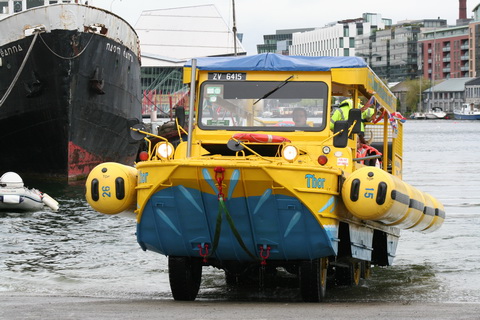
In June 2013 I reported on the sinking of a DUKW in Liverpool, the second of the year, and in September on the fire aboard a DUKW in London. Oddly enough, it seems that the two accidents had a common element: the foam added inside the hulls to improve buoyancy.

The UK’s Marine Accident Investigation Branch has found that the DUKWs in the Liverpool fleet had not been fitted with enough foam to provide 110% buoyancy, enough to keep the vessel afloat when flooded. MAIB’s tests on the Liverpool vessels

… raised serious questions about whether the operators of DUKWs could fit sufficient foam internally to comply with the current requirement for 110% buoyancy without compromising the safe operation and the practical day to day maintenance of these vehicles.

The “safe operation” part affected the London vessels. In July 2013, a DUKW had to be towed in after a drive shaft universal coupling failed when it overheated and ran dry of lubrication: engine bay temperatures were too high because of the volume of foam inserted. And a report commissioned by the London Fire Brigade into the September fire concluded that:

… the most likely cause of fire was the action of the rotating drive shaft (or other moving parts) on the oil contaminated surfaces of the buoyancy foam blocks.

MAIB has issued a safety bulletin [four-page PDF] with this conclusion:

The MAIB identified significant difficulties in fitting a DUKW with the volume of foam required to meet the buoyancy standards set out in MSN 1699 (M). Further, the nature of these old amphibious vessels, specifically their weight in relation to their size and the complexity of their propulsion arrangements, makes it difficult for operators to comply with the standards applicable to more conventional craft by solely using internal foam buoyancy. An alternative standard, ensuring that DUKWs have the necessary level of damage survivability, therefore needs to be established if they are to be operated safely.

It has recommended that the Maritime and Coastguard Agency should

… ensure that the means used by DUKW operators to achieve the required standard of buoyancy and stability for their vessels does not adversely impact on their safe operation. Furthermore, these vessels should not be permitted to operate until satisfactory levels of safety can be assured under all feasible operating conditions.

The Maritime and Coastguard Agency’s website doesn’t seem to be working, but there is a BBC report here quoting an MCA person as saying

We will not be permitting the vessels to operate until we are satisfied that the necessary safety measures have been achieved.

VikingSplash DUKW in Dublin

VikingSplash DUKW in Dublin

All of this may help to explain why the VikingSplash DUKWs operating in Dublin are fitted with additional external buoyancy.

Sailing up the Liffey (not)

While in Blighty I read a brief but entertaining piece in [HM] Independent newspaper [a piece that doesn’t seem to be available online] saying that the Sean O’Casey pedestrian bridge, which spans the Liffey in Dublin, cannot be opened because the remote control has been missing since 2010.

The story doesn’t seem to have had much coverage in Ireland, but The Journal seems to have originated it; it has been picked up by MSN and there is discussion at boards.ie, although I don’t know that many people will be inconvenienced by the inability to get tall vessels into a relatively short stretch of water.

Northsouthery minus northsouthery

I noted here what the Minister for Arts, Heritage and the Gaeltacht had to say about Waterways Ireland’s budget — or at least that portion of it paid by the RoI government — for 2014. The minister listed WI’s “core activities and targets” and various other things it should be doing:

  • promoting increased use of the waterways resource for recreational purposes
  • developing and promoting the waterways
  • attracting increased numbers of overseas visitors
  • stimulating business and regeneration in these areas
  • increasing recreational access along the routes of waterways
  • keeping the waterways open for navigation during the main boating season.

Note that WI is not expected to promote, engage in or achieve anything in the realm of northsouthery. That’s slightly odd when it receives [the larger] part of the northsouthery budget of the minister’s department.

WI’s budget: the minister speaks

I wrote here about the implications of the RoI 2014 budget for Waterways Ireland. The minister, Jimmy Deenihan [FG, Kerry North/West Limerick], spoke about it in the Dáil on Wednesday 16 October 2013 [h/t KildareStreet.com]. At the end of his lengthy contribution he said:

I am committed to developing North-South co-operation within the broader arts, heritage and commemorative activities of the Department as well as through the funding of North-South bodies. A provision of €38.3 million will be made available to support the two North-South implementation bodies, An Foras Teanga, comprising Foras na Gaeilge and the Ulster-Scots Agency, and Waterways Ireland. The provision will enable Waterways Ireland to deliver on its core activities and targets, which include keeping the waterways open for navigation during the main boating season and promoting increased use of the waterways resource for recreational purposes. This expenditure should also assist in developing and promoting the waterways, attracting increased numbers of overseas visitors and stimulating business and regeneration in these areas. Capital funding of almost €4 million will be made available to Waterways Ireland to facilitate the ongoing maintenance and restoration of Ireland’s inland waterways, thereby increasing recreational access along the routes of waterways.

The Government has reaffirmed its commitment to continuing to make progress, to improving the economy, to exiting the bailout, and to helping to create jobs. The Department and the sectors it represents will make a significant contribution to this work over the course of 2014.

I pointed out last year that Waterways Ireland is part of northsouthery and that, at budget time, we don’t get a breakdown of the northsouthery budget between An Foras Teanga and Waterways Ireland. In 2011, WI got roughly 60%, but I don’t know what happened after that. Here’s what I thought was happening last year:

Current spending (WI)

2010 Estimates: €25 585 000
2011 Estimates: € 24 335 000
2012 Estimates: €22 929 600 (60% of €38 216 000)

Capital spending (WI)

2008 Estimates: €11 000 000
2009 Estimates: €10 300 000
2010 Estimates: €8 000 000
2011 Estimates: €6 000 000 (or €6 002 000)
2012 Estimates: €4 500 000 (or €4 502 000) (100%)

In his speech, above, the minister said that northsouthery is going to get €38.3 million and that Waterways Ireland is to get capital funding of €4 million. However, the €4 million is included in the €38.3 million. The expenditure report [PDF; see page 160] gives these details:

  • for 2013 northsouthery had €36 210 000 of current spending; for 2014 it will get €34 425 ooo
  • for 2013 northsouthery had €4 080 000 of capital spending (all, or almost all, of which was for Waterways Ireland}; for 2014 it will get €3 958 000
  • the overall budget for northsouthery is down 5%.

We can calculate that the capital budget is down about 3%; the much larger current budget is down 5%. If WI gets 60% of the total, its current expenditure contribution from RoI will be €20 655 000, down over €2 000 000 from the previous year and about €5 000 000 since 2010, and its total current expenditure (85% RoI, 15% NI) will be €24 300 000.

The other interesting part of the minister’s speech is what WI is expected to do:

  • promoting increased use of the waterways resource for recreational purposes
  • developing and promoting the waterways
  • attracting increased numbers of overseas visitors
  • stimulating business and regeneration in these areas
  • increasing recreational access along the routes of waterways.

That should keep them busy. But I omitted one activity:

  • keeping the waterways open for navigation during the main boating season.

Emphasis mine, but does this mean that winter boating (at least if it involves staff time, eg at locks) will become a thing of the past?


Maureen O’Sullivan and Effin Bridge

A knowledgeable written question [h/t KildareStreet.com] from Maureen O’Sullivan [Ind, Dublin Central] about the Effin Bridge over the Royal Canal at Newcomen Bridge:

To ask the Minister for Arts, Heritage and the Gaeltacht if he will identify the parties concerned with the operation of the lifting bridge which occupies the site of the original first lock on the Royal Canal Newcomen Bridge, Dublin 1; the factors that contribute to the status of the lifting bridge; if he will convene a meeting of interests concerned with the operation of the lifting bridge with a view to devising a management and operational system that is less hostile to the use of the waterway as currently it is an impediment and discouragement to navigation on the Royal Canal and an obstacle to navigation-communication between the Royal Canal and River Liffey and between Royal Canal and Grand Canal at their eastern reaches; and if he considers the lifting bridge could be re-engineered as a dropping bridge.

The minister, Jimmy Deenihan [FG, Kerry North/West Limerick], responded:

I can advise the Deputy that the parties concerned with the operation of the lifting bridge over the railway line close to Newcomen Bridge are Irish Rail and Waterways Ireland. The bridge carries the rail line from Connolly Station to the lower line link to the docks area. The bridge was procured and installed by Waterways Ireland’s predecessors. The bridge is operated by Irish Rail staff on a request basis at Waterways Ireland’s expense. The option of introducing a drop lock to replace the need of the lifting bridge has been considered but not deemed viable due to the cost estimate involved.

Note that the question was about a “dropping bridge” but the answer was about a “drop lock”.

The answer suggests that the number of lifts each year is a function of the number of requests made by Waterways Ireland; it would be interesting to know whether that it actually so. If it is, then WI’s budget [cut again] is probably the ultimate determinant; if Irish Rail has a say in the matter, its operational needs may influence the decisions.

I cannot think of any cost-effective solution. I am not convinced that the bridge in itself discourages navigation.