Tag Archives: Grand Canal

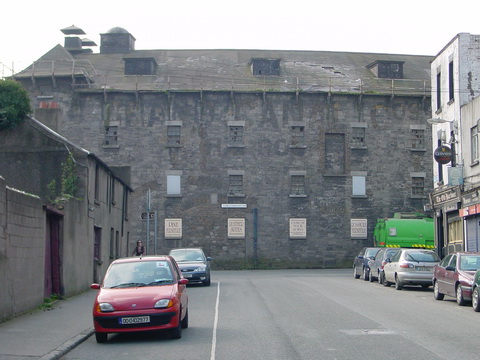
Grand Canal Harbour maltings: a protected structure

I see on this website that the curved building at Grand Canal Harbour in Dublin, is a protected structure.

Here is the roof in 2007:

The roof in 2007

Here is the roof in October 2011:

The roof in October 2011

I have asked the developers for their comments.


Waterways Forward

Read about the EU’s Waterways Forward project here and download PDFs showing what the Irish participants Waterways Ireland and South Tipperary County Council got out of the project. WI’s project was on the implementation of the Water Framework Directive on the Royal and Grand Canals; South Tipperary County Council’s was about generating a shared vision for the Suir through the River Café project.

Some folk may recognise the canal boat on the WI document. That fella gets in everywhere.


Buggering up the Barrow

Have you ever wondered, as you grounded on a sand bar or fought a current upstream, quite why the River Barrow is so challenging?

Here is a confession (with photos) from the man wot done it — in 1931 ….

The Blocks in the Docks

Waterways Ireland’s visitor centre in Dublin, known as the Box in the Docks, has been closed for some time. I don’t know whether it has yet been reopened, but it has a new website.

If you are pained by greengrocers’ apostrophes, don’t go there. The main problem, though, is that the website says nothing about what is in the Box. Why “Plan a visit” if you don’t know what you’ll see when you get there?

Perhaps it’s a work in progress, with more to be added later, but I’d welcome information about what’s in the centre from anyone who has visited it recently.

Pue’s Occurrences

I’ve had an article accepted at the history blog. It’s about the capstan at O’Briensbridge on the old Limerick Navigation and the trade it facilitated. There is more information about the technicalities on my own page about O’Briensbridge.

The Junction Navigation

Here are some pages about the Junction Navigation in the Ballinamore & Ballyconnell drainage district. It later became known as the Ballinamore & Ballyconnell Canal and later still as the Shannon–Erne Waterway.

The role of the cads and bounders of the Ulster Canal Company in getting a canal built at taxpayers’ expense

The construction of the Junction Navigation at Aghoo (Lock 4)

Lock gear old and new

And here’s a reminder of an old page about the Belturbet-built dredger used in constructing the navigation.

Departmental responsibility for waterways

Statutory Instrument No 195 of 2011 transfers responsibility for inland waterways (and Waterways Ireland and waterways northsouthery) from Craggy Island to the Department of Tourism, Culture and Sport.

It does not say whether the same people are still doing the work.

Text of the statutory instrument here.


What happened to the Wingate?

On 22 September 1870 the Irish Times said that the owner of the new steam launch Wingate was

 willing, in case of six or eight gentlemen joining, to defray the expenses of making a cruise through the Grand Canal, down the Shannon to Limerick, and then up the river to its source.

The notice said that the launch would steam through Loughs Allen, Kay [now Key], Dee and Derg. I don’t know where Lough Dee is: perhaps it’s a typo (or printo) for Ree. There would be a side-trip to Lough Gill, taking the Lady of the Lake steamer to Sligo, and the launch would then take the Leitrim Canal (now the Shannon–Erne Waterway) to the Erne, covering the whole of it from Belturbet to Belleek.

After that, the Wingate would travel by the Ulster Canal to Lough Neagh and Coleraine, returning “either by Newry or the Royal Canal” to Dublin. It is not clear how the Royal Canal (which links Dublin to the Shannon) could form part of a route from Lough Neagh to Dublin.

Whoever wrote the notice suggested that the cruise would take ten days, which suggests a degree of optimism not consonant with a knowledge of the distances involved.

An ad appeared in the next day’s paper, offering for sale the Wingate, a composite steam screw launch lying at Kingstown (Dun Laoghaire), and saying that a cruise of 10–12 days, only as far as Lough Erne, could be arranged pending sale.

According to the invaluable Clydebuilt database, a launch called Wingate was built by T Wingate & Company of Glasgow in an unspecified year. But why was a new launch being offered for sale?

Richard Heaton’s genealogy website includes a collection of newspapers, and one of them, the Supplement to the Warder for 3 [not 31] September 1870, has an account of how the Wingate reached Dublin (Kingstown) from Scotland, where the owner had failed to find half a dozen hardy souls willing to accompany him on a tour of the Western Isles and the Highlands. This is scarcely surprising as the Wingate was an open launch only 35 feet long.

So who owned the Wingate? Did the owner manage to reach the Irish inland waterways, or was he forced to sell his launch? I would welcome more information.

Semper aliquid …

… novi Africam adferre, as my old grandmother used to say.

Waterways Ireland’s Marine Notice 45/2011 says:

[…] there will be restrictions on boat movements on Level C5 of the Grand Canal Circular Line between Leeson Street Bridge and Charlemont Bridge, Dublin over the next two weeks.

This is the first time I have seen an official name of any kind, much less an alphanumeric designation, applied to Irish canal levels (pounds). Is this a New Thing? And what are the names of the other levels, on the Grand and elsewhere?

I do hope the new naming of parts works better than this.

RIBs on canals

According to the Sunday Business Post:

Army and Garda sub-aqua unit divers and armed personnel carrying ribs (rigid-hulled inflatable boats) will also be placed at strategic points along the Liffey and Dublin’s canals to ensure that there are no attempts to mount any attack from the water.

RIBS on canals? Well, that should be useful.

Er … they have heard of locks, have they? I mean, no matter how fast either the terrs or the Army and Garda folk zoom along the canal by Mespil Road, for instance, they’re still going to spend ten to fifteen minutes getting through the lock. And maybe the same clearing their props.

I do hope the terrs are not planning on launching attacks from the Royal: they won’t be able to see out from the bottom of the canal along most of the way.

Perhaps they could all be made honorary participants in the IWAI Dublin Rally, which will be on at the time.

Update 5 May 2011: Waterways Ireland says (Marine Notice 45/2011) that:

[…] there will be restrictions on boat movements on Level C5 of the Grand Canal Circular Line between Leeson Street Bridge and Charlemont Bridge, Dublin over the next two weeks. Dublin City Council are currently constructing a boardwalk at this location as part of its wider ‘Premium Cycle Route’ project to improve cycling facilities in the city and along the Grand Canal route. Due to unforeseen delays, and in order to facilitate completion of the boardwalk, it will be necessary to reduce the water level in Level C5 during the period of Monday 9th May 2011 to Thursday 19th May 2011. Waterways Ireland requests that any vessels wishing to pass through level C5 during this period should contact the Eastern Regional Office on 01 868 0148 well in advance to make the necessary arrangements.

I hope that WI has brought this to the attention of potential terrorists intending to zoom along the Grand Canal to attack HMtheQ and to the brave and noble police and army folk, in their RIBs, who will be trying to stop them.