Tag Archives: Liverpool

Elfinsafety and DUKWs

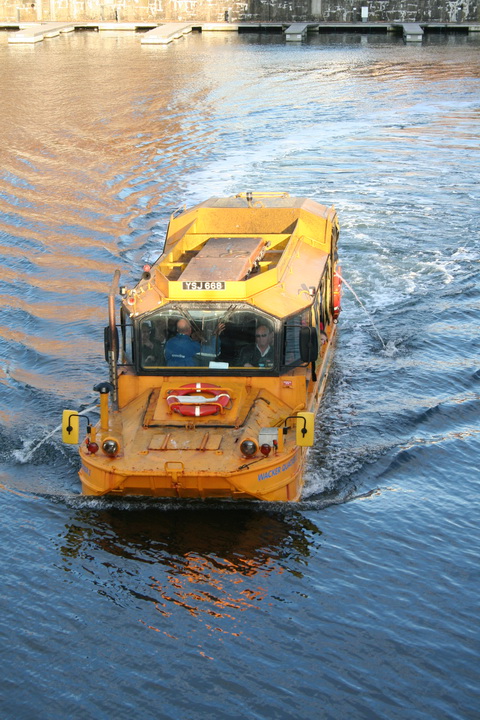
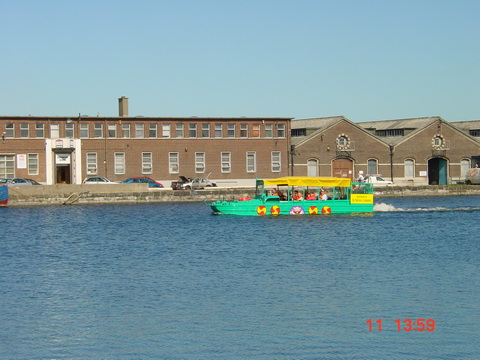
In October 2011 I was in Liverpool, where I took a couple of photos of DUKWs taking trippers around the still waters of the no-longer-used docks.
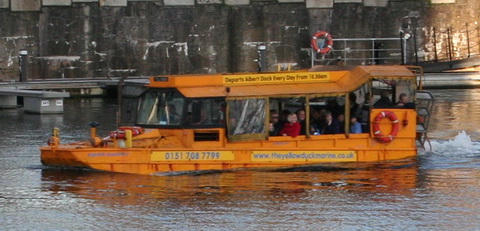
DUKW in the Salthouse Dock, Liverpool
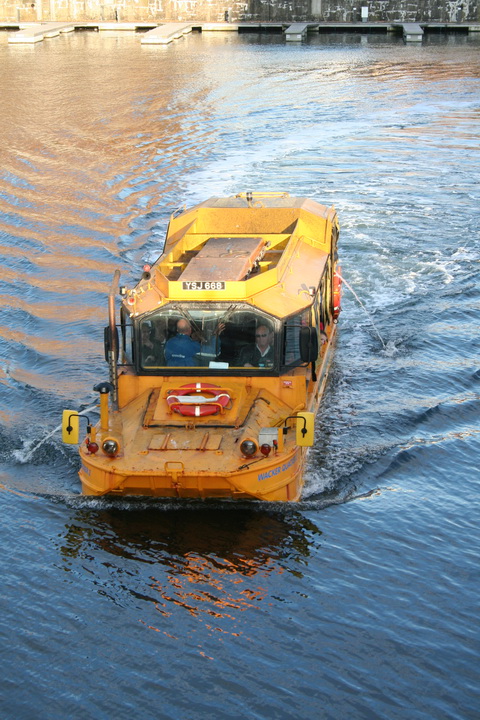
DUKW in the Salthouse Dock, Liverpool

DUKWing under the bridge into the Albert Dock, Liverpool

DUKWing under the bridge into the Albert Dock, Liverpool

In Dublin, Viking Splash offers similar tours, with the regrettable addition of horned helmets, as not worn by Vikings. The Dublin operation seems to have added two other items that were not discernible on the Liverpool DUKW.
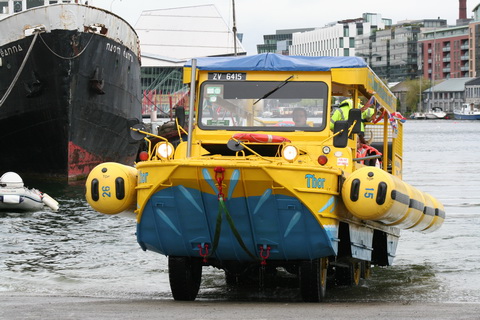
VikingSplash DUKW Thor 18_resize

Extra buoyancy on the Dublin DUKWs

First, before they enter the water at Grand Canal Dock, Ringsend, the DUKWs are fitted with extra buoyancy in cylinders that slide into racks along their sides. I saw the VikingSplash crew removing the cylinders from the yellow DUKW; it took only a couple of minutes, and I presume that it didn’t take much longer to put the cylinders on.
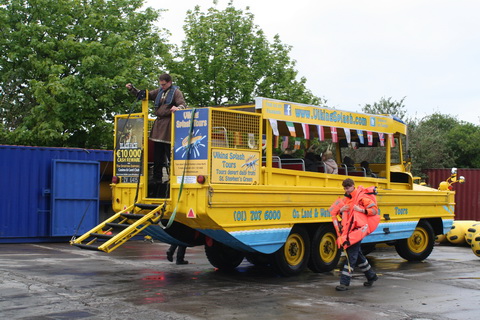
VikingSplash DUKW Thor 25_resize

Buoyancy aids being collected after the trip around the dock

Second, the Dublin passengers are issued with buoyancy aids before they take to the water. I can’t see any buoyancy aids on the Liverpool passengers, although it’s possible that they are out of camera shot.

Sometimes we complain about extra health and safety (which often means insurance) requirements. Then something like this happens: a yellow DUKW sank yesterday in Liverpool — for the second time this year. I don’t know whether the precautions taken in Dublin would have averted the accident or enhanced the safety of the passengers but it does suggest that the Maritime Safety Directorate bods in Dublin do have a point.

Addendum: the speaker on this clip says that passengers began putting on buoyancy aids, which suggests that aids were issued but not worn. Given how quickly the vessel sank, and how constricted the space inside is, it seems to me that passengers should wear their buoyancy aids throughout the waterborne trip.

Later: scary video.

Later still: a BBC story saying that a tyre may have caused the problem, the Liverpool mayor’s opinion (and some good photos) and the firm going into administration.
Dargan, O’Regan, steam and the Newry Canal

I wrote here about Simon O’Regan’s passenger-carrying screw steamer tried on the Grand Canal in Dublin in 1850. I am grateful to John Ditchfield for pointing me to an article about what happened next: steam trials on the Newry Canal in 1850, but this time with a lumber (freight) boat.

I would welcome more information about Simon O’Regan or about the use of steam power on the Newry Canal.

Simon O’Regan -v- John Inshaw

Did Simon O’Regan attempt to preempt John Inshaw? Here is a page about O’Regan’s single-screw passenger steamer, demonstrated at Portobello on the Grand Canal in Dublin in 1850.

Melancholy loss of life on the River Shannon

Last Wednesday we were witness to a most melancholy spectacle. We saw three bodies floating on that part of the river Shannon which lies opposite to Castle Lough, in this county. Having rowed in to shore, we gave notice to some persons there, who, without hesitation, prepared themselves, and joined in the sad task of snatching from the watery element the livid bodies of three unfortunate fellow creatures. When we stretched them on the bank they were recognised by one of the Steam Packet Company to be the bodies of Thomas Minshoe, George Halbert, and Robert Williams, three of the unfortunate five that were drowned some few days ago, while on a party of pleasure. The bodies were far advanced in a state of putrefaction and were a revolting spectacle to look on.

A messenger being despatched to Nenagh for the coroner, James Carroll, Esq, that officer, with his usual promptness, reached here in a short time; and having empanelled a jury, “Accidentally drowned during a squall” was the verdict.

It appeared from evidence that the deceased, with others, left Killaloe on Sunday, the 20th ult, for the purpose of having a day’s amusement on the Upper Shannon. They put in at Castle Lough to take refreshment; during the time they were on shore, the wind freshened and blew a gale, upon which they determined to leave the boat at anchor, and proceed home by land, which they accordingly did. On the following morning they returned and found that the ropes, which were for the purpose of lowering the sails, had been stolen. The day being fine and the weather not likely to change, they made light of the inconvenience, and ventured homeward.

After hoisting sails and reaching the centre of the river (which, at this point, is not two miles broad), a squall came on. Having endeavoured in vain to lower sails, which was completely impracticable, on account of the loss of the ropes, the boat suddenly ducked beneath the weight of canvass, and consigned the poor fellows to an early grave. Thomas Minshoe and George Halbert are natives of Liverpool, and Williams from Wales.

No coffins being convenient, three fishermen were appointed to watch the bodies on the shore until the next day. When we saw them coffined, we observed that the ear had been eaten off Williams by, we suppose, a dog, and a part of Minshoe’s left leg. They were interred at Killaloe on the afternoon of Thursday.

1 September 1837

Dick Gaughan and John Grantham …

… both had an interest in Erin-go-Bragh,

Arthur’s Day

There is quite a modern branch of trade risen up in Ireland — I mean the exportation of Dublin porter. I am not a proprietor in the brewery, and, in praising the beverage, which I consider most excellent, I cannot be considered to be actuated by interested motives. But, it is a curious fact, that, a few years ago, Ireland was an importing country of porter, while, at the present moment, a very considerable export trade is growing up in Dublin.

In this point, and, perhaps, in this point only, I fully expect the learned member for Dublin [Daniel O’Connell MP] to concur with me. I only venture to entreat hon. Members opposite, who wish to give some activity to the trade of their country, to encourage the fermentation of the vat, rather than the fermentation of politics. By so doing, they may greatly improve our trade and our internal condition; and, if they will but take my advice, I, for one, shall be ready, most heartily, to drink their healths in their own porter.

Thomas Spring Rice, MP for Cambridge (and previously for Limerick), Joint Secretary of the Treasury, in a House of Commons debate on the repeal of the Act of Union on 23 April 1834. On this site, you’ll find more on Daniel O’Connell here and on Uncle Arthur here.

Urination in Co Clare

In County Clare, urination has a long and distinguished history. Here is a piece about one early example: while it was not on inland waters, I hope that the involvement of the Head Pacificator, renowned for his efforts to promote the Shannon, as well as of two authors who provide useful information about the river, will excuse the inclusion.

Bring back the Black

The Black Bridge at Plassey has been closed since the floods of November 2009. Its reopening seems to have a low priority; I suspect that is because the importance of the bridge in Ireland’s technological, economic, entrepreneurial and political history is not widely appreciated. Here is a page explaining some of the background and suggesting a context within which reopening might be justifiable.

The surprising importance of the Shannon steamers in the 1830s

A short, lavishly illustrated talk in Killaloe Cathedral, Co Clare, at 6.00pm on Sunday 29 April 2012, as part of the Waterways Ireland Discover Killaloe and Ballina thingie.


Internet search engine

Grand Canal docks, Dublin

Salthouse Dock, Liverpool

Lock 3 Skelan, Shannon–Erne Waterway

Maybe they‘ll give me loads of money for this ….