Tag Archives: lost

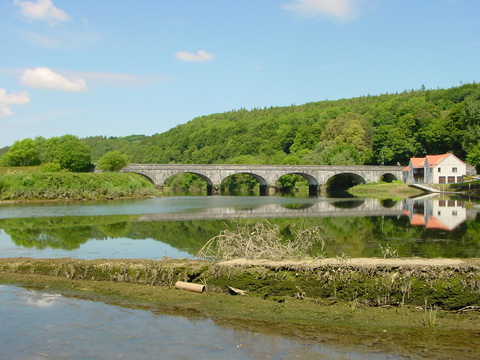
Bare ruined choirs, where late the sweet birds sang

The old Limerick Navigation included a section of canal at Killaloe, with three locks. The uppermost, now disused, is still visible at Killaloe; the middle lock (Moys) is accessible by small boat; the third (Cussaun) is under water in the Flooded Area created by Parteen Villa Weir. The wall that divided the canal from the river downstream of Killaloe bridge forms an island whereon are the former eel-packing station run by the ESB, the former goods store (inhabited by Waterways Ireland) and the former marble mill (now an ESB engineering works). The island hosts the Killaloe market on Sunday mornings.

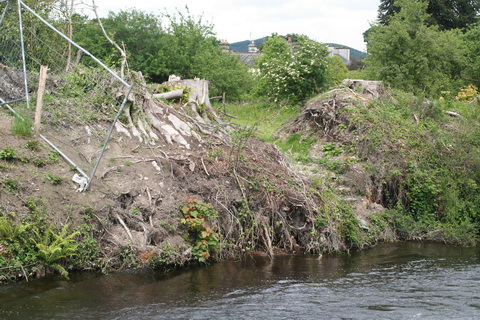
The curious can (obstructions permitting) walk a little further downstream to where the wall was breached, allowing boats to access the canal below the bridge without having to go as far as Moys Lock.

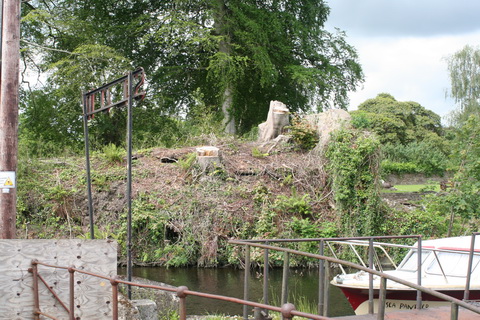
An obstruction

A section of the canal below the bridge in Killaloe ~1900 (OSI)

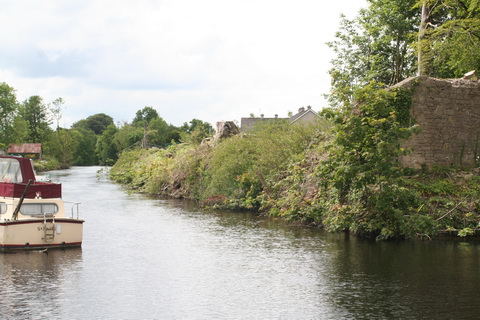
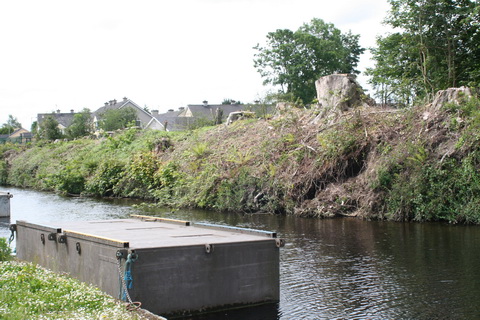
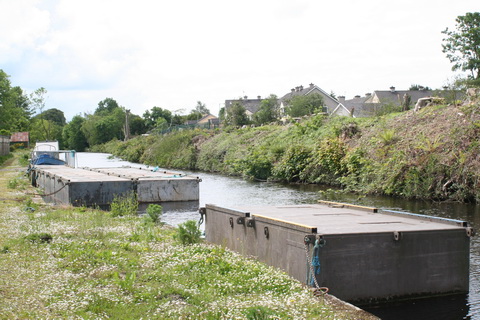
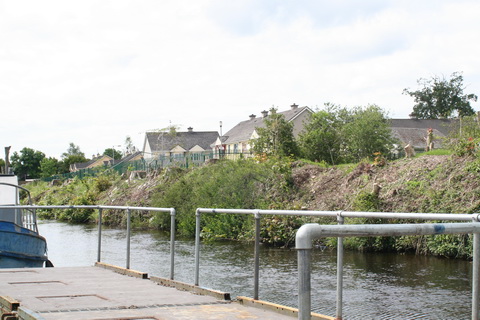
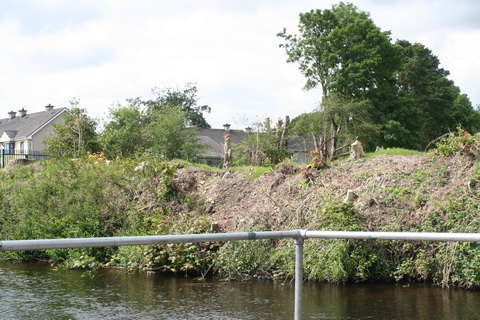
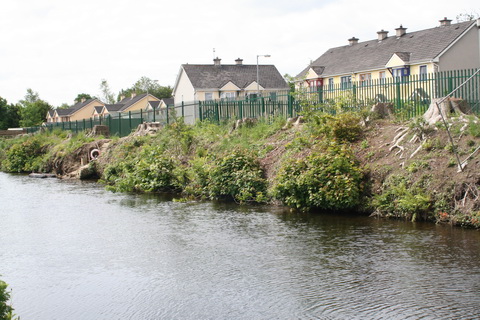
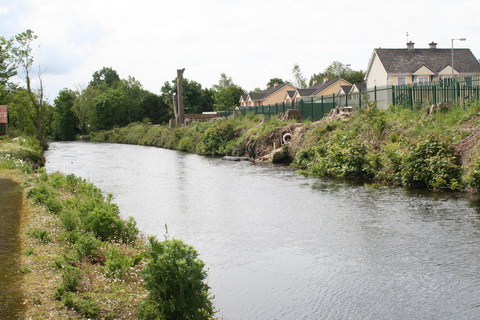
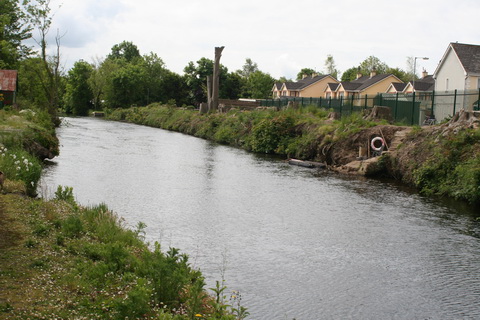
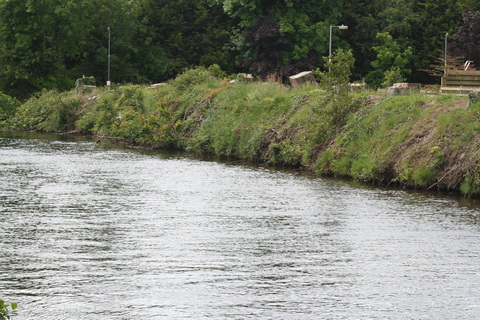
The west side of the canal, below the slip, was lined with trees.

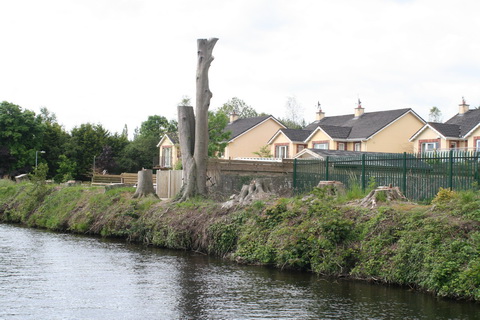
The trees
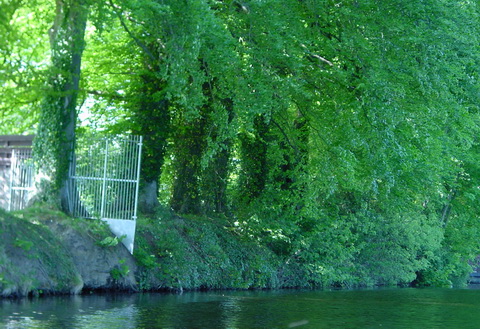
May 2008

May 2008

May 2008

November 2008

November 2008

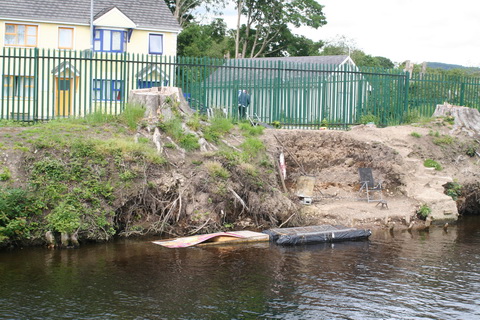
November 2008, with homemade boat shelter
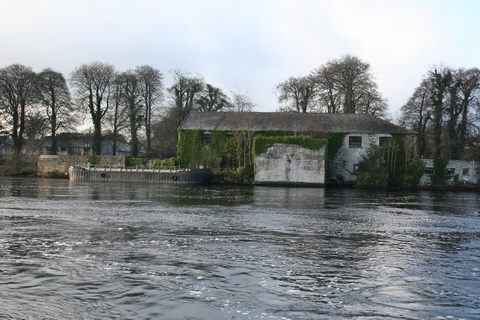
The trees behind the marble mill: seen from the far side of the river in December 2009
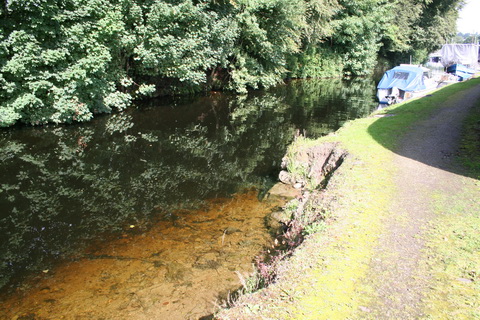
August 2010

A fallen tree blocks the canal in December 2010

April 2011

April 2011

November 2011

November 2011

November 2011

Waterways Ireland Marine Notice 86 of 2011

MARINE NOTICE No. 86 of 2011
Shannon Navigation
Lough Derg
Killaloe Canal

Canal Maintenance – Tree Cutting

Waterways Ireland wishes to advise all masters and owners of vessels that tree cutting will take place along the Killaloe Canal banks from the vicinity of the cathedral downstream to the lower entrance from the river
Shannon, from Monday 19th Sep until about mid Oct.

Access to this section of the canal will be closed during this period. […]

Marine Notice 24/2012 of 16 March 2012 said

Works are still ongoing along the Killaloe Canal banks from the vicinity of the Cathedral downstream to the lower entrance from the river Shannon.

Access to this section of the canal will be closed until further notice.

That notice has not (as of 10 June 2012) been withdrawn so it must be assumed that the works continue.

Cad a dhéanfaimid feasta gan adhmad?

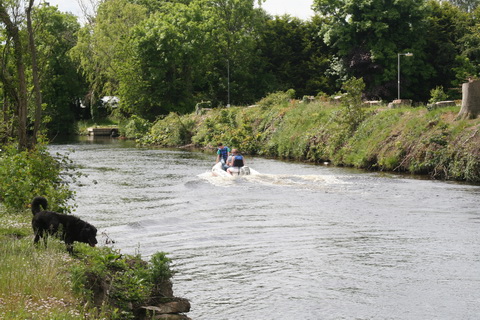
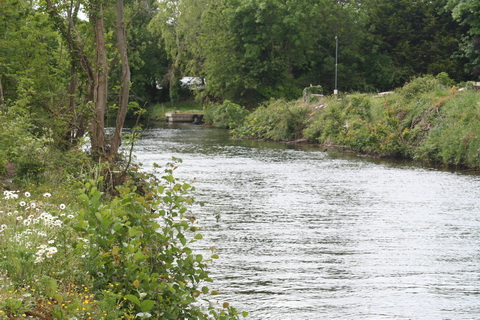
The works photographed on 10 June 2012.
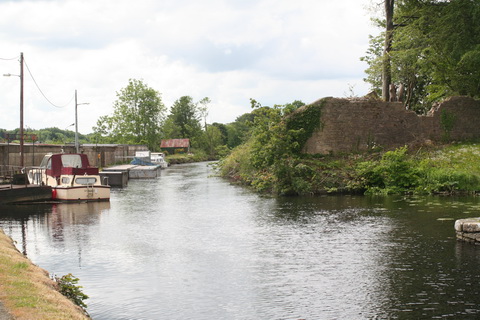
Thomas Omer in Athlone

Here is a new page showing the route of the old canal in Athlone, which was used before the Shannon Commissioners built the new lock, weir and bridge in the 1840s. The canal is easily accessible along most of its route, although some explanatory signs might be useful to call attention to notable features.

How much Dáil time …

… is wasted in asking and answering questions over and over again? I’d have thought that Caoimhghín Ó Caoláin TD (Cavan-Monaghan, Sinn Fein) would have realised that the government has discovered neither oil nor a crock of gold and that there is no money for a canal to Clones. The task of finding some is to be delegated to an “inter-agency group”, poor dears. I’d have thought it might be better to give the job to people with experience of unconventional fund-raising; there must be some such people around.

Hey, Brendan …

… once you’ve recruited the staff for your new government economic and evaluation service, could you send a few of them round to the DAHG to examine the Clones Canal proposal?

Prothero on the Munster Blackwater

The road bridge in Cappoquin


The redoubtable F E Prothero, Rear-Commodore of the Cruising Club, wrote just over three pages about the Blackwater, from Kanturk down to the sea, in A New Oarsman’s Guide to the Rivers and Canals of Great Britain and Ireland edited by F E Prothero and W A Clark and published by George Philip and Son, London, in 1896, as a Cruising Club Manual.

Here is a PDF of the relevant pages. I have also put a link to the PDF on my page about the Blackwater, Bride and Lismore Canal.

Clones Canal update

I’ve done a precis of developments since Novemebr 2011. There is nothing much new on the page, but it may assist new seekers after truth.

I’ve also given the overview a mild update, but without making major changes to its structure.

I’ve been making three main points about the Clones Canal proposal:

  • the expected costs are understated
  • the expected benefits are overstated
  • there is no funding available.

Just in case anyone from Clones, or from the government, is looking in, I want to point out that I have been shown to be right on two of those points so far.

First, I said that the €35 million cost figure, which was widely used by the project’s proponents, was unreliable. Waterways Ireland has recently said that the cost is now expected to be €38 million + VAT, which I gather is about €45 million. So has the government reassessed the economic case? If it has, it’s not admitting it.

Second, I said that I could not see how the Irish government was going to fund the project. I wrote:

So where is the money to come from? I’ve tried asking the public bodies that should know the answer, but they won’t tell me.

The government now admits that funding was not provided and it is clear that there will be no significant funding (ie enough to pay for construction) before 2014. Incidentally, my appeal against the refusal of information is with the Office of the Information Commissioner: I don’t believe that government should be able to keep matters of funding secret, especially if potential investors might be misled.

We have no result yet that would cast light on the expected benefits, but we do know that the boat-hire business has declined drastically in recent years. If Clones is to prosper, as I hope it will, it will need development initiatives that are easier, faster, cheaper and more effective than the proposed canal.

An Bord Pleanála

Big it up for An Bord Pleanála, which has turned down the proposal that a giant alien spaceship be allowed to land near the Blessington Street Basin, just off the Broadstone Line of the Royal Canal. The Irish Times and the Sunday Business Post have both used an artist’s impression of the ghastly object, which is intended to be a children’s hospital, but I can’t find who owns the image so I can’t ask for permission to use it.

If only we had a similar body assessing other investment proposals like those for, say, the Clones Canal. The proponents of both projects argue in similar ways: we have a report, we have experts, it’s time to move on, shut up and give us the money. That both projects are insane — because, apart from being unaffordable, they ignore likely user experiences — is irrelevant to the proposers: their strategy is not to come up with the best (or even a reasonable) allocation of public money but to force through their projects in their currently proposed form. Only German politicians can save us (and our money) from these people; perhaps Germany would like a seventeenth (or eighteenth, after Greece) Land?

The campaign to improve Clones

Tender here. No mention of the engine shed amongst the heritage sites to be interpreted, alas. And the General description of proposed works document has a photo of the playground at O’Briensbridge in Co Clare, captioned as “Playground, Shannon Harbour, Co Offaly” even though Tom Burke’s boat is clearly visible in the background. Still, good to see that they’re not just waiting for a canal. And they intend to build a car park in the town park, which could be useful for the camper vans.

UC@NIA

The Northern Ireland Assembly mentioned the Ulster Canal twice on 20 February 2012; the Lagan was mentioned too. Nothing new, really.

Value for money

Regular readers will be aware that I think the proposed canal to Clones is a bad investment. I thought it might be useful to look for information about other Irish canal restorations to see what they cost and what the return on investment has been. I understand that there was a study of the Shannon–Erne Waterway, but I can’t find a copy on tinterweb (if anyone has one to lend, please get in touch).

I therefore asked Waterways Ireland about the restoration of the Royal Canal:

I would be grateful if you could tell me the cost of the restoration of the Royal Canal, the annual cost of running it and the revenue it generates.

The reply (for which I am, as always, grateful) said:

Restoration of the Royal Canal commenced in 1987.

€37m Capital Expenditure on the restoration project funded through (1) Operational Programme for Tourism 1994-1999 (2) National Development Programme 2000 – 2007 and (3) National Development Plan 2007-2013.

The Maintenance Cost for 2012 is €2.46m.

The revenue generated by the canal in 2011 is not available.

I didn’t really expect that there would be a meaningful figure for revenue. A full assessment of the benefits would cover far more than the (probably minimal) direct revenue; I think such an assessment should be done, but that’s not what really got my attention.

According to Waterways Ireland, the Main Line of the Royal is 146 km long and has 46 locks and many bridges, some of them newly built as part of the restoration. Harbours have been improved, slipways have been provided and service blocks have been built. And all of this was done for €37 million (I don’t know whether that’s in constant prices and, if so, at which year’s rates: I’ve asked a supplementary question).

A canal to Clones would be 13 km long and, according to WI’s final restoration plan [PDF], would have one double lock (staircase pair). Some dredging would be needed on the River Finn and a new canal 0.6 km long would have to be provided; the work at the Finn end would cost €8.5 million altogether. On the line as a whole, work would be required on up to 17 bridges, some major and some minor or private bridges. And there would be a cost for land acquisition, although the Updated Economic Appraisal put that at a mere £1,268,280, a very small portion of the total cost. And then there would be the pumps and pipes to take water from the Erne, pump it to Clones and let it flow back down; it is not clear whether WI would have to pay for the water. And the total cost of this lot would be €38m + VAT, which I am told is about €45 million altogether.

Now, even allowing for the facts that there had been some voluntary and FÁS scheme work on the Royal, that no land had to be acquired and that parts of the canal were in water, I still find it difficult to see how a 13 km canal with one double lock can cost more than a 146 km canal with 46 locks. I have asked WI for a comment, but perhaps readers — especially if any of them are engineers or accountants — would be able to help to explain the mystery. Maybe it’s something simple like a mistake in the figures or maybe I’m missing something about the nature of restorations …. Enlightenment welcome.