Tag Archives: Operations

All sheugh up

Thinking about the exciting news from the North South Ministerial Council plenary session about the Clones Sheugh, I was reminded of the even more exciting news of the first meeting of the North/South Inter-parliamentary Association.

Strangely, its meeting received little publicity in the great world. I asked Messrs Google to search for it but to omit links from the Oireachtas and the Northern Ireland Assembly, as well as those from politicus.org and flickr.com. It found only 42 hits, of which the first seven were links to the site of a Labour senator called Mary Moran. (I won’t provide a link to her site as she’s obviously perfectly capable of generating all the links she wants.)

Anyway, the first meeting of the North/South Inter-parliamentary Association seems to have passed almost unnoticed. You can read about it on InsideIreland.ie, which seems to be a news site run by an advertising agency.

From Ciarán Hanna’s account, I deduce that the North/South Inter-parliamentary Association is an entirely pointless body. I note that it won’t meet again until April 2013. And perhaps the Irish government’s support for the Clones Sheugh is because it gives this pointless body something to discuss, thus keeping it from commenting on anything important.

A London pub and the history of the Shannon

Piloti’s “Nooks and Corners” column in the latest issue of Private Eye [No 1325] reports [brief extract available to non-subscribers here] that a London pub is threatened with demolition. On the Google satellite view with photos, press the button to the bottom right of the building to see a pic headed “Derelict pub”.

Piloti says that the pub was built in the 1840s [Diamond Geezer says 1839] and at that time the Marquis (or Marquess) was Henry Petty-Fitzmaurice, 3rd Marquess of Lansdowne, KG, PC, FRS. The family’s main base was in Britain but they owned large estates in Ireland, notably in Counties Limerick and Kerry; certain roads in Dublin are also named after the family.

The late Marquis has two claims on the attention of Irish waterways enthusiasts. First, the best-known of the early River Shannon steamers, the Lady Lansdowne, was named after his wife. Second, he was Lord President of the Council [the current holder of the post is Nick Clegg] when the government of Her Late Majesty Queen Victoria decided, in 1839, to spend about half a million pounds improving the Shannon Navigation.


Blunderbuses on the Shannon

Saturday 10 May 1845

[…] On our way to Rooskey this Morning we visited Cloneen [Clooneen] & Cox shoal and they were going on very well with about 60 Men

I ordered them to double that Number to my astonishment I found 4 Policemen Barricked in one of our houses and a new Barrick erecting for 30 or 40 more Men this was being done in consequence of three villains placing themselves on the opposite bank of the River and deliberately firing four rounds of Ball from Blunderbuses some of which went into the office and from the marks made by one Ball must have been only a few inches from striking Joe Lambs head — afterwards the villains retired to the Bogs — the object of this outrage was revenge on the Men for not striking for 1/6 [8p] Pd day — the average being about 1/2 [6p] — which is considered at present ample

From David Brooke ed The diary of William Mackenzie, the first international railway contractor Thomas Telford Publishing, London 2000

What the blurb doesn’t say is that Mackenzie was the contractor for works on four areas of the Shannon, working for the Shannon Commissioners in the 1840s. He was responsible for Killaloe, Meelick, Banagher and Rooskey and also held a dredging contract.

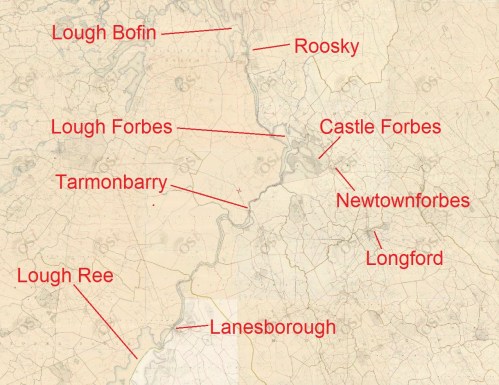
Lanesborough to Rooskey showing Lough Forbes

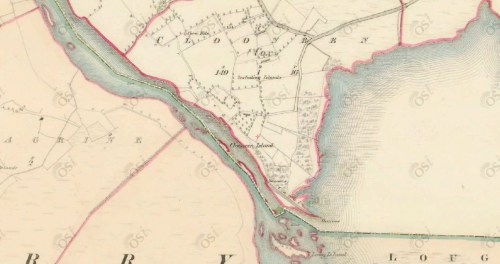
Clooneen (Cox) is the area at the upstream end of Lough Forbes; other Clooneens lie to the north on the east side of the river. Joe Lamb was the ganger.

Clooneen (Cox)

Ardnacrusha

Killaloe Coast Guard report here.

Da new kidz in da hood

A couple of canally sites I hadn’t come across:

  • da corpo’s canal (h/t IndustrialHeritageIreland)
  • Dublin canal walks. I don’t know who is behind this site, which looks like a work in the early stages of progress, but I’m all in favour of folks’ walking along Dublin canals; my own effort at encouragement is here.

Industrial Heritage Ireland, by the way, has been watching the Clones Canal campaign. This suggests that the campaign is being cranked up, although I don’t know what the poor buggers from the NI Strategic Investment Board are doing in the group: pouring money into holes in the ground is not (pace Keynes) usually seen as an investment.

It is reported, nonetheless, that IWAI folk are confident that public money will be wasted on the ghastly project, thus subsidising their hobby. And it seems that a gang of Irish parliamentarians, following the tradition established in Grattan’s Parliament, are keen to distribute pork: there is nothing in the press release to suggest that any of the poor dears have any interest in assessing the costs and benefits of the Clones Canal proposal. In the unlikely event that any of them is interested, the pages starting here might be useful. And interested parliamentarians might like to check on any cost-benefit analyses done (or revised) since it was found that the canal would cost €45m, not €35m.


Coill an Eo

Arklow Marine Services reports:

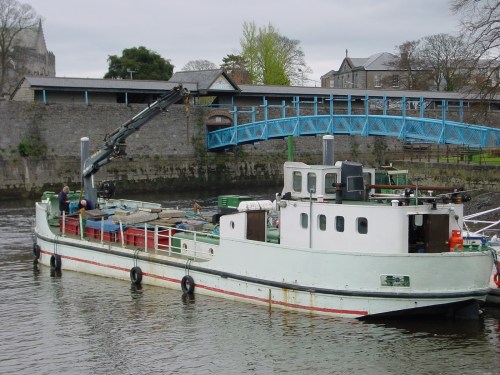
The “Coill an Eo” a 26 metre works barge, used in maintaining buoys and markers on the Shannon and owned by Waterways Ireland, has recently been docked in Rooskey, Co. Roscommon.

The first job the Yard had to do was carry out ultrasonic readings on the vessels hull, both internally and externally. A new main engine, tailshaft, propeller and bearings are to be fitted to the vessel and a complete electrical installation carried out.

Coill an Eo in Limerick in 2003

More photos of WI vessels here.

Pat Sweeney, in Liffey Ships and Shipbuilding Mercier Press, Cork 2010, says that Coill an Eo, launched in 1969, was the last vessel built on the Alexandra Basin slipways. He describes her as “a small grab hopper dredger” and says that the £40,000 cost was shared by the Commissioners of Public Works (then responsible for the Shannon) and Bord Fáilte.

Canal mooring rules

Waterways Ireland issued two press releases about moorings today. The first was the usual one about winter moorings on the Shannon and the SEW; the second was about the canals. Here, unedited, is the text of the second.

Canal Mooring Rules Coming into Force

Waterways Ireland announced in June 2012 that the Canal Bye-laws on the Grand & Royal Canal and Barrow Navigation are to be enforced from autumn 2012, with an accompanying change in the permit system allowing for year-long mooring permits and locations.

Part of bringing in this new location-based permit has been the identification of locations suitable for extended mooring. This process is now completed and work has begun in some areas to improve accessibility.

Waterways Ireland will roll out Extended Mooring Permit applications by area, rather than giving a date when applications for the permit will open. For boat owners this will mean that enforcement of the maximum stay rule will not commence in an area until after boat owners have had the opportunity to purchase an Extended Mooring Permit.

The initial 12 month Extended Mooring Permit will cost €152 and will only be available to boats already holding a valid annual Mooring and Passage Permit.

Boats that cruise and move (staying at a mooring for up to 5 days) will not be in breach of the Bye-laws or require an Extended Mooring Permit.

Waterways Ireland has proposed a small number of draft amendments to the current Bye-laws which date from 1988. These include proposals to provide a range of charges for mooring permits that reflect the location and services provided throughout the canals and also will take into account the size of boat. These proposals include low cost rural moorings on soft banks to ensure the canals are accessible for everyone who owns a boat and requires a mooring. Boat owners allocated an extended mooring location in key areas in villages or towns or with services should be aware that if the new Bye-laws are approved Waterways Ireland will increase the charges for moorings in the future to reflect the location, services, and size of boat.

Waterways Ireland recognises the current situation whereby a small number of boat owners use their boats as their sole or permanent residence. Proposals to make provision for this use of the navigation property have been included in the Bye-law changes.

Furthermore Waterways Ireland intends to work towards the provision of a small number of serviced house boat moorings on the canal network. Such provision will be subject to finance, land availability and compliance with requisite statutory approvals.

Waterways Ireland recognises that a transition period of a number of years will be required to implement this. In the interim these boat owners should apply for an Extended Mooring Permit.

The draft Bye Law amendments are currently being considered by Waterways Ireland’s sponsor Departments. When Waterways Ireland has Ministerial consent, it will proceed to public consultation on the proposed Bye-law amendments.

Waterways Ireland will continue to contact permit holders regularly to ensure they are kept up to date with the roll-out of the new permit. All queries about the enforcement of the current bye-laws or the Extended Mooring Permit should be directed to Shane Anderson, Assistant Inspector of Navigation: Tel no +353 (0)87 286 5726, Email shane.anderson@waterwaysireland.org . Queries about houseboats should be directed to Property & Legal Section Tel no +44 (0)28 6632 3004.

These changes are necessary steps to improve the management of the canals and waterway amenities for both the navigational and recreational user, so that investment in the new infrastructure and facilities which Waterways Ireland has undertaken is maximised for every user.

Hunting Newbury

In his A Tour in Ireland with Meditations and Reflections [S Highley, London 1844], James Johnson MD describes a flyboat trip on the Grand Canal from Dublin. He says:

At Newbury, a station near Edenderry, I debarked, and spent two or three days at the hospitable mansion of Newbury Hall, with my excellent friend Mr Wolstenholme and family, where I also met my amiable friend, Mrs Evans, of Portrane.

I have been trying to find Newbury. So far, the most likely candidate seems to be Newberry Hall, in Carbury, Co Kildare; the spelling Newberry is given on the ~1840 [Historic 6″] OSI map whereas the ~1900 [Historic 25″] map gives Newbury.

The Hall is indeed fairly close to Edenderry, but if Johnson got off the boat in Edenderry I’d have expected him to refer to it as Edenderry harbour. Looking at the OSI map (link above), the only other sensible point of debarkation would (I think) have been at Ticknevin Bridge, from which there was a road towards Newbury, but I have no evidence that it was Newbury station.

I would welcome enlightenment.

The Lagan and Lough Neagh in 1830

Philip Dixon Hardy wrote in The Northern Tourist, or Stranger’s Guide to the north and north west of Ireland: including a particular description of Belfast, the Giant’s Causeway, and every object of picturesque interest in the district referred to William Curry, Jun and Co, Dublin 1830:

The river Lagan, although of very considerable breadth in the immediate vicinity of Belfast, and running nearly thirty miles, is yet by far too inconsiderable to be of any great advantage to the town in the way of trade or commerce. By its means, however, a regular communication is kept up between Belfast, Lisburn, and Lough Neagh. Since the year 1755, upwards of £100,000 have been expended in forming a canal, by the assistance of cuts in various places along the line of the river, where it was found too shallow for lighters to pass.

The Lagan Navigation Company have now the direction of the entire line, and have made such judicious improvements, as materially to promote the desired object — a speedy transit of goods and merchandise. This, however, can, after all, be only partially accomplished, as, from the circumstance of the Company not being able to have a horse-track-way along the entire line, nor to introduce steam power, the journey can be performed in a much shorter space of time by waggons and drays going direct. On Lough Neagh there is a small steam-vessel, by which the goods taken up in the lighters are rapidly conveyed to the different towns which lie in various directions round that extensive sheet of water.

W A McCutcheon, in The Canals of the North of Ireland David and Charles, Dawlish 1965, confirms the point about the trackway:

As a result [of various improvements in the early 1800s] traffic greatly increased, though water supply problems remained, and there was a horse-towing path for only part of the length of the navigation.

He gives no details, though, so I don’t know why the trackway was incomplete, how lighters travelled on those stretches that had no trackway or when and how the deficiency was remedied. My guess is that those stretches were along the river rather than the artificial cuts and that the riparian landowners were unhelpful, but I would welcome further information.

McCutcheon does not mention the steamer on Lough Neagh. However, D B McNeill mentions it in Coastal Passenger Steamers and Inland Navigations in the North of Ireland Belfast Museum and Art Gallery Transport Handbook No 3 1960:

The first steamer on the lough was the Lagan Navigation Company’s Marchioness of Donegall. She was built by Ritchie and MacLaine of Belfast, her engines were obtained from David Napier of Glasgow and she was launched at Ellis Gut in November, 1821. She was the first inland navigation steamer in Ireland and was used for towing the Lagan canal boats across the lough. When new, she was reputed to have had a speed of two knots. She was uneconomical and her owners tried to sell her in 1824, but there were no buyers. It is believed the Marquess of Donegall used her occasionally as a yacht. She was broken up sometime about 1840 and her engines were stored in Belfast.

In his Irish Passenger Steamship Services Volume 1: North of IrelandAugustus M Kelley Publishers, New York 1969 he says that the Marchioness was a wooden paddle steamer, built in 1821 and broken up in 1843, 73′ long with a beam of 16′, with a simple single-cylinder engine. He says that the engine cost £1,400, provided 30hp and gave her a speed of 6 knots. A passenger service was considered but never provided, but picnic parties could charter the boat for five guineas a day.


Dublin’s canals in 1801

Grand Canal

The formation of canals was scarcely known in Ireland until the year 1765, when the Grand Canal was begun by a company of enterprising men, who were incorporated in 1772 by an act of parliament; boats began to ply to Sallins in 1783, to Athy in 1791; it is a cheap and pleasant mode of travelling, at the rate of 3½ miles an hour. This Canal is carrying on to Philipstown, Banagher, and Birr. From the first lock at Kilmainham, a cut has been made to the river Liffey at Rings-end, extending 3 miles, having 12 neat bridges to accommodate the different roads to Dublin. At the seventh lock on this line, the great basons and docks are, 4000 feet long, and 330 feet average breadth, capable of containing 400 sail of square-rigged vessels. On the 23rd of April 1796, it was opened at high tide; when his excellency Earl Camden in the Dorset yacht, commanded by Sir A. Schomberg, with a number of barges from the canal, cutters, and boats highly decorated, were admitted under a discharge of 21 pieces of cannon, and had room to sail in various directions. There were 60,000 people present; it was the best aquatic fête ever seen in this kingdom. John Macartney Esq addressed his Excellency, and was knighted.

Royal Canal

The Royal Canal is another proof of national spirit and national industry. The subscribers were incorporated in 1789; it is now finished beyond Kilcock, 14 miles, and is proceeding rapidly to Kinnegad. On Sunday the 20th of December 1795, the first excursion was made in a barge to Kilcock, with the Duke of Leinster and Marquis of Kildare, amidst the acclamations of the people.

J S Dodd, MD The Traveller’s Director through Ireland; being a topographical description not only of all the roads but of the several cities, towns, villages, parishes, cathedrals, churches, abbeys, castles, rivers, lakes, mountains, harbours, the seats of noblemen and gentlemen on those roads: their antiquities and present state respecting parliamentary representation, patronage, trade, manufactures. commerce, markets, fairs, distances from each other, and natural curiosities; with an account of their foundations, vicissitudes, battles, sieges, and other remarkable events that have occurred at them — insomuch, that this work comprehends in itself, an accurate Irish itinerary, an extensive Irish gazetteer, an Irish chronological remebrancer [sic], and an epitome of the ecclesiastical, civil, military and natural history of Ireland, from the earliest accounts to the present year, and every information necessary for the resident, or the stranger. Embellished with  two elegant maps; one of the roads and post towns in Ireland, the other of the city of Dublin, compiled from the most authentic authorities Dublin 1801