Tag Archives: quay

News from the Suir

Some chap from Limerick has been quoted in the Nationalist (Clonmel) as supporting South Tipperary County Council’s proposed taking in charge of the towing-path between Carrick-on-Suir and Clonmel.

And Carrick-on-Suir River Rescue needs help raising funds to buy a premises.

Mystery solved

Nobody tried the Spot the canal I set the other day, so I must now reveal that the eel weir shown is at the upper end of the Cong Canal. There are many photos and maps on that page.

Grand Canal Dock improvements

L & M Keating at work here.

The fear of Baal’s Bridge

In May 1895 the fear induced by the prospect of a passage under Baal’s Bridge, on the Abbey River in Limerick, as revealed in the commercial court in London before Mr Justice Mathew and reported by the Freeman’s Journal of 20 May 1895.

Arthur George Mumford of Colchester, Essex, was described as an agent, but was actually a marine engineer and manufacturer of steam engines. He owned a 25-ton steam yacht called Gipsy, which he decided to sell through Messrs Cox & King, the well-known yachting agents (their 1913 catalogue is here).

The buyer was Ambrose Hall, the man responsible for the statue of Patrick Sarsfield. A former mayor of Limerick, he was an alderman and a “house and land commission agent”; his address was given as Mignon House, Limerick, which I have not so far found.

Hall bought the boat for £500; it was to be delivered to him at Limerick. The original plan was to sail it around the coast of Ireland and up the Shannon estuary, but bad weather in late 1894 caused Cox & King to suggest taking it to Dublin and then down the Grand Canal and the Shannon to Limerick. Hall agreed; the boat left Dublin in January 1895. It reached Killaloe on 19 January and Limerick “a day or two afterwards”, where it was moored in the canal harbour.
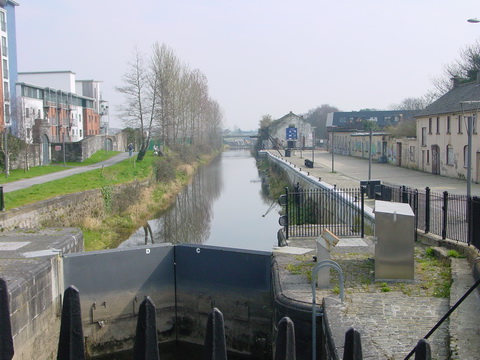
25 Grand Canal Harbour Limerick March 2007 01_resize

Canal harbour, Limerick in March 2007

Hall refused to accept the boat in the canal, saying that it should have been delivered to Limerick dock, a short distance downstream. Mumford and Cox & King sued him and the National Bank.
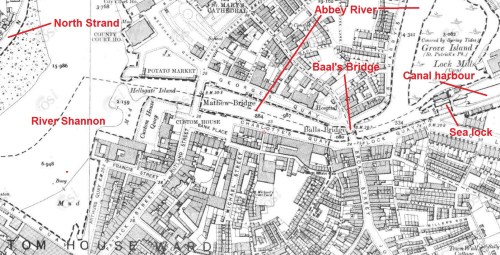
Hall and Baal

Ordnance Survey ~1900

Hall, an alderman and a former mayor, who had lived at North Strand, presumably knew the river and its difficulties.
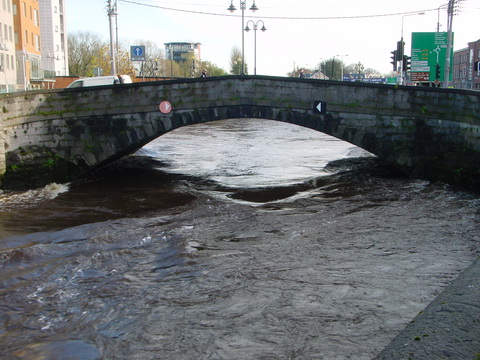
Baal's Bridge 20091128 1_resize

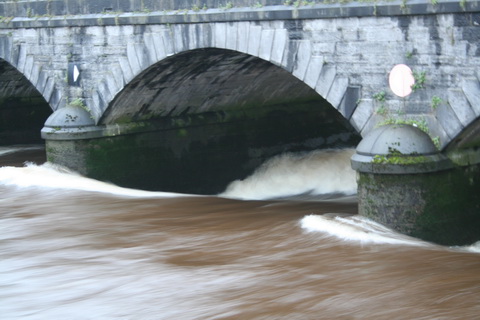
Baal’s Bridge looking upstream towards the canal harbour in the floods of 2009
Navigation arch at Mathew Bridge 20091122_resize

The navigation arch at Mathew Bridge looking downstream in the floods of 2009

It was contended by the defendant that to get the vessel from the canal into the estuary of the Shannon there was a considerable risk involved. The passage was only a few hundred yards, but it was stated it could only be effected at certain states of the tide when it would be possible to get through Ballsbridge.

The judge sensibly suggested that it should be possible to insure the boat for the journey; the plaintiffs agreed to deliver it; Hall agreed to accept delivery and to pay £15 for the cost of the caretaker who had been looking after the boat since 23 January; the case was settled.

Clearly Ambrose Hall didn’t know Pat Lysaght.

My OSI logo and permit number for website

The 120′ Irish steam-powered narrow boat

Read about it here.

A load of old bollards

Our London Correspondent reports that the latest and most fashionable souvenir to go on sale there is a reproduction cast-iron “paperweight/doorstop/bookend based on the mooring bollards of Regents Canal”. Available in black or fluorescent red, these items were designed by a designer who was being worked with by another chap who was commissioned by a Creative Agency. The result is a “desirable antidote to the overly-commercial, tacky souvenirs” available elsewhere, it says here.

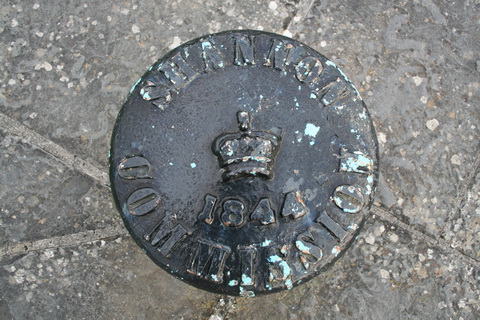
Shannon Commission bollard 1844_resize

A bollard at Meelick

Well, that’s nice. Maybe Waterways Ireland could commission the same creative types to design a range of reproductions of Irish waterways bollards; folk could be encouraged to collect the entire set.

But one minor drawback does strike me. The artistic merits of these reproduction bollards are of course obvious, but as souvenirs they have one minor drawback. A souvenir is something you buy, while on holiday, to take home to someone else. Nowadays, the steamer services are not what they once were and many folk travel on these new-fangled flying-machines. But according to that nice Mr O’Leary, who operates some such machines, you may take only 10 kg of cabin baggage. These bollards, though, weigh about 1.5 kg each, which rather limits the number of bollards you can carry as souvenirs.

Canal Boat No 279

There is a mystery about Canal Boat No 279, which sank in the entrance to Spencer Dock, on the Royal Canal, in December 1873. Actually, there are several mysteries, and readers’ comments, information and suggestions would be welcome. Read the story here.

Canal boat sunk on the Liffey

In a comment here I wondered what a canal boat was doing as far up the Liffey as Grattan Bridge in 1873. Here is a report from the Freeman’s Journal of 10 March 1875 that may provide a possible explanation.

THE LATE WRECK IN THE RIVER LIFFEY:— The porter-laden canal boat which was swamped on Monday by being borne by the flood in the river against the southern abutments, at the western side of Grattan-bridge, still remains in the place where she sank. Though she came with great force against the structure, she did not inflict the slightest injury upon it. Measures will be at once taken for floating the sunken vessel, which does not in any way interfere with the river traffic, as the centre arches are quite clear. All the porter which was on board the canal boat when she went down has been secured.

Remember that Guinness built its wharf on the Liffey in 1873 but did not start building its own fleet of barges for the Liffey until 1877. It did, however, have “a few small tugs” that were used to draw laden boats.

Guinness had easy access to the Grand Canal Harbour at James’s Street, so it seems unlikely to me that Grand Canal boats would risk the Liffey passage to supply pubs along the Grand, the Barrow and the lower Shannon. It therefore seems more likely that the boats were either Royal Canal boats or were being used to supply ships in the port.

Newcomen Bridge again

Last month I wrote about the lock at Newcomen Bridge on the Royal Canal:

Industrial Heritage Ireland has created a page giving the history of the railway crossing at Newcomen Bridge. However, it would be nice to have some documentary evidence about the resiting of the lock — and about the headroom under the bridge before the lock was moved.

Here it is, from the Freeman’s Journal of 12 April 1873, in an article about the new Spencer Docks:

Above the new metal bridge there is a basin for Canal boats, with a quayage of 450 feet at either side and a depth of six feet. In connection with the new works, the lowering of Newcomen-bridge on the Clontarf-road must be alluded to. To effect this the old lock had to be moved higher up, and the old bridge replaced by one suited for the requirements of the tramway traffic. The arch of the bridge crossing the Canal was lowered five feet, and a new girder iron bridge crosses the railway at the same level. The Main Drainage Board wisely took advantage of the opportunity of the Canal being drained to make a main sewer under the canal and the railway above Newcomen-bridge at the low level required.

Happy, Mick?

Dublin

Dublin City Public Libraries have some nice photos available online. The section on the Port of Dublin includes 1926 aerial photos of the Guinness wharf and of Spencer Dock (not busy) and Grand Canal Dock (including the section beyond the railway line, now filled in). There is also a photo of a steam barge at the Guinness wharf. In the Commercial Dublin section, I saw two businesses beside the Grand Canal, Ever Ready Batteries at Portobello and Gordon’s Fuels at Harold’s Cross.