
As a preliminary to increasing coverage of the old Limerick Navigation, I have improved the section’s top-level page. I added maps of the separate sections of the navigation and distances (in eighths of miles) from Prothero and Clark.
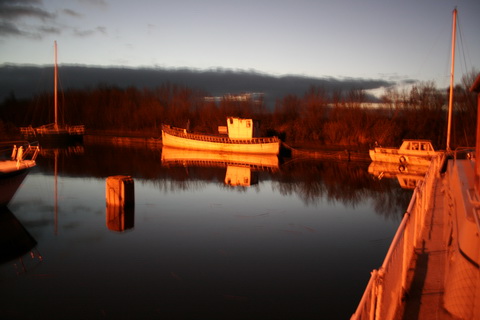
Dromaan at night (December 2011)
Posted in Extant waterways, Ireland, Irish waterways general, Natural heritage, Scenery, Shannon, waterways, Weather
Tagged boats, Clare, Dromaan, Ireland, Lough Derg, night, Shannon, weather
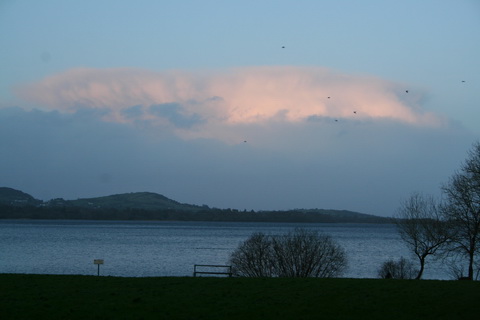
From Twomilegate December 2011
Posted in Ashore, Extant waterways, Ireland, Irish waterways general, Natural heritage, Scenery, Shannon, waterways, Weather
Tagged birds, Ireland, Lough Derg, Shannon, sky, Twomilegate, waterways, winter
The next time some idiot politician curries favour by promising special tax breaks for some favoured area, just mention the Upper Shannon Renewal Scheme. I mentioned before that IrelandAfterNama had covered it; now NamaWineLake, one of the best sites covering the wreckage of the Irish property market, has pointed to the evidence provided by the returns of stamp duty on property sales in 2010. Counties Leitrim and Longford — both covered by the scheme — each paid only €600,000 in stamp duty in 2010:
Practically nothing was sold in Longford and Leitrim which recorded the lowest stamp duty receipts of €0.6m apiece. If the receipts were all for residential property and the average transaction price was €200,000 then that would mean about 100 homes were sold in 2010 in each county.
So as well as spoiling the scenery by cluttering the place with colonies of white houses for white settlers, the scheme has also ruined the property market for the natives. Anyone needing to sell a house, perhaps to move in pursuit of employment, will find it more difficult to sell.
The SS John Randolph, described as “America’s first successful iron ship in commerce”, is commemorated by a historical marker in Savannah, Georgia, USA.
The John Randolph was one of the first six iron vessels built by Lairds of Birkenhead (later merged into Cammell Laird). The other five were built for use on the River Shannon.
Posted in Ashore, Built heritage, Charles Wye Williams, Economic activities, Engineering and construction, Extant waterways, Foreign parts, Industrial heritage, Ireland, Irish inland waterways vessels, Irish waterways general, Operations, People, Politics, Restoration and rebuilding, Shannon, shannon estuary, Sources, Steamers, The cattle trade, Tourism, waterways, Waterways management
Tagged Birkenhead, boats, Charles Wye Williams, Clare, Dublin, estuary, Fergus, Garryowen, Georgia, Grand Canal, Ireland, iron, John Randolph, Killaloe, Lady Lansdowne, Laird, Limerick, lock, Lough Derg, Operations, Savannah, Shannon, steam, tug, vessels, waterways
The Limerick Leader has a story that updates my piece on Limerick dredging.
Posted in Built heritage, Economic activities, Engineering and construction, Extant waterways, Ireland, Irish inland waterways vessels, Irish waterways general, Operations, People, Restoration and rebuilding, Shannon, shannon estuary, waterways, Waterways management, Weather
Tagged boats, bridge, Clare, Custom House, ESB, estuary, floods, flow, Ireland, Limerick, lock, Operations, Pat Lysaght, pontoon, quay, Shannon, vessels, water level, waterways, workboat
The Irish Examiner reports on the proposed LNG storage terminal here. Richard Tol provides an informed view here. The objectors’ site is here. I note from the Examiner report that they say:
Shannon LNG is hoping to make millions of euro profits every year with state support at the consumers’ expense at time of increasing fuel poverty.
Unfortunately the report did not say why a wish to make profits is to be deprecated or why it is a bad idea to increase fuel supplies and security “at time of increasing fuel poverty” but perhaps the extensive bogs, whose product was exported through Saleen, are still available.
Posted in Ashore, Built heritage, Economic activities, Engineering and construction, Extant waterways, Industrial heritage, Ireland, Irish waterways general, Natural heritage, Operations, People, Politics, Restoration and rebuilding, Scenery, Shannon, shannon estuary, The turf trade, waterways, Waterways management
Tagged Ballylongford, boats, estuary, Ireland, irisheconomy, Kerry, LNG, Operations, Rabbitte, Richard Tol, Saleen, Shannon, Tarbert, turf, vessels, waterways
When Waterways Ireland spends on capital investment in either RoI or NI, the total cost is paid by the jurisdiction in which the expenditure occurs (apart from the decision by the RoI government to pay the total cost of a canal from Lough Erne to Clones, where about half of the route lies in NI).
For current spending, Waterways Ireland gets 85% of its grant income (which is itself accounts for the vast bulk of its total income) from the RoI Department of Arts, Heritage and the Gaeltacht and the balance from the NI Department of Culture, Arts and Leisure.
The RoI government expenditure plans were announced on Monday 5 December 2011. The Comprehensive Expenditure Report 2012–2014 section on the Department of Arts, Heritage and the Gaeltacht mentions waterways, or matters affecting them, in several places.
As I noted here, waterways are the lowesst priority within the department. It intends to focus on eight activities, and Waterways Ireland and An Foras Teanga are covered in the final point:
An Foras Teanga covers Foras na Gaeilge and Tha Boord o Ulster-Scotch/The Ulster Scots Agency.
No mention of waterways, but the department says that steps to be taken in 2012 will save €6 million in each year of 2012, 2013 and 2014, with further savings of €10 million to be made in 2013 and €22 million in 2014. The department’s “total allocations for gross current expenditure” are to be reduced from €232 million in 2012 to €218 million in 2013 and €205 million in 2014. I can’t quite make the numbers match, but never mind.
The measures are summarised under five headings, one of which — North-South Co-operation — covers Waterways Ireland and An Foras Teanga. The department expects to save €2.2 million here, but says:
Any savings, in excess of the agreed 3% per annum efficiency savings, for the North/South Implementation Bodies will require the approval of the North/South Ministerial Council. It is envisaged that savings will be achieved through efficiencies and a focus on front-line services.
The 2011 estimate for current expenditure for WI and AFT was €40 982 000; a cut of €2.2 million is about 5.4% of that amount.
This section shows €1 million more saved in each of 2013 and 2014 but says:
Savings, in excess of the agreed 3% per annum efficiency savings, for the North/South Implementation Bodies will require the approval of the North/South Ministerial Council.
It is not clear whether, in the figures for 2012 and in those for 2013 and 2014, the amounts of €2.2 million, €1 million and €1 million are to be in addition to the “3% per annum efficiency savings” or whether the amounts shown include the 3%.
The introduction to the section on Indicative Savings Areas says:
Reducing overall expenditure in 2013-2014, as required by the expenditure ceilings, will be a significant challenge and require ongoing critical analysis by the Department. The Department’s funding is largely focused on supports to sustain the arts and our cultural institutions, to protect our natural and built heritage and to promote our native language. However, much of this current expenditure is also of strategic importance in sustaining and growing cultural tourism and is making a significant contribution to economic recovery and enhancing our national reputation. All areas of spending will be subject to continued evaluation to ensure that scarce resources are directed towards areas of greatest impact and value-for-money.
This is standard civil service please-spare-our-budget stuff.
This section no longer provides a breakdown between An Foras Teanga and Waterways Ireland. In the 2011 Estimates, AFT got roughly 40% and WI roughly 60% of the money for current expenditure; AFT required no capital funding so WI got the whole lot under that heading. I will assume that the same ratios apply for 2012 but, if anyone knows better, I will be happy to amend this.
2010 Estimates: €25 585 000
2011 Estimates: € 24 335 000
2012 Estimates: €22 929 600 (60% of €38 216 000)
2008 Estimates: €11 000 000
2009 Estimates: €10 300 000
2010 Estimates: €8 000 000
2011 Estimates: €6 000 000 (or €6 002 000)
2012 Estimates: €4 500 000 (or €4 502 000) (100%)
A footnote says that the allocations to northsouthery are subject to the approval of the North–South Ministerial Council.
Posted in Ashore, Economic activities, Engineering and construction, Extant waterways, Ireland, Irish waterways general, Operations, Politics, Sources, Ulster Canal, waterways, Waterways management
Tagged budget, department of arts heritage and the gaeltacht, Ireland, Operations, Shannon, Ulster Canal, waterways, Waterways Ireland
Senator Michael Mullins (FG) in the debate on the Second Stage of the National Tourism Development Authority (Amendment) Bill 2011 on 30 November 2011:
[…] We need to see that [tourism] business spread to the regions. In my own county of Galway, one of the most beautiful in the country, Galway city and Connemara do very well. However, while parts of east Galway which I represent have wonderful attractions, we do not seem to be on Fáilte Ireland’s radar to the same extent as other parts of the county or country. In Ballinasloe we have a fine marina in which the State invested significantly some years ago. Ballinasloe is on the River Suck which runs into the River Shannon.
One can travel up the River Shannon through Shannonbridge to Ballinasloe. However, we have a little problem and I hope the Minister of State will be able to help us. There is a Bord na Móna bridge between Shannonbridge and Ballinasloe which, when water levels are high, prevents cruisers of a certain size coming up the river to Ballinasloe. We need the Minister of State’s help to get a number of organisations, including Fáilte Ireland, Bord na Móna and Waterways Ireland, together. We also need some money. A solution to the problem, without having to dismantle the bridge, has been found, but it will cost a significant amount of money. We need the Minister of State’s help to resolve that issue in order that we can increase the number of tourists coming to east Galway, particularly Ballinasloe in which we also have fine conference centres. If other parts of the country are not suitable for the holding of conferences, we have a fine new hotel in Ballinasloe that would be capable of handling large conferences.
I would welcome information about the expensive solution to which Senator Mullins refers.
Posted in Ashore, Economic activities, Engineering and construction, Extant waterways, Ireland, Irish inland waterways vessels, Irish waterways general, Operations, People, Politics, Shannon, The turf trade, Tourism, waterways, Waterways management, Weather
Tagged Ballinasloe, boats, bridge, floods, Ireland, River Suck, Seanad, Senator Michael Mullins, Shannon, Shannonbridge, vessels, water level, waterways, Waterways Ireland

 Irish waterways history