
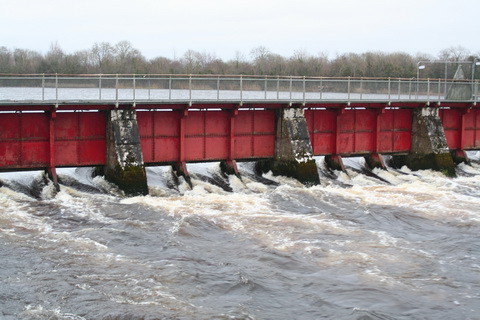
Meelick Weir today
Almost level.
Meelick Weir today
Almost level.
Posted in Ashore, Built heritage, Drainage, Engineering and construction, Extant waterways, Industrial heritage, Ireland, Non-waterway, Operations, People, Politics, Shannon, waterways, Waterways management, Weather
Tagged canal, ESB, farmers, floods, flow, Galway, Ireland, lock, Lough Derg, Meelick, Offaly, Operations, Shannon, Victoria Lock, water level, waterways, Waterways Ireland, weir
For reasons now lost in the mists of time, I forgot to draw the attention of Learned Readers to an exchange in the Dáil on 18 April 2012, which was reported on the invaluable KildareStreet website as well as on the Oireachtas site. Jack Wall, a Labour TD for Kildare South, asked this question:
Question 702: To ask the Minister for Arts, Heritage and the Gaeltacht the position regarding the canal system under Waterways Ireland; the plans the agency has for the development of the canals; the number of lock keepers in the system; if there are any vacancies; if so, when same will be filled and the mechanism that will be adopted to do so; if the agency has any plans to refurbish existing systems that are not in use at present; if the agency has any plans to increase the number of berthings on the canals and if so, in which areas; if the traffic on the canals has shown a percentage increase over each year for the past three years; and if he will make a statement on the matter. [18431/12]
Now, that’s a bit of a portmanteau question. I wonder whether Jack Wall was prompted to ask about lock keepers but not quite well enough briefed to ask follow-up questions. The minister, Jimmy Deenihan, gave a four-paragraph answer, and I’m going to break it up so that I can discuss each element individually.
The minister’s first paragraph was background music:
Since its formation in 1999, Waterways Ireland has continued to upgrade the facilities on the canals through the capital allocations under the National Development Plans. The canals system has benefited extremely well during that time, particularly with the number of additional mooring and landing spaces that have been made available. The provision of further mooring space will be dependent on available finance and priorities over the coming years.
I’m going to move the third paragraph up and deal with it next.
The minister said:
I am informed by Waterways Ireland that there are 20 lock keepers employed at present on the Grand Canal and Barrow Navigation. A number of staff have retired recently and decisions on their replacement will be taken having regard to the business needs of the organisation. I understand that Waterways Ireland is not planning to recruit lock keepers at this time. Any posts filled will be either by internal transfer or external recruitment, depending on the particular circumstances.
Although the minister mentions the Royal Canal elsewhere in his answer, and the question certainly does not exclude the Royal, the minister doesn’t mention it in this paragraph. In fact, there are several things the minister doesn’t mention:
Now, I’m not saying that any of those actualities or possibilities is necessarily a bad thing. In fact, given the virtual absence of lockkeepers on the Canal & River Trust’s English and Welsh canals, it’s hard to see why the Irish canals, with much lower traffic, need so many.
But my point here is that a TD, and especially a Labour Party TD (haven’t they something to do with supporting workers?), might be presumed to be interested in the aspects that the minister did not mention. The minister’s answer was true but incomplete.
For the 2011 election Fine Gael published a document called Reinventing Government, with section headings on “More Open and Transparent Policy-Making Processes” and “New Systems of Openness and Transparency”. Where are they?
Here is the minister’s second paragraph:
My Department’s 2012 capital allocation for Waterways Ireland is €4.5m. This will facilitate continued investment in the development and restoration of the inland waterways. The main thrust of the refurbishment of the waterways over the next few years will be focused on the re-opening of the Ulster Canal from Upper Lough Erne to Clones. However, Waterways Ireland is also undertaking feasibility studies on the Kilbeggan Branch of the Grand Canal and on the Longford Branch of the Royal Canal. These are due to be completed by the end of 2013.
They’re thinking of digging even more sheughs!
Look. I know that engineers love to have excuses (and money) to do engineering: all that kit, wellies and hard hats, muck-shifting and the satisfying feeling that you are bringing joy (and tourists) to a small town. But it’s a waste of time and money. And there is absolutely no point in doing feasibility studies: what you want are cost-benefit analyses. Pretty well every single canal ever built with public funding in Ireland has been a waste of money and there is no reason to believe that relining the canals to Longford and Kilbeggan will be any better. I mean, look at the Naas Branch: very scenic, but hardly anyone ever goes there other than in convoy.
What you want to do is to explain, politely, to the TDs of Longford and Kilbeggan that they can have canals only if they will agree to having all other public services (including the drinking-water supply) cut off. But of course both Kilbeggan and Longford already have ways of attracting tourists. Kilbeggan has a distillery while Longford has an absence of signposts, especially to Athlone, thus causing motorists to drive around in ever-decreasing circles until they imitate the oozlum bird.
I mean, the canal age is over; this is the age of the camper van.
Here is the minister’s final paragraph.
I am informed that boat traffic numbers on the Grand Canal and Barrow Navigation have remained fairly constant over 2009 and 2010. In 2011 the numbers increased by 30% following the re-opening of the Royal Canal and the fact that access was available to the Tall Ships event in Waterford.
Now this is really interesting, for three reasons:
What the canals and the Barrow need is action to increase the amount of traffic, especially in summer (when few people travel because of weed and sometimes water shortages) and winter (when few travel because it’s miserable). Adding extensions only spreads the existing traffic more thinly over a larger number of destinations. When you get to the stage of having traffic jams at locks, you can begin to think about extra destinations. Until then, put the shovels away.
Posted in Ashore, Built heritage, Charles Wye Williams, Economic activities, Engineering and construction, Extant waterways, Uncategorized
Tagged boats, bridge, canal, Clones, Dublin, Erne, floods, Grand Canal, Ireland, Jack Wall, Jimmy Deenihan, Kilbeggan, Kildare, lockkeeper, Longford, Lough Neagh, Operations, Royal Canal, Ulster Canal, vessels, water level, waterways, Waterways Ireland
I have updated my page about Royal Canal feeders with some information provided by Nigel Russell of WI to the An Bord Pleanála oral hearing on the Royal water supply scheme.
Incidentally, the Department of Arts, Heritage and the Gaeltacht, WI’s parent department in RoI, was among the (few) objectors to the proposed abstraction of water from Lough Ennell, although it was in favour of ceasing to abstract water from Lough Owel [Inspector’s report pp11–12]. Indeed it seemed to have some reservations about the reopening of the Royal Canal, not on economic grounds but because “some important nature consideration issues need to be fully addressed”.
Posted in Ashore, Built heritage, Drainage, Economic activities, Engineering and construction, Extant waterways, Industrial heritage, Ireland, Natural heritage, Operations, People, Restoration and rebuilding, waterways, Waterways management, Weather
Tagged boats, canal, department of arts heritage and the gaeltacht, feeder, Ireland, lock, Loiugh Owel, Lough Ennell, Nigel Russell, Operations, Royal Canal, Shannon, vessels, water level, waterways, Waterways Ireland
The Royal Canal water supply applications have been approved by An Bord Pleanala. There were two separate applications [see here and here] but they were in effect treated as one. There are five PDFs available on each page and I haven’t read all of them yet. However, on a first glance, I note that:
2. The proposed development shall be operated as follows:
(a) Rates of abstraction from Lough Ennell to the Royal Canal shall be as specified in the public notices and, in particular, shall not exceed 43,636 cubic metres of water in any 24 hour continuous period and subject to a total maximum abstraction of 6,586,363 cubic metres per annum.
(b) Abstraction from Lough Ennell to supply the Royal Canal shall cease when the lake level reaches 79.325 mOD Malin Datum, being the crest level of Clonsingle weir, measured at Clonsingle weir by continuous monitoring.
(c) The fish pass at Clonsingle weir shall incorporate a minimum flow of 0.29m3/second.
(d) A minimum flow of 682 m3/day (0.5MGD), taken directly from Lough Owel, and excluding water from the fish farm, shall be retained in the original canal feeder.
Reason: In the interest of protecting the integrity of the Lough Ennell Special Area of Conservation and the ecological interest of the River Brosna and the canal feeder, and in the interest of protecting material assets at Lough Ennell and the River Brosna.
If I remember correctly, the amount of water available from Lough Ennell will not always provide enough (eg in a dry season) to keep the canal full. Still, this is a significant advance for Waterways Ireland and for Royal Canal enthusiasts.
Posted in Built heritage, Charles Wye Williams, Economic activities, Engineering and construction, Extant waterways, Industrial heritage, Ireland, Natural heritage, Operations, Restoration and rebuilding, Scenery, Sources, Water sports activities, waterways, Waterways management
Tagged boats, canal, floods, flow, Ireland, Lough Ennell, Lough Owel, Operations, Royal Canal, water level, waterways, Waterways Ireland
Waterways Ireland has parked a canteen trailer and some pontoons at Errina Bridge.
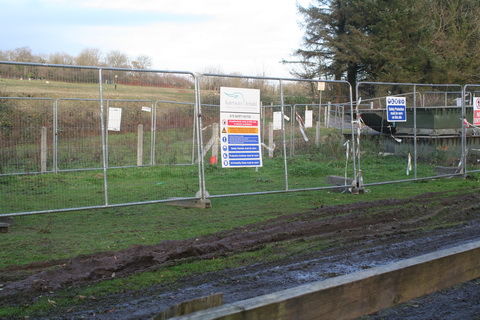
The compound, with Official Notices signed Rabbit
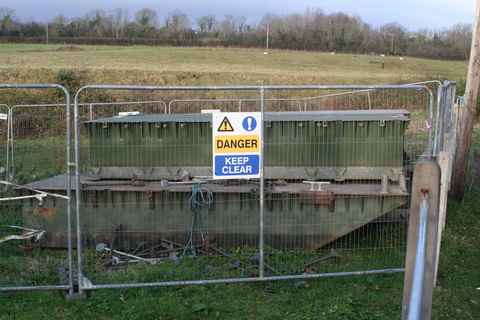
Pontoons
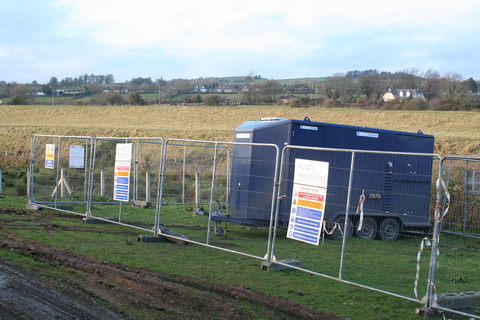
The canteen trailer
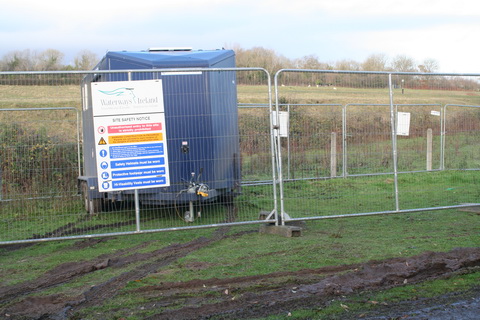
Another view of the canteen trailer
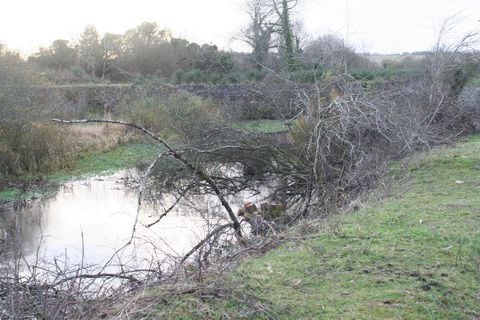
Evidence of tree cutting above Errina Lock, but that may not have anything to do with Waterways Ireland
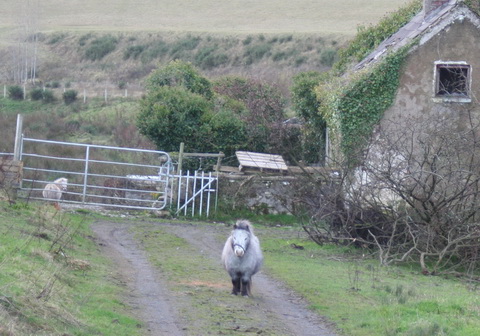
The guardians of the lock
Posted in Ashore, Built heritage, Charles Wye Williams, Drainage, Economic activities, Engineering and construction, Forgotten navigations, Industrial heritage, Ireland, Irish inland waterways vessels, Natural heritage, Operations, Restoration and rebuilding, Shannon, The cattle trade, The turf trade, waterways, Waterways management
Tagged boats, bridge, canal, Clare, Errina, floods, Ireland, Killaloe, Limerick, lock, lost, Lough Derg, O'Briensbridge, Operations, Plassey-Errina Canal, pony, Shannon, Tipperary, water level, waterways, Waterways Ireland, workboat
I wrote here about the Park Canal and why it should not be restored. I did not include, because I had not then seen it, a link to this report in the Limerick Post. It shows why the gates on the second lock were not replaced. The core problem is that the banks in the upper section of the canal slope too steeply to be stable.
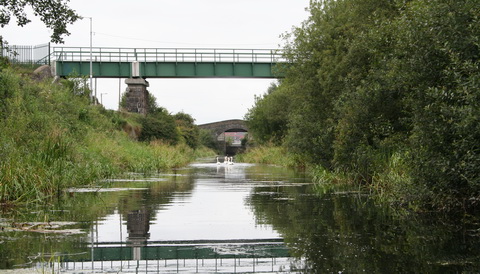
The slope of the banks above the railway bridge (from a boat)
Happily, this deficiency in the original construction has saved us from another foolish restoration.
Posted in Ashore, Built heritage, Charles Wye Williams, Drainage, Economic activities, Engineering and construction, Extant waterways, Forgotten navigations, Industrial heritage, Ireland, Operations, People, Politics, Rail, Restoration and rebuilding, Scenery, Shannon, Sources, The cattle trade, waterways, Waterways management
Tagged boats, bridge, canal, Clare, Guinness, Ireland, Limerick, Limerick City Council, lock, Operations, Park Canal, Shannon, slope, turf, vessels, water level, waterways, Waterways Ireland
In April 2012 I wrote about the proposed supply of water from Lough Ennell to the Royal Canal. I said that
[…] the Lough Ennell proposal had to go to An Bord Pleanála. At any rate, two applications had to be made, one for the water abstraction and the other for the physical works. In practice, the two are being handled as one.
An Bord Pleanála asked Westmeath County Council for some more information; that has now been supplied and a decision is expected by 11 June 2012.
I have just checked An Bord Pleanála’s website for the two applications PW3005 (lodged 9 December 2011) and JA0030 (lodged 7 October 2011); both say:
Proposed decision date not available at this time.
I do not know why decisions are taking so long.
Posted in Drainage, Economic activities, Engineering and construction, Extant waterways, Ireland, Irish waterways general, Natural heritage, Non-waterway, Operations, Politics, Restoration and rebuilding, Sources, Tourism, waterways, Waterways management, Weather
Tagged An Bord Pleanála, boats, bridge, canal, Ireland, Lough Ennell, Lough Owel, Operations, Royal Canal, water level, water supply, waterways, Waterways Ireland, Westmeath County Council
The Limerick Leader article about a proposed Limerick river bus has some statements that do not accord with my understanding.
The venture will see the river bus depart Guinness Pier – across from Athlunkard Boat Club at O’Dwyer Bridge – every two hours, bound for the power station […].
As far as I know, the pier in question was the Ranks jetty and was not used by Messrs Guinness. The Eclipse Flower, and other vessels owned by Ranks and their predecessors, sailed up the Shannon from there rather than attempt the stretch from Baal’s Bridge to Custom House Quay.
The boat will follow the route taken by barges of old – both passenger and commercial – some of which historically transported Guinness to the city up until the mid-1960s.
“It is a tried and tested route,” said Mr Flynn, stressing the viability and safety of the route, which passes Long Pavement – the edges of which have been repaired and grassed over – and finishes at the hydro-electric plant.
“Every passenger and commercial barge that came to Limerick for 50 years used that stretch of water. It is very safe. It was navigated by all the barges,” he said.
The route to Limerick through Ardnacrusha came into use only after the construction of the power station in the 1920s and was used for a little over thirty years. To the best of my knowledge, there were no passenger services in those years: passenger carrying stopped in the first half of the nineteenth century, when traffic was still using the old Limerick Navigation. There have been some trip-boats in recent years, but they did not (and do not) use “barges of old”. Some old barges, now converted and with more powerful engines, have safely navigated that stretch, but they do it when conditions are right.
During the final phases of Ardnacrusha’s construction, both old and new navigations were closed; the Grand Canal Company (GCC), the main commercial carrying company, ran to Killaloe and had its cargoes carried onward by rail to Limerick. When the new route through Ardnacrusha was opened, the GCC thought it was so dangerous that it refused to use it for about a year. It resumed operations only when a boom was put across the river above Baal’s Bridge and posts were provided upstream of O’Dwyer Bridge to which barges could tie while waiting for suitable states of the tide.
I accept that the proposed river bus will not be going downstream as far as Baal’s Bridge, but it will still be navigating on a stretch of water where Waterways Ireland advises that boats should not navigate when more than one turbine is running at Ardnacrusha. The ESB can run up to four turbines, each of which is said to add a knot to the current, and it can switch them on immediately, with no warning to any boat using the river.
Other pages on this site make it clear that I share the promoters’ enthusiasm for Ardnacrusha and the canal and river thence to Limerick. I do not say that the difficulties of that stretch cannot be overcome, but I do not think that they should be dismissed.
Posted in Ashore, Built heritage, Economic activities, Engineering and construction, Extant waterways, Industrial heritage, Ireland, Irish inland waterways vessels, Non-waterway, Operations, People, Rail, Restoration and rebuilding, Scenery, Shannon, Sources, Tourism, waterways, Waterways management
Tagged Ardnacrusha, Baal's Bridge, boats, bridge, canal, Clare, Eclipse Flower, ESB, floods, flow, Grand Canal Company, Guinness, Ireland, jetties, Killaloe, Limerick, Limerick Leader, lock, Lough Derg, O'Dwyer Bridge, Operations, Park Bridge, Ranks, river bus, Shannon, vessels, water level, waterways, Waterways Ireland
… from the (presumably artificially created) photograph in the Limerick Leader seems to be the Cailín Turána, formerly part of the Aran Islands Fast Ferries fleet at Doolin and seen here out of the water at Cork Dockyard in 2004. The vessel has not been on the Dept of Transport’s List of Certified Passenger Ships since 2007 (and may have come off the list before that: I have not kept copies of the lists earlier than 2007). It could of course have been used in Ireland for purposes other than carrying fare-paying passengers, or outside Ireland for any purpose, after 2004.
And it may be that the vessel shown in the photo is not that which is to be used in Limerick.
Posted in Economic activities, Engineering and construction, Extant waterways, Industrial heritage, Ireland, Irish inland waterways vessels, Non-waterway, Operations, People, Restoration and rebuilding, Shannon, Sources, Tourism, waterways, Waterways management
Tagged Ardnacrusha, Athlunkard, boats, canal, Clare, ESB, estuary, flow, Ireland, Limerick, lock, Operations, Ranks, Shannon, vessels, water level, waterways, Waterways Ireland, workboat

 Irish waterways history