Tag Archives: waterways

Bottles in Limerick

Limerick has a new Economic and Spatial Plan, with lots of downloadable files and the general tone of a letter to Santa Claus. It has lots of adjectives, though, and fashionable concepts; all it lacks is money.

It wants a renaissance of the Limerick waterfront. It seems, though, that that doesn’t mean lots of dockers unloading timber, turf boats from Poulnasherry Bog, ships taking the ground at low tide, gales throwing vessels against the bridge, mills at Curragour, tolls on the bridges or other features of past life along the quays. Instead there will be things like this:

A New Public Waterfront

 Arthur’s Quay Park will be transformed into a signature Waterfront public space that draws visitors, hosts special events and provides a key stopping point within the City Centre and along the Waterfront and Riverwalk;

 This new Riverside Park will run the length of the City Centre from Sarsfield Bridge through where Sarsfield House currently stands, along between the Hunt Museum and the River and over a new pedestrian bridge into a pedestrianised Potato Market area linking up to the upgraded King John’s Castle tourist attraction;

 A new appropriately sized iconic building could be developed in the new Riverside Park on the former Dunnes Stores Site to accommodate tourism/cultural uses;

 New landscape, trees, surfaces, lighting, furniture, public art and interpretation should be structured to create a landmark WaterfrontPark, designed to international standards reflecting the prominence of this location within Limerick;

 A new space should be defined to host public events including celebrations, performance, festivals and start and finish points to Limerick based marathons and races;

 Clear, high quality pedestrian connections from Patrick Street and O’Connell Street and Henry Street would draw people to the Park;

 Signage and materials should identify the water’s edge as part of the continuous Riverwalk linking bridges across the Shannon and the two sides of the Shannon River;

 A new public open space should be created at the Sarsfield House site in the event of government office relocation, to reveal the view north along the Shannon to King’s Island from the City Centre and extend Arthur’s Quay Park;

 The Waterfront and public space at the Hunt Museum should be strengthened to provide an intimately scaled green space with external seating from the Hunt Museum restaurant and destination in its own right along the Riverwalk.

What is being proposed here (page numbered 99; page 124 of 172 in An Economic and Spatial Plan for Limerick [PDF]) is that Sarsfield House should be demolished and the area above the Custom House moorings would be opened up, with citizens not just permitted but encouraged to enter. Later on (page 108; PDF page 133 of 172) we read this:

Limerick Quays will be defined as the principal visitor and entertainment zone in the City  Centre – passive and active – accommodating a new visitor destination, walking, as well as eating and drinking in bars and restaurants that will activate the quays overlooking the River. This will be fully pedestrianised.

Now, that’s all very nice in theory, but what it means in practice is that any boats moored at the only safe moorings in Limerick, at Custom House Quay, will be within range of any bottles that may be thrown by the less domesticated portion of the citizenry, on their way home from getting tanked up in the bars and restaurants.

But perhaps the planners have thought of that and solved it in their own way. Figure 36: City Centre Proposals – Aerial View 1 on page 116 (141/172) is an aerial photo with coloured bits added; it shows the Custom House moorings. But Figure 37: City Centre Proposals – Aerial View 2 on page 117 (142/172), taken from a different angle, shows the pontoon at the corner of the weir, and the water space in the corner behind the Custom House, but the mooring pontoons have disappeared.
 

Hunt the lock

The Hunt Museum in Limerick is chiefly famous for its being accommodated in the former Custom House, which was designed by Davis Dukart [there are many variants of the spelling] who installed dry hurries on Dukart’s Canal, built in the eighteenth century to link the Drumglass coalfield to the town of Coalisland and thence to Lough Neagh, the Newry Canal and Dublin.

At the moment the Custom House has a large banner draped over it, with a picture of a canal lock on it. This is to advertise an exhibition of paintings collected by a bank. Unfortunately there is very little information about the collection on the museum’s website, so I can’t say whether the ratio of important  pics (showing canals, boats etc) to dross is high enough to make a visit worthwhile.


The decline of the Shannon

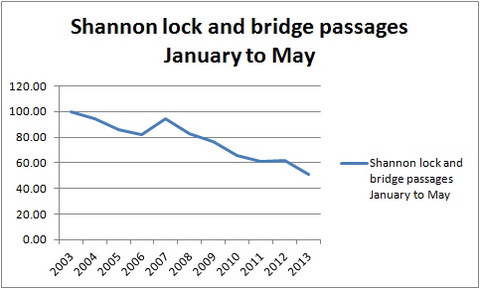
The number of lock and bridge passages for the Shannon, in the first five months of 2013, has been just a little over half what it was in 2003.

Shannon passages

Shannon passages as percentages of the 2003 total

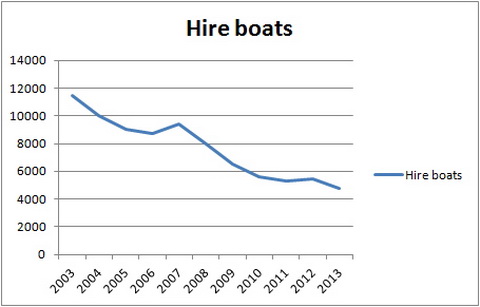
The usual caveats apply: the underlying figures (kindly supplied by Waterways Ireland) do not record total waterways usage as, for instance, sailing, fishing or waterskiing on lakes or river stretches, which did not involve a passage through a lock or Portumna Bridge, would not be recorded. The passage records are our only consistent long-term indicator of usage of the Shannon but they would not show, for instance, a change in the balance of types of activities from those in larger cruising boats to those in smaller (sailing, fishing, waterskiing) boats. On the other hand, they do include the Shannon’s most significant tourism activity, the cruiser hire business.

Cruiser hire activity, January to May 2003–2013

Cruiser hire activity, January to May 2003–2013

Over eleven years, the number of hire-boat passages has fallen from 11440 to 4781, a drop of almost 60%.

There are some minor inconsistencies in the Waterways Ireland figures, but they’re not large enough to affect the general picture.

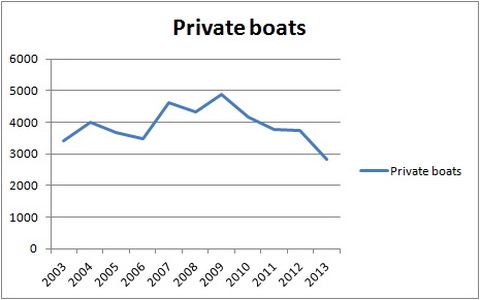
Another caveat is that the picture to the end of May doesn’t predict the outcome for the year. Things like the weather and the date of Easter can cause boating activity to occur earlier or later in the year. In the first year of this series, 2003, private boaters seem to have been slow to get started; the number of passages in the first five months was lower than that for 2004. However, private boaters’ total for 2003 was higher than that for 2004.

Private boats January to May 2003–2013

Private boat activity, January to May 2003–2013

But 2013 is the first year in the series in which private boat passages have fallen below 3000.

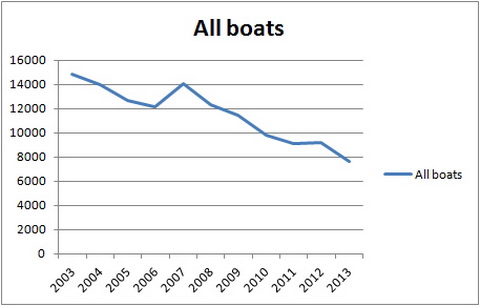
Total Shannon passages, January to May 2003–2013

Total Shannon passages, January to May 2003–2013

And there are the totals: 51.15% of the 2003 figure.

We’re still in the first shoulder season; if the peak season is better than usual (and if the weather is good), the final figures for 2013 may end up looking more cheerful.

One small point, if I may: this sort of decline makes it pretty well impossible to justify increasing the cruising area by building sheughs in Cavan, Monaghan, Longford or anywhere else.

Addendum: if this story is true, we won’t be needing any increase in waterways capacity for quite some time to come.

It’s back!

The unmissable weekly read: the list of holders of marked fuel traders’ licences [xls] has returned! Life just wasn’t the same without it.

The list of Shannonside fuel traders is the same, though, at least as far as I can see.

Elfinsafety and DUKWs

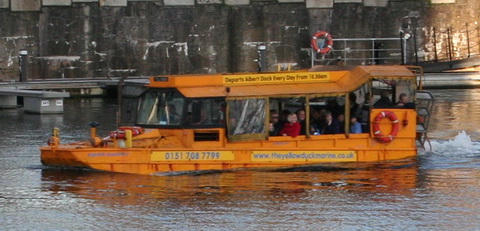
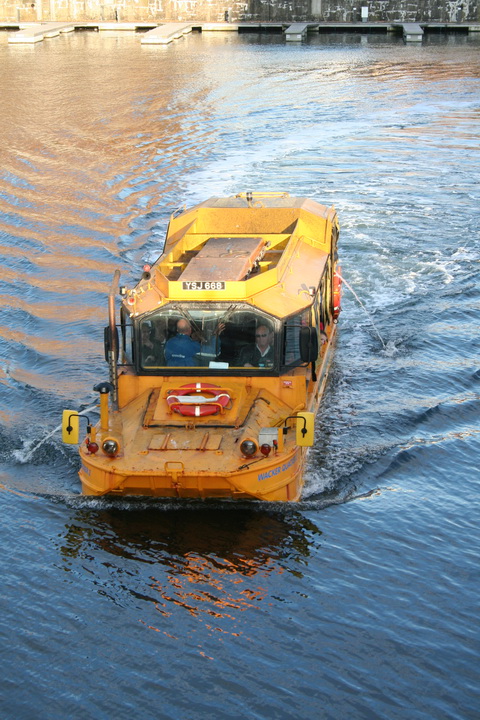
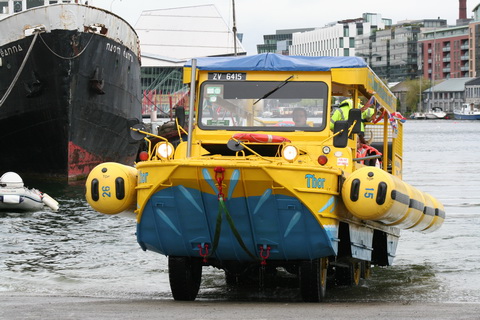
In October 2011 I was in Liverpool, where I took a couple of photos of DUKWs taking trippers around the still waters of the no-longer-used docks.

DUKW in the Salthouse Dock, Liverpool

DUKW in the Salthouse Dock, Liverpool

DUKWing under the bridge into the Albert Dock, Liverpool

DUKWing under the bridge into the Albert Dock, Liverpool

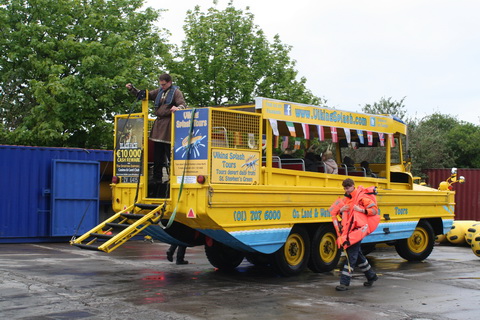
In Dublin, Viking Splash offers similar tours, with the regrettable addition of horned helmets, as not worn by Vikings. The Dublin operation seems to have added two other items that were not discernible on the Liverpool DUKW.

VikingSplash DUKW Thor 18_resize

Extra buoyancy on the Dublin DUKWs

First, before they enter the water at Grand Canal Dock, Ringsend, the DUKWs are fitted with extra buoyancy in cylinders that slide into racks along their sides. I saw the VikingSplash crew removing the cylinders from the yellow DUKW; it took only a couple of minutes, and I presume that it didn’t take much longer to put the cylinders on.

VikingSplash DUKW Thor 25_resize

Buoyancy aids being collected after the trip around the dock

Second, the Dublin passengers are issued with buoyancy aids before they take to the water. I can’t see any buoyancy aids on the Liverpool passengers, although it’s possible that they are out of camera shot.

Sometimes we complain about extra health and safety (which often means insurance) requirements. Then something like this happens: a yellow DUKW sank yesterday in Liverpool — for the second time this year. I don’t know whether the precautions taken in Dublin would have averted the accident or enhanced the safety of the passengers but it does suggest that the Maritime Safety Directorate bods in Dublin do have a point.

Addendum: the speaker on this clip says that passengers began putting on buoyancy aids, which suggests that aids were issued but not worn. Given how quickly the vessel sank, and how constricted the space inside is, it seems to me that passengers should wear their buoyancy aids throughout the waterborne trip.

Later: scary video.

Later still: a BBC story saying that a tyre may have caused the problem, the Liverpool mayor’s opinion (and some good photos) and the firm going into administration.

Longford

I thought I might make some rude remarks about Longford — the town rather than the county — but I felt I should investigate the case for the defence first. I decided to see what tourist attractions it had to offer, so I looked at the Longford page on the Discover Ireland website. It’s about the county, but that includes the town, whose many attractions will no doubt be listed. Clicking on the Highlights tab gave me a page listing three places for sightseeing:

  • Belvedere House and Gardens, which are in Co Westmeath
  • Strokestown Park House, Gardens and Famine Museum, which are in Co Roscommon
  • Corlea Trackway Visitor Centre, which is in a bog, although it is at least in a County Longford bog.

The Longford Tourism website is slightly more cheerful, mentioning walks by the Camlin on the north side of the town and along the line of the abandoned Longford Branch of the Royal Canal on the south. And the county council (I think) runs the Longford.ie website here.

Longford also has a place that fixes alternators and some nice bypasses, which is just as well as it also has the most infuriating one-way system in Christendom, allied with an almost complete lack of comprehensible signposts, especially if you want to go to Athlone, and a non-industrial wasteland to the south that adds nothing to the town’s charms.

What Longford doesn’t have is any particular reason for tourists to want to go there. So restoring the Royal Canal branch to Longford would not attract more people to the canal as a whole; it would simply displace them from elsewhere. For a boat entering the canal from the west, a night spent in Longford means a night not spent in Killashee or Keenagh or one day less to travel eastward.

The invaluable KildareStreet.com tells me that this point was not considered in a written question and answer in the Dáil on 11 June 2013.

James Bannon [FG Longford-Westmeath]: To ask the Minister for Arts, Heritage and the Gaeltacht if he will provide an update on the restoration plan for the section of the Royal Canal from Killashee, County Longford to Longford Town, in view of the fact that this has been characterised as the missing link on the Royal Canal system; and if he will make a statement on the matter.

Jimmy Deenihan [FG, Kerry North/West Limerick]: I can confirm to the Deputy that the Waterways Ireland Corporate Plan for 2011-2013, which has been approved by the North South Ministerial Council, plans for the completion of the feasibility study on the extension of the Longford Branch of the Royal Canal in December 2013, I am informed by Waterways Ireland that this study is presently on target.

I presume that, on the principle of a canal for everybody in the audience, an Inter-Agency Group will be set up shortly to find the money for the Longford Sheugh. But it makes no sense for the state to spend a penny on such a canal, although it might make sense for Longford Town Council (if it continues to exist) to spend its own money on the job of attracting visitors away from villages in County Longford.

Mr Bannon is known for his earlier attempt to promote the Irish organ.

Palindrome

“A man, a plan, a canal — Panama!”, said Leigh Mercer.

The man with the plan this time is Daniel Ortega, President of Nicaragua, who wants to build a second Atlantic–Pacific canal, capable of taking ships of greater capacity than the Panamax limits. The OilPrice story says that the canal would be more than three times as long as the Panama, with (if I understand it correctly) 130 miles of cut and 50 in Lake Nicaragua:

[…] the proposed canal could take 11 years to build, cost $40 billion and require digging roughly 130 miles of channel.

[…] the canal’s proposed locks will require 1.7 billion gallons of water per day, given that the channel will be 200 feet deep in places.

Mr Ortega hopes that China will fund the construction, which suggests that he is rather more optimistic about the Chinese economy than some others are. However, it is a thought, and one that the Inter-Agency Group on the Ulster Canal might wish to consider.

This week’s quiz: which ocean lies at the western end of the Panama Canal?


Life gets tedious …

… don’t it, when there’s no 100-page list of holders of Marked Fuel Traders Licences to plough through. Revenue didn’t update the list last week; I attributed that to the Monday bank holiday. But there was no new list today either.

Given that I probably constitute 100% of the readers of the document, I feel I should Make Representations, In The Strongest Possible Terms.

Where is it?

In 1809 Thomas Newenham included the Cloonastra amongst the tributaries of the River Shannon. There is no obvious logic to the order in which he listed the rivers, so it is not possible to deduce its position relative to other rivers.

In 1833 Charles Wye Williams listed it amongst rivers connected with the Shannon that might be noticed; he did so again in 1835. On both occasions the other rivers are identifiable and, to some extent, navigable, which suggests that the Cloonastra is a navigable tributary of either the inland or the estuarial Shannon.

If you know where it is, or what name it now bears, please leave a Comment. My best guess so far is that it might be the Hind River, which joins Lough Ree at Clooneskert and which might have been made navigable, but I have no actual evidence. There’s a Cloonmustra townland north of Ballyleague, but the watercourses look much smaller. Rinn River? I can’t find anywhere nearby that looks like a variant of Cloonastra.

No money for sheughs …

… in the government’s new €150 million election manif exchequer works programme 2013–2014, announced today. Maybe it will be in the “New PPP [public–private partnership, I presume] Pipeline”, but I note that

The Minister for Public Expenditure and Reform will be engaging with his colleagues the Minister for Education and Skills and the Minister for Transport, Tourism and Sport in order to bring forward these additional PPPs.

No mention of Arts, Heritage and the Gaeltacht, thus depriving keen investors of the opportunity of making a profitable return on an investment in the Clones Sheugh.