Tag Archives: waterways

Ephemera 14: Ulster Canal: departmental bullshit

I have created a new page covering correspondence with the Department of Community Equality and Gaeltacht Affairs in January 2011. I have accordingly removed postings Ephemera 11 and Ephemera 13; the correspondence with the department is now on the new page.

I don’t know why the Irish government finds it so difficult to provide a straight answer to a straight question (well, actually, I can guess, but let’s be polite). But if funding were available, the government would be issuing press releases to beat the band, especially with an election coming up. So I deduce that there is no money, although I wouldn’t be at all surprised to find a press release or two making some vague announcement or lauding the start of some low-cost activity.

But I won’t believe in the restoration or rebuilding of the Ulster Canal until I see evidence that real money has been allocated to cover the cost.


Ephemera 12: WI staffing

The Sunday Tribune of 9 January 2011 reports that Waterways Ireland’s staff increased from 355 last year to 367 this year. It says that the Department of Community, Equality and Gaeltacht Affairs (to which Waterways Ireland reports in the southern state), or rather its minister, was “among the worst offenders when it comes to increasing staff numbers in the agencies under his remit.”


Suir railway

If George Stephenson, Father of Railways, had had his way, you would have been able to travel from Carrick-on-Suir to Waterford by river – but in a railway carriage. Read about it here.

New section

I have started a new section on People. So far, the top-level page links only to the first entry, which is for Major Rowland Raven-Hart OBE, whose Canoeing in Ireland, published in around 1938, is a short guide to canoeing on several of Ireland’s longer rivers, including the Shannon, the Erne, the Suir, the Barrow and the Munster Blackwater.

I have added such information about Major Raven-Hart as I have been able to find.


Nineteenth-century Irish canal boats

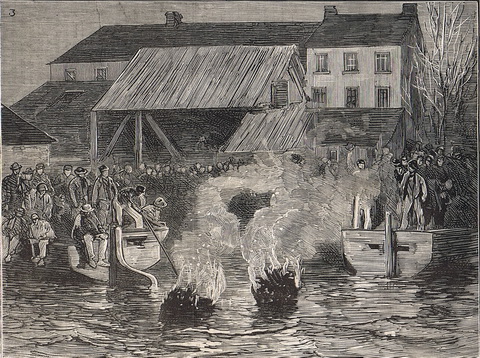
Illustrations of early Irish inland waterways vessels are relatively scarce. The drawing below shows the sterns of two of them.

Portobello Harbour 1882

This is from The Graphic of May 13, 1882, and shows the lighting of tar-barrels in Portobello Harbour, on the Grand Canal in Dublin, to celebrate the release from prison of Charles Stewart Parnell and two colleagues.

The layout of the harbour in around 1900 can be seen on the OSI Historic 25″ map. Where were the vessels tied? What are the buildings in the background? What can be said about the vessels? Presumably wooden horse-drawn barges, but they look rather narrow to me. Comments welcome.

The harbour itself is, alas, no more.


Ephemera 10: the pontoons at Ballina

Do my eyes deceive me?

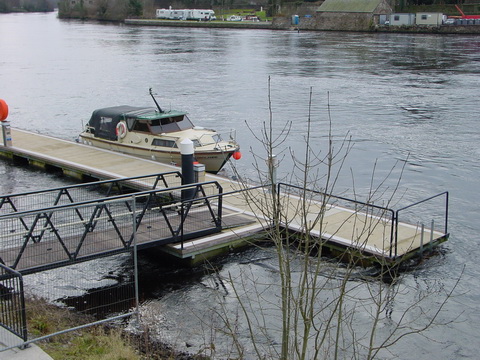
The still-unopened mooring pontoons below the bridge at Ballina (bottom of Lough Derg) seem to have sprouted an extension.

Here is what they looked like in 2009.

The upstream end of the Ballina pontoons in February 2009

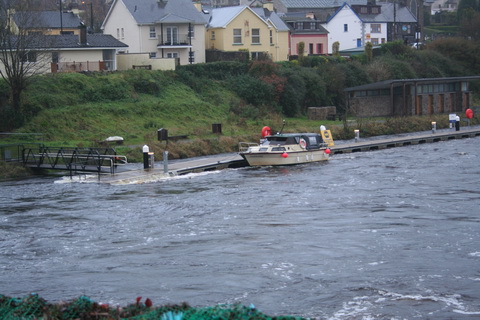
Here they are in the floods of November 2009.

The upstream end of the Ballina pontoons in the floods of November 2009

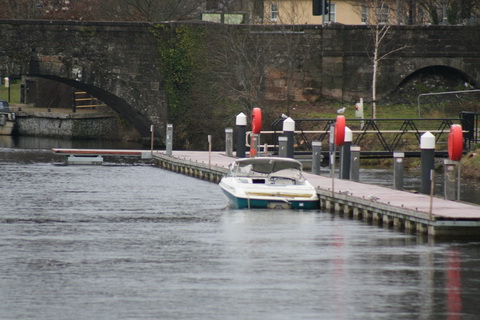
And here they are in January 2011, seen from downriver.

The upstream end of the Ballina pontoons in January 2011

Well I never.


Ephemera 8: Tarbert

Tarbert Island

The Irish Times reports that:

AN BORD Pleanála has approved the application by Endesa Ireland, part of the Spanish energy company, to build a combined-cycle gas turbine power plant on the former ESB station at Tarbert, Co Kerry.

I presume that, when it says that “A submarine cable is to supply Moneypoint.” it means that a submarine pipe will do so: I imagine that the power station at Moneypoint is more likely to want gas than electricity from its rival across the estuary.

Tarbert is now the southern station for the ferries that cross the Shannon Estuary, but it has had a long history as an estuary port. Even before the first of the piers was built, Tarbert Roads provided a sheltered anchorage, and the estuary steamers adopted ingenious methods to get passengers and cargo from shore to steamer and vice versa.

Tarbert was also an important administrative centre and Tarbert Island (as was), which now houses piers and power station, had a Coast Guard station, a lighthouse, a signal mast and the largest of the six forts that guarded the Shannon Estuary. The ESB power station is built on the Ordnance Ground, right on top of the seven-gun battery, as you can see if you play with the Overlay feature on the Historic 6″ Ordnance Survey map.

Moneypoint had a large quarry; it may have been from there that Charles Wye Williams got the “marble” that he polished in the marble mill at Killaloe.

Saleen Pier at Ballylongford is covered here.

Ephemera 7

The view from Dromod 30 December 2010.

Dromod

The Swiss Army Knife is no longer sprawling across the canal above Noggus Bridge on the Grand: it’s parked in the middle of the canal, closer to the bridge.

Locks at locks

Here‘s a thing.

Clondra Lock

The lock at Clondra may be the only one on the Shannon that is in the same place, and doing the same job, since the days of the Commissioners of Inland Navigation in the middle of the eighteenth century. The lock itself has been refurbished several times, and in recent years the lock furniture has been altered to make it impossible for boaters to work their own boats through it. But it has a very interesting collection of gear and it is well worth using, even if you’re not going to the Royal Canal at Richmond Harbour.