Category Archives: Engineering and construction

Dublin dockyards 1852

Hunt’s Universal Yacht List for 1852 has a small ad from Henry Teall.

Henry Teall,
Ship Builder,
Brunswick Dock Yard and Patent Slip, Dublin

Established 1841

H Teall, begs respectfully to inform the Owners of Yachts, that his Establishment maintains superior facilities for the Building and Repairing of Yachts to any other establishment in Dublin, having always an extensive supply of every requisite in the trade, and employing the best workmen in the port.

It lists these yachts built by Teall:

Brilliant, 8 tons
Rover, 18 tons
Marina, 20 tons
Fairy Queen, 12 tons
Belle, 60 tons
Circe, 20 tons
Trio, 53 tons.

A note on Marina says

This Yacht is of novel construction, the bow being extended sufficiently to set the jib without the bowsprit, giving a much finer entrance as well as allowing more beam.

Our yachting correspondent tells us that Yachts without bowsprits are now becoming common.

Hunt also lists yachts built by George Marchall, Ringsend, Dublin:

Atalanta, 27 tons
Foam, 17 tons
Eagle, 15 tons
Halcyon, 10 tons
Lord of the Isles, 14 tons
Spray, 14 tons
Daring, 17 tons
Kelpie, 18 tons
Swallow, 16 tons
Banshee, 10 tons
Emerald, 10 tons
Water Wyvern, 45 tons
Gipsy, 10 tons
Priestess, 12 tons
Syren, 16 tons
Cormorant, 15 tons
Avenger, 10 tons
Irish Lily, 80 tons
Grace’s Guide and the Brunswick Dockyard

William Watson, of the City of Dublin Steam Packet Company, held patents for a double canal boat, capable of being shortened to pass through locks, and for a form of composite construction for boats, with iron ribs and wooden planking. I found recently that at least one composite boat was built for the CoDSPCo at the Brunswick boatyard in Ringsend, Dublin.

The invaluable Grace’s Guide had no entry for the Brunswick boatyard/dockyard but, when I mentioned the matter, undertook some research and produced a page about it. Grace’s and I would welcome any more information about that yard; as the Guide says:

The precise location of the dockyard has yet to be identified.

Pat Sweeney’s Liffey Ships and Shipbuilding (Mercier 2010) just mentions Henry Teal [sic]; Irish Maritime History’s list is light on early nineteenth century construction.

I would welcome information about other yards that might have built vessels for the CoDSPCo.


Hospital barge

Richard Hare, writing in Practical Boat Owner February 2014, drew my attention to this ww1 poem by Wilfred Owen..

Composite construction on Irish inland waterways

I wrote here about Watson’s Double Canal Boat, saying inter alia that, in 1839, William Watson, manager of the inland department of the City of Dublin Steam Packet Company, patented:

an improvement in the construction of ships, and which improvement is also applicable to all kinds of sea-going vessels; and also certain improvements in the construction of boats and other vessels intended to be used on canals and inland navigations. [1]

I quoted the Mechanics’ Magazine of December 1839, which said that:

Three canal barges have already been built upon Mr Watson’s plan of construction, of 60 tons burthen each, and with eminent success.[2]

I said that the size suggested that these canal barges were for the CoDSPCo’s Irish inland operations, but that I had no information about where they were built.  I have now found information about one builder.

SHIP BUILDING

On Thursday, the 22nd instant, a fine new trade boat, built with iron ribs, according to the patent of William Watson, Esq., and belonging to the City of Dublin Steam company, also a new smack, 50 tons measurement, were launched from the Brunswick dock-yard, Ringsend Docks.[3]

I would be grateful for more information.


[1] “List of patents granted for Scotland from 18th March to 18th June 1839” in The Edinburgh New Philosophical Journal , exhibiting a view of the progressive discoveries and improvements in the sciences and the arts Vol XXVII No LIII — July 1839; “List of English patents granted between the 25th of May and the 25th of June, 1839” in The Mechanics’ Magazine No 829, Saturday, June 29, 1839

[2] The Mechanics’ Magazine Vol XXXII No 855 28 December 1839

[3] The Freeman’s Journal Saturday 24 July 1841. An almost identical note appeared in the Dublin Evening Mail of Monday 26 July 1841.

Lough Derg floods: a book

If you happen to have €1400 or so to spare, you could buy Henry Trench’s 1879 book called Shannon Floods. Lough Derg level. The 25 Miles North from Killaloe with a double-page map and seven coloured plates. I have no connection with the seller — and no €1400 either, so I won’t be buying it.

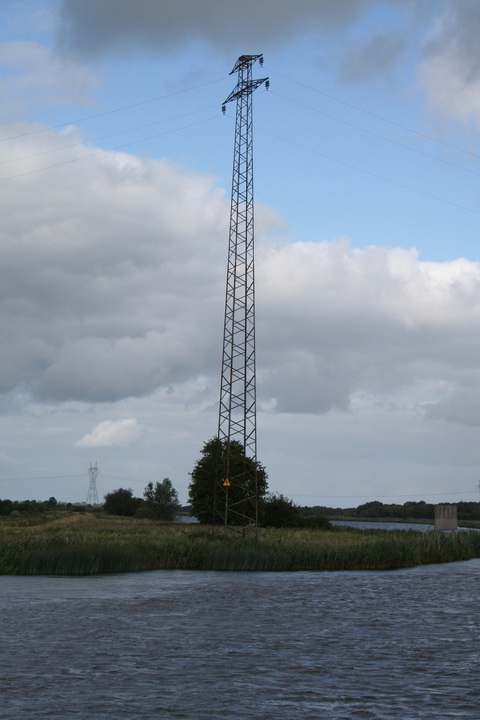
A new concept in electricity transmission

Lower pylons 2_resize

We read on the Clare FM website:

The Government says it is not realistic or financially feasible to run new electricity pylons underground.

Well, yes, I’d imagine there’s something in that. Although I don’t quite see why anyone would want underground pylons. I knew some folk wanted underground electric cables, but hadn’t realised they wanted the pylons buried too.

Personally, I’m all in favour of pylons: I like them, and would like to see more of them. I don’t understand why a row of nice pylons should be thought to make scenery less, er, scenic. It might make scenery less like a pre-industrial idea of scenery, but that’s a good thing; big it up for Stephen Spender.

And think of the industrial heritage value in the future: as well as old canals and railways, folk will come to photograph pylons; indeed some people already do so.


Slightly Foxed

WI says today, of its sale of surplus barges:

The ” Fox” workboat/barge currently located at Roosky has been withdrawn from the Sale .

Clashganny Lock on the Barrow

I would be grateful if anyone could explain the holding tank at Clashganny. Waterways Ireland’s water-level gauge [Flash thingy; takes ages to load] at Clashganny is named “Clashganny Holding Tank”.

A threat to an existing navigation

I have a page here about the River Maigue, one of Ireland’s oldest improved navigations. Incidentally, the river’s name is locally pronounced Mag, to rhyme with bag.

In 2009 I wrote to the Powers That Be to suggest that the (much to be desired) bypass of Adare, a major bottleneck on the N21 Limerick–Tralee/Killarney road, should pass to the south of the town, thus avoiding the interference with the navigation that would undoubtedly have resulted from a northern bypass. It was no doubt the strength of my case, and a recognition of the importance of the navigation, that caused the Powers to opt for a southern bypass. A proposed link to a proposed M20 Limerick–Cork motorway may have been a minor factor in their decision: as nobody was going to build a motorway to Kerry, Adare would piggyback on the motorway to Cork.

However, An Bord Pleanála overturned the decision [PDFs available here] because the M20 proposal was withdrawn. The Irish Cattle and Sheep Farmers’ Association is pleased because it wanted a northern bypass of Adare, to be linked to a new road from Limerick to the port of Foynes; its submission on the matter is here [PDF]. A Limerick ICSA chap has a letter to the editor about the Foynes link in the current issue of the Limerick Leader, although it’s not yet available online.

Now, this proposal has the drawback that it might actually be slightly sensible: a better road to Foynes might stop people agitating for a restoration of the railway line and enable a speedy ending of port activities in Limerick, thus removing large piles of scrap from the riverside. But have the ICSA not considered the damage to the turf-boat traffic to Adare if a road bridge is added to the railway bridge downstream of Adare?

A former British inland waterways campaigner has died

See here and here.