
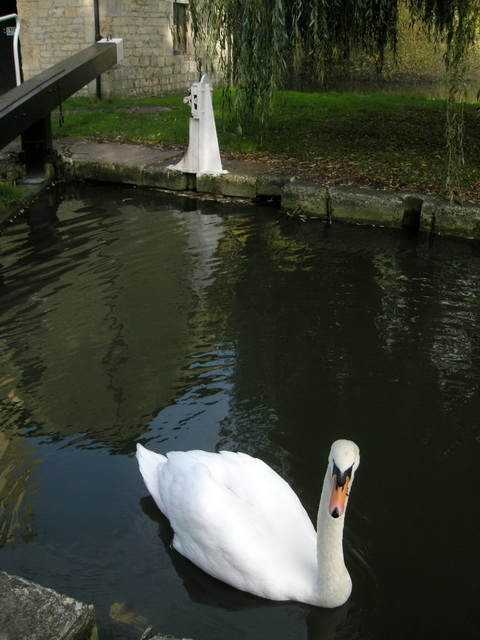
See the bottom of a lock (with no water in it). This is Carpenters Road Lock in London, which also featured here.
h/t CELR
See the bottom of a lock (with no water in it). This is Carpenters Road Lock in London, which also featured here.
h/t CELR
Posted in Built heritage, Canals, Economic activities, Engineering and construction, Extant waterways, Foreign parts, Industrial heritage, Operations, Restoration and rebuilding, waterways, Waterways management
Tagged canal, canal & river trust, Carpenters Road Lock, gates, lock, Operations, sill, stop-planks
The Minister for Arts, Heritage and the Gaeltacht [who is also a Fine Gael TD for Cavan–Monaghan] spoke at the meeeting of the Joint Oireachtas Committee on Environment, Culture and the Gaeltacht on 25 November 2014. She said:
In addition to progressing North-South co-operation, my key priority is progressing the first stage of the Ulster Canal project from upper Lough Erne to Castle Saunderson, near Belturbet, County Cavan. I am working on this with the Government and other key partners, including the North-South Ministerial Council and Waterways Ireland. […]
It sounds, then, as if the minister intends to get work started on the Clones Sheugh, but only as far as Castle Saunderson, where there is a scouting establishment. The route from Quivvy Lough (location of the Quivvy Marina) is along the Finn River; the first 5.5 km of the route would be in the river and the last 8.5 km to Clones in a canal. The route to Castle Saunderson would, I imagine, require dredging and the removal of rocks as well as work on [or replacement of] Derrykerrib Bridge [I have not read all the details].
It would, of course, be faster to get there by road, but no doubt lots of people will travel from Foreign Parts for the excitement of seeing Castle Saunderson from the water and paying tribute to the memory of a stout Orangeman and founder of the Irish Unionist Alliance.
No mention of the treasure-hunting group who are to find the money, but there’s an election in the offing so money won’t be a problem. Until afterwards.
![Quivvy to Castle Saunderson [OSI ~1840]](https://irishwaterwayshistory.com/wp-content/uploads/2014/12/quivvy-to-castle-saunderson_resize.jpg)
Quivvy to Castle Saunderson [OSI ~1840]
Regarding the Ulster Canal, which stretches from upper Lough Erne to Castle Saunderson, we hope to get the project started on that section because that is the one part of the inland waterway system that has not been developed. If we get that done, the Ulster Canal will connect into Lough Neagh. That means we will have a complete network of waterways in Ireland, which is very important. It is also a cross-Border project, and there is a peace dividend in terms of that project. It is very important in terms of cross-Border relationships. It is one shovel-ready project that can be progressed.
The minister said that “a complete network of waterways in Ireland […] is very important”. She did not say why and I can think of no possible economic justification for the creation of such a “network”. Nor is it clear what the “peace dividend” is. But the phrase that evoked most terror is “shovel-ready project”, which I take to mean something that might buy votes in the next election.
The minister’s predecessor, Éamon Ó Cuív, a Fianna Fáil TD for Galway West, said:
I welcome the Minister’s continuation of the work on the Ulster canals. There was quite a bit of work done on that in my time and I was very anxious to see it progress on a step-by-step basis. I was going to bring it to Clones, I am not sure whether the place the Minister mentioned is further or nearer than that.
The minister interjected:
It is not as far as Clones. We will start it anyway and we will get it there.
And Mr Ó Cuív continued:
I take the view that even if she were to get it half a mile, we should just nibble away at it until we get it finished. It is of strategic national importance and if we could connect Coleraine, where I was the other day and where my poor car is getting mended, all the way down the coast through Lough Neagh down to Shannon and back up the canals, it would be a fantastic facility for the island. I will not be heard complaining in any way that it is in the Minister’s constituency – that just happens to be a happy coincidence in this case.
Actually, although both Quivvy Marina and Castle Saunderson are in the Free State, most of the River Finn route is in the United Kingdom of Great Britain and Northern Ireland.
It seems that I must cease to speak of the Clones Sheugh: it’s Saunderson’s Sheugh. I suppose that, if reaching Castle Saunderson were enough to shut up the Shinners, who seem to be madly keen on Sheughery for some reason that is hidden from me, that might be a bargain: it would certainly be better than going all the way to Clones.

Posted in Ashore, Built heritage, Canals, Economic activities, Engineering and construction, Extant waterways, Foreign parts, Forgotten navigations, Industrial heritage, Ireland, Natural heritage, Non-waterway, Operations, People, Politics, Restoration and rebuilding, Sources, Tourism, Ulster Canal, Uncategorized, Water sports activities, waterways, Waterways management
Tagged Belturbet, boats, bridge, canal, Castle Saunderson, Clones, department of arts heritage and the gaeltacht, Derrykerrib, Erne, flow, Ireland, lock, lost, Lough Neagh, Operations, Quivvy, River Finn, Shannon-Erne Waterway, Wattle Bridge, workboat
Messrs Pesda Press have a new book on Canoe Camping. I haven’t read it, but Pesda produced the excellent Oileáin, David Walsh’s superb guide to 570 Irish offshore islands, many of them most easily accessible by kayak. With more emphasis on the development of blueways and canoe trails in Ireland, Tim Gent’s book on canoe camping might be of interest to canoeists and kayakers and to those providing facilities and services for them.
It appears that these new-fangled railways are here to stay, displacing the passage-boat and the mail-coach, the Scotch cart and the lumber boat.
Accordingly, I have rearranged my small number of railway-related pages under a top-level heading of their own.
I have added a new railway page, about the Lundy Island Railway and Colonization Company, from the Dublin Evening Mail of 2 May 1845. Gerald M King has produced stamps for Lundy, including Railway Parcel Stamps, but it is not clear whether they depict any of the engines or rolling stock described in the Mail and there are few other sources of information about the railway.
I have tried to explain as many of the references as I could, but some are still obscure to me and I would welcome comments from those expert in Irish religious conflicts of the 1840s (as well as those knowledgeable about railways and other technology of the period).
A small Steam Boat (apparently about fifty feet long, and six or seven feet wide), belonging to Mr Wm Busk, of Pall-mall, was exhibited on Friday on the Thames. The boat was propelled easily and rapidly through the water, both with and against the tide, by a very small steam power, without the use of any paddle-wheel, by means of an elastic paddle, or fin, recently invented by Mr Busk, which was subject to a reciprocating motion wholly under water, and acting equally both ways.
When the action is not brought too near the surface, no motion seems to be occasioned in the water which could at all prejudice canal banks; and as the range of the fins, by their being placed in the narrow after-part of a boat, admits of being confined completely within the depth and breadth of the boat, no impediment need be presented to the passing of locks or bridges. The invention appears to be extremely simple and efficacious, and of very ready application to vessels of all classes and dimensions.
Bath Chronicle and Weekly Gazette 5 May 1825
Experiments of rather a novel character have for some weeks been in progress on the Forth and Clyde Canal, to ascertain the merits of an invention for propelling boats on canals at greater velocities than have hitherto been attained either by steam or horses. The principle on which the experiments are founded may be thus described.
A light chain is laid in the canal, from one extremity to the other, and firmly fixed at each end. To effect motion by this means, a twin boat is used, in the trough of which a grooved wheel (receiving the chain) is made to revolve by a steam engine placed in the boat. From this description it will be evident that, as the wheel revolves, the boat is drawn forward at a speed equivalent to the power, or at precisely the same velocity as the periphery of the grooved wheel.
At first sight there appear to be several objections to the plan, not the least of which are turning the bends, and meeting and passing general craft on the canal. The experiments made on Friday the 29th ult, however, fully prove the facility with which the vessel can be steered from side to side of the canal; describing, at the same time, quicker curves than any to be met with on the Forth and Clyde navigation.
On the whole the experiments, though conducted under great disadvantages, were highly satisfactory, and such as to induce further trials. A speed of 8¼ miles per hour was attained, and there was little doubt in the minds of those who witnessed the trials, that, with a lighter engine, and a boat drawing less water, a higher velocity might be acquired at a cheaper rate than is now produced by horses.
It will be proper here to observe that it is not intended to carry passengers in the same boat that contains the engine and propelling apparatus.
Chester Chronicle 12 September 1834
An American journal says that a Mr Caleb Williams, of New York, has just constructed a boat of this material, and that he has applied for a patent for his invention.
Huntingdon, Bedford & Peterborough Gazette 4 July 1835
Posted in Economic activities, Engineering and construction, Extant waterways, Foreign parts, Operations, Sources, Steamers, waterways
Tagged boats, Busk, Caleb Williams, canal, catamaran, chain, elastic paddle, fin, Forth and Clyde, india rubber, sculling oar, steamer, twin boat, vessels
Amongst the objects of iron found during the Shannon Navigation Works, 1843–48, and presented by the Shannon Commissioners to the Academy, an iron sword (figure 1) is of much interest. It is of the Halstatt class, and is, I believe, the only iron example of that class which has been found in Ireland.
A label attached to the sword states that it was “taken up in the buckets of the ‘C’ dredger” out of the bed of the Shannon above the new bridge of Athlone, August, 1847.
It is incomplete, and has lost much of its substance from rust, especially along the edges. The form, however, can be distinguished. It is made on the pattern of the leaf-shaped bronze sword. The width of the blade increases towards the point, and the handle-plate was of the flat form of the bronze swords.
![Fig 1 Iron sword found in the Shannon [rotated]](https://irishwaterwayshistory.com/wp-content/uploads/2014/11/iron-sword-found-by-snncommnrs-george-coffey_resize.jpg)
Fig 1 Iron sword found in the Shannon [rotated]. Top end to right-hand side
This latter feature is certain, and is the most definite in the specimen. The edge of the handle-plate is intact for a short length at the right side; and the remains of a rivet-hole can be seen on the expanded portion at the hilt.
The curve in the blade does not appear to be intentional, but to be due to a bend it has received about one-third up; the line of the ridge is straight to and beyond the bend. This ridge along the centre of the blade is not a very usual feature; but it occurs occasionally on the bronze swords, and on an iron Halstatt sword found in Poitou, figured by the Abbé H Breuil (Revue Archéologique 1903 II p57).
This latter sword was found at Mignaloux-Beauvoir, near Poitiers, in 1836, but had remained unnoticed in the Museum at Poitiers until the paper mentioned. It measures in its present state 45 cm. The Irish fragment is 18½ inches long (47 cm); so the two swords were much of the same length.
A fairly large number of the bronze swords of the Halstatt type have been found in Ireland. There are twenty in the collection, and six of the winged chaps or scabbard ends of that period.
The occurrence in Ireland of the type in iron is therefore of considerable interest. The somewhat slender look of the sword and the ridge disposes me to regard it as late in the series; it must, however, rank as probably the earliest type of the iron sword which has been found in this country.
The early iron sword with flat handle-plate had been found in considerable numbers east and south of Poitou in Berry, Bourgogne, and in Lot. But its extension to the west had not been known till the example figured by the Abbé Breuil. It should be noted that Poitiers is close to the old line of communication between Ireland and the Continent by way of the Loire valley.
Illness has prevented me from placing before the Academy the archaeological evidence I have collected bearing on the question of early intercourse between Gaul and Ireland; but I should like to state as a preliminary note, that certain forms of bronze caldrons and types of pottery at the close of the Bronze Age, also of types of iron spear-heads and other objects of the La Tene period, may be advanced in support of the historical tradition in our tales of a settlement of Gauls in Leinster under Labraidh Loinngsech, at a date placed perhaps too early by the Four Masters (BC 541), and from whose “broad blue spears” the name of the province of Leinster (Laighen) is derived.
George Coffey “Early iron sword found in Ireland” Proceedings of the Royal Irish Academy Vol XXVI Section C No 3 February 1906 Hodges, Figgis & Co Ltd, Dublin; Williams & Norgate, London
Posted in Economic activities, Engineering and construction, Extant waterways, Foreign parts, Industrial heritage, Ireland, Irish inland waterways vessels, Operations, Restoration and rebuilding, Shannon, Sources, waterways
Tagged Athlone, bridge, Commissioners, dredger, Operations, Shannon, Shannon Navigation, sword, vessels, waterways
It is with painful regret we have to announce a very afflicting calamity that occurred on Lough Neagh, on Friday, by which Mr Alexander Charters, son of our esteemed townsman, Mr John Charters, Mr Henry Nelson, son of Mr James Nelson, Ballinderry, and Mr Allen Bell, Glenavy-water-foot, have been consigned to an early grave.
They had that day gone on the lake on a pleasure excursion; and between three and four o’clock in the afternoon, when rounding Ram’s Island, the yacht in which they were capsized in a sudden and violent squall and sunk, when the three young men perished. Several persons on the shore witnessed the occurrence, but at the distance, and the wind blowing an unusually stiff gale from the north, no assistance could be afforded.
All the bodies have been recovered. Mr Alexander Charters, whose untimely death it is thus our melancholy duty to record, had been on a visit to his uncle, who resides near the shore of the lake.
The Dublin Monitor 3 May 1844, quoting the Northern Whig
Posted in Extant waterways, Foreign parts, Ireland, Irish inland waterways vessels, People, Safety, Sources, Water sports activities, waterways, Weather
Tagged boats, gale, Ireland, Lough Neagh, Ram's Island, vessels, waterways, yacht
John Ditchfield very kindly photographed some airholes on the Kennet & Avon Canal and sent on the photos. The captions are his comments.
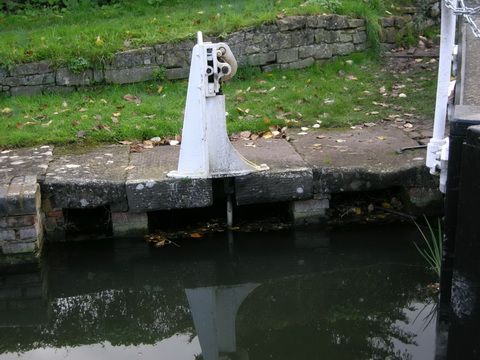
Good length of overflow. Water flowing.
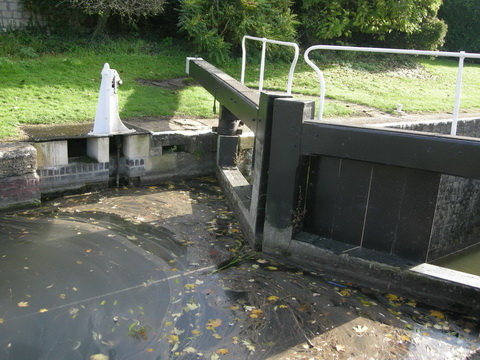
No overflow.
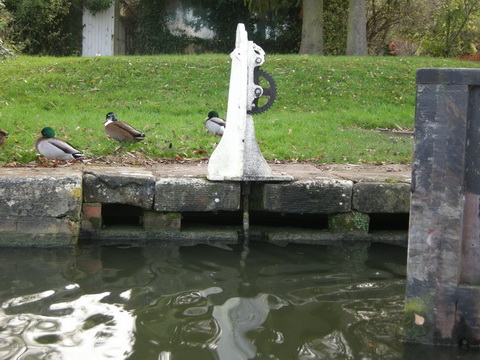
(Rebuilt) small openings are above the level of the top of the adjacent lock gate. However, just upstream there is another paddle or sluice gate on the canal side (next photo), so perhaps that is used to control the level.
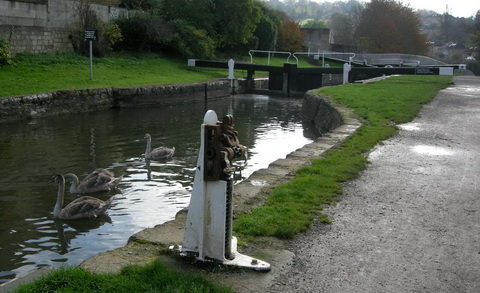
The upstream paddle or sluice gate.
Overflow in action, preventing water overflowing gates.
Note: this lock connects the canal with the River Avon, and the building in the background was a steam pumping station, presumably for topping up the canal from the river.
Many thanks to John for taking the trouble.

 Irish waterways history