Category Archives: Forgotten navigations

Interesting information about the Ulster Canal …

… as distinct from ministerial reelection photo opportunities.

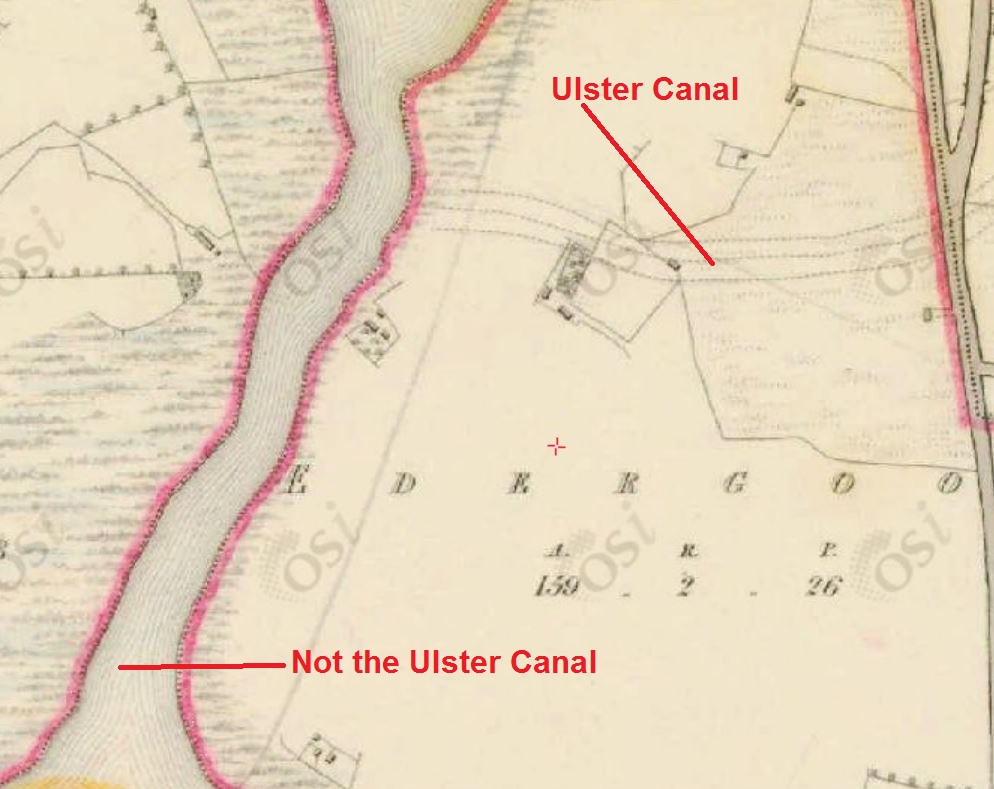
By the way, some folk get confused about the location of the Ulster Canal; this map may help:

Saunderson's Sheugh -v- the Ulster Canal (OSI ~1840)

Saunderson’s Sheugh -v- the Ulster Canal (OSI ~1840)

Anyway, for folk who are interested in weightier matters than ministers talking through portions of their anatomies that they can’t distinguish from their elbows, here is some speculation about opening bridges on the Ulster Canal.

That’s the Ulster Canal Ulster Canal, not the Saunderson’s Sheugh “Ulster Canal”, by the way.

My OSI logo and permit number for website


Ballygalane on the Blackwater

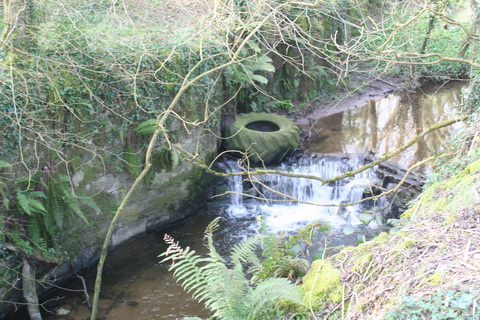
Lismore Canal lock 28_resize

The Lismore Canal lock

The only lock on the Lismore Canal is at Ballygalane, on the River Blackwater. Here is a new page about the canal, with photos of some of its important features.

Was the Brickey a navigation?

The Brickey is a small river that flows into Dungarvan Bay. Small boats used its lower, tidal reaches, but in the eighteenth century there was a proposal to link the Brickey to the Finisk, another small river that flows into the Blackwater south of Cappoquin.

Waterford County Museum, and others, believe that work began on that project in the mid nineteenth century and that a driveable track along the south bank of a stretch of the river was built as a towpath.

I have visited the river and looked online for further information; my conclusions (with maps and photographs) are here. However, I would welcome further information.

A grand day out in Galway for small boats

Here, courtesy of Kyran O’Gorman, are his notes on navigating the Ballycuirke Canal from Lough Corrib to Ross Lake. Small boats only, and at your own risk.

A canal is not just for Christmas …

… but I’d like to know more about Mr Christmas’s canals.

Off the Suir, near Mount Congreve.

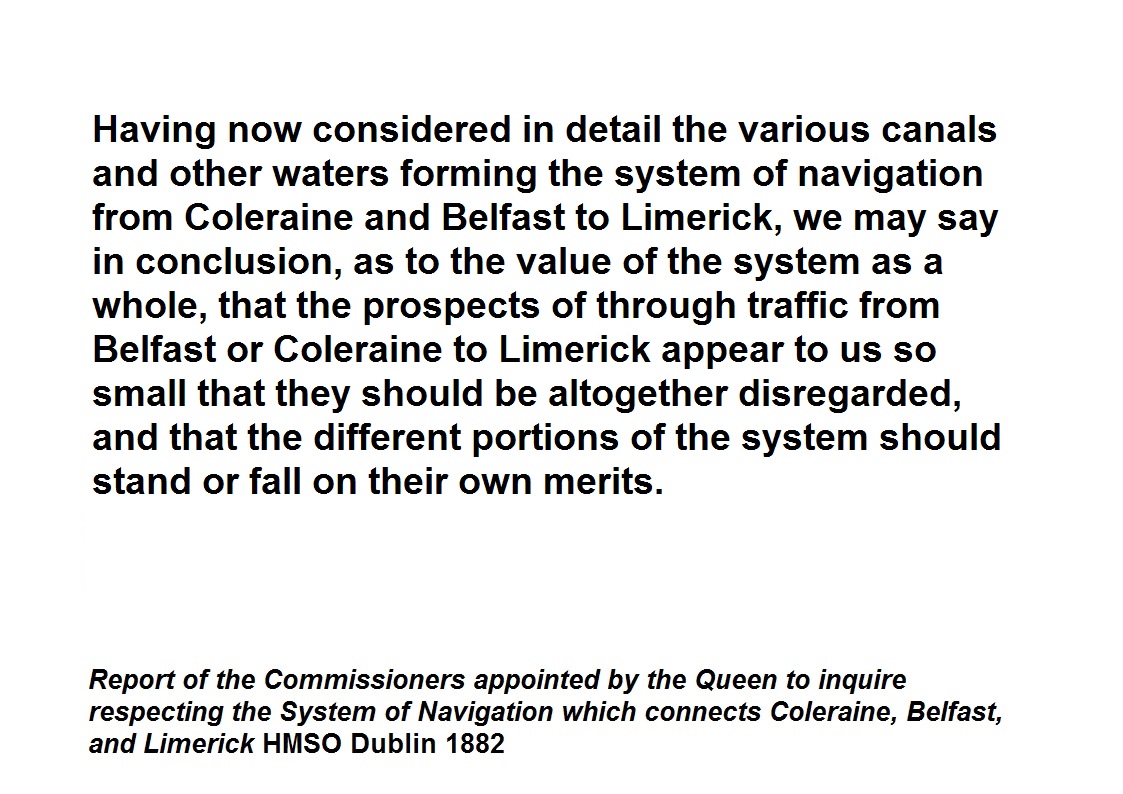
How true these words are …

… even today.

Connected system

Blueways

Longford Tourism and Waterways Ireland are holding an information meeting about Blueways in Longford tomorrow. It’s in the Backstage Theatre on Tuesday 24 March 2015 at 7.00pm. The blurb reads:

Are you an activity provider, accommodation provider, walker, boater, canoeist, outdoor enthusiasts?

Longford Tourism, in conjunction with Waterways Ireland is delighted to invite you to a Public Information Meeting regarding exciting new recreation and tourism products called Blueways.

Blueways are a series of innovative, safe and easy to use water and land-based trails. These provide for guided and unguided paddling, walking and cycling. Visitors can opt to paddle along the Shannon Blueway, on a 10km looped trail along the Camlin and Shannon Rivers, while the Royal Blueway provides 16km of off road walking and cycling from Cloondara to Longford Town.

To celebrate this exciting trails development, Longford Tourism will host the inaugural Longford Blueways Festival in April. So, come along and hear how you can get involved. All are welcome to attend.

I wish them well and I hope this initiative works. I think that the Blueways are more likely to be successful than any attempted revival of the cruiser-hire business (although I’d like that to work too). However, I would like to learn more about the Blueways business model (if that’s the right term). Who has to invest how much and who gets what returns? Clearly, Waterways Ireland spends money up front, but far less (I presume) than (say) canal restoration would require. But are there viable businesses, or at least viable supplementary income-generating activities, for small local service providers? How do they reach overseas markets? Or is the focus on domestic markets?

One point that strikes me is that Blueways allow for more interaction between tourists and locals: something that used to be a strength of the Irish tourism offering (I’m trying to keep up with modern marketing jargon here) until we decided we were too busy being rich and successful to waste time chatting to tourists (or, if you prefer, providing unpaid support services to the tourism industry). Indeed we felt that even paid employment in tourist enterprises was beneath us: we could get nice people from overseas to do that work instead. Did we, I wonder, hollow out Ireland, removing the Irishness, the distinctiveness (whatever it was) from the tourist experience?

If so, the Blueways’ opportunities for interaction with small-scale and local enterprises might put them back again. There are difficulties in making a living from small-scale operations, but there are benefits too. And the Blueways might tap into other local, small-scale developments: for instance, the recent startling growth in the number of craft breweries. The Lough Allen and Longford Blueways each have a local brewery — St Mel’s in Longford and Carrig in Drumshanbo — and the products of at least one other brewery, Co Roscommon’s Black Donkey, are available on the North Shannon. Maybe, now that KMcG is back, “Places to find good beer” might be added to places to stay, eat and go on the Blueways website.

A Blueway is defined there as

a recreational water activity trail that is developed for use by non-motorised water activity enthusiasts. It is defined by trail heads, put in and take out points and readily available trail information. Blueways can be developed on canals, rivers, lakes or along the coast and can incorporate other associated land base​d trails adjacent to the water trail.

So what about a Blueway for Lough Oughter, with sailing, canoeing and camping?

[h/t Carthach O’Maonaigh]

Are the Sheughers …

seeing sense?

A cynic (not that there are any of them around here) might say that DAHG feels that it has done as much as it’s going to do (admittedly at Waterways Ireland’s expense) by dredging the River Finn and that it has told Monaghan Council that, if it wants any more Sheughery for Clones, it will have to pay for it itself. The Council might like a canal, but only if someone else pays for it, so it will have to be content with a greenway.

And rightly so.


Navigations under threat

Limerick City & County Council [why don’t they shorten it to Limerick Council?] is examining options for an improved road from Limerick to Foynes, which is the main port on the Shannon Estuary. The options are set out on this website and you can download a PDF map that makes it easier to see the details.

The Red Route would cross the Deel Navigation just below Askeaton: the existing route does the same so there might not be any extra interference with the navigation. But the Red Route would also cross the Maigue and the Blue Route would do so just below the new quay at Adare. No doubt the Adarians would welcome a bypass but I imagine that some will be watching to ensure that navigation on the Maigue is not impeded.

Meanwhile we learn that some folk and some other folk want the railway line from Foynes to be reinstated. I have no idea why they think that’s a good idea: it’s not as if there were vast piles of incoming freight piled up at Foynes, unable to be shifted by road. Rip up the tracks and make a greenway, that’s what I say.

Good news for Sheughers

I noted recently that, according to the Department of Arts Heritage and the Gaeltacht, Waterways Ireland’s budget for the Clones Sheugh assumed a cost of land [including legal costs] of just over €52,500 per acre, when “the majority of [the land] is poor quality agricultural land”. I have asked Waterways Ireland for more information about this.

But today [as I am sure all regular readers will be aware] the Irish Farmers Journal Agricultural Land Price report 2014 has been published. It says that the average price of Co Monaghan land (based on 25 completed transactions) was only €9384 per acre, with a range from €1049 (for a 43-acre lot of which 12 acres were bog) to €40000 for land with development potential near Carrickmacross. A 25-acre “holding of prime agricultural land overlooking the lake at Emyvale” went for €14800 per acre and the county’s weighted average was €8103 per acre.

In Fermanagh, in Northern Ireland, the average price was £7493 (€10126) per acre, but “Lots of poor, rocky and heather land sold for around £1700/acre”.