
Category Archives: Historical matters

Sligo Ship Canal

Good article here.

Deep doo-doo

10000 tons manure

`To be SOLD by AUCTION, at One o’Clock on Monday, 20th July, 1830, at the North Strand Depot, in Lots agreeable to Purchasers. This is well worth the attention of Land-Owners.

NB A reasonable time will be given for the removal of same.

John Littledale, Auctioneer

Dublin Evening Post 6 May 1830

I wonder how they weighed it before offering it for sale.

Sail on Irish inland waterways

Here is a new page about the use of square sails on Irish inland waterways. I intend to add to this as I come across more information.

Grand Canal 1829

Grand Canal Lumber and Parcel Boats

Safe and expeditious carriage by land and water in four days

5, Grand Canal Harbour, James’s-street

Messrs Maher and Adamson beg leave to inform their Friends and the Public, that they have now made arrangements for plying Two Boats a Week to and from Dublin and Ballinasloe; they pledge themselves for the safe arrival of every article committed to their care.

Gillen Bridge

They have stores at Dublin, Tullamore, Gillen, and Ballinasloe, where careful Agents attend to receive and to forward Goods to their respective destinations. Their Boats are new, and drawn by two horses each, their own property; they retain no person in their establishment but men of tried honesty, sobriety, and diligence.

The Proprietors, for the satisfaction and accommodation of their Customers, have provided drays with large tarpaulen covers, and will insure the safe delivery of any goods committed to their care, at the regular price charged in each place per mile or per cwt. Loughrea, Gort, Galway, Eyrecourt, Birr, Banagher, Tuam, Moate, Kilbeggan, or any of the neighbouring places.

A Boat will leave Dublin on Wednesdays and Saturdays at Ten o’clock, AM: loaded or not the Proprietors pledge themselves to be punctual to the day and hour.

Dublin Evening Post 17 March 1829

Some interesting points

We don’t have much information about canal carriers in the early years of the Grand Canal, so this is a useful snippet. The use of two horses is interesting: I wonder whether the extra cost paid off. And here is more evidence of the former glory of Gillan or Gallen, which was also a stop on the coach-routes. What is now the R437, from Frankford/Kilcormac north through the bogs to Ferbane, seems to have been more important than what is now the N62.

Mills on the Barrow

Mill sites — Ireland

The Directors of the Barrow Navigation Company will receive Proposals for the several unoccupied Falls on their line of Navigation. These falls are from five to ten feet, with a constant and powerful supply of water; and, from some of the large Establishments now on the line of Navigation, a fair estimate may be formed of their value.

The River Barrow joins the Grand Canal at Athy, 32 miles from Dublin, from whence there is a navigation to Dublin capable of carrying Boats of 50 tons burden, and the River Barrow is navigable from Athy to the Sea-ports of Ross and Waterford, between which places there is a constant and extensive communication for 20 miles of its length.

The River Barrow is not above 10 miles of its length from any part of the extensive Collieries, known by the name of the Kilkenny Collieries, and only three miles from some parts of them, and the country intersected with good Roads. There are several Towns situated on the River adjoining the Falls, `with a superabundant well-disposed Population, only wanting employment. The country is well inhabited, the soil fertile, the climate mild, the River not being frozen over once in ten years.

Any further particulars may be learned by application to the Company’s Acting Secretary, E S Hunt; and Messrs Latouche, Dublin, if by letter, post paid.

Dublin Mercantile Advertiser, and Weekly Price Current 13 June 1825

New header pic 16 May 2020

Early steamer in Dublin 1820s

Quakers, privateers and Post Office packets

During the French Revolutionary/Napoleonic wars, several of the British Post Office’s packet boats were seized by French privateers. As a result, the Post Office decided that the packet boats should be armed. The packet boats were privately owned and contracted to the Post Office,

Arthur Hamilton Norway takes up the story as it applies to the packet boats between Britain and Ireland.

The Waterford packets

It had not been customary in former wars to arm the Holyhead and Dublin boats, but a few light guns were now allowed to them, as well as to those from Port Patrick to Donaghadee. The Packets running between Milford Haven and Waterford were somewhat more exposed to the attacks of Privateers, which might be expected to hang about the entrance to St George’s Channel in the hope of intercepting the shipping out of Bristol, but here a curious difficulty was raised by the proprietors, a body of merchants, nineteen in number.

All but six of these gentlemen were members of the Society of Friends, and, being sincerely convinced of the sinfulness of war, they put in a decided objection against the proposal to provide their vessels with implements of strife and destruction.

The Postmaster General proceeded to reason with these ardent theorists, and pointed out that as, by the existing rule, the Department was bound to pay the value of captured Packets it was but reasonable that it should be allowed, at its own cost, to protect them. The men of peace, touched by the financial argument, admitted this, but retorted that if only the Government would refrain from the wickedness of placing guns and cutlasses in the hands of their sailors, they, that is to say the thirteen Quaker proprietors, would waive all claim to compensation in the event of capture.

It was true, they admitted, that the six proprietors who were not Quakers were by no means ready to make this sacrifice, but the Government, they urged, might fairly be expected to risk the liability for six-nineteenths of the loss when a principle was at stake.

By this time, however, the Postmaster General had become tired of the discussion, and closed it with a brief intimation that if the Packets were not armed the contract would be withdrawn, and in view of this unsympathetic attitude the Quakers sold their shares and retired from the concern.

That the unwarlike attitude of the Quakers was by no means always accompanied by any want of natural courage was demonstrated not long after this period by a certain inhabitant of Falmouth, an old and greatly respected member of the Society of Friends. This gentleman held the appointment of surgeon to the Post-Office establishment, and was one day cruising on board a Packet when a French Privateer hove in sight. It was obvious that there was going to be a fight; and the commander, knowing his passenger’s principles, suggested that he had better go below. The doctor, a fine tall man, declined to budge from the deck; and the captain thereupon offered him a cutlass and pistol, observing that as he intended to remain in the way of danger, he might at least use weapons in self-defence.

But this suggestion also the doctor refused to entertain; and, standing quite unarmed on the quarter-deck, he remained an interested and placid spectator of the action. After a sharp cannonade, the French vessel hurled her boarders into the Packet. The doctor showed no sign of excitement as he saw the fierce St Malo men swarming up the sides, cutlass in hand; but when, a moment later, a swarthy giant came clambering up unperceived, at a point where there was no one to resist him, the doctor calmly stepped forward, threw his arms round the astonished Frenchman with a grip few men could have resisted, and saying, gently, “Friend, thee makes a mistake, this is not thy ship”, tossed him into the sea.

More information

For background, see here on PO packet boats, but note that the article gives undue attention to the Falmouth-based packets. The Dover-based service is covered here. One of the packet service scandals is covered here.

Source

Arthur H Norway History of the Post-Office Packet Service between the years 1793–1815 compiled from records, chiefly official Macmillan and Co, London 1895. Mr Norway, father of the novelist Nevil Shute, was in the GPO in Dublin in 1916

Killaloe eels

A new export from Ireland

The banks of the Shannon, says the Limerick Chronicle, are inexhaustible in providing sustenance, not only for the natives, but our constant customer, John Bull. Salmon has for some time been an article of profitable export to the English market; but what will the public think of that cheaper and more abundant dainty — eels?

There are 10 tons of this prolific fish now in tanks at Killaloe, awaiting a conveyance to London; and a vessel adapted for the trade will take on board from this port in the ensuing week 40 tons of eels for the London Market.

Ipswich Journal 26 October 1844

Walking on water

Marine Pedestrianism

Mr Kent, whose surprising exploits have attracted so much attention in Liverpool and other places where he has appeared before the public, arrived here on Sunday evening by the Steam Packet Waterloo.

On the packet reaching Ringsend, he launched and mounted his marine velocipede, and proceeded before the packet up to Sir John Rogerson’s-quay, where he was loudly cheered by the spectators on shore.

We understand it is his intention to exhibit his apparatus here, should he meet with public encouragement previously to his departure for London.

Saunders’s News-Letter 24 July 1821

Walking on water

On Friday a prodigious crowd, upwards of 30000 people, assembled on the banks of the Clyde, to witness the performance of Mt Keat [sic], who had announced his intention of riding on his aquatic velocipede, from Rutherglen-bridge to the Wooden-bridge. He started precisely at a quarter before three o’clock, and reached the Wooden-bridge at a quarter past three. He amused himself with loading and discharging a fowling-piece as he sailed along. Several porters were stationed at the different entrances of the Green with subscription-boxes. The machine consists of three oval tin cases united by iron rods to support a sort of saddle, upon which the artist sits, at such a height as is suitable for using his feet to give the requisite impulse. The weight of the whole does not exceed 14 lbs.

Salisbury and Winchester Journal 21 May 1821

Here’s a later version.

Dublin’s foreign trade 1837

Here’s an interesting extract from Lewis’s Topographical Dictionary of 1837. It’s about the foreign trade of the port of Dublin.

At the time, trade was classified as either coasting or foreign: since the conclusion of the free trade area between Ireland and Britain in 1825, trade between Ireland and Britain was classed as coasting. As a result, no records were kept of that trade except for corn (from Ireland to Britain) and coals (the other way). To quote Tables of the Revenue [Tables of the Revenue, Population, Commerce, &c of The United Kingdom and its dependencies Part III from 1820 to 1833, both inclusive. Compiled from official returns; presented to both Houses of Parliament by Command of His Majesty HMSO, London 1834 ]:

No general Account of the Trade between Ireland and Great Britain can be rendered for the period subsequent to 1825, the commercial intercourse between the two Countries having, from the termination of that year, been assimilated by law to a coasting traffic.

In this extract, Lewis is therefore talking about Dublin’s trade with places outside the United Kingdom. He starts with northern Europe, then moves on to the West Indies and North America, then China and South America, finishing in the Mediterranean. The indented italicised paragraphs are Lewis; the others are comments.

Northern Europe

There is very little foreign export from Dublin. The trade with the Baltic in timber, staves, &c, is greatly diminished by the high rate of duty imposed and the low rate at which Canada timber is admitted. From St. Petersburgh, Riga, Archangel, &c, there is a considerable import of tallow, hemp, and tar, with some linseed, bristles, &c.;

The Baltic had been Britain’s main source of timber and other supplies for shipping (including hemp and tar) but, during the Napoleonic Wars, timber from North America had taken over.

from Spain and Portugal the chief import is wine, with some corkwood, raisins, barilla, and bark; from France the imports are wine in wood and bottle, claret, champagne, &c, also cork-wood, prunes, dried fruits, and some brandy;

Wine, brandy and gin:

from the Netherlands the imports are bark and flax ; from Holland, tobacco pipes, bark, cloves, and flax-seed, and small quantities of gin, Burgundy pitch, Rhenish wines, madder, &c.

So far many of the imports seem to be either inputs to industrial processes (eg barilla, madder) and exotic food and drink for the more affluent consumers.

West Indies

With the West Indies the trade is chiefly in sugar from Jamaica, Demerara, and Trinidad, estates in the last-named island being owned in Dublin.

For more on Irish slave-owners, insert “Ireland” in the “Country” field of the “Address Details” section here.

Encouraging people to drink whiskey:

Coffee is imported in small quantities and also rum, but very little foreign spirits are consumed in Ireland, in consequence of the low price and encouragement given to the use of whiskey.

The Irish provision trade, which supplied (inter alia) the British navy and slave plantations, had been in decline for many years, with the livestock trade increasing to compensate.

Beef and pork in casks, and soap and candles in boxes, were formerly exported to the West Indies in large quantities, but the trade is now nearly lost in consequence of permission being given to the colonists to import these articles from Hamburgh, Bremen, &c, where they can be purchased at lower prices than in Ireland.

The West Indies could also buy from America (see below) and could buy preserved cod as an alternative to beef.

North America

The linen trade had become concentrated on Belfast; Dublin had lost its role in handling the product when Belfast opened its own Linen Hall in 1783.

To the United States of America formerly there was a very large export of linen, principally to New York, and flax-seed, staves, turpentine, clover-seed, &c, were brought back; but the bounty on the export of linen having been withdrawn, the trade between the United States and Dublin has greatly diminished. The export of linen and import of flax-seed is now chiefly confined to Belfast and other northern ports.

The growing of tobacco in Ireland had been banned in 1832.

The American tobacco which is either sold or consumed in Dublin is brought from Liverpool.

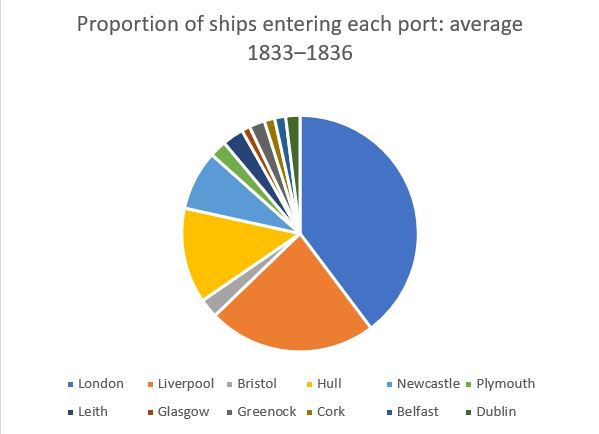
The import of American tobacco via Liverpool was part of a much wider trend. Liverpool was simply so much busier a port than any of its Irish counterparts; it dominated the Atlantic trade (to the chagrin of Bristol). It made sense to send cargoes in large vessels from the Americas to Liverpool; from there they could be distributed quickly, especially to Dublin, to which there were daily steam services. This changed the way Dublin merchants worked: instead of getting a few shiploads from the Americas per year, they could now import small quantities as required, once a week if they liked. That reduced the amount of capital tied up in stock and may have made it available for other investments.

UK port traffic 1833–1836 (derived from Tables of the Revenue 1838)

The timber trade was, in effect, the emigrant trade: emigrants provided a useful back cargo for ships that would otherwise return almost empty to the Americas.

With British America the trade is very great in timber, as a return cargo of vessels sailing thither from Dublin with emigrants.

An inland waterway connection:

With Newfoundland there is no direct trade; the cod and seal oil consumed are imported from Liverpool or brought by canal from Waterford, which has a direct trade with Newfoundland; dried codfish and ling being much used in the southern counties, but not in the northern or midland.

China

More exotica:

With China there are three vessels owned in Dublin, besides others engaged in the tea trade; the number of chests directly imported is, therefore, considerable.

South America

As well as timber, one of the things that industrialising countries were running out of was hides for leather. Argentina and Uruguay both had extensive exports; they were also able to export salted beef to the Americas and the Caribbean.

With South America there is no direct trade, the Dublin tanners being abundantly supplied with native hides, and any foreign hides required being brought from Liverpool, whence also is imported the cotton wool consumed in the Dublin factories.

Mediterranean

And finally …

With Turkey the trade is confined to the importation from Smyrna of valonia, figs, raisins, and small quantities of other articles: madder-roots and emery-stone being always transhipped for Liverpool.

With Leghorn there is a considerable trade for cork-tree bark, and small quantities of hemp in bales, oil, marble, &c, are also imported, but very little communication is kept up with Trieste or other Italian ports.

With Sicily the trade is in shumac and brimstone ; the latter article in considerable quantities for the consumption of vitriol and other chymical works.


Source: Samuel Lewis A Topographical Dictionary of Ireland, comprising the several counties, cities, boroughs, corporate, market, and post towns, parishes, and villages, with historical and statistical descriptions; embellished with engravings of the arms of the cities, bishopricks, corporate towns, and boroughs; and of the seals of the several municipal corporations: with an Appendix, describing the electoral boundaries of the several boroughs, as defined by the Act of the 2d and 3d of William IV S Lewis & Co, London 1837