Category Archives: Industrial heritage

Sort it yourself, Heather

No, that’s not me saying it: that’s the message from Enda Kenny to Heather Humphreys about Saunderson’s Sheugh. Recall that Ms Humphreys’s Northern Ireland counterpart has been pressing her to do something about the Ulster Canal:

Moving to implementation would have a positive impact on wider North/South relations. It would provide delivery on a commitment given by the North South Ministerial Council in 2007 in the context of the restoration of the Northern Ireland Assembly and Executive following a five year hiatus. It had not been possible to make visible progress up to now in the absence of planning permission. However, now that the necessary preparatory work has been completed and the required planning permissions are in place, failure to proceed to implementation could be viewed as tantamount to retracting the commitment given in 2007 and reported on regularly at North South Ministerial Council meetings since then.

Strange words to find in a business case, but that’s where they are: in the Department of Arts, Heritage and the Gaeltacht’s Restoring the Ulster Canal from Lough Erne to Clones: Updated Business Case February 2015. They read to me as if they might have been written by Carál Ní Chuilín’s Department of Culture, Arts and Leisure in the draft they sent to DAHG; it might have been tactful to remove them, as they smack of the message I envisaged here:

[…] I suspect that Sinn Féin put a gun to someone’s head: “We’re fed up waiting for our sheugh. Start digging or the baby gets it.”

Presumably, then, Ms Humphreys went to her government colleagues and asked for money to buy a few shovels. It is clear that the government took a decision on the matter:

The Government also remains committed to the Narrow Water bridge project and to developing the Ulster Canal. The Government made a decision in regard to an element of that project today.

That was Enda Kenny in the Dáil on 24 February 2015. Later in the same discussion, he said:

This morning, on a recommendation from the Minister for Arts, Heritage and the Gaeltacht, the Government approved a recommendation from Waterways Ireland to allocate €2 million from its resources to address a 2.5 km section of the Ulster Canal. It is a stand-alone project which will demonstrate further evidence of great co-operation. I understand a further 11 km are due for assessment after that.

Now, I am quite ready to believe Mr Kenny’s assertion that Waterways Ireland volunteered to have its already tattered budget cut by another €2 million to pay for dredging the River Finn; I also believe Mr Kenny’s assertions about economic recovery and about the existence of unicorns. I’m less certain that having the southern state pay the entire cost can be called “evidence of great co-operation”. But I am happy to note that no decision has been taken to dig a further 11 km of sheugh to Clones.

It seems, though, that — despite its commitment to sheughery — Mr Kenny’s government does not intend (at least until that economic recovery is further advanced and the unicorn mating season is over) to pay an extra penny or cent to cover the costs. That is very wise, but I suspect that it left Ms Humphreys swinging in the wind: forced to do something to satisfy DCAL and Sinn Féin but unable to extract any extra money from the government. Waterways Ireland then — without, I am sure, any prompting — nobly volunteered to reduce the spending levels agreed in its business plan just two months before, and to sell some unidentified property, to come up with €2 million to save its southern minister.

I have asked DAHG for a list of those government departments to which the business case was sent; I’ll then ask them what they said about it. As it stands, it seems that DAHG’s work of imaginative literature failed to convince the Irish government.

 

Shannon history

Folk interested in the history of the Shannon Navigation, and in particular in the work of the Shannon Commissioners in the 1840s, may like to get hold of an article “Steam, the Shannon and the Great British breakfast”, published in the Journal of the Railway & Canal Historical Society Vol 38 Part 4 No 222 March 2015.

They’re taking the [bodily fluid]

Of the cost of land to be acquired for a canal to Clones:

We understand that the costs of land acquisition are based on the purchase of 46 hectares of land (equivalent to approx. 114 acres), the majority of which is poor quality agricultural land for a total estimated cost of €6m. This is equivalent to an average price for acquisition of just over €52,500 per acre, although the total acquisition costs would also include legal costs associated with the process.

Nevertheless, an average price of €52,500 would appear to be very high compared with the average price at which agricultural land is currently sold in the area. If an average price of €25,000 per acre (including legal costs) was applied, then total land acquisition costs would be reduced to €2.85m. This is still a generous assumption. The average RoI price of agricultural land in 2014 was less than €10,000. [Irish Farmers’ Journal Agricultural Land Price Report 2013 January 2014]

That’s from Department of Arts, Heritage and the Gaeltacht Restoring the Ulster Canal from Lough Erne to Clones: Updated Business Case February 2015. Hats off to Fitzpatrick Associates for checking and for leaving the information in the final report. I have written to Waterways Ireland to ask for more information:

I would be grateful if you could let me have a list of

  • the names and addresses of the owners of the land you propose to buy to build a canal to Clones

  • map references or maps showing the location of that land

  • the size and nature of each plot of land you propose to acquire

  • the amount you propose to pay for each plot

  • the justification for each such amount.

Actually, I have the list of landowners in Co Monaghan, because it’s in the planning application. I can’t find the equivalent on the NI Planning Service’s website because I can’t work out how to search by applicant.

The stony grey soil of Monaghan must be worth more than one might think. Either that or this proposal is a steaming dunghill.

DAHG and the unicorns

In purely quantifiable monetary terms, it is clear from these estimates that the project has a very significant capital cost of circa €46m and that the quantified annual net economic benefits are at most €323.5k per annum. The latter thus covers the annual revenue costs of €308.8k per annum only. Applying any cost benefit analysis, whether payback period or net present cost, will result in a large negative for the project.

The justification of the project therefore relies largely on the unquantifiable benefits associated with the project and the disadvantaged area in which these will occur.

Department of Arts, Heritage and the Gaeltacht Restoring the Ulster Canal from Lough Erne to Clones: Updated Business Case February 2015

The project will give this border region, which has suffered greatly from economic deprivation, a much needed boost in terms of job creation and tourism. There is significant potential for growth in the waterways based tourism market and I have no doubt that the reopening of this section of the canal will help to attract significant numbers of visitors to the area.

Heather Humphreys quoted in Department of Arts, Heritage and the Gaeltacht press release Minister Humphreys secures Government approval to restore Ulster Canal from Upper Lough Erne to Castle Saunderson 24 February 2015

If “quantified annual net economic benefits are at most €323.5k per annum” for a sheugh running all the way to Clones, it is hard to see how a shorter sheugh to Castle Saunderson is going to result in “a much needed boost in terms of job creation and tourism”.

But that’s where the unicorns come in: it will all happen by magic.

What DAHG knows about waterways history

Commercial traffic on all waterways in Ireland ended during the first half of the 20th century.

For certain values of “half”.

Saunderson’s Sheugh and the border problem

Castle Saunderson and the border

Castle Saunderson and the border

Saunderson’s Sheugh, the latest manifestation of the proposed reconstruction of the Ulster Canal, would run along a border for much of its length. That’s the border between Ireland and Northern Ireland, but there is one important border it does not seem to cross [as far as I can see]: that between counties Cavan and Monaghan.

Has Cavan stolen the sheugh from its northern neighbour? I’m sure that folk in the Monaghan part of the Dáil constituency of Cavan-Monaghan won’t mind, but I wonder whether the Minister for Arts, Heritage and the Gaeltacht, who is a TD from the Monaghan end and is in charge of Sheughery, is concerned that her Monaghan colleague Caoimhghín Ó Caoláin [Sinn Féin] might turn the situation to his party’s advantage. On the other hand, from Sinn Féin’s viewpoint, the question might be whether any sheugh is better than none.

Of course, as soon as a coalition of Sinn Féin and the Éamon Ó Cuív wing of Fianna Fáil takes power, we’ll have the entire Ulster Canal built immediately. And there will be grants for growing flax, carrying corn to Dublin and draining the Shannon [which might mean that there are no southern boats to visit the Ulster Canal].

I should say, though, that Davy, in two reports out today, is not very worried about what Sinn Féin might do: Finfacts story here; Davy here; the two reports here and here [each of which should open as a PDF; if that doesn’t work, use the links on the Davy or the Finfacts page].

Map: OpenStreetMap; copyright explained here.

Ulster Canal restoration: a history

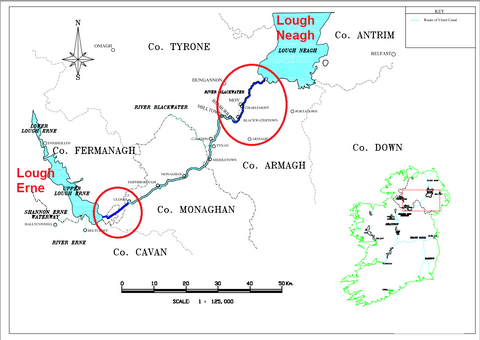
Ulster Canal 01 whole_resize

Studies 1994–2000

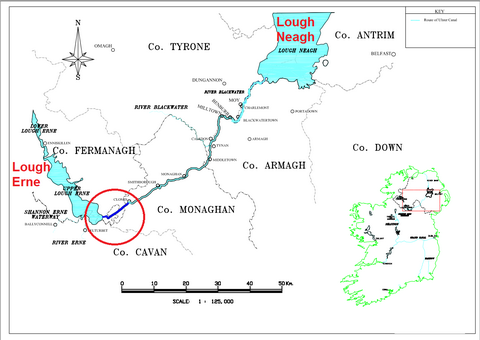
Ulster Canal 02 whole_resize

Socio-economic summary report and feasibility study 2006

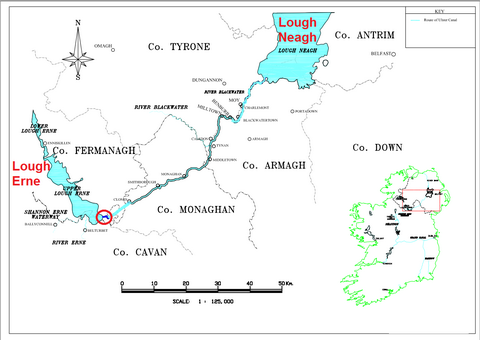
Ulster Canal 03 whole_resize

North/South Ministerial Council agreement 2007, with the Irish government to pay the full cost

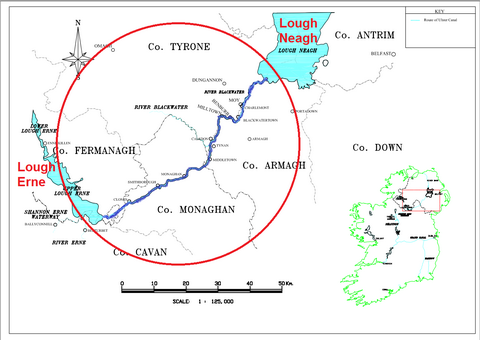
Ulster Canal 04 whole_resize

DCAL business case to DAHG 2015

Exhaustive coverage begins here but use the search facility for updates. More to come.

Saunderson’s Shack

Some links to info about the Castle Saunderson estate, to which DCAL is trying to persuade DAHG to construct a sheugh.

Cavan County Council owns it, I think.

There is an International Scout Centre, although I’m not clear whether the scouts occupy the entire site or just part of it. For instance, do they control the church where services take place, at least occasionally?

There was an Orange parade to the site last year.

It is close to Belturbet, where the County Council has a River Project. Was that completed?

Cycling the MGWR

From Michael Geraghty:

There is a photography exhibition currently running at the National Photographic Archive in Temple Bar’s Meeting House Square called Midland – Lár Tíre: Cycling the MGWR from past to present and features photographs along the 1,000km old Midland Great Western Railway (MGWR) network. The photographer, Pamela De Brí (my sister), cycled the 1,000km and recorded her journey as photographs and audio tapes.

The exhibition will run until Sunday 24 May 2015 and here is a link to an article on the Journal.ie.

The history of the MGWR is linked to that of Irish waterways more closely than, I think, that of any other Irish railway.

Outbreak of sanity in Co Westmeath

Our big thing is to link the Galway Dublin cycleway into Kilbeggan and along the stretch of the old canal to Ballycommon. That’s around a million euro project and the biggest thing in our Vision for Kilbeggan plan.

Thus Dan Scally of Renew Kilbeggan in the Westmeath Examiner.