
The Dublin People has the story.
Don’t those fluorescent colours look disgusting? Enough to give you a headache. Bring back the gas works, say I: at least they could cure whooping cough.
The Dublin People has the story.
Don’t those fluorescent colours look disgusting? Enough to give you a headache. Bring back the gas works, say I: at least they could cure whooping cough.
Posted in Ashore, Built heritage, Economic activities, Engineering and construction, Extant waterways, Industrial heritage, Ireland, Operations, People, Politics, Restoration and rebuilding, The turf trade, Water sports activities, waterways, Waterways management
Tagged boats, bridge, canal, Dublin, Grand Canal, Ireland, moorings, Operations, vessels, waterways, Waterways Ireland
Irish Times report on the oral hearing into the proposed abstraction of water from Lough Ennell. The hearing is scheduled for three days at the Mullingar Park Hotel and a decision is expected by 11 June 2012. The two cases are being heard together:
PW3005: Ladestown, Mullingar, Co. Westmeath.
Case Type: Provisional Order Water Supplies Act (Board Reference: PL25 .PW3005)
Description: Taking of a Supply of Water from Lough Ennell to Supply the Royal Canal.
and
JA0030: Kilpatrick Bridge and Clonsingle, County Westmeath.
Case Type: LA Non-Road development – Application (Board Reference: PL25 .JA0030)
Description: Royal Canal Water Supply Scheme from Lough Ennell, Ladestown.
Posted in Ashore, Built heritage, Drainage, Economic activities, Engineering and construction, Extant waterways, Industrial heritage, Ireland, Natural heritage, Operations, People, Politics, Restoration and rebuilding, Water sports activities, waterways, Waterways management, Weather
Tagged An Bord Pleanála, Ireland, Lough Ennell, Lough Owel, Mullingar, Operations, oral hearing, rain, Royal Canal, summit, water level, Waterways Ireland, Westmeath Councty Council
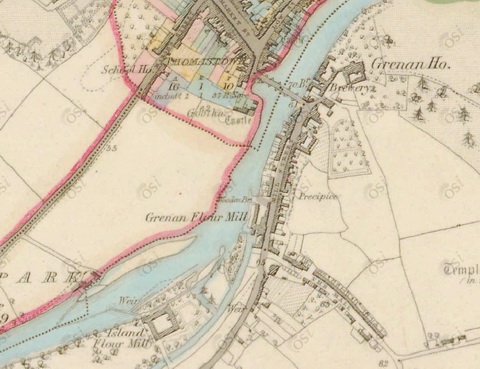
Thomastown ~1840 (OSI)

Thomastown, Co Kilkenny, is offering a month-long programme of events from 1 June to 1 July 2012, including:
There will be exhibitions and other events during the month; download the brochure here [PDF]; read about the Thomastown Weir and the Thomastown Community River Trust here.
We recall that Samuel Lewis wrote of Thomastown in 1837:
A very considerable trade was formerly carried on, and the town was the commercial depot for the county of Kilkenny ; flat-bottomed boats of an aggregate burden of 11,000 tons were constantly employed in conveying goods from this town, besides many others which did not belong to it; but the river is now choked up with deposits of sand. Inistioge has become the head of the navigation of the Nore, and the boats employed on the river at this place do not exceed an aggregate burden of 150 tons; the goods are now conveyed on Scotch cars by land from Waterford to Kilkenny. The improvement of the navigation of the Nore would tend greatly to the revival and extension of the trade of the town, and to the development of the resources of the county, which is rich in marble, coal, culm, slate, and limestone, for which, in addition to its agricultural produce, it would afford facilities of conveyance to the neighbouring ports. It has been estimated that the clearing of the channel of the river, which would open the navigation from New Ross to this town for flat-bottomed steam-boats of 70 tons’ burden, might be accomplished at an expense of £15,000, and effect, by a reduction of the charges for freight and the discontinuance of land carriage, a saving of at least £10,000 per annum. There are several large flour-mills worked by water in the town and its vicinity, and also two breweries and a tan-yard.
Posted in Ashore, Built heritage, Economic activities, Engineering and construction, Extant waterways, Forgotten navigations, Industrial heritage, Ireland, Irish inland waterways vessels, Operations, Restoration and rebuilding, Scenery, Suir, waterways
Tagged cot, Ireland, Kilkenny, mill, Nore, Suir, Thomastown, weir
The Birdhill Tidy Towns group has a heritage trail on its website and it was there that I first heard of the Dunally Line, AKA the R496. Tipperary North Riding County Council also uses the name [.DOC] and it is also used in several places on OpenStreetMap.
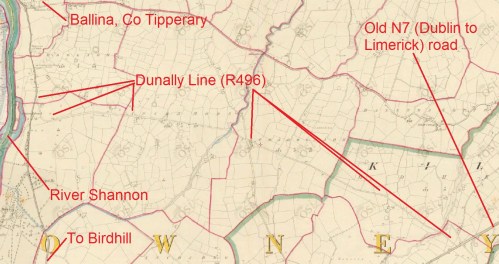

I would like to know more about the date, purpose and circumstances of the construction of the Dunally Line.
Posted in Ashore, Built heritage, Charles Wye Williams, Economic activities, Engineering and construction, Extant waterways, Industrial heritage, Ireland, Operations, People, Shannon, Steamers, The cattle trade, waterways, Waterways management
Tagged Ballina, Clare, Ireland, Killaloe, Shannon, steam, Tipperary, waterways
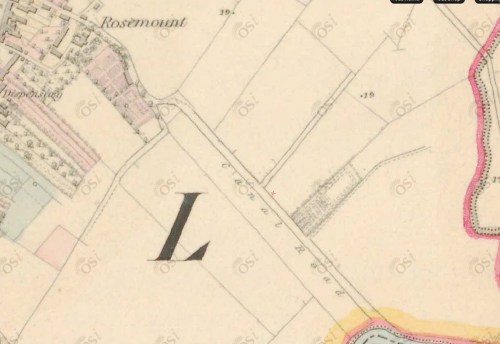
Letterkenny, in Co Donegal, has a Canal Road, but did it have a canal? If so, can anyone tell me anything about it?

According to the Irish Times:
Ahead of the summit later this month, Government departments have been told to draw up lists of capital projects with potential to create thousands of jobs for which funding would be sought if EU leaders agree on the package at the meeting to be held a week before polling day here.
Will DAHG be able to resist the temptation of suggesting the Clones canal? I’m sure that, since it discovered the project was going to cost almost one third more than it had originally believed, it has had teams of economists busily reassessing its, er, viability (and I’m expecting a visit from the easter bunny at any moment) so it will have its “business case” ready.
Still, there’s a slightly more cheering take on the matter here, where Michael Taft suggests that the government won’t be able to get much money for “stimulus”. I like the idea of using project bonds for the Clones Canal, though it might be hard to show that it qualified as “key strategic EU infrastructure in transport, energy and broadband” despite the Irish state’s delusions.
Posted in Economic activities, Engineering and construction, Foreign parts, Industrial heritage, Irish waterways general, Operations, Politics, Restoration and rebuilding, Ulster Canal, waterways, Waterways management
Tagged canal, Clones, department of arts heritage and the gaeltacht, Erne, Ireland, Lough Neagh, Ulster Canal, waterways, Waterways Ireland
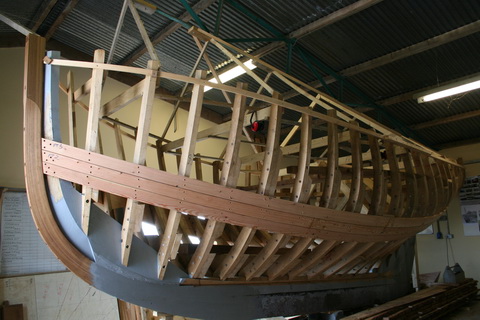
Seol Sionna under construction
The reproduction 25′ Shannon estuary hooker Seol Sionna will be launched at Querrin, Co Clare, on Saturday 19 May 2012, with celebrations continuing at Carrigaholt (home of the sublime Long Dock pub and eatery) on the following day [h/t dbm].
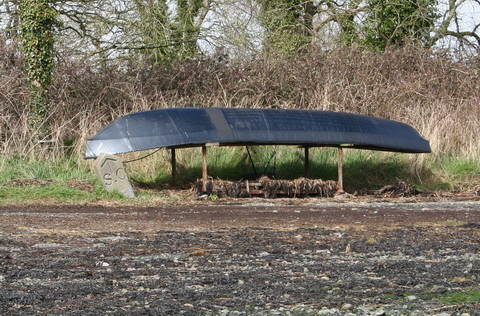
Canoe at Querrin. The second syllable of “canoe” rhymes with “go”
The pier at Querrin was built by the Shannon Commissioners; one of their marker stones (there are four at Querrin) is shown above.
Whaddya mean, you don’t know where Querrin is?
Remember, if the turf boats had not established the tourist traffic to Kilrush and Kilkee, the Shannon estuary steamers might never have got going and there might never have been a P&O line.
Posted in Built heritage, Charles Wye Williams, Economic activities, Engineering and construction, Extant waterways, Forgotten navigations, Industrial heritage, Ireland, Irish inland waterways vessels, Operations, People, Restoration and rebuilding, Scenery, shannon estuary, Sources, Steamers, The turf trade, Tourism, waterways
Tagged boats, estuary, Ireland, Kilkee, Kilrush, Querrin, Seol Sionna, Shannon, steamers, turf, turf boats, vessels, waterways
From the Freeman’s Journal of 5 December 1833:

The Broadstone, from The Tourist’s Illustrated Hand-Book for Ireland 3rd ed David Bryce, London 1854
UNPRECEDENTED SPEED ATTAINED IN TRAVELLING UPON THE ROYAL CANAL
The Court of Directors of the Royal Canal hereby give Notice, that the present Day-Boat will cease running on Friday, the 6th, and that an Iron-Boat, capable of conveying Seventy Passengers, will leave the Broadstone harbour, at Nine o’Clock, on the Morning of Saturday, the 7th inst, for Mullingar, where it will arrive at Five o’Clock in the Evening; and Notice is further given, that at Nine o’Clock upon each Tuesday, Thursday, and Saturday, a Boat will leave Dublin for Mullingar, and return from thence at the same hour upon Monday, Wednesday, and Friday. By the foregoing arrangement a saving of three hours and a half will be effected. The Night-Boat will, for the present, continue to leave Dublin for Longford, each day, at Two o’Clock, and a Boat will depart from thence, for Dublin, each Morning, at Eleven o’Clock.
By Order,
SAMUEL DRAPER, Secretary.
Royal Canal-house, 2d Dec., 1833.

 Irish waterways history