Category Archives: Ireland

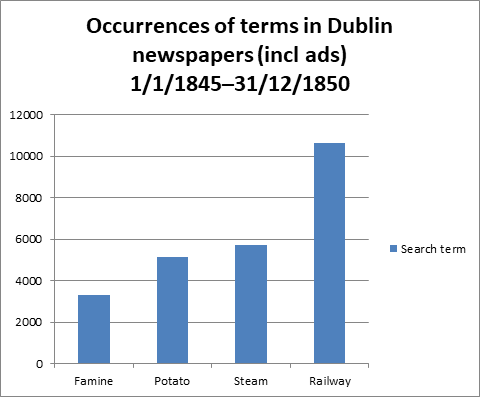
What Dublin newspapers wrote about during the Famine

As recorded in newspapers that were published in Dublin [Freeman’s Journal, Dublin Evening Mail] between 1 January 1845 and 31 December 1850 and that are available through the British Newspaper Archive.

Count including ads and family notices

Count excluding ads and family notices

Those charts are a few years old; I must redo them. I suspect that the two terms I’ve used, “famine” and “potato”, don’t capture the full extent of famine reporting: I should perhaps add other terms (eg “distress”).

Kilglass

The Marquis of Westmeath presented a Petition, from certain landholders of the county of Tipperary and another from the inhabitants of Navan, in the county of Meath, against the Grand Jury Laws of Ireland, and praying for their repeal. He trusted, their Lordships would permit him to make a few observations on the matter of these petitions, and the subject to which they related. […]

He had to call their Lordships’ particular attention to some anecdotes, which he could relate respecting the manner in which this system worked, odious as it was, and deservedly so to the people of Ireland. He would begin with one occurring in the county of Roscommon — with which he was connected. In the year 1817, a presentment was made with his knowledge from the parish of Kilglass, for a road to connect it with the river Shannon, which washes its shores.

The population of that parish was immense, and it contained upwards of 5,000 Irish acres. It had no road whereupon any farmer could convey a loaded cart; and the case then was, as it now remains, that, though in a county groaning under crops of oats, the produce was brought out piecemeal, to be consigned to the river Shannon as it might; and, although within twelve miles of the great market of Longford, no loaded conveyance could travel into or out of it, nor could then, or can now, any farmer transport manure, or any other load, in that county, except upon horses’ backs.

Their Lordships would learn, with astonishment, that this county was all heavily taxed by the Grand Jury, to the amount of from 2s[hillings] to 3s annually per acre; concurrently, indeed, with those parts of the county where the Gentlemen who compose the Grand Jury disport themselves and reside; but, while one part of the county had not a single passable carriage road, its wealth was extracted to form easy communications and gravel-walks in another part of the county with which it had neither sympathy nor interest. Was it to be supposed that such a system could be endured? He himself, in 1817, had been examined before that Grand Jury, as to the oppressed and neglected state of this part of the county; and from that hour to this, it had remained precisely in the same state. […]

Irish Grand Jury Presentments in
House of Lords Debate 5 July 1831

Header photo 20191202

Looking towards Clondra Lock.

The new header photo 20191102

Lanesborough bridge

Scrubbing the Sheugh

Monaghan Town meanwhile got €57,600 to clean a section of the Ulster canal, and carry out appropriate planting and turn this section of Ulster Canal Greenway into a haven for wildlife […].

From The Anglo-Celt 31 October 2019

Another estuary quay

Here is a page about Ringmoylan, a quay on the south side of the estuary.


A gale at Limerick

Doubtless there must have been a pretty considerable storm at Limerick on Thursday week; though the following Hibernian account of it, in the Limerick Chronicle, goes somewhat beyond our sober and humble notions of the style proper for narrative.

That comment was made by the Spectator of 7 December 1833. Odd that a mag later edited by Boris Johnson should once have been devoted to “sober and humble” narratives. O tempora o mores.

Here is the Chronicle report as the Spectator quoted it:

A violent gale of wind set in at WNW, accompanied by occasional heavy showers of rain; and on the same evening, the gale assumed all the appalling characteristics of a most furious hurricane.

Throughout the night, the scene was terrific in the extreme, and the streets presented a most desolate aspect. Nearly all the public gas-lights were extinguished; and the howling of the storm, as it swept in pitiless squalls through every street, lane, and alley, struck terror to the hearts of every inmate of those mansions which suffered more or less from its destructive power.

A spring-tide, raised by the storm beyond its usual boundaries, dashed with desperate force against the quays, rolling a vast mass of water over the docks, etc and presenting one continuous sheet of liquid foam, at either side of the river for two miles. Several boats were thrown out of the docks upon the quay, where they were left high and dry at low tide. The vessels of the Shannon Yacht Club, laid up for the winter season at anchorage in the Abbey river, were driven against the salmon-weir bank, but received no material injury.

The strong banks enclosing the Abbey river (island and salmon-weir) were broken up, and the waters rushed in, deluging the fields on both sides to a wide extent. The cattle grazing there, cows and sheep, were saved with great difficulty. The long-pavement, or causeway, from Quinpool to the Thomond Gate Distillery, was inundated, and the fields around flooded.

The yards of the city gaol were full of water, and the tide came up to its very gates, as it did also to the verge of the flagging on Arthur’s Quay. The underground kitchens in houses adjacent to the river were from one to two feet deep in water. It is worthy of remark, that a few hours before this dreadful commotion, the quicksilver fell rapidly to a degree so low as we scarce ever remember.

The horses of the Ennis coach had to wade knee-deep several miles of the road, especially about Cratloe, without a vestige of the usual landmarks. The salmon weir received considerable damage, a great portion of the large timber-work having been torn up and sent adrift. Some of the strongest houses in the city literally rocked in the blast like a cradle. A house building off William Street, which wanted merely the roofing to complete it, was hurled to the ground, and became a pile of rubbish.


Romance on the Shannon

Elopement

We are informed that Maurice O’Connell Esq, MP for Clare, has proceeded to Scotland on a matrimonial excursion. Our correspondent states that on Saturday morning the Member for Clare induced Miss Scott to leave her father’s residence at Cahircon and proceed with him to Gretna Green. The Lady is young, handsome, and an heiress.

Wexford Conservative 3 October 1832

A letter has just arrived in town from a friend of the member for Clare, which states that, on Saturday morning, a Miss Scott eloped from Cahir Con (between Knock and Kildysart), with Maurice O’Connell, MP. They crossed the Shannon in a pleasure-boat, and landed at Shanagolden, county of Limerick. From thence they proceeded in a chaise through Limerick. Their route will probably be through Waterford to Bristol, and thence northward to Gretna Green. Miss Scott has, or will have, it is said, £20,000.

Spectator 6 October 1832 citing “Dublin Paper”

It’s not safe to believe conservative papers.

Marriages

At Tralee, by special licence, by the Very Rev Dr McEnery, and afterwards at Kenmare, by the Rev William Godfrey, Rector of that parish, Maurice O’Connell, MP for the County of Clare, to Mary Frances, only daughter of Bindon Scott Esq of Caheracon in that County.

Limerick Chronicle 3 October 1832

Who said Cahircon was boring?

Mind you, Mary Frances may have inherited less than she expected. Perhaps if her father had spent less on the house of the dead, he might not have ended up as the only Shannon Estuary landlord unable to pay his debt to the Shannon Commissioners. His estate was offered for sale in the Encumbered Estates court in 1854.

Kilrush fisheries

Letter from James Patterson, Kilrush, to the Commissioners of Fisheries, 31 May 1823

Sir

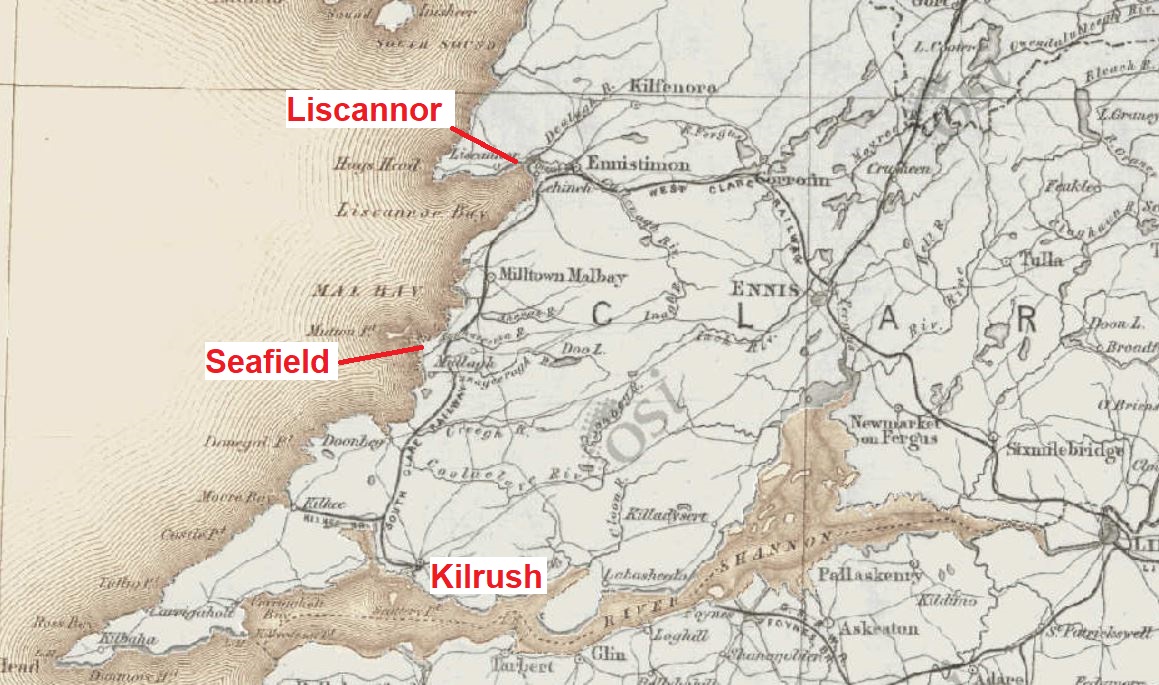
Encouraged by the erection of the fishery piers on this coast, two persons registered themselves as fish-curers, viz Francis Coffee, on the 10th of March, at Liscannor, and James Shannon, on the 26th of April, at Seafield.

On the 26th instant I had a request note from the former to attend at his curing-house on the 28th, to inspect seven hundred and sixty ling, and nine hundred and ninety-six cod; I accordingly attended, and have great pleasure in saying, that a finer parcel of fish I never beheld; I at the same time registered twenty-six row-boats.
Kilrush, Seafield and Liscannor, Co Clare (OSI 25″ ~1900)

From thence I proceeded to Seafield to see what was going on there, where, I am sorry to say, I found the fishermen very desponding; they had an immense quantity of fish, offering at 1½d per dozen; but few purchasers, Mr Shannon not having as yet begun to cure. At Liscannor, agreeable to a previous arrangement made with the fishermen, Mr Coffee pays 3½d per dozen.

It would tend greatly to promote this speculation if some little additions were made to the bounty in lieu of the drawback on the salt, which they find it very difficult to recover, principally owing to the great distance to any custom-house, and the difficulty of travelling bad roads.

I send herewith the production bounty debenture. As the curer has but a small capital, I hope the board will order payment with as little delay as possible; every little encouragement that can be given this speculation in its infancy will greatly tend to promote it; and I have no doubt, in a short time, it will become very general, and productive of great advantage to the country.

I am, Sir, &c, &c, (signed) James Patterson

Report from the Select Committee on the Employment of the Poor in Ireland Ordered, by The House of Commons, to be Printed, 16 July 1823 [561] with edits by me


Navigating Ardnacrusha

The Western Mail & South Wales News of 19 April 1929 had an article by M Franklin Thomas about “Ireland’s Big Engineering Scheme”. The article was illustrated with a map and three photographs were reproduced on the newspaper’s “picture page”. It had a couple of interesting points about the headrace and tailrace considered as navigations; I can’t recall seeing these points made elsewhere.

Current

This [headrace] canal is level, but a flow of about 3½ miles per hour will be maintained owing to the water released through the turbines and navigation locks.

I don’t recall seeing a figure for the current. I presume that that is with three turbines running flat out.

There is an interesting account of the laying of the concrete apron that protects the banks against the “wave action set up by navigation, and the flow of the stream, wind, &c”. And the lock was to have an “ingenious arrangement by which the entering streams of water neutralise each other’s effect”.

Tailrace

Mr Thomas says

The tail race is one mile and a half long, cut from the solid blue limestone, and one of the most interesting points was the method adopted to permit barges to ascend the tail race against the enormous scour from the turbine discharges.

A special navigation channel is cut from the locks to a point some 200 yards below the outfall, and the bed of the tail race rises 20ft in the mile and a half, so that the depth of water will be 35ft at the outfall from the turbines and 15ft at the junction with the Shannon.

This will give a cushioning effect, and the rate of flow will be thus reduced to enable barges to navigate upstream. A bend is also provided where the special navigation channel joins the tail race and the rate of flow is estimated to be the same as that of the head race — 1.5 metres per second, or about 3½ miles per hour.

I would be glad to hear from anyone who can cast further light on this, and especially on whether the rising bed does have the intended effect.